
From $1,680 to $809: How three days of flexibility can fund your entire Abu Dhabi hotel stay
Flight Timing Strategy: The $871 Saving Decision
Imagine you’re planning a business trip from New York to Abu Dhabi. Same destination, same airlines, same seat class – but your departure date choice could mean the difference between paying $1,680 and $809. That’s not a typo. That’s a $871 difference based purely on calendar strategy.
This isn’t about cutting corners or sacrificing comfort. This is about understanding airline pricing patterns and turning flexibility into financial advantage. The data reveals something remarkable: sometimes the “expensive” choice is actually extending your trip and spending more time at your destination.
The Data Story: New York to Abu Dhabi Case Study
Let’s examine real flight pricing data for September 2025 travel, comparing identical routes with strategic timing variations:
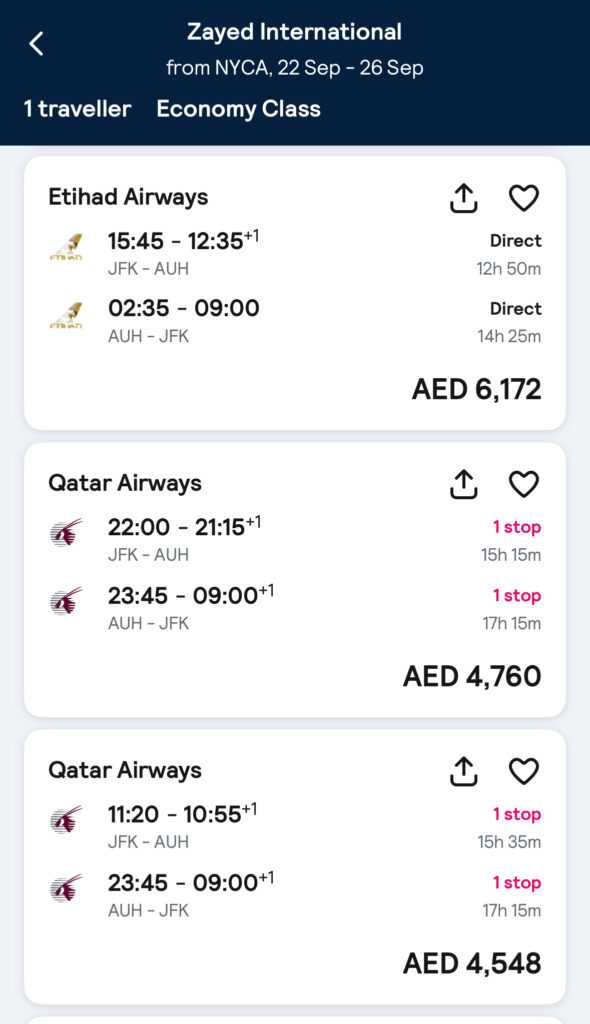
The Premium Rush: September 22-26 Travel
Etihad Airways Direct Flight
- Departure: September 22, 15:45 → Abu Dhabi 12:35+1
- Return: September 26, 02:35 → New York 09:00
- Total Cost: AED 6,172 ($1,680)
- Trip Length: 4 days
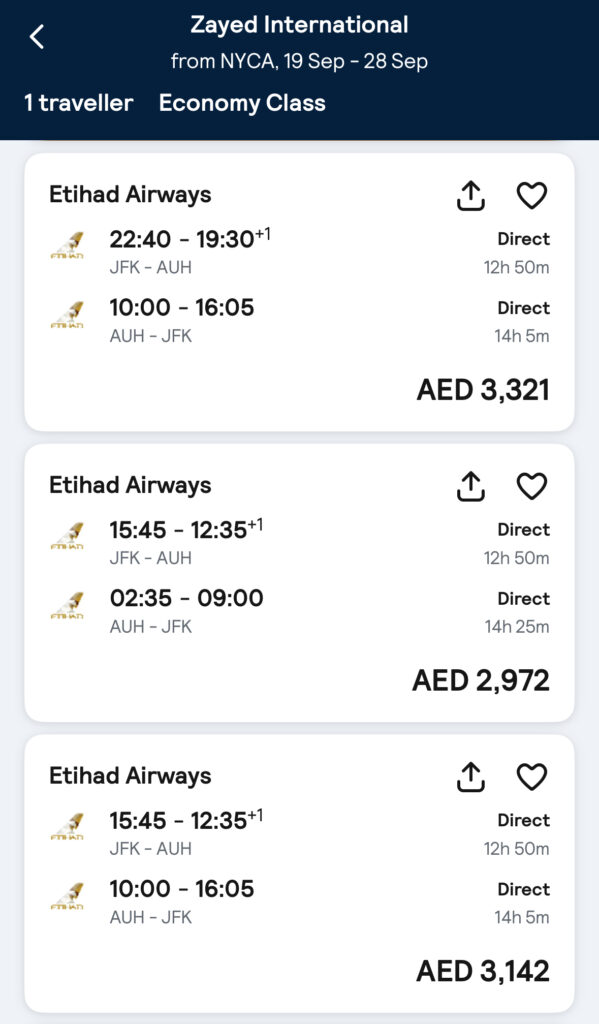
The Strategic Extension: September 19-28 Travel
Etihad Airways Direct Flight
- Departure: September 19, 22:40 → Abu Dhabi 19:30+1
- Return: September 28, 10:00 → New York 16:05
- Total Cost: AED 2,972 ($809)
- Trip Length: 9 days
- Savings: AED 3,200 ($871) – 52% reduction
The Revelation: By extending the trip 5 additional days, you save enough money to cover luxury hotel accommodation for the entire extended stay.
The Airlines Comparison: Direct vs. Connection Strategy
Etihad Airways: The Direct Route Advantage
Pricing Range: AED 2,972 – AED 6,172 ($809 – $1,680) Flight Time: 12h 50m to Abu Dhabi, 14h 25m return Advantage: No connections, maximum time efficiency Premium: Direct flights command higher prices during peak business travel periods
Qatar Airways: The Strategic Stopover
Pricing Range: AED 4,548 – AED 4,950 ($1,238 – $1,347)
Flight Time: 15h 15m – 18h 15m total (including Doha connection) Advantage: More consistent pricing, excellent Doha airport experience Consideration: Additional 2-5 hours travel time each way
The Calendar Psychology: Why Certain Days Cost More
Peak Business Travel Patterns
Tuesday-Thursday Departures: Premium pricing for business travelers Sunday Returns: High demand for Monday meeting preparation
Mid-Week Short Trips: Maximum price pressure from corporate travel budgets
Value Travel Windows
Friday-Saturday Departures: Lower business demand Wednesday-Thursday Returns: Flexibility in return scheduling Extended Stays: Airlines discount longer bookings to improve load factors
The Extended Stay Economics: When Longer Costs Less
The Counter-Intuitive Math
4-Day Trip at Premium Timing:
- Flights: AED 6,172 ($1,680)
- Hotels (4 nights): AED 1,600 ($435)
- Total: AED 7,772 ($2,115)
9-Day Trip at Strategic Timing:
- Flights: AED 2,972 ($809)
- Hotels (9 nights): AED 3,600 ($980)
- Total: AED 6,572 ($1,789)
- Net Savings: AED 1,200 ($326)
The Result: More than double the time in Abu Dhabi for less total cost.
Strategic Departure Time Analysis
Evening Departures: The Hidden Advantage
22:00-23:45 JFK Departures: Consistently lower pricing Arrival Pattern: Land in Abu Dhabi evening/night, maximizing first full day Business Logic: Less disruptive to New York business day
Afternoon Departures: The Convenience Premium
14:55-15:45 JFK Departures: Higher pricing for convenient timing Trade-off: Half work day lost in New York, premium arrival time in Abu Dhabi
The Route Strategy: Direct vs. Connection Economics
When Direct Makes Sense
Business Priority: Time-sensitive meetings, minimal schedule flexibility Cost Tolerance: Premium budget, expense account travel Jet Lag Management: Minimize travel fatigue for immediate productivity
When Connections Create Value
Schedule Flexibility: Extended stays, leisure components Budget Consciousness: Personal travel, cost-sensitive business trips
Hub Experience: Qatar Airways’ Doha airport as destination amenity
Advanced Booking Strategies
The Date Range Search Method
Instead of: Searching specific dates Strategy: Search ±3 days around preferred dates Tool Optimization: Use flexible date calendars on booking platforms Potential Savings: 30-60% on peak vs. valley pricing
The Split Itinerary Consideration
Concept: Book outbound and return flights separately Risk Assessment: Schedule change complications, separate ticket protections Reward Potential: Occasional significant savings on specific routes
The Stopover Extension Strategy
Qatar Airways Example: Extend Doha connection into mini-vacation Cost Impact: Often no additional flight cost for longer stopovers Value Addition: Two destinations for price of one route
Business Travel Optimization Framework
The ROI Calculation Model
Traditional Approach:
- Fixed dates based on meeting schedule
- Accept premium pricing as business cost
- Minimize total travel time
Strategic Approach:
- Build flexibility into meeting scheduling
- Calculate savings vs. extended stay value
- Optimize for total trip experience and cost
Meeting Schedule Integration
Front-Load Meetings: Schedule important meetings early in trip Buffer Days: Use saved money for extended relationship building Cultural Immersion: Transform business trip into cultural learning opportunity
Regional Pricing Patterns: Beyond Single Routes
Middle East Hub Dynamics
Qatar Airways (Doha Hub): Consistent pricing, premium service Emirates (Dubai Hub): Competitive on longer routes, luxury positioning Etihad (Abu Dhabi Hub): Direct route advantages, government backing
Seasonal Considerations
September-October: Shoulder season pricing advantages November-March: Peak season premiums Summer Months: Heat factor creates pricing opportunities
The Psychology of Travel Decision Making
Cognitive Biases in Flight Booking
Anchoring Bias: First price seen becomes reference point Urgency Bias: Pressure to book immediately vs. strategic waiting Convenience Premium: Paying extra for perceived schedule perfection
Strategic Thinking Framework
Question 1: What’s the real cost of an extra day on each end? Question 2: How much is schedule convenience actually worth? Question 3: What experiences become possible with savings?
Technology Tools for Strategic Booking
Flexible Search Platforms
Google Flights: Calendar view showing price variations Skyscanner: Whole month and cheapest month options Momondo: Color-coded calendar for visual price comparison
Price Tracking Strategy
Set Alerts: Track routes 6-8 weeks before travel Multiple Dates: Monitor several date combinations simultaneously Patience Premium: Booking too early or too late both cost more
Corporate Travel Policy Integration
Policy Flexibility Advocacy
Present Data: Show savings potential to finance teams Propose Framework: Guidelines for when flexibility creates value Pilot Programs: Test strategic booking on non-critical trips
Expense Management
Documentation: Clear reporting of savings achieved Reinvestment: Use savings for enhanced ground experience ROI Measurement: Track productivity impact of strategic travel
The Abu Dhabi Extension Strategy
What $871 in Savings Enables
Luxury Accommodation: 5 additional nights at premium hotels Cultural Experiences: Desert safaris, cultural district exploration
Business Networking: Extended time for relationship building Personal Enrichment: Transform business trip into growth experience
Extended Stay Optimization
Day 1-2: Core business meetings and objectives Day 3-5: Secondary meetings, relationship building Day 6-9: Cultural immersion, personal exploration, reflection
Risk Management in Strategic Booking
Schedule Change Considerations
Direct Flights: Single point of failure, but easier rebooking Connected Flights: Multiple failure points, complex rebooking Insurance Evaluation: Trip protection for flexible bookings
Business Risk Assessment
Meeting Criticality: How much schedule flexibility actually exists? Relationship Impact: Will extended stay enhance or complicate business relationships? Personal Sustainability: Can extended travel enhance rather than drain energy?
The Future of Strategic Travel
AI-Powered Optimization
Predictive Pricing: Machine learning for optimal booking timing Personalized Recommendations: AI considering individual travel patterns Dynamic Rebooking: Automated optimization as prices change
Corporate Travel Evolution
Results-Oriented Travel: Focus on outcomes rather than schedule efficiency Experience Integration: Business travel as professional development Sustainability Considerations: Longer stays reducing environmental impact per day
Implementation Guide: Your Strategic Booking Process
Phase 1: Data Gathering (2 weeks before booking)
- Define Core Constraints: Truly fixed vs. flexible elements
- Research Price Patterns: Track prices across date ranges
- Identify Opportunities: Find savings potential through timing
Phase 2: Strategic Analysis (1 week before booking)
- Calculate Total Cost: Include accommodation, ground costs
- Assess Experience Value: What becomes possible with savings?
- Risk Evaluation: Understand trade-offs and failure modes
Phase 3: Optimization Execution (Booking week)
- Final Price Check: Confirm patterns before purchasing
- Booking Strategy: Direct vs. connected, single vs. split tickets
- Contingency Planning: Backup options if primary strategy fails
The Bottom Line: Strategic Travel Intelligence
Flight timing strategy isn’t about being cheap – it’s about being intelligent. When three days of schedule flexibility can save enough money to fund luxury accommodation for an entire week, we’re not talking about minor optimizations. We’re talking about fundamental shifts in how travel budgets work.
The Abu Dhabi Example Proves: Sometimes the “expensive” choice is the short trip, and the “economical” choice is the extended cultural immersion.
The Strategic Traveler Realizes: Every rigid schedule decision carries an opportunity cost that compounds across a travel lifetime.
The Conscious Explorer Understands: Time flexibility doesn’t just save money – it creates space for the unexpected discoveries that transform business trips into life experiences.
Ready to transform your travel economics? Start by questioning every “fixed” constraint in your travel planning. The most expensive flight might be the one that gets you home too quickly.
Remember: The goal isn’t to travel cheaply – it’s to travel intelligently. When strategic timing creates both savings and enhanced experiences, you’re not cutting corners. You’re cutting through conventional thinking to discover what conscious travel planning actually makes possible.
Bottom Line: Master travelers understand that flexibility isn’t a compromise – it’s a competitive advantage that turns travel budgets into experience multipliers.

Beyondia
Trusted Travel CompanionReal digital nomad. I travel. I learn. I grow.
What about you? Where are you going?