GoBeyondia Atlas 🗺️ South-East Asia 🗾
Cambodia: Where sacred stone meets living culture.
Cambodia in 30 seconds
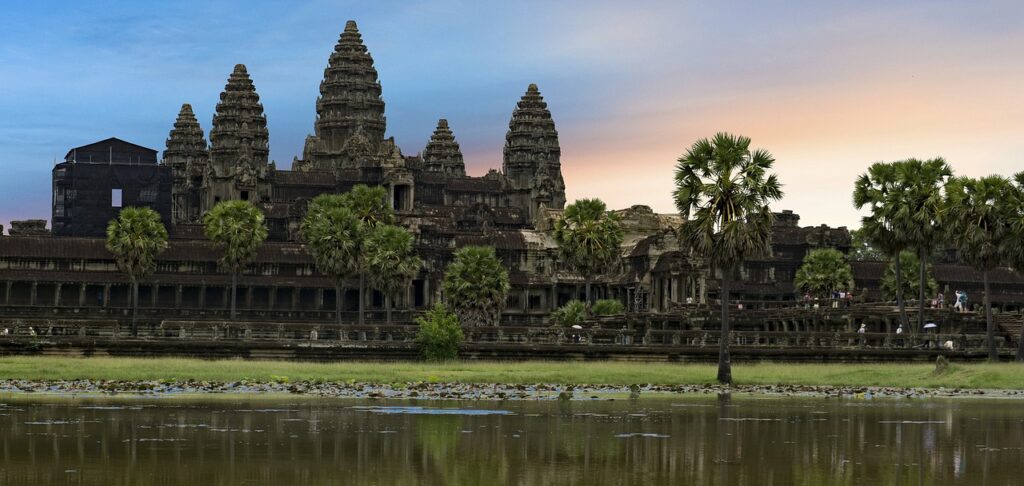
A country that survived the unthinkable and chose, with extraordinary deliberateness, to remain. Angkor Wat rises from the Cambodian jungle at dawn like a hallucination the landscape decided to make permanent — the largest religious monument ever constructed, built by a civilization that understood cosmic geometry and had the human willpower to express it in stone across four centuries. Phnom Penh sits at the confluence of four rivers and carries the full weight of its twentieth century — the Royal Palace with its silver-tiled floors, the markets alive with color and noise, and the Tuol Sleng Genocide Museum and Killing Fields that must be visited and will not leave you. The south coast hides beaches that haven’t been fully discovered — Kep’s crab market, Kampot’s crumbling French colonial streets, Rabbit Island’s silence. The Tonle Sap Lake is one of the world’s great ecological phenomena — a lake that reverses its flow twice a year, swelling to six times its dry season size and sustaining floating villages of extraordinary ingenuity. The Cambodians themselves carry a gentleness that exists alongside the knowledge of what their country endured, which makes it not despite the history but inseparable from it.
Evoke – Why You Visit Cambodia
You come to Cambodia because something in your life has felt disproportionately heavy and you need the perspective that only genuine history can provide. Not the polished kind — the kind that sits in a building you have to walk through slowly, reading names. You need to stand in front of Angkor Wat at the moment the sun clears the towers and understand that humans built this with rope and mathematics and time, and that the civilization that built it also collapsed, and that collapse is not the end of a story but a chapter in one. You’ve been carrying something that feels too large for your life. Cambodia will not diminish what you’re carrying — it will put it in the correct frame. You came here because you suspected that surviving something and remaining gentle afterward is the hardest human achievement. You wanted to be near people who have managed it.
Explore – How You Experience Cambodia
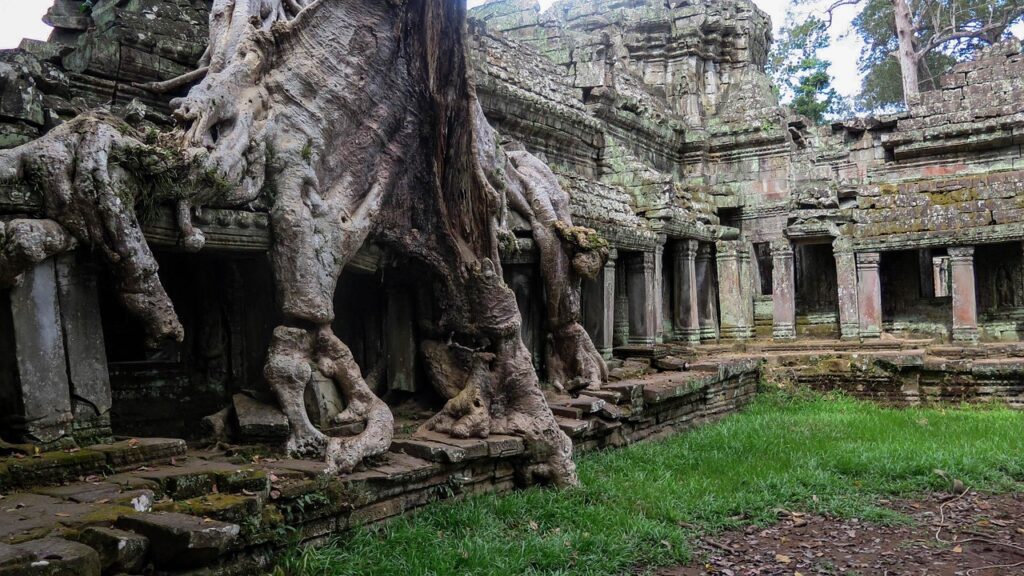
Arrive at Angkor Wat before dawn and find a position facing the reflection pools as the sky moves from black to purple to gold behind the five towers — thirty-seven minutes of light that change color faster than you can photograph and slower than you can forget. Hire a tuk-tuk driver for the day who knows the small temples — Banteay Srei’s pink sandstone carvings so detailed they look pressed rather than chiseled, Ta Prohm where the jungle made its own decision about ownership and the restoration team wisely negotiated rather than won. Walk through Phnom Penh’s Central Market under its art deco dome and then take the harder walk to Tuol Sleng, because understanding Cambodia requires holding both in the same day. Take the slow boat from Phnom Penh to Siem Reap along the Tonle Sap when the lake is full — floating villages where children row themselves to school, fishermen who read the water’s mood rather than checking forecasts, and a horizon so flat and wide that the sky becomes the dominant architecture. Eat fish amok — Cambodia’s national dish, a coconut curry steamed in banana leaves with a texture between mousse and custard — at a restaurant where the owner learned to cook from his grandmother after returning from the refugee camps. Kayak through Kampot’s mangroves at low tide when the roots are exposed and the egrets are hunting and the city’s colonial buildings are visible through the trees, faded and beautiful in the way that things are beautiful when they’ve endured.
Evolve – Who You Become in Cambodia
You leave Cambodia quieter in a way that isn’t sadness. It’s the specific quiet of someone who has been given perspective as a gift they didn’t ask for and needed more than they knew. You stop catastrophizing the manageable problems that filled your days before you came. Not because Cambodia shamed you out of caring about your own life — but because you met people who rebuilt theirs from less than you started with and did so without bitterness, which is the part that stays with you longest. The Khmer word Sabay means something like contentment — not happiness as a peak but ease as a baseline. You carry some of that home. You also carry Angkor — not the photographs, which won’t work, but the physical memory of standing in front of something humans made that outlasted the civilization that made it, and understanding for the first time in your body rather than your head that some things persist. You start building things meant to last.
Your practical guide to Cambodia starts bellow 👇
🕰️ Cambodia Historical Backdrop
Cambodia’s story is one of breathtaking ancient grandeur and profound resilience, deeply rooted in the magnificent Khmer Empire that once shaped much of Southeast Asia. From the awe-inspiring architectural feats of Angkor Wat, a testament to spiritual devotion and imperial power, its history flows through periods of vibrant cultural exchange, French colonial influence, and the devastating shadows of the Khmer Rouge regime. Yet, through these epochs of triumph and tragedy, Cambodia’s spirit remains unwavering. It’s a land where echoes of forgotten kings resonate in crumbling temples, where every smile from its people reflects an enduring hope, inviting a deep connection with a nation rebuilding with grace and strength.
🌟 Cambodia Local Experiences
Beyond the iconic temples, Cambodia invites you to experience its gentle rhythms and profound spirit. Ride a traditional bamboo train through emerald rice fields, share a simple, flavorful meal with a local family in a floating village on Tonlé Sap Lake, or witness the timeless grace of Apsara dance performed under the stars. These are the moments of quiet connection and resilient joy that reveal Cambodia’s enduring soul beyond its celebrated history.
🌄 Cambodia Natural Wonders
- Tonlé Sap Lake: Southeast Asia’s largest freshwater lake, a unique ecological wonder with a fluctuating size, supporting a vast floating village community and diverse birdlife.
- Cardamom Mountains: One of Southeast Asia’s largest remaining rainforests, offering pristine wilderness, unique wildlife (including elephants, sun bears), and challenging trekking.
- Bokor National Park (Preah Monivong National Park): Features waterfalls, dense forests, and the eerie abandoned Bokor Hill Station, offering panoramic views.
- Kep National Park: A small, accessible park near the coast, providing scenic hiking trails through lush forest to viewpoints overlooking the sea and islands.
- Koh Rong Archipelago: A group of stunning islands off the coast of Sihanoukville, famous for their pristine white-sand beaches, turquoise waters, and vibrant marine life.
- Phnom Kulen National Park: Considered a sacred mountain, it features waterfalls, ancient temple ruins, and the “River of a Thousand Lingas,” symbolizing fertility and prosperity.
🏙️ Cambodia Must-See Cities
- Siem Reap: The gateway city to the magnificent Angkor Wat complex (UNESCO), offering vibrant markets, diverse dining, and a thriving arts scene. (Temple Gateway, Cultural, Vibrant)
- Phnom Penh: The bustling capital of Cambodia, home to the Royal Palace, Silver Pagoda, and the poignant reminders of the Khmer Rouge era (Killing Fields, S-21 Prison). (Historic, Urban, Cultural)
- Battambang: Cambodia’s second-largest city, known for its French colonial architecture, artistic community, and the unique bamboo train experience. (Colonial, Artistic, Rural Charm)
- Kampot: A charming riverside town famous for its Kampot pepper plantations, French colonial buildings, and laid-back atmosphere near the coast. (Relaxed, Gastronomic, Riverside)
- Kep: A historic seaside town known for its fresh crab, dilapidated colonial villas, and serene coastal views, offering a glimpse into Cambodia’s past glamour. (Coastal, Seafood, Historic)
- Sihanoukville: A coastal city serving as a gateway to Cambodia’s southern islands, offering beaches and growing tourism infrastructure. (Coastal, Island Gateway, Developing)
🏖️ Cambodia National Parks & Nature Reserves
Cambodia’s protected areas safeguard its remaining forests, wetlands, and crucial wildlife habitats.
- Phnom Kulen National Park: Sacred mountain, waterfalls, ancient ruins.
- Virachey National Park: Remote, biodiverse park in Ratanakiri, home to indigenous groups.
- Botum Sakor National Park: Coastal park with mangroves, forests, and diverse wildlife in Koh Kong.
- Ream National Park (Preah Sihanouk National Park): Coastal park near Sihanoukville with mangroves, beaches, and marine life.
- Cardamom Mountains Wildlife Sanctuary: Large protected area within the Cardamom Mountains, vital for conservation.
🏛️ UNESCO World Heritage Sites
Cambodia is home to 4 UNESCO World Heritage Sites, reflecting its profound historical and cultural significance:
- Angkor: (Cultural) The magnificent archaeological park containing the remains of various capitals of the Khmer Empire, including the iconic Angkor Wat, Angkor Thom, and Bayon Temple.
- Temple of Preah Vihear: (Cultural) A spectacular Khmer temple built on a clifftop, dedicated to the Hindu deity Shiva, offering stunning views.
- Sambor Prei Kuk, Archaeological Site of Ancient Ishanapura: (Cultural) An archaeological site of an ancient city, a prominent center during the pre-Angkorian period.
- Koh Ker: Archaeological Site of Ancient Lingapura or Chok Gargyar: (Cultural) A large archaeological site with a unique 7-tiered pyramid temple (Prasat Thom), briefly serving as a capital of the Khmer Empire in the 10th century. (Note: Recently inscribed as of 2023).
- For more details on these sites, visit the official UNESCO World Heritage Centre.
🖼️ Cambodia Museums & Galleries
Cambodia’s museums and galleries offer vital insights into its ancient civilizations, rich cultural traditions, and poignant recent history.
- National Museum of Cambodia (Phnom Penh): Houses the world’s finest collection of Khmer sculpture, dating from the 4th to the 13th centuries, including artifacts from Angkor.
- Tuol Sleng Genocide Museum (S-21 Prison, Phnom Penh): A former high school turned brutal Security Prison 21 by the Khmer Rouge regime, a stark and vital historical site.
- Choeung Ek Genocidal Centre (Killing Fields, Phnom Penh): One of the sites of mass killings and burials during the Khmer Rouge regime, now a memorial and museum.
- Angkor National Museum (Siem Reap): Offers a comprehensive overview of Khmer civilization and the history of Angkor, with galleries dedicated to various aspects of Angkorian culture.
- Cambodia Landmine Museum (Siem Reap): Founded by a former child soldier, showcasing the devastating impact of landmines and efforts towards demining.
🎉 Cambodia Festivals & Celebrations
Cambodia’s festivals are deeply intertwined with its Buddhist traditions, harvest cycles, and historical commemorations, offering vibrant cultural experiences.
- Khmer New Year (Choul Chnam Thmey): The most important Cambodian holiday (mid-April), celebrated over three days with traditional games, family gatherings, temple visits, and water splashing.
- Water Festival (Bon Om Touk): A spectacular annual festival (November) celebrating the reversal of the Tonlé Sap River’s flow, marked by dragon boat races, illuminated floats, and fireworks in Phnom Penh.
- Pchum Ben (Ancestors’ Day): A significant Buddhist festival (September/October) where Cambodians visit pagodas to offer food to ancestors and honor the deceased.
- Royal Ploughing Ceremony (Preah Reach Pithi Chrat Preah Neang Korl): An ancient royal ceremony (May) predicting the country’s agricultural fortunes for the upcoming year, often attended by the King.
- Angkor Sankranta (Siem Reap): A large-scale event (mid-April, coinciding with Khmer New Year) held within the Angkor complex, showcasing traditional Khmer arts, culture, and sports to promote national heritage.
🧽 How to Arrive
✈️ By Air:
- Main International Airports:
- Phnom Penh International Airport (PNH): The largest airport, serving the capital and central Cambodia.
- Siem Reap International Airport (REP): The gateway to Angkor Wat. (Note: A new airport, Siem Reap-Angkor International Airport (SAI), has recently opened further from the city, gradually replacing REP for major flights. Verify current operational airport for your trip.)
- Sihanoukville International Airport (KOS): Serving the southern coast and islands.
- Airlines offering regular connections (examples, check for current routes):
- National Carrier: Cambodia Angkor Air
- Regional & International: Thai Airways, Vietnam Airlines, Malaysia Airlines, Singapore Airlines, China Eastern, EVA Air.
- For comprehensive flight search, use: Skyscanner, Google Flights
🚆 By Rail:
- International Rail Connections: Limited. There is a rail line connecting Phnom Penh to the Thai border (Poipet), but cross-border passenger services are not consistently seamless and often require transfer to a different Thai train.
- Key Domestic Lines: Cambodia has two main operational rail lines:
- Phnom Penh to Sihanoukville (offering a scenic coastal journey).
- Phnom Penh to Poipet (border with Thailand).
- Operated by Royal Railway Cambodia.
🚗 By Road:
- Border Crossings: Cambodia shares land borders with Thailand, Vietnam, and Laos. Key crossings include Poipet (Thailand), Bavet (Vietnam), and Dom Kralor (Laos). Visa on arrival is generally available at these major crossings, but check specific requirements by nationality.
- Toll Info: Some major highways may have tolls.
- Best Self-Drive Routes: Self-driving a car can be challenging due to road conditions and traffic rules; most travelers opt for private drivers, taxis, or motorbikes.
- Popular Regional Road Trip Ideas:
- Siem Reap to Phnom Penh: Connects the two major cities, often with stops at roadside markets.
- Coastal Loop (Kampot, Kep, Sihanoukville): Explore Cambodia’s southern coast.
📶 Stay Connected
SIM Cards & Telecom:
- Top Providers:
- Smart Axiata: One of the largest and most popular, good coverage, especially in urban areas.
- Cellcard: Also a major player with good coverage and various plans.
- Metfone: Widely used, particularly known for its extensive rural coverage.
- Tourist SIMs and Data Package Options: All major providers offer very affordable prepaid SIM cards specifically for tourists, including generous data packages, valid for various durations.
- Where to buy: Easily available at international airports (Phnom Penh, Siem Reap), official operator stores, and numerous small shops and kiosks in cities and towns. Staff are generally accustomed to assisting tourists.
- eSIM: Availability varies by provider and package, but generally supported by Smart and Cellcard for certain plans. Check their official websites or inquire upon arrival for tourist eSIM options.
🏨 Where to Stay
Cambodia offers a range of accommodation from luxury hotels in Siem Reap and Phnom Penh to charming boutique guesthouses and rustic eco-lodges.
- Notable Hotel Chains (local or international):
- International: Accor Hotels, Hyatt Hotels, Anantara Hotels,Marriott. (Present in Siem Reap, Phnom Penh, Sihanoukville).
- Local/Boutique: Numerous independent boutique hotels and charming guesthouses, especially in Siem Reap and Phnom Penh, offering unique Cambodian design.
- Tips: Boutique vs. Resort Regions:
- Boutique & Charm: Siem Reap and Phnom Penh excel in boutique hotels with pools and personalized service, often blending modern comfort with traditional Khmer aesthetics.
- Coastal Resorts: Sihanoukville and the islands (Koh Rong, Koh Rong Sanloem) offer beachfront resorts, from budget bungalows to luxury properties.
- Unique Stays:
- Eco-lodges: Stay in sustainable lodges within national parks or rainforests for immersive nature experiences (e.g., in the Cardamom Mountains).
- Floating Village Homestays: For the truly adventurous, some communities on Tonlé Sap Lake offer basic homestays for a unique cultural immersion.
- Restored Colonial Villas: Find charming stays in renovated colonial buildings in cities like Battambang or Kampot.
- Booking Platforms: Booking.com, Agoda (popular in SE Asia), Airbnb for private rentals.
⛳ Unique Finds
- Golf Courses: Cambodia offers a growing number of championship golf courses, particularly around Siem Reap and Phnom Penh.
- Phokeethra Country Club (Siem Reap): A championship course near Angkor Wat, often hosting international tournaments.
- Angkor Golf Resort (Siem Reap): Designed by Nick Faldo, known for its pristine conditions.
- Garden City Golf Club (Phnom Penh): A luxurious 18-hole course near the capital.
- List of Annual Marathons (for Limit Pushers & Growth Evolvers):
- Angkor Wat International Half Marathon: (December) A globally renowned half-marathon, offering the unique experience of running through the ancient temples of Angkor.
- Phnom Penh International Half Marathon: (June) Runs through the streets of the capital, past key landmarks.
- Khmer Empire Marathon (Siem Reap): (August) A full marathon also passing through the Angkor complex.
- Sihanoukville International Half Marathon: (March) A scenic coastal run.
- Bamboo Train (Battambang): Experience a unique, informal railway system where passengers ride on simple bamboo platforms powered by small engines, offering a fun and rustic journey through the countryside.
- Apsara Dance Performances: Witness the traditional Khmer classical dance, often performed at cultural venues or alongside dinner shows in Siem Reap, reflecting ancient court traditions.
- Floating Villages (Tonlé Sap Lake): Visit the unique floating villages on Tonlé Sap Lake (e.g., Kampong Phluk, Chong Kneas) to observe a distinct way of life adapted to the lake’s fluctuating water levels.
- Kampot Pepper Plantations: Tour renowned pepper plantations in Kampot, learn about the cultivation of this world-famous spice, and enjoy tastings.
- Ethical Elephant Sanctuaries: Engage with rescued elephants in responsible sanctuaries (e.g., Wildlife Alliance) that prioritize animal welfare and conservation.
✨ Bonus Tip
When visiting temples in Cambodia, particularly Angkor Wat, remember to dress respectfully (shoulders and knees covered) and bring plenty of water. The best time for photos and profound moments is often at sunrise or sunset, before the main crowds arrive.
🔗 Featured Links
Official Resources:
- National Tourism Board: Tourism Cambodia (Ministry of Tourism)
- Safety & Travel Advisories: Your Country’s Government Travel Advisory for Cambodia (e.g., US Department of State Travel Advisories for Cambodia)
- Public Transport (Railways): Royal Railway Cambodia
- Official Angkor Enterprise (Temple Pass Sales): Angkor Enterprise

Beyondia
Trusted Travel CompanionReal digital nomad. I travel. I learn. I grow.
What about you? Where are you going?