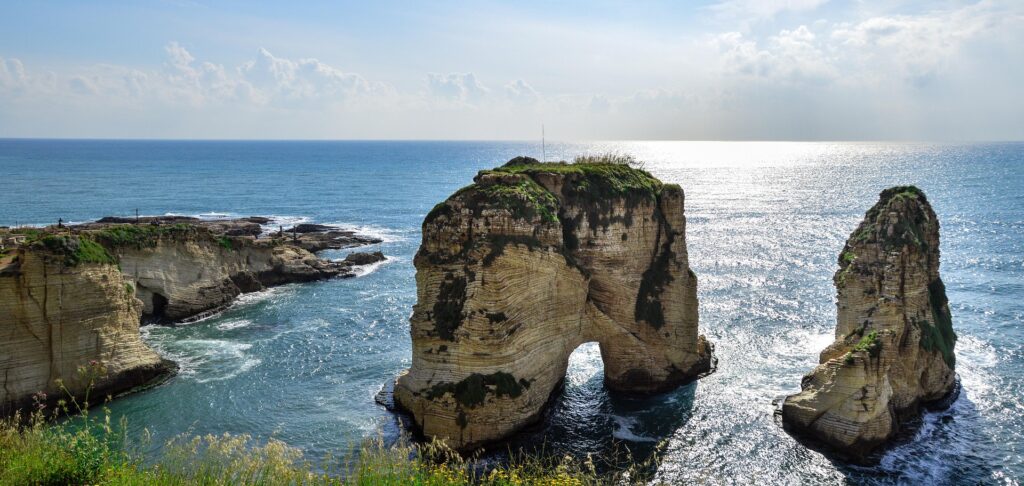
GoBeyondia Atlas 🗺️ Mediterranean Region 🗾
Lebanon: Where Phoenician traders invented the letters you are reading right now, the Romans built their largest temple in a valley that smells of hashish and thyme, eighteen religious sects share a country smaller than Connecticut, and Beirut keeps rebuilding itself because the alternative is unthinkable.
Lebanon in 30 Seconds
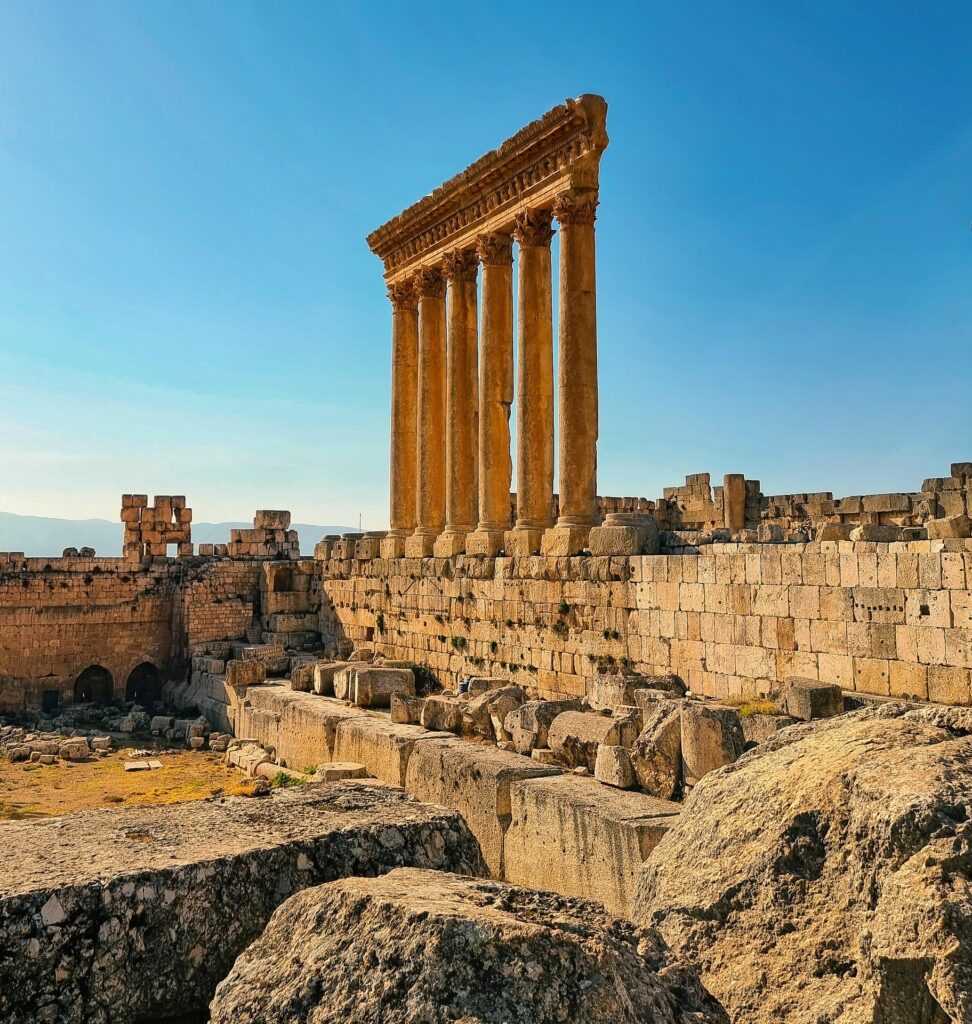
A country of 10,452 square kilometers — smaller than some national parks — containing the birthplace of the alphabet, the largest Roman temple ever constructed, one of the oldest Christian monastic settlements on earth, the last surviving grove of the cedars that built Solomon’s Temple, eighteen officially recognized religious sects sharing political power through a constitutional arrangement that assigns the presidency to a Maronite Christian, the prime ministership to a Sunni Muslim, and the speakership of parliament to a Shia Muslim, and a capital that was called the Paris of the Middle East before a fifteen-year civil war tore it apart and is now called whatever Beirut decides to call itself because it stopped waiting for other cities’ permission. Byblos on the northern coast has been continuously inhabited for seven thousand years and is where Phoenician scribes carved the twenty-two-character alphabet on the sarcophagus of King Ahiram around 1000 BC — the ancestor of Greek, Latin, Arabic, Hebrew, and virtually every script on the planet — and also where the Greeks imported so much papyrus that the city’s name became their word for book, which became the English word Bible. Baalbek in the Bekaa Valley holds the Temple of Jupiter, whose six remaining columns rise nearly twenty meters into the sky and whose foundation stones — some weighing over eight hundred tons — remain among the heaviest blocks ever placed by human hands, an engineering achievement so excessive that conspiracy theorists still cannot accept that Romans did it with ropes and rollers and the arrogance of empire. The Kadisha Valley in the north, whose name means “holy” in Aramaic, has sheltered Christian monks in cliff-face monasteries since the earliest centuries of the faith, its gorge so deep and inaccessible that the Maronite Patriarchate governed from a cave for five hundred years. Above the valley at Bcharre, the last grove of Cedars of God survives — trees that once covered the mountains, that were exported to build Egyptian ships and Mesopotamian temples and Solomon’s house of worship, and that now stand on the Lebanese flag as the country’s most honest symbol: ancient, diminished, but still standing.
Evoke — Why You Visit Lebanon
You come to Lebanon because you’ve been living as though survival and elegance are opposites — as though you must choose between getting through the day and making the day beautiful — and Lebanon will dismantle that assumption in the time it takes to eat lunch. This is a country that endured fifteen years of civil war, an economic collapse that erased ninety percent of its currency’s value, a port explosion that flattened half its capital, and periodic bombardments that crack the walls of buildings still under reconstruction from the last periodic bombardment — and responds by setting a table. Not a modest table. A Lebanese table is an argument against despair conducted in hummus and tabbouleh and fattoush and labneh and grilled halloumi and kibbeh and stuffed grape leaves and bread that arrives so hot it burns your fingers, served simultaneously because the Lebanese do not believe in courses — they believe in abundance as a philosophical position, the idea that generosity is not what you do after the crisis passes but what you do during the crisis to prove the crisis has not won. You also come because somewhere in the story you’ve been telling yourself about the Middle East, you left out the part where a Phoenician port city invented the technology that allows you to tell stories at all. The alphabet did not arrive from nowhere. It arrived from Lebanon — from merchants who needed a writing system simple enough for trade and portable enough for ships — and it changed everything about how civilizations remember themselves. You’ve been reading your whole life without thinking about where reading came from. Lebanon will remind you.
Explore — How You Experience Lebanon
Walk through the Crusader-era gate at Byblos and stand in an archaeological site where Neolithic fishermen’s huts sit beside Phoenician temple foundations beside Roman colonnades beside a twelfth-century church, layer after layer of civilization compressed into a few hectares of Mediterranean coastline — then sit at the ancient harbor where wooden fishing boats still dock and eat fried fish and understand that the oldest continuously inhabited city in the world is not a museum but a place where people are having lunch. Drive to the Bekaa Valley and enter the Baalbek complex where the Temple of Jupiter’s six surviving columns make you understand what imperial ambition looks like when it stops being an abstraction — columns so tall that standing at their base recalibrates your sense of what humans are willing to build for their gods, beside the Temple of Bacchus so perfectly preserved and ornately carved that archaeologists call it the most beautiful temple in the Roman world. Descend into the Kadisha Valley where monasteries cling to cliff faces like architectural prayers, built by monks who chose the most inaccessible gorge they could find and turned it into the spiritual headquarters of an entire faith — then climb to Bcharre where Khalil Gibran was born and is buried in a grotto-museum filled with his paintings, and where above the town the last Cedars of God stand in a grove so small and so ancient it feels less like a forest and more like a congregation. Return to Beirut and walk the Corniche at sunset where joggers and families and old men playing backgammon share the seafront promenade, then cross into Gemmayzeh where bars and galleries occupy buildings still pocked with bullet holes from the civil war, because Beirut does not hide its scars — it hangs art on them.
Evolve — Who You Become in Lebanon
You leave Lebanon with your relationship to resilience permanently recalibrated. You had been thinking of resilience as the ability to endure — to take damage and remain standing — and that definition is not wrong but it is incomplete. Lebanon taught you that resilience is also the ability to set a beautiful table during the catastrophe, to pour the arak and arrange the mezze and invite the neighbor whose politics you despise and whose god you don’t worship and whose grandmother’s recipe for kibbeh you secretly prefer to your own grandmother’s. The eighteen sects sharing one country is not a system that works elegantly — the Lebanese will be the first to tell you it doesn’t — but it is a system that insists on the table. The table is the point. Everything else is negotiation. You also leave understanding that the most important inventions are not the ones that look impressive but the ones that disappear into daily life until you forget they were invented at all. The Phoenicians gave you the alphabet. The Romans gave Baalbek its columns. The monks gave Kadisha its silence. The cedars gave the flag its symbol. And the Lebanese gave you the principle that you do not wait for peace to start living beautifully — you live beautifully and let peace catch up. You come home and stop waiting for conditions to improve before setting your own table. Lebanon proved that the table is not the reward for surviving. The table is how you survive.
Your practical guide to Lebanon starts bellow 👇
Please check travel advisory before traveling.
🕰️ Lebanon Historical Backdrop
Lebanon’s history is a 5,000-year epic of maritime ambition and cultural layering. As the homeland of the Phoenicians—the master seafarers who gifted the world the alphabet—Lebanon has always been a bridge between the Orient and the Occident. Its soil is a living museum, holding the monumental Roman temples of Baalbek, the Crusader castles of Byblos, and the elegant Ottoman palaces of Beiteddine. Despite a tumultuous modern era, the nation is defined by its “Phoenix” spirit—a cycle of destruction and magnificent rebirth. Today, Lebanon is a Mediterranean mosaic where bells and minarets harmonize, and where the preservation of heritage is not just a duty, but a fierce expression of national identity and resilience.
🌟 Lebanon Local Experiences
Beyond the legendary nightlife, discover Lebanon’s soul in the ritual of the Mezza—a culinary marathon of small plates that celebrates community and the bounty of the land. Experience the profound stillness of the “Cedars of God” forest, the intoxicating scent of orange blossoms in the coastal city of Sidon, or the exhilarating rush of skiing in the morning and swimming in the sea by the afternoon. Whether it’s sharing a pipe of Arghileh with a local in a mountain village or exploring the secret subterranean world of the Jeita Grotto, these moments reveal a nation that finds beauty in complexity and joy in every heartbeat.
🌄 Lebanon Natural Wonders
- Jeita Grotto: A breathtaking system of two separate but interconnected karstic limestone caves, housing the world’s largest stalactites.
- The Cedars of God (Bsharre): The last vestiges of the ancient forests that once provided timber for the Temple of Solomon and Phoenician ships.
- Qadisha Valley (The Holy Valley): A deep, dramatic gorge filled with ancient monasteries carved directly into the rock faces.
- Tannourine Cedar Forest: A rugged and wild nature reserve perfect for hiking through dense, ancient groves.
- Baatara Gorge Waterfall: A mesmerizing “three-bridge” sinkhole where water drops 250 meters into a Jurassic-age cave.
🏙️ Lebanon Must-See Cities & Regions
- Beirut: (Capital) A Mediterranean metropolis known for its world-class dining, eclectic architecture, and a nightlife scene that rivals any global hub. (Cosmopolitan, Resilient, Energetic)
- Byblos (Jbeil): One of the oldest continuously inhabited cities in the world, featuring a charming harbor, medieval souks, and a Crusader castle. (Ancient, Romantic, Picturesque)
- Baalbek: Home to the “Heliopolis” of the Roman world, featuring some of the largest and most intact Roman temples ever built. (Grand, Monumental, Historic)
- Tyre (Sour): An ancient maritime capital famous for its Roman hippodrome and pristine sandy beaches. (Coastal, Archaeological, Relaxed)
- Sidon (Saida): Known for its Sea Castle, historic soap museum, and labyrinthine Ottoman-era souks. (Traditional, Maritime, Artisanal)
🏞️ Lebanon National Parks & Nature Reserves
Managed with a focus on high-altitude biodiversity by the Ministry of Environment.
- Shouf Biosphere Reserve: The largest nature reserve in Lebanon, encompassing cedar forests and the historic palace of Beiteddine.
- Horsh Ehden Nature Reserve: A unique remnant of the Mediterranean forest, home to rare plants and endangered eagles.
- Palm Islands Nature Reserve: Three uninhabited islands off the coast of Tripoli, serving as a sanctuary for sea turtles and migratory birds.
🏛️ UNESCO World Heritage Sites
- Anjar — A unique 8th-century Umayyad city and trade hub.
- Baalbek — The towering temples of Jupiter, Bacchus, and Venus.
- Byblos — A site that bears witness to the origins of the Phoenician alphabet.
- Tyre — A Phoenician city once unconquerable by the world’s greatest empires.
- Ouadi Qadisha (the Holy Valley) and the Forest of the Cedars of God (Horsh Arz el-Rab) — A spiritual refuge and natural monument.
- For a full list, visit the UNESCO Lebanon Portal.
🖼️ Lebanon Museums & Galleries
- National Museum of Beirut: An extraordinary collection of archaeological artifacts that survived the civil war through clever preservation.
- Sursock Museum: A museum of modern and contemporary art housed in a magnificent 19th-century villa.
- Mim Mineral Museum: A world-class private collection of over 2,000 minerals from around the globe, located in the heart of Beirut.
- Beiteddine Palace: A masterpiece of 19th-century Lebanese architecture and home to exquisite mosaics.
🎉 Lebanon Festivals & Celebrations
- Baalbek International Festival: (July/August) The most prestigious cultural event in the Middle East, held within the ancient Roman ruins.
- Byblos International Festival: (Summer) A music and arts festival set against the stunning backdrop of the ancient harbor.
- Beiteddine Art Festival: (July) An annual summer festival featuring international and local performers in the grand courtyard of the palace.
- Independence Day: (November 22) Celebrated with military parades and nationwide festivities.
🧽 How to Arrive
- ✈️ By Air
- Beirut Rafic Hariri International (BEY) is the sole international gateway to the country.
- Airlines: Middle East Airlines (MEA) is the national carrier. The airport is exceptionally well-connected to Europe, Africa, and all major Arab hubs (Doha, Dubai, Abu Dhabi).
- 🚢 By Sea
- Beirut and Tripoli are major Mediterranean ports. Seasonal cruise ships and private yachts frequently anchor in the Zaitunay Bay marina.
- 🚗 By Road
- Due to geopolitical complexities, land arrival is currently only possible via the border with Syria (Masnaa or Arida crossings). Ensure you check current safety and visa regulations.
📶 Stay Connected
- SIM Cards: The two main state-owned providers are Touch and Alfa.
- Where to buy: Kiosks are available at the airport arrival hall and in every neighborhood. Passport registration is mandatory.
- eSIM: Supported by both Touch and Alfa; available for digital activation via their respective apps.
🏨 Where to Stay
Lebanon offers a sophisticated mix of world-class luxury, historic boutique hotels, and charming mountain guesthouses.
- Le Gray (Beirut): A contemporary icon of urban luxury in the heart of the city.
- Albergo Hotel (Beirut): A member of Relais & Châteaux, offering an atmosphere of old-world Lebanese elegance.
- Beit Al Batroun: A pioneering Bed & Breakfast that captures the coastal charm of the north.
- Mountain Guesthouses: Explore the “L’Hôte Libanais” network for authentic stays in restored traditional homes across the country.
⛳ Unique Finds
- Château Ksara: Visit Lebanon’s oldest and largest winery to taste world-class vintages aged in natural Roman-era caves.
- Batroun’s Lemonade: Sip on the legendary freshly-squeezed lemonade in the coastal town of Batroun—a Lebanese summer staple.
- Soap Museum (Sidon): Watch the traditional cold-process soap-making method that has remained unchanged for centuries.
- The “I Love Beirut” Sign: A symbolic landmark in the downtown district representing the city’s unbreakable bond with its people.
🤝 Lebanon Cultural Guidance
- Hospitality: The Lebanese take immense pride in their generosity. If offered food or coffee, it is polite to accept.
- Dress Code: Lebanon is the most liberal country in the region. Beirut is highly fashionable; however, modest dress (covering shoulders and knees) is required when visiting religious sites.
- Multilingualism: Expect locals to switch seamlessly between Arabic, French, and English—often in the same sentence (“Hi, kifak, ça va?”).
- Basic Phrases:
- Hello: “Marhaba”
- Thank you: “Shukran” (or the French “Merci”)
- Please: “Min fadlak” (to a man) / “Min fadlik” (to a woman)
- Cheers: “Sahtain” (Health to you—used when eating)
🛂 Lebanon Entry & Visa Requirements
Please check travel advisory before traveling due to recent geopolitical developments.
- Visa on Arrival: Citizens of over 80 countries (including the UK, US, Canada, EU, and Gulf nations) are eligible for a free one-month visa on arrival at Beirut Airport.
- Note: Entry will be denied if your passport contains an Israeli stamp or visa.
- Official Source: Consult the Lebanese General Security for the latest entry regulations.
💰 Practical Essentials
- Currency: Lebanese Pound (LBP). Due to the current economic situation, the economy is highly “dollarized.” It is recommended to carry USD cash (new bills) for most payments.
- Electricity: Type C (European) and Type G (UK style). Voltage is 230V. Be aware that private generator schedules are a common part of daily life.
- Safety: While Lebanon is generally safe for tourists, it is essential to monitor local news and follow your embassy’s travel advisories.
- Climate: Mediterranean. Best visited in Spring (April–June) for green landscapes or Autumn (September–November) for wine harvests.
✨ Bonus Tip
To truly embrace Lebanon, leave the coast and head to the Bekaa Valley at dawn. Stand amidst the colossal pillars of the Temple of Jupiter in Baalbek before the crowds arrive. It is in this profound silence, surrounded by stones that have seen five thousand years of human ambition, that you will feel the true scale of the Lebanese spirit. It is a land that doesn’t just survive history; it masters it.
🔗 Featured Links
- Official Tourism: Visit Lebanon.
- Trail Inspiration: Lebanon Mountain Trail (LMT).

Beyondia
Trusted Travel CompanionReal digital nomad. I travel. I learn. I grow.
What about you? Where are you going?