
GoBeyondia Atlas 🗺️ Africa Region 🗾
Ethiopia: Where the 3.2-million-year-old skeleton of a female hominid was found in the Afar region in 1974 and the scientists named her Lucy after a Beatles song playing at camp that night but the Ethiopians named her Dinkinesh — “you are marvelous” in Amharic — and the coffee plant originated in the region of Kaffa and the word “coffee” may derive from that name and the Ge’ez script has been in continuous use since the Kingdom of Aksum and the eleven churches of Lalibela were carved from living rock from the top down in the twelfth century and on March 1, 1896, one hundred thousand Ethiopian soldiers defeated an invading Italian army at the Battle of Adwa making Ethiopia the only African nation to decisively repel a European colonial power during the Scramble for Africa — because Ethiopia does not borrow its identity, does not accept someone else’s version of events, and does not wait to be discovered, because Ethiopia is the origin.
Ethiopia in 30 Seconds
A highland country in the Horn of Africa that runs on its own calendar — thirteen months, roughly seven years behind the Gregorian system — and its own clock, where the day begins at dawn rather than midnight, and which adopted Christianity in the fourth century under King Ezana of Aksum, making the Ethiopian Orthodox Tewahedo Church one of the oldest Christian institutions on earth. In the Afar region in 1974, paleoanthropologist Donald Johanson found forty percent of a female skeleton dated to 3.2 million years ago — at the time, the oldest and most complete early human ancestor ever discovered. The scientists celebrated that night with the Beatles’ “Lucy in the Sky with Diamonds” playing on a tape deck and named the skeleton Lucy. The Ethiopians called her Dinkinesh. You are marvelous. She is stored in a specially constructed safe in the National Museum of Ethiopia in Addis Ababa. She proved that our ancestors walked upright before their brains grew large — that the body led and the mind followed. The coffee plant, Coffea Arabica, originated in the Ethiopian highlands, specifically the region of Kaffa, where it still grows wild in forests between fourteen hundred and twenty-one hundred meters above sea level. Ethiopia is the world’s fifth-largest coffee producer and Africa’s largest, yet half of all Ethiopian coffee is consumed domestically — the country drinks what it invented. The traditional coffee ceremony, Jebena Buna, involves roasting green beans over open flame, grinding by hand, and brewing three rounds — Abol, Tona, and Baraka — and it is considered impolite to leave before all three are complete. The Ge’ez script, developed in the Kingdom of Aksum and still in use today for Amharic, Tigrinya, and liturgical texts, is one of the oldest writing systems in Africa with continuous use. Ethiopia was never colonized. It was briefly occupied by Fascist Italy from 1935 to 1941, but that occupation was considered illegal by the international community and was ended by Ethiopian resistance fighters joined by Allied forces. The country that contains the oldest human skeleton, the oldest African script still in active use, the origin of the world’s most consumed beverage, and one of the oldest Christian traditions on earth has never belonged to anyone but itself.
Evoke — Why You Visit Ethiopia
You come to Ethiopia because something you built is being claimed by someone else — the idea repackaged, the credit redirected, the story retold with your name removed — and you need a country that has spent three thousand years refusing to let anyone else narrate its existence. In 1889, Emperor Menelik II signed the Treaty of Wuchale with Italy. The treaty was written in two languages. The Amharic version said Ethiopia had the option to use Italian diplomatic channels when dealing with European powers. The Italian version said Ethiopia consented to conduct all foreign affairs through Italy — effectively making Ethiopia an Italian protectorate. When Menelik discovered the discrepancy, he demanded correction. Italy refused. Empress Taytu Betul, when told by an Italian diplomat that rejecting the protectorate would cost Italy its dignity, replied: “We too must retain our dignity.” Menelik renounced the treaty in 1893 and began preparing for war. On March 1, 1896 — the day of Saint George on the Ethiopian calendar — roughly one hundred thousand Ethiopian troops, many armed with modern European rifles that Menelik had spent years acquiring, met approximately seventeen thousand Italian and colonial soldiers near the town of Adwa. The Italians had expected thirty thousand Ethiopians at most. Menelik had deliberately leaked false intelligence to ensure they underestimated him. Empress Taytu personally led six thousand cavalry. The Italian force was routed. Over six thousand Italian and colonial troops were killed, nearly four thousand captured. The Italian prime minister resigned. The Treaty of Addis Ababa recognized Ethiopian sovereignty — one of the only treaties in the history of colonial Africa in which European powers treated an African ruler as their equal. The victory at Adwa became the foundational symbol of pan-Africanism, proof that the assumption of European supremacy was not a fact but a story — and that the story could be rewritten by the people it was written about. You come because someone is telling a version of events that removes you from your own origin. Ethiopia will remind you that the origin does not need permission.
Explore — How You Experience Ethiopia
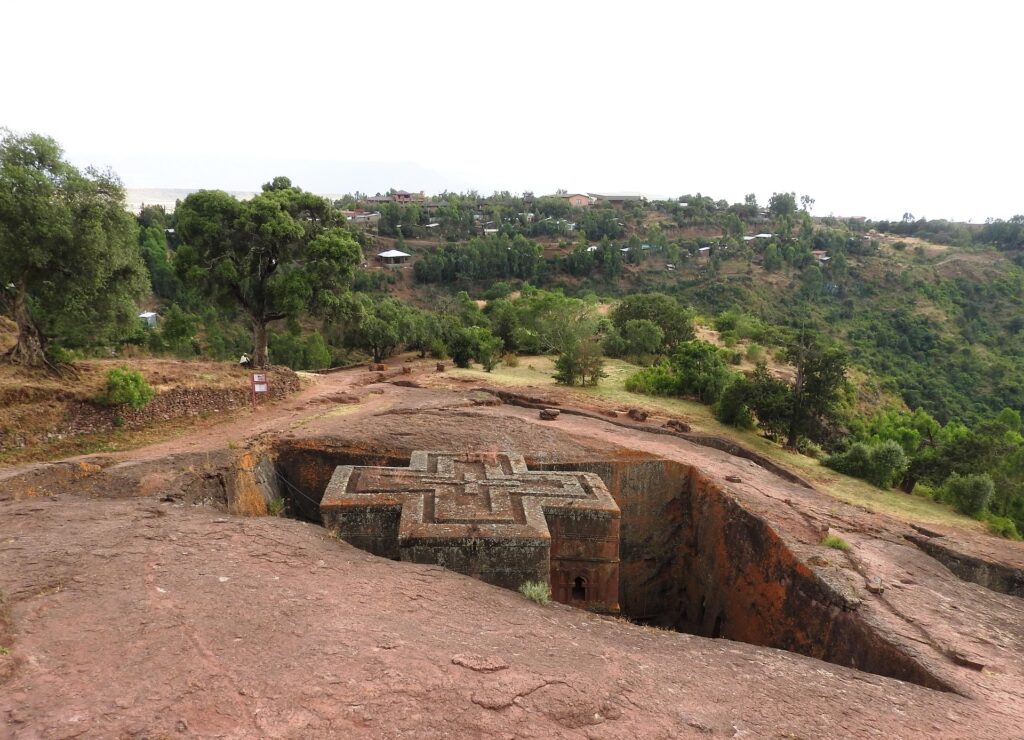
Fly into Addis Ababa — the highest capital city in Africa at roughly twenty-four hundred meters — and visit the National Museum where Dinkinesh waits in her safe, a plaster replica displayed in her place because the original is too fragile and too important to risk. Stand in front of three point two million years of ancestry and understand that every human being on earth is looking at a relative. Then travel north to Lalibela in the Ethiopian Highlands and descend into the rock-hewn churches commissioned by King Gebre Meskel Lalibela in the late twelfth and early thirteenth centuries. Eleven churches carved not from blocks assembled upward but from living volcanic rock excavated downward — the builders began at the top and removed everything that was not a church, cutting trenches around monolithic structures, hollowing interiors, carving windows, columns, and drainage channels from a single piece of stone. Bet Giyorgis, the Church of Saint George, is a perfect cruciform cut twelve meters into the earth, visible only when you stand at its edge and look down. These churches were built to create a new Jerusalem in Ethiopia after Muslim conquests made pilgrimage to the original Jerusalem impossible — an entire holy city reproduced not by imitation but by subtraction, carved from the mountain rather than built upon it. Visit Aksum, the ancient capital where obelisks — stelae — tower over royal tombs, some exceeding twenty meters, monuments to a kingdom that was one of the four great powers of the ancient world alongside Rome, Persia, and China. Sit for a coffee ceremony and understand that what the rest of the world calls a morning habit, Ethiopia calls a three-round social ritual that has been performed for centuries in the country where the plant itself evolved — not cultivated, not imported, but native, growing wild in highland forests where no one planted it.
Evolve — Who You Become in Ethiopia
You leave Ethiopia understanding that the origin does not announce itself. It does not campaign for recognition. It does not need a monument because it is the ground the monument stands on. Lucy did not know she was the oldest. Kaffa did not know it was inventing the world’s most traded commodity after oil. The builders of Lalibela did not carve churches to impress visitors — they carved them to pray in. Menelik did not fight at Adwa to make a political statement — he fought because an Italian diplomat wrote a treaty in two languages and assumed the African version would be the one that was ignored. The Ethiopians named their oldest ancestor “you are marvelous.” The world named her after a pop song. Both names survive, but only one was given by the people who kept her. You come home and look at the thing you originated — the idea, the method, the project, the insight that someone else has repackaged with a different name — and you stop asking for credit. The origin does not ask. The coffee grows wild in the forest. The churches were carved downward from the surface. The skeleton was already there for three point two million years before the scientist arrived. The calendar runs seven years behind because Ethiopia never adopted someone else’s counting system. The script is still in use because no one replaced it. You are marvelous. That is what the origin says to itself, in its own language, on its own calendar, in churches carved from the rock it was standing on. The rest of the world can use whatever name it wants. Ethiopia already has one.
Your practical guide to Ethiopia starts bellow 👇
🕰️ Ethiopia Historical Backdrop
Ethiopia’s history is a profound epic of sovereignty and endurance. As the only African nation never to be colonized, it has maintained a unique cultural and linguistic identity for over three millennia. From the powerful Aksumite Empire—once one of the four great powers of the ancient world—to the medieval majesty of King Lalibela’s rock-cut churches and the imperial legacy of Haile Selassie, Ethiopia serves as a living archive of human civilization. Its story is told in the ancient Ge’ez script, the legendary “Resting Place of the Ark of the Covenant,” and the resilient spirit of the Adwa victory. Today, it stands as the diplomatic heart of Africa, a nation that fiercely protects its ancestral roots while navigating a path toward modern continental leadership.
🌟 Ethiopia Local Experiences
Beyond the historical monuments, discover Ethiopia’s soul in the ritual of the Coffee Ceremony—the birthplace of Arabica coffee—where the roasting of beans and the pouring of three rounds of coffee creates a profound sense of community. Experience the breathtaking “Acoustic Stillness” of a dawn liturgy in Lalibela, the sensory explosion of a bustling “Merkato” in the capital, or the simple joy of sharing a communal platter of Injera and Doro Wat (spicy chicken stew). Whether it’s trekking among the giant lobelias of the high plateau or exploring the rainbow-colored thermal pools of Dallol, these moments reveal a nation that finds richness in connection, spirituality, and the raw beauty of the earth.
🌄 Ethiopia Natural Wonders
- Simien Mountains National Park: A spectacular landscape of jagged peaks and deep valleys, home to the rare Walia ibex and Ethiopian wolf.
- Danakil Depression: One of the hottest and lowest places on Earth, featuring the bubbling lava lake of Erta Ale and the psychedelic salt formations of Dallol.
- The Blue Nile Falls (Tis Abay): Known as “The Smoke of Fire,” where the river plunges over a massive basalt cliff.
- The Great Rift Valley Lakes: A chain of stunning freshwater and soda lakes, including Lake Langano and Lake Chamo, teeming with flamingos and crocodiles.
- Bale Mountains: A high-altitude afro-alpine wilderness of glacial lakes and misty moorlands.
- Omo River Valley: A culturally dense region of dramatic river landscapes and diverse nomadic communities.
🏙️ Ethiopia Must-See Cities & Regions
- Addis Ababa: (Capital) The “Political Capital of Africa,” a bustling metropolis where modern skyscrapers meet historic cathedrals and world-class jazz clubs. (Dynamic, Diplomatic, Urban)
- Lalibela: A spiritual sanctuary famous for its 11 monolithic churches carved out of solid red volcanic rock in the 12th century. (Spiritual, Ancient, Majestic)
- Gondar: The “Camelot of Africa,” home to the Fasil Ghebbi fortress and beautifully preserved 17th-century castles. (Historic, Imperial, Picturesque)
- Axum (Aksum): The ancient capital of the Aksumite Empire, home to towering monolithic obelisks and the Chapel of the Tablet. (Ancient, Mystical, Archaeological)
- Harar: A UNESCO-listed walled city in the east, considered the fourth holiest city of Islam, famous for its narrow alleys and the nightly hyena feeding ritual. (Cultural, Colorful, Traditional)
🏞️ Ethiopia National Parks & Nature Reserves
Managed with a focus on endemic species protection by the Ethiopian Wildlife Conservation Authority (EWCA).
- Simien Mountains National Park: A UNESCO site of global importance for biodiversity.
- Bale Mountains National Park: Protecting the world’s largest population of the endangered Ethiopian wolf.
- Omo National Park: A remote wilderness and primary sanctuary for African savanna elephants and buffalo.
🏛️ UNESCO World Heritage Sites
Ethiopia boasts one of the highest concentrations of UNESCO sites in Africa.
- Rock-Hewn Churches, Lalibela — Medieval subterranean architecture carved into rock.
- Fasil Ghebbi, Gondar Region — The residence of the Ethiopian emperors in the 16th and 17th centuries.
- Axum — Monumental stelae marking ancient royal tombs.
- Harar Jugol, the Fortified Historic Town — A unique African-Islamic urban landscape.
- Konso Cultural Landscape — Spectacular stone-walled terraced fields and wooden statues.
- For a full list, visit the UNESCO Ethiopia Portal.
🖼️ Ethiopia Museums & Cultural Sites
- National Museum of Ethiopia (Addis Ababa): Home to “Lucy,” the 3.2-million-year-old fossil of one of our earliest ancestors.
- Ethnological Museum (Addis Ababa): Located in the former palace of Emperor Haile Selassie, providing a comprehensive look at the nation’s diverse tribes.
- Tiya Stelae Field: A prehistoric cemetery featuring mysterious carved stone markers.
🎉 Ethiopia Festivals & Celebrations
- Timket (Epiphany): (January) The most spectacular Orthodox festival, featuring colorful processions of priests carrying the Tabot (replicas of the Ark) to water sources.
- Meskel: (September) Commemorating the finding of the True Cross with massive bonfires (Demera) in the center of Addis Ababa.
- Genna (Ethiopian Christmas): (January 7) Celebrated with traditional games and night-long vigils in Lalibela.
- Enkutatash (New Year): (September 11/12) Marking the end of the rainy season with yellow daisies and traditional singing.
🧽 How to Arrive
- ✈️ By Air
- Addis Ababa Bole International (ADD) is one of the world’s most vital aviation hubs.
- Airlines: Ethiopian Airlines (Flag carrier) is the best-connected airline in Africa, offering a world-class network to Europe, North America, the Middle East, and Asia.
- 🚆 By Rail
- The Ethio-Djibouti Railway is a modern, standard-gauge rail line connecting the capital to the port of Djibouti.
- 🚗 By Road
- Ethiopia shares borders with Kenya, Sudan, South Sudan, Eritrea, Djibouti, and Somalia. Note: Always check current border status and safety advisories for land crossings.
📶 Stay Connected
- SIM Cards: The state-owned Ethio Telecom and the international provider Safaricom Ethiopia are the primary networks.
- Where to buy: Kiosks are available at Bole International Airport and in city centers. Passport registration is standard.
- eSIM: Supported by Safaricom Ethiopia; also available via international data platforms like Airalo.
- Connectivity: High-speed internet is available in Addis Ababa, but signal strength can be volatile in remote mountain areas.
🏨 Where to Stay
Ethiopia offers everything from international five-star brands in the capital to eco-lodges in the mountains.
- Skylight Hotel (Addis Ababa): A flagship modern luxury hotel directly at the airport hub.
- Limalimo Lodge (Simien Mountains): An award-winning sustainable luxury lodge with breathtaking views of the escarpment.
- Kuriftu Resort & Spa: A local luxury chain offering high-end retreats in Bishoftu, Bahir Dar, and Adama.
- Historic Guesthouses: Explore traditional stays in Harar’s walled city for total cultural immersion.
⛳ Unique Finds
- The Ark of the Covenant: Visit the Chapel of the Tablet in Axum (though the Ark itself is never shown to the public).
- Tej Tasting: Sample the traditional honey wine, Ethiopia’s ancient alcoholic beverage, in a local Tej Bet.
- Ethio-Jazz: Catch a live performance in Addis Ababa to hear the unique 1960s-inspired fusion of Ethiopian scales and American jazz.
- Rock-Hewn Monasteries of Tigray: Hike to remote, cliff-face churches accessible only by climbing ropes.
🤝 Ethiopia Cultural Guidance
- Hospitality Protocol: If you are invited to a home, it is a great honor. Finishing the food on your plate is a sign of enjoyment, and being offered a second helping is standard.
- The Time System: Be aware that Ethiopia uses a unique 12-hour clock starting at dawn (1:00 AM in Ethiopia is 7:00 AM Western time) and the Ethiopian Calendar (approx. 7-8 years behind the Gregorian calendar).
- Dress Code: Dress modestly (shoulders and knees covered) when entering churches and monasteries. Head scarves are often provided for women at entrances.
- Basic Phrases (Amharic):
- Hello: “Selam”
- Thank you: “Ameseginalehu” (A-me-se-gi-na-le-hu)
- How are you?: “Dehna neh?” (to male) / “Dehna nesh?” (to female)
- Everything is good: “Tiru”
🛂 Ethiopia Entry & Visa Requirements
- e-Visa: Most nationalities can apply for a tourist e-visa online via the official Ethiopia e-Visa Portal.
- Visa on Arrival: Currently restricted for some nationalities; e-visa is the “Operational Standard” and highly recommended.
- Official Source: Consult the Ethiopian Main Department for Immigration and Nationality Affairs.
💰 Practical Essentials
- Currency: Ethiopian Birr (ETB). Cash is king. While cards are accepted in high-end Addis hotels, you will need Birr for markets and local transport.
- Electricity: Type C, F, and G (European and UK style). Voltage is 220V.
- Safety: Ethiopia is generally safe for travelers, though standard urban vigilance is advised in Addis Ababa. Always check current regional advisories for travel outside major cities.
- Climate: Diverse. The highlands are temperate (“Eternal Spring”), while the Danakil and lowlands are tropical and hot. Best visited October to March (Dry Season).
✨ Bonus Tip: The Slower Audit
To truly embrace Ethiopia, you must surrender to the “Land of Origins” pace. Don’t rush your coffee ceremony or your walk through a medieval church. Ethiopia is a country that measures time differently—not just by its calendar, but by its soul. It is in the deliberate, third pouring of the coffee (the Bereka or blessing) that the true, transformative warmth of the people—and your own sense of internal grounding—will finally reveal themselves.
🔗 Featured Links
- Official Tourism: Visit Ethiopia.
- Aviation Logistics: Ethiopian Airlines Official.

Beyondia
Trusted Travel CompanionReal digital nomad. I travel. I learn. I grow.
What about you? Where are you going?