
GoBeyondia Atlas 🗺️ Africa Region 🗾
Seychelles: Where forty-two islands in the western Indian Ocean are not volcanic, not coral, but granite — the only oceanic archipelago on earth made of continental rock.
Seychelles in 30 Seconds
One hundred and fifteen islands scattered across the western Indian Ocean, about sixteen hundred kilometers east of the African coast. Forty-two of them are made of granite. This is the detail that changes everything. Every other remote oceanic island on earth is volcanic — built from below by eruptions, temporary by geological standards, destined to erode back into the sea. The Seychelles granitic islands are not built. They are left over. They are pieces of continental crust — fragments of Gondwana, the ancient supercontinent that once contained Africa, India, Madagascar, Antarctica, South America, and Australia in a single landmass. When Gondwana began to break apart one hundred and sixty million years ago, the tectonic forces that would eventually separate India from Africa left behind a sliver of continental rock in the Indian Ocean. That sliver is the Seychelles. The granite that forms the beaches of Mahé and Praslin was emplaced seven hundred and fifty million years ago — Precambrian rock, formed before complex life existed on earth. Alfred Wegener, who proposed the theory of continental drift, cited the Seychelles granite as among his earliest evidence. The islands are not visitors to the ocean. They are refugees from a continent that Evoke — Why You Visit Seychelles
Evoke — Why You Visit Seychelles
You come to Seychelles because something has broken off from you — a career, a relationship, a version of yourself that was part of a larger structure — and the severing left you feeling like a remnant, a leftover, a piece that no longer belongs to the whole it came from. You need a country that is literally a fragment of a supercontinent, torn away sixty-six million years ago, and carrying in its granite and its palms and its tortoises and its impossible trees the memory of a world that no longer exists anywhere else. The Seychelles did not form. The Seychelles remained. It is what was left when everything else moved on — when India drifted north to collide with Asia and build the Himalayas, when Africa consolidated, when Madagascar settled into its isolation. The Seychelles sat in the Indian Ocean on seven-hundred-and-fifty-million-year-old rock and kept living. The coco de mer kept growing its forty-five-kilogram seeds. The jellyfish tree kept flowering in granite cracks, its seeds remembering a climate that vanished. The tortoises kept outliving every human who tried to study them. The fragment did not diminish. It concentrated. Everything that Gondwana distributed across six continents, the Seychelles held in four hundred and fifty-seven square kilometers. The world’s largest seed. The world’s rarest tree. The world’s oldest oceanic islands. The world’s largest tortoise population. The world’s first ocean debt swap. You come because you have been broken off from something larger and you are afraid that the fragment cannot hold as much as the whole. Seychelles will show you that the fragment holds more. The whole forgot. The fragment remembers.
Explore — How You Experience Seychelles
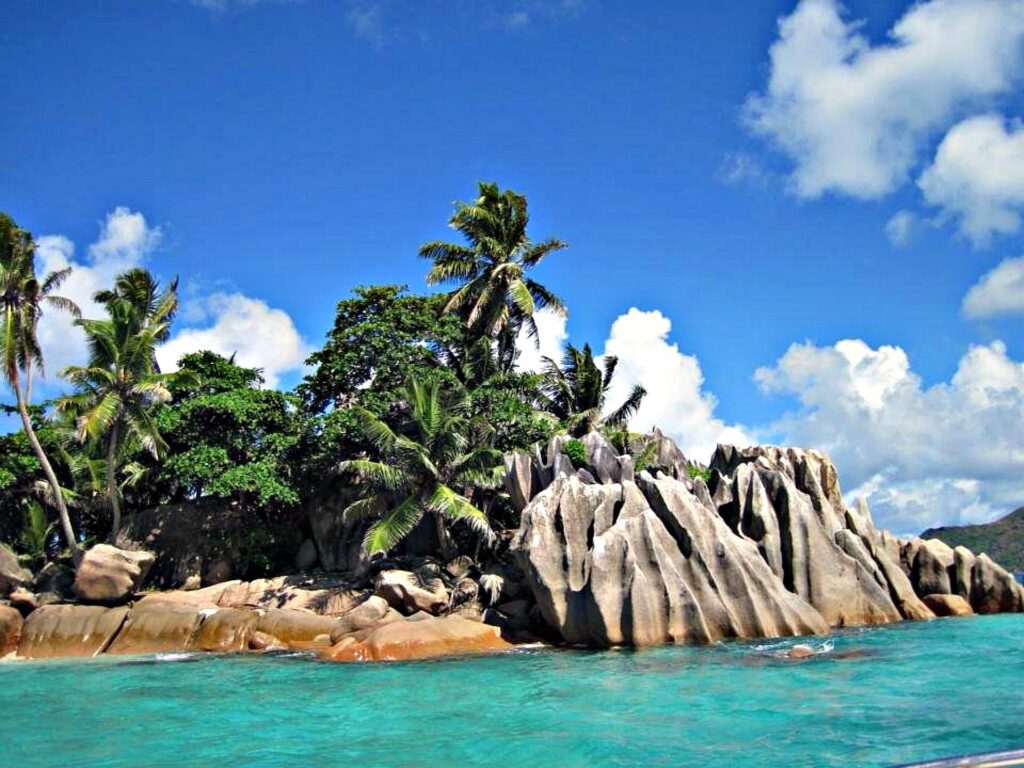
Fly into Mahé, the largest island, and the first thing you notice is the granite. It is not like any beach rock you have seen — it is smooth, sculpted by hundreds of millions of years of erosion into curves that look intentional, boulders the size of houses arranged along white sand as if placed by a sculptor working at geological time scales. This is Precambrian rock on a tropical beach. You are standing on the exposed skeleton of Gondwana. Take the short flight or ferry to Praslin and enter the Vallée de Mai. The forest is dark, dense, ancient — the canopy formed by coco de mer palms whose leaves can reach ten meters in diameter, creating a green ceiling that filters the light into something that feels pre-human. Look up and see the enormous green hearts of the developing nuts, each tree supporting up to one hundred and eighty kilograms of fruit. The forest floor is quiet. There are no large mammals. The dominant sound is birdsong — the Seychelles black parrot, the national bird, endemic and rare, its call echoing through a forest that has sounded essentially the same for millions of years. If you are fortunate and attentive on the granite slopes of Mahé, you might glimpse one of the fewer than one hundred jellyfish trees — small, with dark fissured bark and leathery leaves that turn red with age, growing in the cracks where almost nothing else can. You cannot buy this experience. You can only witness the quiet persistence of a species that has outlasted every geological event that created and then abandoned it. Aldabra is difficult to reach — specialized research expeditions or eco-tourism cruises costing thousands — but if you go, you will walk among tortoises that have been walking the same paths for longer than most human civilizations have existed. They graze the vegetation into lawns. Hermit crabs dismantle their dung. Seeds sprout in the shape of a piece of waste. The ecosystem cycles at the pace of an animal that can live two centuries.
Evolve — Who You Become in Seychelles
You leave Seychelles understanding that a fragment is not a diminishment — it is a concentration. The Seychelles was not impoverished by separating from Gondwana. It was distilled. Everything that the supercontinent distributed across landmasses that would become six continents, the Seychelles held in a cluster of granite islands in the Indian Ocean. The largest seed. The oldest oceanic rock. The rarest tree. The longest-lived animals. The first ocean debt swap. The fragment did not lose what the whole had. The fragment kept what the whole let go. The coco de mer grows the largest seed on earth because it evolved on a fragment where resources were finite and every reproductive act had to be maximized. The tortoise lives two centuries because on an atoll without predators, longevity is the strategy. The jellyfish tree clings to granite cracks because it adapted to a continent that left, and it stayed adapted, waiting, producing seeds that remember conditions that ended sixty-six million years ago. You come home and look at the break — the severance, the departure, the piece of your life that separated from the whole — and you stop treating it as a loss. The fragment does not need the continent. The continent needs the fragment, because the fragment is where the memory lives. Gondwana is gone. The granite remains. The palm forest remains. The tortoise that outlives every scientist who measures it remains. Seychelles is four hundred and fifty-seven square kilometers of land in one point three five million square kilometers of protected ocean, and it carries more biological memory per square meter than any continent on earth. The break was not the end of the story. The break was the beginning of the concentration. What broke off from you is not missing. It is distilled. It is waiting in the cracks of the granite, growing the largest seed, outliving everyone who said it would not survive the separation.
Your practical guide to Seychelles Travel Guide starts bellow
🕰️ Seychelles Historical Backdrop
The history of Seychelles is a lyrical narrative of a remote archipelago that remained a hidden sanctuary for most of human history. Uninhabited until the late 18th century, the islands first served as a transit point for explorers and pirates before becoming a French colony and later a British crown colony. This dual European heritage, combined with the arrival of people from Africa, India, and China, created the vibrant Seychellois Creole identity that defines the nation today. Since gaining independence in 1976, Seychelles has transformed from an agrarian economy based on cinnamon and copra into a global leader in “Blue Economy” initiatives. Today, it is a stable republic that has constitutionally mandated the protection of nearly 50% of its landmass, preserving a world where nature remains the primary sovereign.
🌟 Seychelles Local Experiences
Beyond the world-class resorts, discover the soul of Seychelles in the vibrant “Take Away” culture, where locals and visitors alike share affordable, spice-rich Creole curries under the shade of a Takamaka tree. Experience the profound stillness of the Vallée de Mai at dawn, the exhilarating grace of a giant Aldabra tortoise roaming freely on Curieuse Island, or the simple joy of a sunset “Bazaar Labrin” on Beau Vallon beach. Whether it’s navigating the jungle trails of Morne Seychellois or learning the rhythmic steps of the Moutya dance around a bonfire, these moments reveal a nation that finds its greatest wealth in the rhythm of the tides and the preservation of its ecological heritage.
🌄 Seychelles Natural Wonders
- Anse Source d’Argent: Frequently cited as the most photographed beach in the world, famous for its unique prehistoric granite formations.
- Vallée de Mai (Praslin): A UNESCO-listed prehistoric palm forest and the only place where the rare Coco de Mer—the world’s largest seed—grows in its natural state.
- Aldabra Atoll: One of the largest raised coral atolls on Earth and home to over 150,000 giant Aldabra tortoises.
- Morne Seychellois: The highest peak in the archipelago, offering mist-shrouded trails through ancient cloud forests and panoramic ocean views.
- Aride Island: One of the finest nature reserves in the Indian Ocean, hosting millions of breeding seabirds and endemic floral species.
- The Blue Lagoon (Desroches): A stunning example of an outer-island coral atoll, offering total isolation and untouched reef systems.
🏙️ Seychelles Must-See Islands & Districts
- Victoria (Mahé): (Capital) One of the smallest capitals in the world, known for its silver-painted “Little Ben” clock tower, vibrant Sir Selwyn Selwyn-Clarke Market, and botanical gardens. (Historic, Cultural, Gateway)
- Praslin: The second-largest island, home to the world-famous Anse Lazio and the mystical Vallée de Mai. (Lush, Coastal, Scenic)
- La Digue: An island where time seems to stand still, where bicycles and ox-carts remain popular modes of transport and the beaches are world-renowned. (Traditional, Picturesque, Relaxed)
- Beau Vallon (Mahé): The most popular coastal bay on the main island, offering a vibrant atmosphere with diving centers, restaurants, and evening markets. (Vibrant, Social, Coastal)
- The Outer Islands: A remote frontier of 72 coralline islands like Alphonse and Desroches, offering a “true wilderness” experience. (Remote, Pristine, Exclusive)
🏞️ Seychelles National Parks & Nature Reserves
Managed with world-class environmental standards by the Seychelles Parks and Gardens Authority (SPGA).
- Ste Anne Marine National Park: The oldest marine reserve in the Indian Ocean, perfect for glass-bottom boat tours and snorkeling.
- Curieuse Marine National Park: A sanctuary for giant tortoises and home to a unique mangrove ecosystem.
- Cousin Island Special Reserve: A globally recognized success story in island restoration and bird conservation.
🏛️ UNESCO World Heritage Sites
- Vallée de Mai Nature Reserve — A sanctuary for the rare Coco de Mer palm and the endemic Black Parrot.
- Aldabra Atoll — A pristine laboratory of evolution and the world’s largest colony of giant tortoises.
- For more information on heritage preservation, visit the UNESCO Seychelles Portal.
🖼️ Seychelles Museums & Cultural Sites
- Seychelles Natural History Museum (Victoria): Detailing the unique geological origins and endemic species of the islands.
- Mission Lodge (Venn’s Town): A historic site offering panoramic views and a poignant look at the education of liberated slaves.
- Domaine de Val des Près (Craft Village): A restored colonial estate showcasing traditional Creole architecture, crafts, and gastronomy.
🎉 Seychelles Festivals & Celebrations
- Festival Kreol: (October) The most important cultural event, celebrating Creole music, dance, art, and food across the islands.
- Seychelles Ocean Festival: (November/December) Highlighting the importance of marine conservation through film, photography, and eco-events.
- Carnaval International de Victoria: (Variable) A vibrant parade in the capital featuring international and local cultural groups.
🧽 How to Arrive
- ✈️ By Air
- Seychelles International (SEZ) on Mahé is the sole international gateway.
- Airlines: Air Seychelles (Flag carrier) and major carriers (Emirates, Qatar Airways, Turkish Airlines, Ethiopian, Air France) connect the islands to the world.
- Domestic: Air Seychelles (Domestic) operates frequent 15-minute scenic hops between Mahé and Praslin.
- 🚢 By Water
- Frequent high-speed ferries (Cat Cocos) connect Mahé, Praslin, and La Digue.
- Private yacht charters and occasional cruise calls provide maritime access to the outer islands.
- 🚗 By Road
- Driving is on the left (British legacy). Car rentals are available on Mahé and Praslin. Buses on Mahé are efficient, colorful, and inexpensive.
📶 Stay Connected
- SIM Cards: The two main providers are Cable & Wireless Seychelles and Airtel Seychelles.
- Where to buy: Kiosks are available at SEZ Airport arrivals and in Victoria city center. Registration with a passport is standard.
- eSIM: Supported by major providers; international platforms like Airalo provide data-only “Tactical Access.”
- Connectivity: High-speed Wi-Fi is common in resorts and Victoria, but expect “off-grid” status on the smaller outer islands.
🏨 Where to Stay
Seychelles offers a spectrum from world-leading private island luxury to charming “Seychelles Secrets” guesthouses.
- North Island (a Luxury Collection Resort): An ultra-exclusive private island sanctuary—the pinnacle of privacy and conservation.
- Six Senses Zil Pasyon (Felicité): A design-forward resort integrated into the island’s massive granite boulders.
- Le Domaine de L’Orangeraie (La Digue): An elegant boutique resort reflecting the traditional island aesthetic.
- Seychelles Secrets: Explore the network of high-quality, family-run guesthouses for an authentic and accessible Creole experience.
⛳ Unique Finds
- Coco de Mer Discovery: See the world’s heaviest nut—famously suggestive in shape—which can weigh up to 30kg.
- Seybrew & Takamaka Rum: Sample the local “Core Liquid Assets” at the distillery on Mahé or at any beachside bar.
- Bird Island: Visit between May and October to witness millions of Sooty Terns nesting on this remote coral cay.
- Bicycle Culture (La Digue): Join the island tradition of exploring entirely by bicycle—the ultimate way to “go slow.”
🤝 Seychelles Cultural Guidance
- Island Pace: Understand that “Island Time” is a cultural standard. Service is polite but unhurried. Patience is a sign of respect.
- Conservation Ethics: Seychelles is a pioneer in nature protection. Never touch coral, do not collect shells, and do not feed the tortoises or birds.
- Modesty: While casual island wear is standard, modest dress (covering shoulders and knees) is expected when visiting Victoria or churches.
- Basic Phrases:
- Hello: “Bonzour”
- Thank you: “Mersi”
- Please: “Silvouple”
- Everything is good: “Tou korek”
🛂 Seychelles Entry & Visa Requirements
- Visa-Free: Seychelles is a “Visa-Free” country. No visa is required for any nationality for tourism stays up to 3 months.
- Digital Travel Authorization (DTA): All travelers must apply for a mandatory Seychelles Electronic Border System authorization before arrival.
- Official Source: Consult the Seychelles Department of Immigration.
💰 Practical Essentials
- Currency: Seychellois Rupee (SCR). While major resorts and shops accept credit cards and Euros/USD, SCR is essential for local markets and buses.
- Electricity: Type G (Three rectangular pins—same as UK and Middle East). Voltage is 240V.
- Safety: One of the safest destinations in Africa and the Indian Ocean. Standard urban vigilance is advised in Victoria at night.
- Climate: Tropical. Best visited April to May or October to November (the “calm” windows between the trade winds) for the best diving visibility.
✨ Bonus Tip: The Granitic Perspective
To truly embrace Seychelles, you must understand the difference between “Coral” and “Granite.” Most tropical islands are born from volcanoes or reefs. The inner islands of Seychelles are different—they are the mountaintops of a submerged continent. When you stand on a beach in La Digue, you are touching the oldest ocean rocks on earth. It is in this ancient, “Granitic Stillness”—away from the noise of modern commerce—that your own sense of scale and long-term clarity will finally reveal themselves. Seychelles is a lesson in how the most durable things in life are often the ones that have been weathered the most.
🔗 Featured Links
- Official Tourism: Seychelles.com.

Beyondia
Trusted Travel CompanionReal digital nomad. I travel. I learn. I grow.
What about you? Where are you going?