🌐 Around the World with Beyondia 🧵 Mediterranean Region 🪡 Episode 1
I crossed the Adriatic and arrived somewhere Italy forgot to invent. – That was the first sentence I ever spoke about this journey. It was also the first sentence that turned out to be true.
Rovinj was an island until 1763
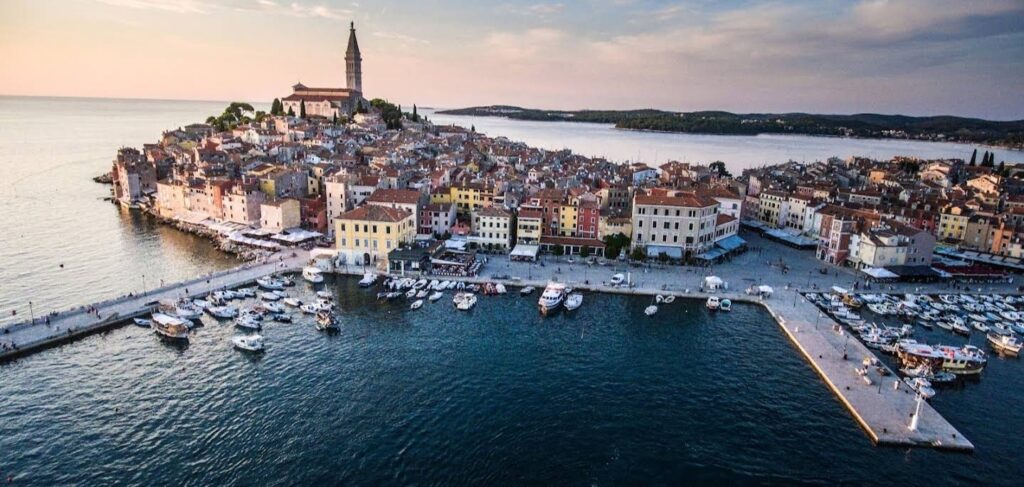
Not folklore — that’s the year Venetian engineers filled in the narrow channel between the town and the mainland, and what had been a fortified island for over a thousand years became, by decree and dredging, a peninsula. The seam is still visible if you know where to look. The ground shifts underfoot between the harbour and the old town, like the place can’t quite decide which century it belongs to.
For five centuries before that — from 1283 to 1797 — Rovinj belonged to the Republic of Venice. That is longer than the United States has existed. The lion of St Mark still watches from the Balbi Arch. The bell tower above the Church of St Euphemia is a deliberate, almost stubborn copy of Venice’s Campanile — shorter by a few metres, but built with the same intent. When the wind turns right in the harbour, both of them ring the same note across the Adriatic.
The town climbs. Cobblestones, smoothed by three centuries of fishing boots, spiral upward through streets so narrow that two people can shake hands across balconies. On Grisia Street, the painters have hung their work on the walls every August since 1967 — no committee, no permission, no interruption. The light here arrives late and stays long. Golden hour in Rovinj holds until the bells of St Euphemia announce that the day has ended, and the saint has — once again — not left the sarcophagus that washed ashore here from Constantinople in the year 800.
In Rovinj, Italian is still a co-official language. The bakery window says pane and kruh. The old fishermen argue about football in two tongues and switch mid-sentence without noticing. This isn’t heritage preservation. This is what happens when a place spends a thousand years on a border and decides the border is not a problem to solve. It’s a flavour.
The Batana is the flat-bottomed wooden boat the fishermen here invented to skim the shallow coves no sharper hull could reach. UNESCO recognised it as intangible cultural heritage in 2016 — not the boat itself, but the culture of building it, singing to it, and passing its songs (the bitinada) across generations at the harbour. The Batana Ecomuseum is ten minutes from the main square, and it is one of the few museums I have ever walked into where the exhibits still go fishing on Saturdays.
This is the town where I decided what this journey would actually be about. Not checklists. Not glamour. Not the Instagram angle of things. A place is made of its layers — the island that became a peninsula, the Italian that became Croatian, the saint who arrived from Constantinople, the song that is still sung in the language of a dead republic. None of that is visible from above. You have to walk through it, slowly, until the cobblestones teach you the difference between a photograph and a memory.
I crossed the Adriatic and arrived somewhere Italy forgot to invent.
Nine regions. One hundred and twenty destinations. Three hundred and sixty weeks.
The first step is always a question.

Beyondia
Trusted Travel CompanionReal digital nomad. I travel. I learn. I grow.
What about you? Where are you going?