🌐 Around the World with Beyondia 🧵 Mediterranean Region 🪡 Episode 2
I arrived in Lovran by scent. The laurel got there first.
Lovran – The town is named after a tree.
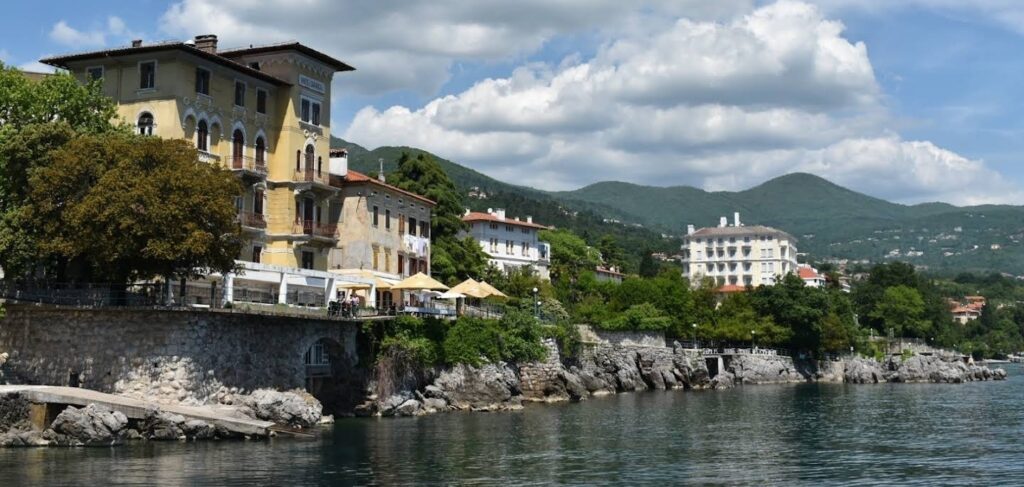
I didn’t know a place could be named after a smell. In Croatian, lovor means laurel — the bay leaf, the Roman victor’s wreath, the tree that grows wild along this stretch of coast and gives its name to every street, every hill, every garden wall in this town. Lovran doesn’t remind you of laurel. Lovran is laurel.
The town is one of the oldest settlements on the Kvarner Bay — a line of stone houses pressed between the Adriatic and Mount Učka, which rises behind it to 1,401 metres like a curtain the weather forgot to draw back. In medieval times it had its own statute, the written laws of a small coastal republic: Latin on the page but čakavski in the mouth. Čakavski is one of the oldest living dialects of Croatian, and it is still spoken in Lovran the way it has been spoken here for a thousand years — by fishermen, by grandmothers, by the men who tend the chestnut groves above the town.
The streets climb. From the harbour, a single stone staircase — steep enough that locals call it plainly, stube na moru, the steps to the sea — carries you up into the old town and then up again. Past walls the colour of sun-faded bread. Under windows hung with geraniums. Toward the church of Sveti Juraj, where Glagolitic letters cut into the stone still spell out prayers in a Croatian alphabet the rest of Europe forgot. The air shifts as you climb. At the harbour it is salt and diesel. Halfway up, it is laurel, crushed underfoot, warm. At the top, it is the cold clean breath of Učka coming down off the mountain, carrying the smell of sweet chestnut forests you cannot yet see.
There is a poem, written in čakavski by Drago Gervais, that everyone from this coast knows by heart. Pod Učkun kućice bele, miće kot suzice vele. Under Učka, small white houses, small as big tears. Two lines. It describes the entire town better than any guidebook ever has. This is a place that speaks in miniatures. It doesn’t announce. It doesn’t insist. It simply is, and has been, for as long as anyone has bothered to count.
Every October, when the chestnuts fall, Lovran holds Marunada — a festival built around a single fruit, the sweet chestnut, the marun, that has grown on these slopes for centuries. The whole town smells of them roasting. Pastry shops invent new things to do with them. Old men argue about whose grandmother’s recipe was correct. In June, it is the Lovranka cherry — a small, dark, intensely sweet variety that grows only here, on these exact slopes, between this exact mountain and this exact sea. You do not find the Lovranka in a supermarket. You find her in a woman’s hand, held out from a garden wall, for the price of a compliment.
Lovran taught me that some places don’t need drama to be worth the journey. They reward attention instead of demanding it. You don’t come here for the view from the top — Vojak has the better one, and it is twenty minutes up the mountain. You don’t come here for the big cathedral or the famous wall. You come here to smell the laurel, climb the steps, listen to čakavski in a café, eat a chestnut in October, and understand that some places are quiet on purpose.
That quiet is a form of confidence.
I arrived in Lovran by scent. The laurel got there first.
Nine regions. One hundred and twenty destinations. Three hundred and sixty weeks.
The journey doesn’t always go up. Sometimes it just stays still and lets you catch up.

Beyondia
Trusted Travel CompanionReal digital nomad. I travel. I learn. I grow.
What about you? Where are you going?