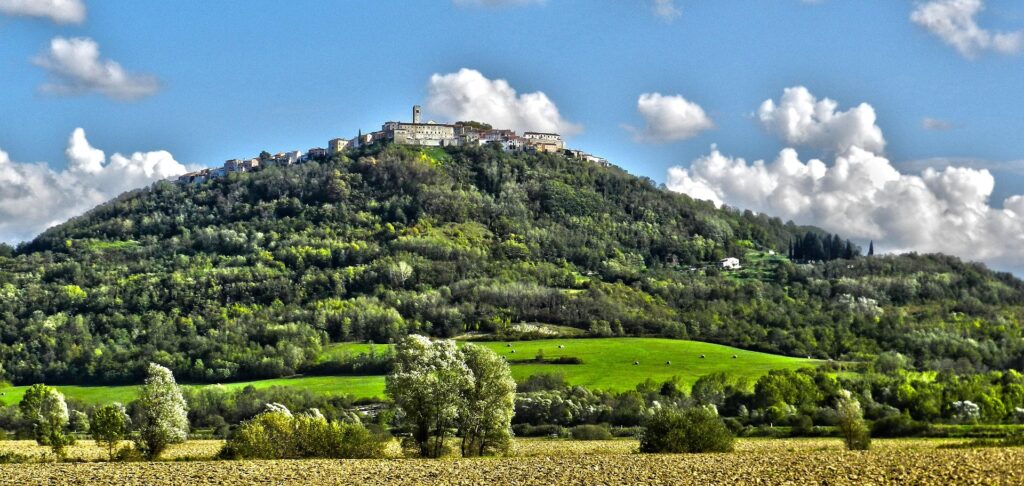
🌐 Around the World with Beyondia 🧵 Mediterranean Region 🪡 Episode 3
The morning in Istria doesn’t begin with coffee. It begins with a cow.
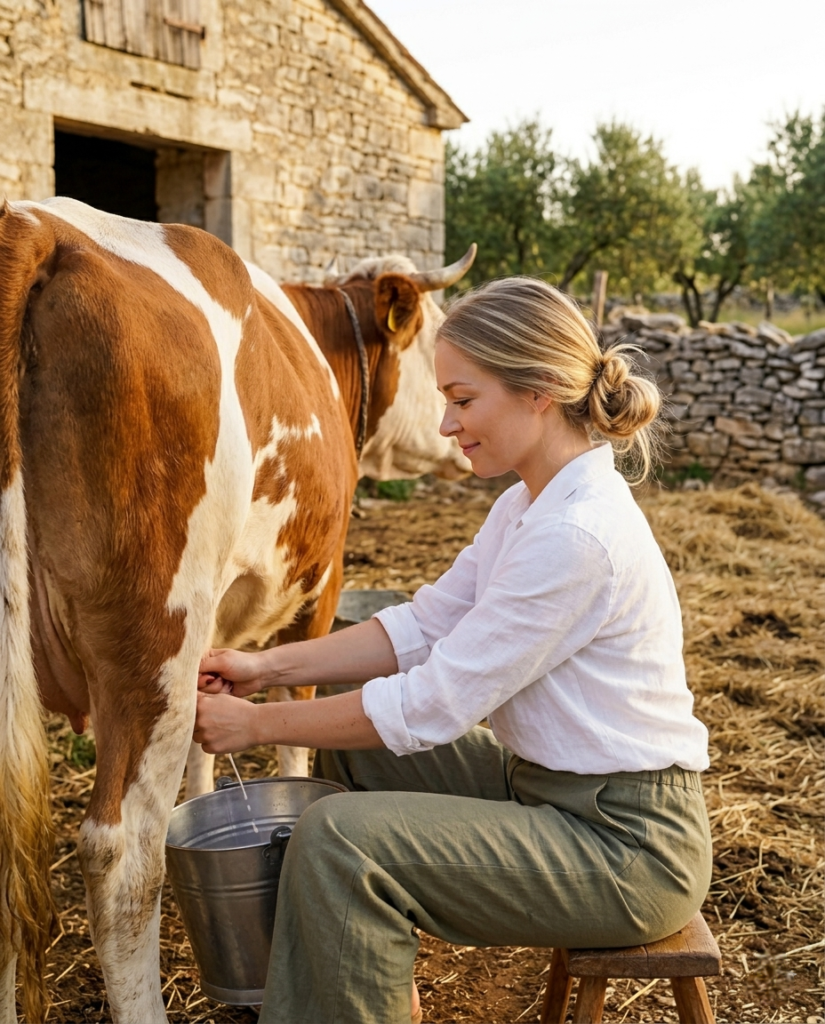
She was already awake when I walked to the barn — the kind of cow that has done this so many times she finds the human’s nervousness slightly embarrassing. The farmer handed me the stool and the bucket and said almost nothing, which is the Istrian way. Explanation is wasted on a body that hasn’t tried yet.
I tried.
It takes longer than you think to convince hands that have never milked a cow that milking is a rhythm, not a grip. Squeeze and release, top to bottom, each finger in sequence. The first stream missed the bucket entirely. The second found metal. By the third I had the sound right — that dense, muffled ring — and the cow, who had been monitoring my progress with the patience of a schoolteacher in her final year, exhaled through her nose as if to say: finally. Is it only in Istria?
The milk was warm. That’s the thing nobody warns you about. Warm in a way that feels almost wrong if your whole life you’ve only ever met milk as a cold thing in a carton.
The chickens were next.
They live in a low wooden coop at the edge of the courtyard, and they have opinions. One of them objected to me on principle — I could tell from the pitch of her complaint — but the nests were unguarded, and the eggs were still holding the heat of the hens that had just left them. Five eggs. Pale brown. One almost white. I carried them back in a cloth the way I had seen the farmer’s wife do it, cupped against the ribs, because a basket is vanity when a cloth will do.
Then the forest.
Istria is red earth country, and the forest floor holds that redness under the leaves — oak, hornbeam, chestnut, the slow trees. The farmer walked ahead of me the way people walk in forests they’ve known since childhood, which is to say, not looking down. His feet knew where the mushrooms would be before his eyes did. He’d stop, nudge something with his boot, bend without comment, and add another vrganj — porcini — to the basket. I like Croatia.
I learned what I could. You don’t pull. You twist, gently, low at the stem, so the mycelium underneath stays intact and the same spot can give again next year. You leave the young ones. You leave the old ones. You take the middle-aged ones, which is a philosophy that could be applied to most things.
We came back with enough.
The kitchen was the kind of kitchen that predates the word kitchen — a hearth, a long wooden table worn smooth by four generations of elbows, a window looking out at nothing in particular, which is to say, at everything. The wife cracked the eggs into a bowl with one hand. The milk I had coaxed from the cow went into a jug. The mushrooms were cleaned with a brush, not water — water drowns the flavor, she said, in the only English sentence she volunteered all day.
This is fritaja. In the rest of the world it would be called an omelette, but Istria would disagree. Fritaja is eggs, yes, but it’s also a verb, a room, a smell, a small ceremony that takes ten minutes and belongs to the hearth. Olive oil first — their own, pressed two villages over. Then mushrooms, browning until they give up their water. Then the eggs, pulled gently across the pan, never beaten into submission.
We ate it standing up. That’s also the Istrian way.
The bread was from yesterday. The wine was from the cellar, which is to say from the hill outside the door. The olive oil was greener than I had words for.
This is how rural Croatia actually eats.
Not with a menu. With a morning.

Beyondia
Trusted Travel CompanionReal digital nomad. I travel. I learn. I grow.
What about you? Where are you going?