🌐 Around the World with Beyondia 🧵 Mediterranean Region 🪡 Episode 4
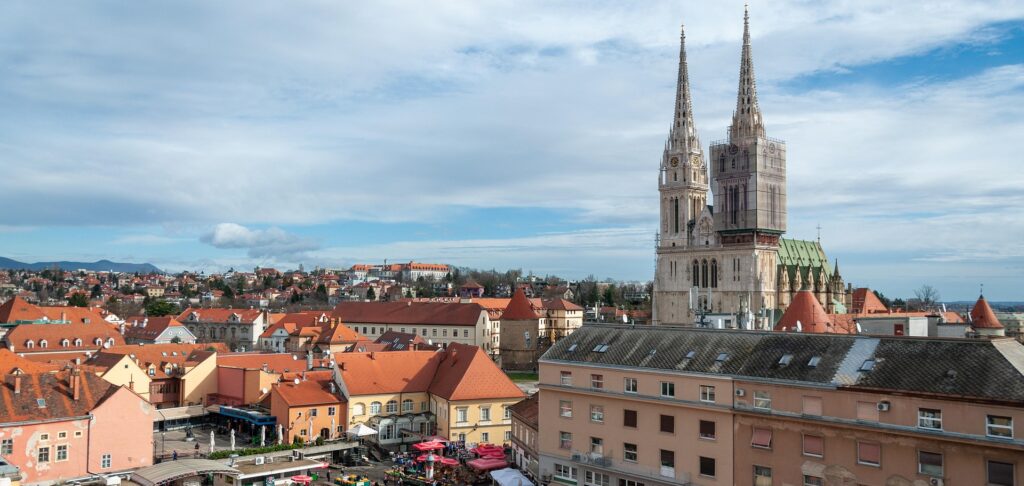
Zagreb’s trams have been running since 1891. But the real heart of the city is Dolac — open every morning since 1930. Locals call it Zagreb’s belly.
There are cities people visit to see landmarks. Zagreb is not one of them.
Zagreb is the kind of capital you visit to understand how a city actually works when you slow down enough to listen to it. What most first-time visitors don’t realise is that Zagreb’s Lower Town was drafted, in the 1880s, as one of the most ambitious urban plans in Central Europe — the Zelena potkova, the Green Horseshoe. Eight parks and squares arranged in a U-shape by city engineer Milan Lenuci, linking the old town to the railway station. Vienna had its Ringstrasse. Paris had Haussmann. Zagreb had Lenuci. Same century. Same ambition. And Lenuci built his city with gardens.
I met Zagreb in three rhythms.
In the morning, at Dolac — the open-air market perched above the main square, where the red parasols have gone up every day since the 1st of September 1930. Locals call it Trbuh Zagreba: the city’s belly. The market is literally raised above the street, built on a terrace where an older neighbourhood used to stand. The women behind the stalls still hand-pick tomatoes, still know who grows the best paprika in Zagorje, still call each other by first name. You don’t shop at Dolac. You are introduced to it, usually by someone’s grandmother, and then you belong.
By midday, I was on Ilica — the longest street in the city, over five kilometres of shopfronts, stone facades, and tram tracks running west from Ban Jelačić Square. Tram number six has rattled down the middle of it since before the First World War. Ilica is where the two medieval hills of Zagreb used to divide — on one side, Gradec, where noblemen ruled; on the other, Kaptol, where bishops did. The two were once so stubbornly separate they had different laws. Ilica is the seam between two small republics that eventually remembered they were a city.
By evening, I was in Park Zrinjevac — the first and most beloved of Lenuci’s parks. Plane trees planted in the early 1870s arch over a music pavilion where orchestras still play free concerts on summer nights. A small meteorological column from 1884, Croatia’s first weather station, still measures the same air it has always measured. And at dusk, a man walks the paths with a long brass pole and lights the gas lamps one by one, the same way they have been lit in this park since the nineteenth century. He is called the lampaš — the lamplighter. Zagreb is one of the last cities in Europe where this job still exists.
This is the paradox of Zagreb. It is a Balkan capital that thinks like Vienna, and a Habsburg city that laughs like Split. The architecture is Austro-Hungarian; the humour is darker and funnier than anything Vienna has produced in a century. Coffee takes forty-five minutes on purpose — not because the service is slow, but because kava is a verb here. You don’t drink coffee in Zagreb. You sit coffee. You read the newspaper coffee. You argue politics coffee. And nobody, anywhere in this city, brings you the bill until you ask for it twice.
Zagreb slowed me down. Not the way a small village does, by having less to show. Zagreb slowed me down while everything around me continued to move. The trams kept running. The market kept filling. The lamps kept being lit. And somehow, inside all of that motion, I kept forgetting to hurry.
Some cities show you their skylines. Some cities show you their skylines and refuse to show you anything else. Zagreb showed me its belly, its backbone, and its garden, and never asked for more attention than I chose to give it.
Nine regions. One hundred and twenty destinations. Three hundred and sixty weeks.
The best cities are the ones you leave more slowly than you arrived.

Beyondia
Trusted Travel CompanionReal digital nomad. I travel. I learn. I grow.
What about you? Where are you going?