🌐 Around the World with Beyondia 🧵 Mediterranean Region 🪡 Episode 15
Ios has two reputations. Only one of them is correct. Both of them are true.
There is a hilltop on the northern end of Ios
Above a valley called Plakotos, where a low stone mound sits in the dry grass with a view across the sea toward Naxos. A small plaque, when it is there, identifies it as the Tomb of Homer. The plaque is stolen and replaced more or less annually. The mound itself has been called the tomb of Homer on this island for roughly two and a half thousand years. The tradition is recorded by Herodotus in the fifth century BC. The Life of Homer attributed to him names Ios as the place where the poet died, returning from Samos, on a voyage he never completed. His mother, this tradition holds, was Ios-born. He was brought home. He was buried on the hill. The bards who came after him sang the Iliad and the Odyssey for a thousand years, and the island that kept his bones did not grow rich from it, build a temple over it, or particularly insist. The grave simply stayed where the grave was. It is still there. The island has not moved.
Most visitors to Ios today do not come to see it. Since the 1970s, Ios has been one of the most famous young-backpacker destinations in Europe — the island of cheap rooms, beachfront bars in Mylopotas, and late-night dancing in the main square of Chora that does not stop until it gets light. None of this is untrue, or recent, or superficial. Island culture adapts. The same harbour that unloaded Ottoman traders unloads ferries full of Australian university students on gap years. The same cobbled streets that carried bread up to families in the 1920s carry takeaway souvlaki boxes past them tonight. Chora’s whitewashed houses are still whitewashed every spring. The windmills on the ridge above the town, four of them still standing, still turn slightly in the wind they were built to use, although the wheat they used to grind is now grown somewhere else. The party and the place it is being held in are different ages.
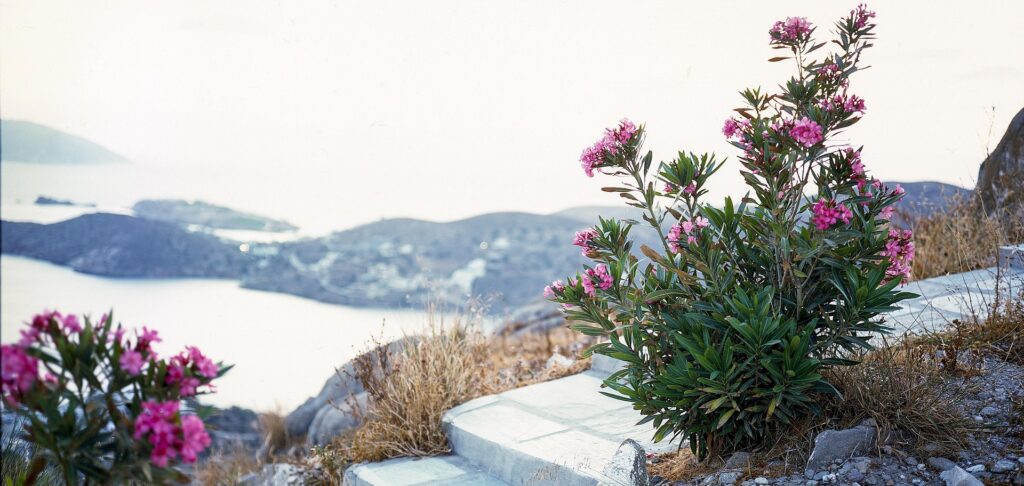
The island itself is small — about 108 square kilometres, barely 2,000 permanent residents, and almost everything is walkable from everything else. Chora sits high on a hill a kilometre or so inland from the harbour, protected in the old way against raiding, and above it stands the Panagia Gremiotissa — Our Lady of the Cliff — a small Orthodox chapel perched at the highest point of the town, which is the single best place on the island to watch the sunset. From the chapel’s terrace, the view includes Sikinos, Folegandros, a slice of Santorini on a clear evening, and, directly to the north, the end of Naxos. This is what Homer, if he existed, and if he died here, saw last. Whether or not he did, the sightline has not changed in three thousand years. The sea is where it was. The islands are where they were. The sun still goes down in the same place.
Ios was a Minoan island before it was a Greek one. Shards of Minoan pottery have been found at Skarkos, an Early Bronze Age settlement on the island’s northwest side, inhabited roughly four and a half thousand years ago. Skarkos is one of the best-preserved prehistoric settlements in the Cyclades, with stone-paved streets and the foundations of two-storey houses still visible in the soil. Hardly anyone goes. It is not on the main backpacker map. It sits on the island with the patience of all old places that have survived famous neighbours. The Greek tradition about Homer’s arrival on this island says he came because his mother was born here. If that tradition reaches all the way back to the Minoan period — which is now increasingly the scholarly view — then what happened at Skarkos was already here, in the ground, when the poet was brought home to die.
There is no honest way to resolve the question of whether Homer was a single historical person, multiple poets, a school, or a literary ghost assembled backward from the texts. The debate has run for two thousand years and will run for two thousand more. What Ios has is something the question does not touch: the tradition of where he ended. Every ancient and medieval Greek writer who named a place for the grave named this island. No competing island ever argued for the honour. Chios claimed his birth; Smyrna claimed him too; Athens copied his poems into official manuscripts. None of them claimed his end. Ios got him quietly, kept him quietly, and has been quietly holding the claim for the entire subsequent life of Western literature.
This is the real character of the island. Not the party. Not the grave. The coexistence. An island where Australian backpackers drink in the same main square that the first known reader of the Odyssey might have walked across on the way to deliver a jar of oil. Where a 2,500-year-old tomb sits untended on a hill overlooking a beach that charges €15 for a cocktail. Where the sunset every Greek evening over the Panagia Gremiotissa is watched simultaneously by twenty tourists taking identical photographs and by the same wind that has been doing the same thing since before Europe had a name for itself. No other island holds both registers as comfortably. Ios does not apologise for either one. And it does not explain them to you.
Some islands pretend to be one thing. The best ones hold several at the same time and let you choose what you saw.
Nine regions. One hundred and twenty destinations. Three hundred and forty-six weeks remaining.
Some graves demand pilgrims. Some graves prefer to be forgotten by almost everyone.

Beyondia
Trusted Travel CompanionReal digital nomad. I travel. I learn. I grow.
What about you? Where are you going?