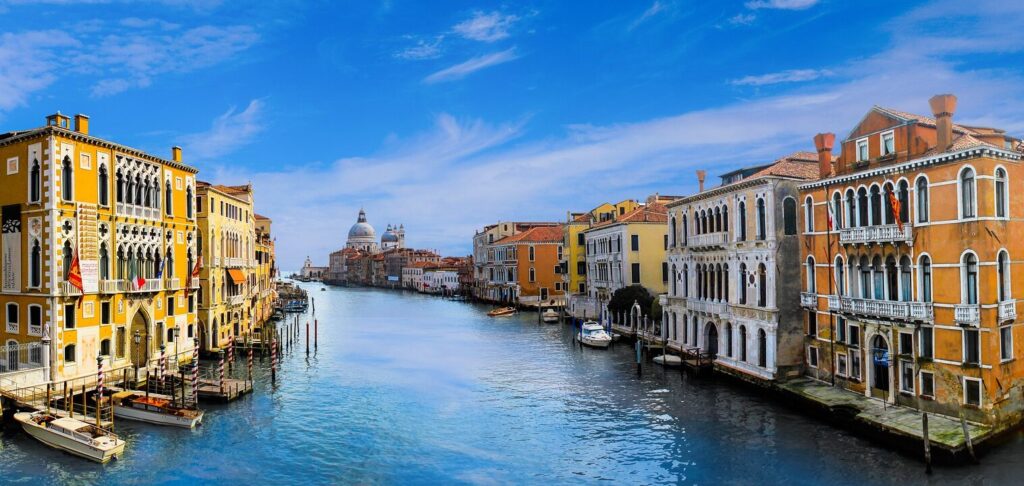
🌐 Around the World with Beyondia 🧵 Mediterranean Region 🪡 Episode 27: Venice
Republic of Venice — La Serenissima
Sometime in the fifth and sixth centuries AD, while the western Roman Empire was collapsing under successive waves of barbarian invasion, groups of Roman provincials from the mainland Veneto — small landowners, traders, fishermen, religious refugees — fled into the marshes of a shallow saltwater lagoon at the head of the Adriatic. The lagoon was largely useless to anyone who wanted land: too shallow to sail across in anything larger than a flat-bottomed boat, too brackish to drink, too unstable to farm, too exposed to storms to defend conventionally. Which was exactly why it served as refuge. The barbarians could not get to it. The early settlers built temporary shelters on the few mud-and-sand islets that broke the surface, and over the following two centuries — slowly, then more quickly — they did something almost nobody had ever attempted at the scale Venice would eventually require. They began to build a city by driving wooden piles into the mud of the lagoon. Trunks of oak, larch, and pine felled in the forests of Friuli, of Cadore, of the southern Alps, were rafted down rivers to the lagoon edge, sharpened into points, and pile-driven vertically into the silt. The piles were then sawn level just below the waterline. Stone foundation slabs were laid across them. Brick and Istrian limestone walls rose on the slabs. By the time the Basilica of San Marco was begun in its first form in 828 AD, the technique had been refined into something close to industrial. Roughly ten million wooden piles now lie beneath the city. The Basilica of Santa Maria della Salute alone, completed in 1681, sits on more than one million one hundred thousand of them, sunk into the mud across an area roughly the size of a small village. The piles have not rotted, because submerged in oxygen-free silt, they have slowly mineralised over the past thousand years into something close to stone. Venice is, in literal physical fact, a stone city built on a petrified forest someone planted upside down.
The republic that grew up on this foundation lasted one thousand one hundred years. The Most Serene Republic of Venice — La Serenissima — is traditionally dated from the election of the first doge in 697 AD, though the institutional consolidation took another two centuries. It ended only when Napoleon’s army arrived in May 1797 and the last doge, Ludovico Manin, surrendered without resistance, removing his ducal cap with the famous remark that he would no longer be needing it. Between those two dates, Venice was a continuously self-governing republic for longer than any other state in human history. Longer than the Roman Republic. Longer than the Roman Empire. Longer than the Byzantine Empire. Longer than England has been a unified country. Longer than the United States has existed by a factor of more than five. The constitutional system that produced this longevity was an obsessively complex apparatus designed, over centuries, to prevent any single individual from accumulating power. The doge was elected by a system that involved at least nine separate rounds of lottery and voting, alternately drawing lots from the Great Council and voting on those drawn, in a process so elaborate that historians have written entire books just to explain the procedure. The point of the system was not democracy in the modern sense. The point was the prevention of tyranny. The procedure worked. In eleven centuries, no doge succeeded in turning the office into a hereditary monarchy. The republic outlived every dynasty in Europe that tried.
The republic also invented an extraordinary number of the things the modern world now takes for granted. The world’s first patent statute was passed by the Venetian Senate in 1474 — Parte Veneziana, the first law in any country to grant a temporary monopoly to an inventor in exchange for public disclosure. Every patent law in every modern jurisdiction descends from this single Venetian statute. The world’s first dedicated quarantine island, Lazzaretto Vecchio in the southern lagoon, was established by the republic in 1423 to isolate plague-infected travellers — six decades after Dubrovnik passed the first quarantine law, but the first permanent quarantine facility, complete with hospital, isolation wards, and burial grounds, anywhere in Europe. The word ghetto, used now in every language for any concentrated minority district, originated in Venice in 1516, when the Senate decreed that the city’s Jewish population should live in a single enclosed quarter on the site of a former copper foundry — getto in Venetian, meaning foundry-pour, which mutated into ghetto. The Jewish quarter of Venice was, in its restrictive form, the original from which the word and the concept spread. The gold ducat, minted by the republic from 1284 to 1797 in a coin of 3.545 grams of pure gold, rivalled the Florentine florin as the dominant high-value coinage of Mediterranean and European trade for half a millennium. The Republic of Venice ran what was, by any modern standard, a financial superpower — controlling a trading empire that stretched from the Atlantic to the Black Sea, from Bruges to Alexandria, from Crete to Cyprus. At the height of its power in the fifteenth century, Venice produced more ships per year than any other city in Europe, and the Venetian Arsenal — its state-run shipyard — could outfit a complete galley in a single working day. Henry III of France toured the Arsenal in 1574 and watched a galley be built, launched, and armed during the time it took him to eat lunch.
What makes the achievement almost incomprehensible to a modern visitor is the geography. Venice was the dominant naval power of the Mediterranean for half a millennium, and Venice had no land. The republic controlled overseas colonies — Crete for four hundred and fifty years, Cyprus for nearly a century, the Ionian Islands, parts of the Peloponnese, slices of the Dalmatian coast — but the capital city itself had no agriculture, no forests, no quarries, no fresh water. Everything had to be imported. Drinking water came in the form of rainwater, collected from rooftops, channelled into the city’s roughly six thousand five hundred cisterns, and filtered through layers of sand laid beneath every public square. The squares themselves were engineered specifically for water collection — gently sloped toward central drainage points where filtered rainwater accumulated in underground reservoirs and was drawn up by hand pump. The famous wellheads in Venetian squares are not decorative. They are infrastructure. For more than a thousand years, this is how a population of up to 180,000 people drank. The fresh water that the rest of Europe took for granted was, in Venice, an engineering achievement renewed daily from the sky.
The city the Venetians built on top of this — the city the visitor walks through today — is one of the most consistently beautiful urban environments ever produced. Not because of any single building. Because of the cumulative effect of having had eleven hundred years of one of the wealthiest cultures in Europe build, with marble and Istrian stone, at a scale dictated entirely by what could be carried by boat. There are no horse statues in Venice on the scale of Rome’s, because there were essentially no horses in Venice — the streets are too narrow and the bridges too steep. There are no triumphal avenues, because there was no parading army. There are no monumental gates, because there were no city walls. The city’s defences were the lagoon itself, which no enemy navy ever successfully forced. Venice was, throughout its independent history, the only major European capital that did not need to be walled. The lagoon was the wall. The empire was the wall. The republic was the wall.
And then there is what is happening now. The Venice of 1797, when Napoleon arrived, had a population of about 137,000 people. The Venice of 1951 had 174,000 — its modern peak. The Venice of today has roughly 49,000 permanent residents in the historic centre. The collapse is a 72% population loss in seventy-five years, in a city that simultaneously hosts up to thirty million tourists a year. The buildings are sinking — the city is subsiding at a rate of one to two millimetres per year, while the Adriatic is rising — and the cumulative effect, combined with increased storm frequency from climate change, has produced the rising frequency of acqua alta, the high-water flooding that now regularly inundates the lower-lying squares including San Marco. Forty-seven children were born in the historic centre of Venice in 2023. The mainland city of Mestre, across the lagoon, now contains more Venetians than Venice does. The pharmacies and grocery stores of the historic centre are closing as their customer base relocates; in their place open mask shops, gelaterias, and short-term rental concierge services. UNESCO has repeatedly threatened to place Venice on its endangered list. There are credible estimates that within roughly a generation, perhaps two, the historic centre will have no permanent residents at all. The lagoon will remain. The piles will remain. The buildings will remain, in some condition. The Venetians will not. The most photographed city in Europe is currently emptying in real time, and almost every photograph being taken is a photograph of a population that is leaving.
This is the strangest fact about modern Venice, and it is impossible to write about the city honestly without saying it. The republic outlasted every empire in Europe. The piles outlasted every successor state. The water rose and the buildings sank, in centimetres rather than metres, for a thousand years. The thing that may finally end Venice — that may be ending it now — is not the lagoon. It is not Napoleon, or Austria, or the German occupation of 1943, or the cruise-ship industry, although the cruise ships have not helped. The thing that is ending Venice is that people cannot afford to live there. The apartments have been bought as investments. The grocery stores have been replaced by souvenir shops. The schools are closing. The children are being raised in Mestre. The city remains, and the city is empty.
And yet the city still operates. The vaporetti run on schedule. The pharmacies that remain dispense medications. The masses are still said in San Marco. The patriarch of Venice — successor to the offices held by Pope Pius X and Pope John XXIII before they were elected to Rome — still presides. The arsenal still hosts the Biennale every two years. The Bridge of Sighs still has its name. The lions of San Marco — sent home by Venetian merchants and admirals as imperial trophies from across the eastern Mediterranean for five hundred years — still stand on every façade and every column where the republic put them. The republic ended in 1797. The republic’s furniture is still in the room.
Some cities decline. This one declined eleven hundred years ago and never stopped working anyway.
Nine regions. One hundred and twenty destinations. Three hundred and thirty-four weeks remaining.
The journey turns north into the Alps. The next stop is a town that speaks German in Italy and has not entirely decided which one.

Beyondia
Trusted Travel CompanionReal digital nomad. I travel. I learn. I grow.
What about you? Where are you going?