🌐 Around the World with Beyondia 🧵 Mediterranean Region 🪡 Episode 33: Avignon
For sixty-eight years in the fourteenth century, every major decision in Western Christianity was made in a small French city on the Rhône. The Popes had moved. Almost nobody remembers.
Avignon — The City in France That Was the Capital of Christianity
In 1309, the head of the Catholic Church — Pope Clement V, a French cardinal who had been elected to the papacy four years earlier in Lyon under heavy French political pressure — moved the papal residence from Rome to the small city of Avignon, on the eastern bank of the Rhône, in what was then the territory of the County of Provence, ruled by the Angevin kings of Naples but effectively under French royal influence. The official reasons were political: Rome was in chaos, factional Italian noble families were making the city ungovernable for any pontiff who was not protected by their party, and the recent election of a French Pope had created an opportunity to relocate the curia to a more stable territory. The unofficial reasons were less dignified. Philip IV of France, the king who had crushed the Knights Templar two years earlier in one of the most spectacular acts of judicial-political violence in medieval European history, wanted the papacy closer to him. Clement V was already a former Archbishop of Bordeaux and a Frenchman by birth, training, and political loyalty. The move suited everyone — except the Italians, who were furious, and Petrarch, who was not yet old enough to denounce it. The papal seat shifted six hundred miles north-west. It did not return for sixty-seven years.
Seven Popes reigned from Avignon between 1309 and 1377. All seven were French. The papal court — which in Rome had been an Italian-language institution with a significant international component — became, in Avignon, a French-language institution with French-dominated cardinals, French legal advisors, French civil servants, and a French-language correspondence apparatus. The number of cardinals appointed during the Avignon period was 134. One hundred and thirteen of them were French. Eight were Italian. The remaining few were from other European countries, almost all of them serving short terms. The financial centre of medieval Western Christendom relocated from the Vatican to a city whose population in 1309 was around five thousand and which, by the time of the papacy’s return to Rome in 1377, had grown to forty thousand inhabitants — most of them connected, directly or indirectly, to the papal administration. The largest Gothic palace ever built in medieval Europe — the Palais des Papes, the Palace of the Popes — rose in the city centre between 1335 and 1364, in two distinct phases under Popes Benedict XII and Clement VI. It is the largest Gothic structure in the world, covering nearly 15,000 square metres of floor space, surrounded by 50 metres of stone walls, holding chapels, banqueting halls, cardinal apartments, treasury vaults, archive rooms, kitchens that could feed two thousand people, and a private audience chamber whose walls Clement VI had frescoed by Italian masters imported specifically for the work. The Palace stands today, mostly intact, in the centre of the modern city. It is the largest medieval Gothic building still standing anywhere in Europe.
The popes did not move themselves alone. They brought, over the course of seven decades, the entire administrative apparatus of the medieval church. The Apostolic Camera — the papal treasury — installed itself in Avignon and began collecting Peter’s Pence and ecclesiastical taxes from every Catholic kingdom from Iceland to Cyprus to Lithuania, all of which now flowed to a small French city on the Rhône rather than to Rome. The Chancery, the papal correspondence office that issued bulls and legal pronouncements, expanded its staff dramatically and standardised its procedures. The Penitentiary and the Rota Romana — the papal courts handling religious appeals from across Christendom — sat in Avignon and issued judgments that bound the consciences of millions of Catholics across Europe. The papal bureaucracy doubled in size between 1309 and 1377. Its income, in real terms, roughly tripled. The Church that left Avignon in 1377 to return to Rome was, structurally, a vastly more powerful and modernised institution than the Church that had arrived in 1309. The Avignon period professionalised the Catholic Church. It introduced systematic accounting, archival record-keeping, civil-service-style examinations for clerical appointments, and the kind of centralised bureaucratic command-and-control structure that would not be matched by any European royal state until well into the seventeenth century. The Catholic Church became, in Avignon, the prototype of every modern centralised institutional bureaucracy that has existed since. Most travel writing about Avignon mentions the Palace and stops there. The Palace is the symptom. The bureaucracy is the disease.
Catherine of Siena travelled to Avignon in 1376 — a thirty-year-old Italian Dominican mystic who had decided, on the basis of her religious convictions, that the popes must return to Rome. She wrote letters to Pope Gregory XI of such intensity that Gregory eventually agreed to meet her in Avignon. The meeting changed his mind. He moved the papal seat back to Rome in January 1377. Catherine returned to Italy. Both died in 1378 — Catherine of Siena was 33, Gregory XI was around 47. The Avignon period was over. Except that it was not. Gregory’s death precipitated the Western Schism — a split in the church that lasted from 1378 to 1417, during which two and then three rival popes simultaneously claimed legitimate authority, with one line continuing to rule from Avignon while a competing line ruled from Rome. The Avignon line was eventually declared illegitimate at the Council of Constance in 1417, and its successors were retroactively classified as antipopes. But for forty years after Gregory XI moved back to Rome, the city continued to host a Pope. The fall of Avignon as a papal capital was not a single event in 1377. It was a slow decline that took until the early fifteenth century to complete. By the time the dust settled, Avignon had been the principal residence of either a Pope or an antipope for over a century — from 1309 to 1417 — with a fourteen-month gap in 1378 between Gregory’s departure and the schismatic conclave that elected the first Avignon antipope.
Then France absorbed the city. Avignon and the surrounding Comtat Venaissin — a small enclave of papal territory carved out of Provence — remained formally papal possessions until 1791. For nearly four hundred years after the popes left, Avignon was a small Italian-administered enclave inside France, run by a papal legate, with its own laws, its own taxes, and a population that included a significant Jewish community protected by papal authority during a period of European Jewish expulsions. (The Jewish community of Avignon was one of the four communities of the Comtat Venaissin — Avignon, Carpentras, Cavaillon, and L’Isle-sur-la-Sorgue — that survived continuously through the late Middle Ages and the early modern period, when Jews had been expelled from France in 1394, from Spain in 1492, and from England in 1290. The synagogues of Carpentras and Cavaillon are still in use — Carpentras’s, dating to 1367, is the oldest functioning synagogue in France.) The French Revolution incorporated Avignon into France in 1791 by popular vote and revolutionary decree. The city has been French ever since. The Palace of the Popes, which had been the seat of papal government, became a French military barracks in the nineteenth century. The barracks vandalised many of the original frescoes. Restoration began in the 1860s. The Palace was inscribed as a UNESCO World Heritage Site in 1995, along with the historic centre of Avignon and the Pont Saint-Bénézet.
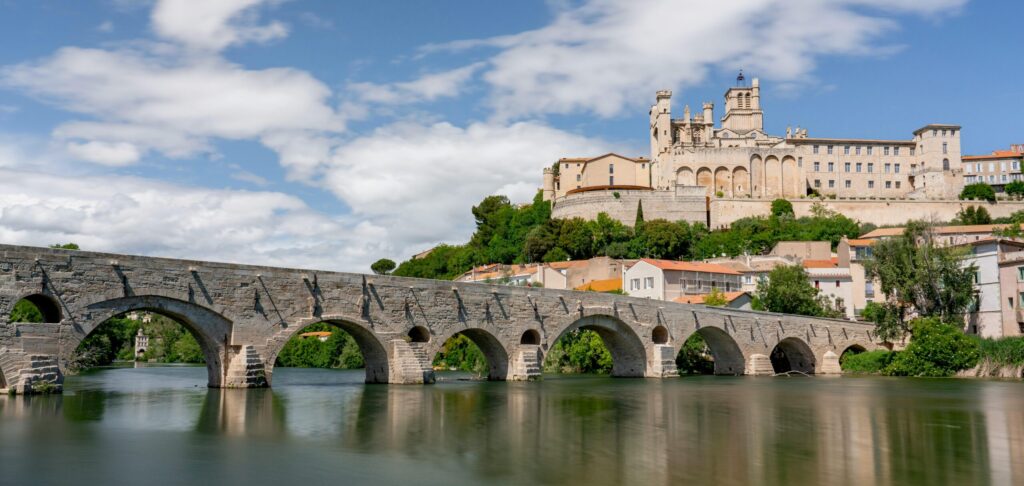
The Pont Saint-Bénézet is the most famous broken bridge in Europe. It was built between 1177 and 1185, in legend by a young shepherd boy named Bénézet who claimed divine inspiration directed him to build a bridge across the Rhône and was granted permission after lifting an enormously heavy stone the local authorities had set as a test. The bridge had twenty-two arches and stretched nearly 900 metres across the river, connecting Avignon to the small fortified town of Villeneuve-lès-Avignon on the opposite bank — the latter belonging to the Kingdom of France, the former, at the time, to the papacy. The bridge was the only crossing of the Rhône for hundreds of kilometres. Pilgrims, merchants, soldiers, and tax collectors all used it. The Rhône is a violent river. Floods damaged the bridge repeatedly. It was rebuilt in 1234 after a particularly catastrophic flood. It was damaged again in 1603, 1605, 1644, and a final time in the great Rhône flood of 1668–1669, which destroyed more than half of the bridge. After 1669, the people of Avignon stopped rebuilding it. The cost had become impossible. The papacy was no longer there to pay. The French crown had no interest. Four arches remained standing on the Avignon side. They are still there. The Pont Saint-Bénézet — the Pont d’Avignon of the song — has been a partial bridge, broken in the middle, leading from the city into open river, for three hundred and fifty-seven years. It is the most famous architectural fragment in France. Tourists pay to walk its four remaining arches. The river continues underneath. The bridge ends in the air.
The song — Sur le pont d’Avignon, l’on y danse, l’on y danse — dates in its modern form from around 1853, when the French composer Adolphe Adam wrote it as part of his comic opera L’Auberge pleine. Adam’s version was based on an older traditional song, probably dating from the sixteenth or seventeenth century, when the bridge was still intact in significant part and when, in fact, people did dance under the arches at the Île de la Barthelasse — the river island that the original bridge crossed before reaching Villeneuve-lès-Avignon. The dancing was probably under the bridge, on the island, not on the bridge itself; medieval bridges had buildings on them and were not particularly suitable for dancing. The famous opening line is therefore historically slightly wrong, in the most charming possible way: people danced near the bridge of Avignon, not on it. The song nevertheless became one of the best-known French folk melodies in the world. Every French child learns it. Every visitor to Avignon has it in their head. The bridge is famous because of the song. The song is famous because of the bridge. The bridge has been broken for longer than the song has been famous. None of this makes the bridge less beautiful. The four arches in the morning sun are some of the most photographed stone in Europe.
Since 1947, the Palace of the Popes has had a second life. In that year, the French actor and director Jean Vilar — recently returned from wartime exile and frustrated by the Parisian theatrical establishment’s reluctance to take risks — founded the Festival d’Avignon as an attempt to bring serious theatre to a non-Parisian audience in the courtyard of the Palace. Vilar staged Shakespeare’s Richard II, Paul Claudel’s Tobias and Sarah, and Maurice Clavel’s La Terrasse de Midi in the Cour d’Honneur — the main inner courtyard of the Papal Palace, surrounded by fifty metres of medieval Gothic stone walls, open to the southern French summer night. The audience was a few hundred. The reviews were excellent. The festival continued. It now runs for three weeks every July, with around forty official productions in the official Festival In and roughly fifteen hundred additional shows in the parallel Festival Off. Roughly 140,000 audience members attend each year. It is, alongside Edinburgh, one of the two largest and most consequential performing-arts festivals in Europe. The medieval Gothic palace built to house the papal bureaucracy of the fourteenth century is, in this sense, still serving as a venue for one of the most ambitious institutional projects in contemporary European culture — six hundred years after the popes who built it left. The Palace’s first function was administration. Its second function is theatre. The audiences in 2026 are watching plays inside a building that was designed, in 1335, to house the papal treasury of medieval Christendom. The continuity is accidental. The continuity is also the point.
This is the deeper character of Avignon. The city was, for sixty-eight years, the capital of a religion. It was, for over a century, the headquarters of half a divided church. It was, for four hundred years after that, a small papal enclave inside France, governing itself under medieval canon law while the country around it modernised. It is the home of the largest Gothic palace in Europe, the most famous broken bridge in Europe, and one of the two most consequential theatre festivals in Europe. The popes who built the palace were French. The bridge was built by a shepherd boy on divine instruction. The song that immortalised the bridge gets the geography slightly wrong. The theatre festival now uses the palace as a stage. Everything in this city is doing something other than what it was designed to do, and almost all of it has been doing the other thing for longer than the original function lasted. Avignon is a city of second purposes. The first purposes have long since ended. The second purposes are what is here now.
Some cities are remembered for what they once were. This one is in the middle of becoming several other things at the same time.
Nine regions. One hundred and twenty destinations. Three hundred and twenty-eight weeks remaining.
The journey continues.

Beyondia
Trusted Travel CompanionReal digital nomad. I travel. I learn. I grow.
What about you? Where are you going?