Around the World with Beyondia 🧵 Mediterranean Region 🪡 Journal 11
Corsica. Nice. Avignon. An island that doesn’t fully agree is part of France, a city that weaponise light, and a town still haunted by a papacy that packed up and left.
Corsica feels like a dare
The ferry from the Italian mainland crossed overnight and I woke to mountains rising straight out of the sea — not gentle Mediterranean hills but actual jagged peaks, snow still visible at the top in late spring, shoreline cliffs dropping into water so clear the seabed was visible twenty metres down. Corsica is the fourth largest island in the Mediterranean and it behaves like a continent that shrank but refused to lose its attitude.
I started in Ajaccio, Napoleon’s birthplace, because you can’t not. The house on Rue Saint-Charles where he was born in 1769 is now a museum — small rooms, family portraits, modest furniture. Nothing about it suggests that the boy born here would redraw the map of Europe. That’s the thing about Corsica. It produces people of unreasonable ambition and then acts like it had nothing to do with it. The town square has his statue. The locals walk past it the same way Romans walk past the Pantheon.
I drove into the interior and Corsica showed me what it actually is. The coastline is beautiful, but the mountains are the soul. The GR20 — often called the most difficult long-distance hiking trail in Europe — runs 180 kilometres along the island’s granite spine. I didn’t walk the whole thing. I did a section near the Aiguilles de Bavella, needle-like rock spires jutting into the sky like a cathedral designed by geology instead of architects, and the trail punished me for every shortcut I tried. Corsica’s interior doesn’t want visitors. It tolerates them.
The maquis — the dense scrubland that covers the mountains — smells like nothing else. Wild rosemary, myrtle, juniper, immortelle. Napoleon supposedly said he could recognise Corsica by its smell before he could see it from the sea. I believe him. The scent is aggressive. It gets into your clothes, your hair, your memory. The word “maquis” later became the name for the French resistance fighters in World War II because, like the scrubland, they were impossible to find and impossible to clear out.
In Bonifacio, at the southern tip, the old town sits on top of limestone cliffs that have been undercut by the sea until the buildings literally overhang the water. I stood at the edge and looked down at a sixty-metre drop into turquoise. The houses above me had been there since the 12th century, leaning over nothing, trusting stone that the ocean carves a little more every year. Bonifacio is either the most beautiful town in Corsica or the most stubborn. Probably both.
I ate Corsican charcuterie in a village so small it didn’t appear on my map — lonzu, coppa, figatellu, all from free-range pigs that graze on chestnuts in the forests. The cheese was brocciu, fresh and sharp, made from sheep’s milk. The wine was Nielluccio, a grape genetically identical to Sangiovese but raised in Corsican soil, which means it tastes like Tuscany’s rebellious cousin. Everything on the plate had walked, grown, or grazed within sight of where I was sitting. Corsica feeds itself and doesn’t particularly care whether anyone else notices.
Nice hits you with colour
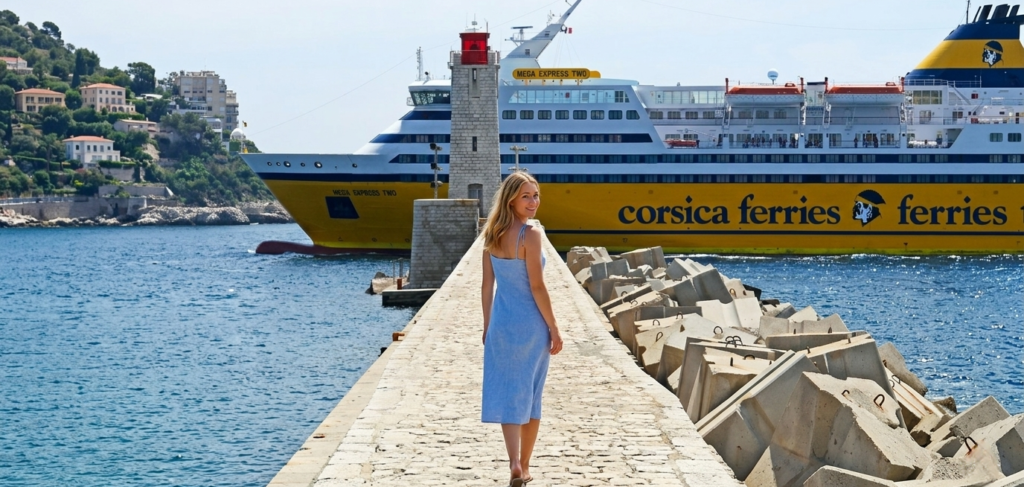
Then I took the ferry to Nice, and the volume changed.
Nice hits you with colour before anything else. The Baie des Anges curves in a long arc of white pebble beach — not sand, pebbles, which the locals defend fiercely as superior — and the water shifts from pale green to deep blue in a gradient that looks like someone adjusted the saturation on the entire coast. The Promenade des Anglais runs along the seafront, seven kilometres of wide pavement built in the 1820s by the English who wintered here because they could and because the light was unlike anything in Britain.
That light. I understood within an hour why Matisse moved to Nice in 1917 and stayed for 37 years. Why Chagall settled here. Why the whole Impressionist movement treated this coast as a laboratory. The light in Nice doesn’t illuminate — it collaborates. It changes the colour of every building, every face, every plate of food. I sat at Cours Saleya — the flower and produce market in the old town — and watched morning light turn a pile of courgette flowers into something a painter would spend a week trying to capture. Nice doesn’t just have good light. It has light that makes everything it touches into a better version of itself.
The old town, Vieux Nice, is a maze of narrow streets painted in ochre, terracotta, and faded yellow, shutters in every shade of green and blue. I ate socca — chickpea flatbread cooked in a wood oven and served on paper — standing up at a counter where the woman making it didn’t ask what I wanted because there was only one thing. Salade Niçoise at a restaurant that insisted, correctly, that real Niçoise has no cooked vegetables. Pissaladière — onion tart with anchovies and olives — that tasted like the entire Provençal coast compressed into a square of dough.
I climbed Castle Hill — the château is gone but the park remains — and at the top, Nice spread out below me in both directions. The port on one side, the Promenade on the other, the Alps behind the city like a wall that keeps winter from getting too close. Nice has been a Greek colony, a Roman settlement, a Savoyard territory, an Italian-speaking city. It became French only in 1860. That’s recent. The city still feels like it belongs to everyone and no one — Mediterranean first, French second, and completely fine with that arrangement.
Avignon was where the trip got quiet.
I arrived by train and the Palais des Papes appeared before I was ready for it. The largest Gothic palace in the world, built in the 14th century when a sequence of seven popes moved the papacy from Rome to Avignon and ran the Catholic Church from here for nearly seventy years. The palace is enormous — 15,000 square metres of stone, towers, chapels, and halls built to house a court that rivalled any monarchy in Europe. I walked through rooms where papal conclaves were held, where Clement VI threw banquets that lasted five days, where the most powerful institution in the medieval world operated from a city that was not Rome because Rome had become too dangerous.
The Western Schism that followed — rival popes in Rome and Avignon, each excommunicating the other — tore the Church in two and reshaped European politics for decades. Standing in the Great Chapel, empty now, stripped of its frescoes by revolution and neglect, I felt the echo of a power that was absolute and then simply left. The palace remains. The authority doesn’t. Avignon is a monument to the fact that even the most powerful institutions on earth can relocate, fracture, and leave behind nothing but architecture.
The Pont d’Avignon — the Pont Saint-Bénézet — was the other thing I had to see. Four arches remaining out of the original twenty-two, ending abruptly in the middle of the Rhône. The bridge was built in the 12th century, destroyed by floods repeatedly, and finally abandoned in the 17th century. It goes nowhere. It is the most famous bridge in France and you cannot cross it. I walked to the end of the remaining arches and stood above the river looking at the empty space where the rest used to be, and there was something honest about it — a structure that stopped pretending to be useful and became something more interesting instead.
I walked the ramparts that surround the old city — nearly five kilometres of 14th-century walls, intact, unbroken — and inside them Avignon was alive in a way the palace wasn’t. The Place de l’Horloge full of people eating and arguing. Side streets leading to small theatres — Avignon hosts the largest performing arts festival in the world every July, the Festival d’Avignon, and even outside the festival the city carries performance in its bones. Lavender and rosé and the particular sound of French spoken in the south, slower and rounder than Parisian French, like the accent has been warmed by the sun.
Three stops. An island that smells like defiance and produces emperors without taking credit. A city that turned light into a reason to stay and food into a reason to never leave. A town that hosted the papacy, lost it, and kept the palace like a receipt for something the world still owes it.
France doesn’t start gently. It starts with a bite, a glare, and a story that’s still unfinished.
Next week — deeper into France. But Corsica’s maquis is still in my jacket and I’m not washing it out.

Beyondia
Trusted Travel CompanionReal digital nomad. I travel. I learn. I grow.
What about you? Where are you going?