🌐 Around the World with Beyondia 🧵 Mediterranean Region 🪡 Episode 34: Paris
Paris was built by a France bureaucrat with a deadline. He had seventeen years, an emperor’s blank cheque, and a city he was instructed to make beautiful, modern, and impossible to barricade.
The Paris a contemporary visitor walks through
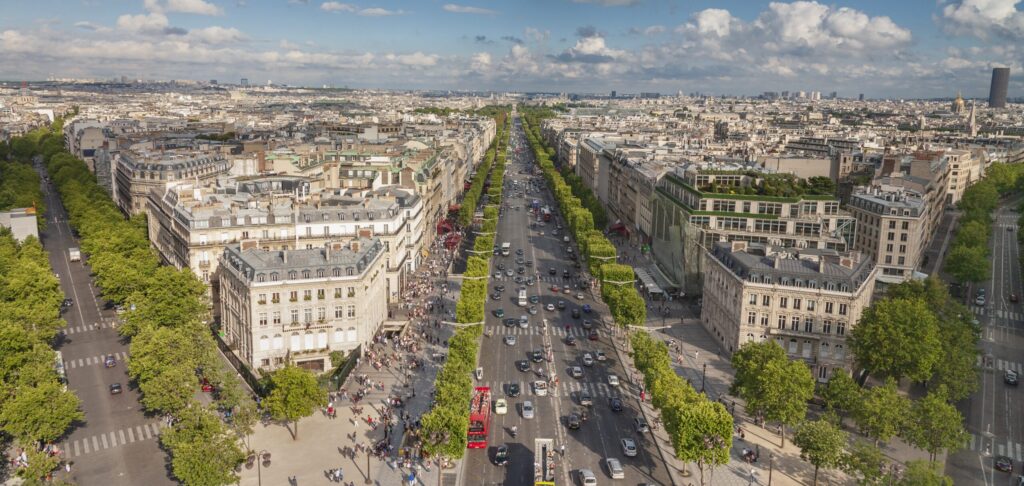
The wide boulevards lined with apartment buildings of uniform height, the wrought-iron balconies repeating every two metres along façades that all share the same cream limestone, the long avenues opening onto monumental perspectives, the green tree-lined squares at calculated intervals, the train stations terminating boulevards as if every architectural decision in the city had been coordinated by a single hand — is not, in the sense most visitors assume, an ancient city. It is a city largely demolished and rebuilt between 1853 and 1870 by Baron Georges-Eugène Haussmann, prefect of the department of the Seine, acting on the personal orders of Emperor Napoleon III. The Paris that existed before 1853 was a dense, dark, narrow-streeted medieval city whose central districts had not been substantially redesigned since the twelfth century. The Seine was filthy. Cholera epidemics in 1832 and 1849 had killed nearly forty thousand people. The streets of the Île de la Cité had not been widened since the reign of Saint Louis. The infrastructure of the modern industrial age — sewers, water mains, gas lighting, public transport — had been added to a city whose street plan was not designed to accommodate any of it. The barricades of the 1848 revolution had brought down a king and shaken the foundations of the bourgeois order. Napoleon III, who had come to power in 1851 in a coup d’état and who had spent his exile years in London observing what large-scale public works could do for a capital, decided that the only solution to all of these problems was to rebuild the city. He hired Haussmann in 1853. Haussmann did the work for seventeen years. The Paris that resulted is the Paris that most of the world has been visiting ever since.
The scale is almost impossible to comprehend in modern terms. Between 1853 and 1870, Haussmann demolished approximately 20,000 buildings, displaced roughly 350,000 residents from the central city, cut twelve new grand boulevards through the medieval street pattern (including the Boulevard de Sébastopol, the Boulevard Saint-Michel, the Avenue de l’Opéra, the Boulevard Saint-Germain, and the Avenue Foch), constructed 600 kilometres of new sewers, installed 50,000 gas streetlights, planted 600,000 trees along the new avenues, built twenty new parks including the Bois de Boulogne and the Bois de Vincennes on the city’s edges, dug two new aqueducts to bring fresh water from a hundred kilometres away, and oversaw the construction of approximately 24,000 new buildings designed to a uniform aesthetic code laid down in 1859. The cost was approximately 2.5 billion gold francs over seventeen years — equivalent, in modern terms, to several hundred billion dollars sustained over a period nearly as long as the United States was in continuous war in Afghanistan. The work was paid for partly through municipal bonds, partly through controversial public-private financing arrangements, and partly through a property compensation system that channelled enormous wealth to politically connected developers and made Haussmann himself the most controversial public official in nineteenth-century France. He was forced out of office in 1870, shortly before Napoleon III’s regime collapsed in the Franco-Prussian War. He died in 1891, blamed by some for the destruction of medieval Paris and credited by others with the creation of the modern city.
The 1859 building code — the Réglementation des Constructions — was Haussmann’s quietest and most consequential single instrument. The code mandated, for buildings constructed along the new boulevards, the use of cream-coloured Lutetian limestone quarried from the Paris basin; identical façade heights (typically six storeys, capped at twenty metres); identical balcony positions (continuous on the second and fifth floors, individual elsewhere); identical roof slopes (a 45-degree mansard, named for the seventeenth-century architect François Mansart whose roof form was revived as standard); and a uniform spacing of windows and decorative elements across long stretches of the new avenues. The result was the visual unity that makes Paris look like Paris. Walk down any Haussmannian boulevard today — Boulevard Haussmann itself, Avenue de l’Opéra, Rue de Rivoli, Boulevard Saint-Germain — and what you are looking at is, in architectural terms, a single design repeated several hundred times. The buildings are different in their detail. They are identical in their proportions. The reason Paris feels coherent in a way London and Berlin and Madrid do not is that one prefect of the Seine spent seventeen years applying a uniform aesthetic across hundreds of thousands of buildings, and that the building code he wrote remained in force, in some form, for the next sixty years. The visual coherence that makes Paris the most photographed city in Europe is the direct result of one of the strictest building codes ever enforced in a major capital.
The reconstruction was not, in any meaningful sense, democratic. Hundreds of thousands of working-class residents were displaced from central neighbourhoods that had been theirs for generations. The displaced moved outward — to Belleville, to Ménilmontant, to the northern and eastern faubourgs — creating a class geography of the city that has persisted into the twenty-first century. The medieval Latin Quarter, where Villon had drunk and Rabelais had taught and Abelard had argued with Héloïse, lost some of its oldest streets. The Île de la Cité — the original Parisian island where Lutetia had been founded in the third century BC and where the medieval city had been densest — was largely cleared, with the entire residential population of the island demolished out to make room for the broader streets and public buildings that survive there today (the Conciergerie, the Sainte-Chapelle, the Hôtel-Dieu hospital, Notre-Dame’s improved approach). The Marais — the historic Jewish, aristocratic, and royal neighbourhood that had been Paris’s centre of fashionable life in the seventeenth century — was substantially gutted; only a sustained preservation campaign starting in the 1960s under André Malraux saved its remaining seventeenth-century hôtels particuliers from continued demolition. The architectural critic Émile Zola, in his novel La Curée (1872), described Haussmannisation as the looting of the city by its own rulers. The poet Charles Baudelaire — who lived through the destruction — wrote in Le Cygne (1859): “Le vieux Paris n’est plus (la forme d’une ville / Change plus vite, hélas! que le cœur d’un mortel)” — “Old Paris is no more (the form of a city changes faster, alas, than the human heart)”. He was right. The city he had grown up in was being demolished around him while he was writing the poem.
The military purposes of the reconstruction are rarely emphasised in tourist guidebooks but were entirely explicit in Haussmann’s own writings and in Napoleon III’s instructions. The 1848 revolution had brought down the July Monarchy in three days of barricade fighting in the narrow streets of central Paris. The army had been unable to use cavalry or artillery effectively against barricades thrown up across streets six metres wide. Napoleon III instructed Haussmann to design the new boulevards specifically so that they could be swept clear by cannon fire from one end to the other, and so that troop columns could move from the railway stations to the working-class neighbourhoods of the east and north of the city without ever having to pass through a defendable barricade. The wide straight boulevards that visitors now admire for their perspectives — Sébastopol, Magenta, Strasbourg, the Avenue de l’Opéra — were designed as artillery sight-lines. The Place de la République, with its broad approaches from five directions, was deliberately positioned at the gateway to the working-class east of the city, with the Caserne Vérines barracks built directly on the square to house the troops needed for crowd control. The aesthetic and the military served the same project. The beauty was the by-product of the security policy.
What the reconstruction created, however, when the dust settled, was a city of such concentrated and sustained visual quality that it has functioned, for the 160 years since, as the single largest urban tourist destination on earth. The Eiffel Tower, built for the 1889 World’s Fair (the centennial of the Revolution) by Gustave Eiffel as a temporary structure scheduled for demolition after twenty years, was kept in place because it had become indispensable to the city’s identity within its first decade. It is now the most-visited paid monument in the world, with approximately seven million paying visitors per year. The Louvre — converted from royal palace to public museum during the Revolution in 1793, expanded by Napoleon, restored by the Bourbons, re-expanded by Napoleon III, and given its glass pyramid entrance by I.M. Pei in 1989 — receives approximately nine million visitors per year and is the most-visited museum in human history. The Musée d’Orsay — the former Beaux-Arts railway station converted to a museum of nineteenth-century art in 1986 — receives three and a half million visitors per year. Notre-Dame Cathedral, before the fire of April 2019 that destroyed its roof and spire, received approximately fourteen million visitors per year, making it the most-visited religious building in the world. The post-fire restoration, completed and reopened on the 8th of December 2024 after a five-year reconstruction effort, has returned the cathedral to public access with renewed crowds. The city as a whole receives between thirty and fifty million visitors per year depending on the year — more than any other city on the planet. Most of them are walking through architecture that was built or rebuilt in the seventeen years Haussmann was in office. Almost none of them know this.
This is the deep paradox of Paris. The city presents itself as ancient, and is in fact substantially modern. It presents itself as organic, and is in fact deliberately designed. It presents itself as the eternal capital of European cultural achievement, and is in fact a mid-nineteenth-century imperial public works project that survived the collapse of the empire that built it. The poets, the painters, the philosophers, the cafés, the bookstores, the bohemian quarters — all of these found their forms inside a city whose physical infrastructure had been laid out for them by a bureaucrat working on imperial deadlines. Baudelaire wrote about modernity in Haussmann’s Paris. Hemingway drank in Haussmann’s Paris. Sartre and de Beauvoir argued in Haussmann’s Paris. The students of 1968 built barricades in streets that had been designed, a hundred and ten years earlier, to be impossible to barricade — and the design worked: the 1968 protests were extraordinary, but they did not bring down the regime, in part because the boulevards did exactly what they had been built to do. Paris, in the sense most of the world means when it uses the word, is Haussmann’s Paris. The city before him was a medieval town with cholera. The city after him became the global symbol of what European urban civilisation could look like when one government decided it was worth building from scratch.
The Roman foundation of the city, Lutetia, was established around 250 BC by a Gallic tribe called the Parisii. The Romans took it in 52 BC under Labienus, one of Caesar’s deputies, and renamed it Lutetia Parisiorum. The remains of the Roman amphitheatre — the Arènes de Lutèce, built in the first century AD with capacity for 17,000 spectators — are still visible behind a wrought-iron gate off the Rue Monge in the fifth arrondissement, surrounded now by residential buildings, where children play football in the same gravel oval where gladiatorial combats and theatrical performances were held two thousand years ago. The medieval city grew up around the Île de la Cité from the fifth century onwards under the Merovingian kings, expanded under Charlemagne, consolidated as the capital of the Kingdom of France under Philip Augustus in the late twelfth century, and produced — over the next six hundred years — Notre-Dame Cathedral (built 1163–1345), the Sainte-Chapelle (1241–1248), the Sorbonne (founded 1257), the Louvre (begun as a fortress 1190, repurposed as a royal palace from the fourteenth century), the Marais quarter (developed from the fourteenth century onwards), the Place des Vosges (1605–1612, the oldest planned square in Paris and still one of the most beautiful), and the Pont Neuf (1578–1607, the oldest bridge in Paris still in use today despite its name meaning “new bridge”). The Revolution of 1789, the Restoration, the July Monarchy, the Second Republic, the Second Empire, the Third Republic, the German occupation of 1940–1944, the Liberation, the Fourth and Fifth Republics, the protests of 1968, the Grands Travaux of the 1980s, and the urban transformations of the twenty-first century have all left their layers on the city. Haussmann’s reconstruction is one of those layers. It happens to be the layer that determines what the surface of the contemporary city looks like, but it is not the only layer underneath. The Paris that exists is the cumulative result of two and a half thousand years of continuous urban occupation, with Haussmann’s seventeen years occupying disproportionately visible real estate.
Some cities grew slowly into beauty. This one was destroyed and rebuilt, on order, in a decade and a half, by an administrator who had been given a blank cheque and a deadline. The result has been the most-visited city in the world for over a century.
Nine regions. One hundred and twenty destinations. Three hundred and twenty-seven weeks remaining.
The journey continues west. The next stop is a city famous for wine, which produces the wine that the rest of the world judges all other wines against.

Beyondia
Trusted Travel CompanionReal digital nomad. I travel. I learn. I grow.
What about you? Where are you going?