
GoBeyondia Atlas 🗺️ South-America Antarctica 🗾
Antarctica: Where twelve nations at the height of the Cold War agreed that an entire continent would belong to no country, permit no military, extract no minerals, and exist solely for peace and science — where the ice holds seventy percent of the world’s fresh water and the memory of climates older than our species, a ship named Endurance was crushed and every one of its twenty-eight men survived, and the only permanent residents are penguins who outnumber visiting humans a thousand to one.
Antarctica in 30 Seconds
A continent of fourteen million square kilometers — larger than Europe — with no government, no indigenous population, no economy, and no permanent human inhabitants. In 1959, at the peak of the Cold War, seven nations with overlapping territorial claims and five more with strategic interests signed a treaty that did something unprecedented in the history of civilization: they declared an entire continent a demilitarized zone devoted to peace and science, banned all military activity, prohibited nuclear testing and radioactive waste disposal, required the free exchange of all scientific data, and froze every territorial claim indefinitely. The Madrid Protocol of 1991 added a complete ban on mining and oil exploration. Today, fifty-four nations are party to the treaty. The continent holds ninety percent of the world’s ice and seventy percent of its fresh water. Its ice cores contain atmospheric records stretching back eight hundred thousand years — the longest climate archive on earth. In 1914, Ernest Shackleton sailed the Endurance into the Weddell Sea to make the first land crossing of the continent. The ship was trapped in pack ice, crushed over ten months, and sank. Shackleton and twenty-seven men survived on ice floes for five months, sailed lifeboats to the uninhabited Elephant Island, then Shackleton and five others crossed eight hundred miles of open ocean in a twenty-two-foot boat to reach South Georgia, hiked thirty-six hours across the island’s mountains to a whaling station, and returned to rescue every single member of his crew. His family motto: Fortitudine Vincimus. By endurance we conquer.
Evoke — Why You Visit Antarctica
You come to Antarctica because you have spent your life surrounded by things that belong to someone — every square meter of earth claimed, taxed, developed, monetized — and you need to stand on a continent that humanity looked at and decided to leave alone. Not because it was worthless but because it was too important to own. This is where the Cold War’s two superpowers, who could agree on almost nothing, agreed that one place should exist outside the logic of possession. Where scientists from nations that refuse to speak to each other in diplomatic halls share research stations, meals, and data, because the treaty requires it and the ice demands it. Where Shackleton lost his ship, his plan, and every material advantage — and saved every life, because when everything is stripped away, leadership is the only resource that matters. You come because the world has taught you that value means ownership, that land means property, that territory means power, and Antarctica is the living proof that the most valuable place on earth is the one no one is allowed to take.
Explore — How You Experience Antarctica
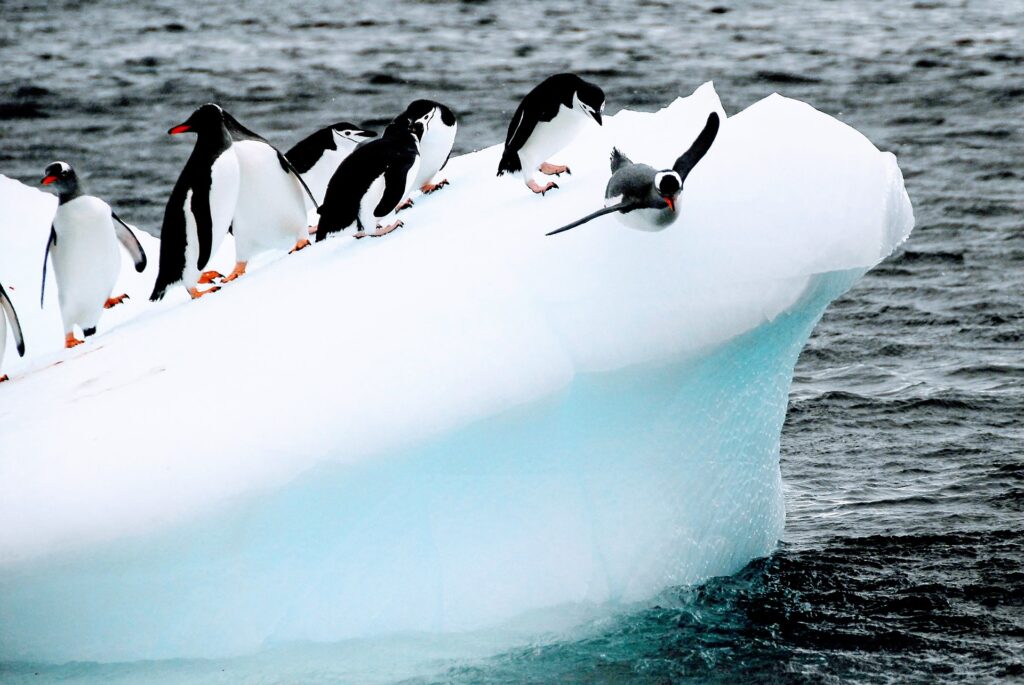
Cross the Drake Passage — the most violent ocean crossing on earth, where the Atlantic, Pacific, and Southern Oceans collide — and earn your arrival the way every explorer before you earned theirs, through two days of swells that test whether you meant it. Sight land as a white horizon that slowly resolves into mountains, glaciers, and a silence so total it recalibrates your hearing. Watch a tabular iceberg the size of a city drift past with the patience of geological time, its visible surface only ten percent of its mass — ninety percent invisible, holding the structure from below. Step onto the continent and stand among colonies of gentoo and chinstrap penguins who regard you with mild curiosity because in their entire evolutionary history they have never had reason to fear a terrestrial predator. Zodiac through icebergs sculpted by wind and current into shapes that no architect would attempt, past leopard seals draped on ice floes and humpback whales breaching in water so cold and clear that the blue of the ice beneath the surface is a color that does not exist anywhere else on the planet. Visit a research station where scientists drill ice cores that contain air bubbles trapped eight hundred thousand years ago — each bubble a sealed sample of the atmosphere from a world no human ever saw — and understand that the climate data being extracted from this ice is the evidence on which the future of civilization depends. Stand at a place where the treaty says you are in no country, subject to no sovereignty, surrounded by nothing that any nation can claim, and feel what it is like to be on earth without being on anyone’s territory.
Evolve — Who You Become in Antarctica
You leave Antarctica understanding that the most advanced thing humanity has ever done is not build a city, launch a satellite, or split an atom — it is agree to leave something alone. The Antarctic Treaty is the only document in history where rival nations looked at unclaimed land and said: this belongs to science, not to us. That agreement has held for over sixty years through wars, regime changes, economic crises, and the discovery of mineral deposits worth trillions — and still, no one has broken it. Shackleton’s expedition failed by every metric he set for himself. He never crossed the continent. He lost his ship. He spent two years in ice. And he is remembered not for what he achieved but for what he refused to lose — not a single life. You come home and look at your ambitions, your territory, your claims on the world, and you ask whether the thing you are holding so tightly might be more valuable if you opened your hand. Antarctica taught you that the greatest act of strength is restraint. That the most important discovery is sometimes what you choose not to extract. That an entire continent can exist for sixty years under a single principle — peace and science — and that principle has held because every signatory understood that some things are too important to own. The ice holds its memory. The treaty holds its promise. What are you willing to leave untouched so that it can remain what it is?
Your practical guide to Antarctica starts bellow 👇
🕰️ Antarctica Historical Backdrop
Antarctica’s history is a legendary epic of human endurance and international cooperation. Unlike any other landmass, it has no indigenous population. Its story began with the “Heroic Age of Antarctic Exploration,” defined by the daring expeditions of Shackleton, Scott, and Amundsen, who tested the limits of human survival in a race to the South Pole. In 1959, the Antarctic Treaty was signed, establishing the continent as a scientific preserve where military activity is banned and no country holds recognized sovereignty. Today, it remains the only place on Earth where human presence is temporary and governed by a shared mandate for peace and discovery. It is a land that belongs to no one and everyone—a living laboratory that holds the history of our atmosphere trapped in its ice cores.
🌟 The Antarctic Experience
Beyond the “bucket list” checkmark, discover Antarctica’s soul in the absolute silence that exists outside of human civilization. Experience the profound “Scale Shift”—the moment you realize a single iceberg can be the size of a city—and the exhilarating vulnerability of being at the mercy of the Drake Passage. Witness the chaotic, ammonia-scented energy of a penguin colony, the haunting grace of a humpback whale breaching in a field of brash ice, or the surreal experience of a “Polar Plunge” into sub-zero waters. These moments reveal a world where nature is not a backdrop, but the absolute master of the narrative.
🌄 Antarctica Natural Wonders & Landscapes
- The Lemaire Channel: Known as “Kodak Gap,” a breathtakingly narrow passage between towering cliffs and steep glaciers.
- Deception Island: A flooded volcanic caldera where ships can sail directly into the center of a volcano, featuring geothermal black sand beaches.
- The Dry Valleys: One of the most extreme deserts on Earth, where low humidity and high winds have prevented snow and ice for millions of years.
- Blood Falls: A bright red plume of saltwater flowing from the Taylor Glacier, caused by ancient iron-rich subglacial brine.
- Mount Erebus: The world’s southernmost active volcano, famous for its persistent lava lake.
- The Ross Ice Shelf: A massive floating sheet of ice the size of France, representing the titanic scale of the Antarctic ice cap.
📍 Antarctica Key Landing Sites & Research Hubs
- Neko Harbour: One of the rare spots where you can set foot on the Antarctic mainland, surrounded by a massive glacier and Gentoo penguins.
- Port Lockroy: Home to the “Penguin Post Office,” a historic British base that is now a museum and the most southerly operational post office.
- McMurdo Station: The largest community in Antarctica, a high-tech US research hub that feels like a frontier mining town.
- South Shetland Islands: Often the first stop for expeditions, home to diverse wildlife and numerous international research stations.
- The South Pole (Amundsen–Scott Station): The literal bottom of the world, accessible only by specialized fly-in expeditions.
🏞️ Antarctica Conservation & Governance
Travel to Antarctica is strictly regulated to preserve its pristine state.
- IAATO (International Association of Antarctica Tour Operators): The industry body ensuring safe and environmentally responsible private-sector travel.
- The Antarctic Treaty System: The international legal framework that governs the continent’s use for peaceful, scientific purposes.
- Secretariat of the Antarctic Treaty: Providing resources on environmental protection and tourism regulations.
🏛️ Historical Sites (Antarctic Heritage)
- Shackleton’s Hut (Cape Royds): Perfectly preserved by the cold, looking exactly as it did when the explorer left in 1909.
- Scott’s Hut (Cape Evans): A poignant time capsule of the ill-fated Terra Nova expedition.
- Mawson’s Huts: The base of the Australasian Antarctic Expedition, located in the windiest place on Earth.
🐧 Antarctica Wildlife Encounters
- Penguins: Adélie, Chinstrap, Gentoo, and the elusive, majestic Emperor Penguin.
- Whales: Humpback, Minke, Fin, and the apex predator of the southern oceans—the Orca.
- Seals: Weddell, Crabeater, Fur, and the formidable Leopard Seal.
- Seabirds: The Wandering Albatross (with the largest wingspan on Earth) and the scavengers of the south, the Skuas.
🧽 Antarctica Expedition Logistics
- 🚢 By Sea (Expedition Cruise)
- The most common way to visit. Most ships depart from Ushuaia, Argentina or Punta Arenas, Chile.
- The Drake Passage: A 48-hour crossing that can be “Drake Lake” (calm) or “Drake Shake” (stormy).
- ✈️ By Air (Fly-Cruise)
- Some operators offer flights from Punta Arenas to King George Island to skip the Drake Passage, joining the ship directly in Antarctica.
- 🧊 Seasonal Window
- November: Early season; giant icebergs and pristine snow.
- December – January: Peak summer; 20+ hours of daylight and penguin chicks hatching.
- February – March: Late season; best time for whale watching and receding ice allowing further southern penetration.
📶 Stay Connected
- Satellite Link: Most modern expedition ships offer Starlink Wi-Fi. Connection is generally stable but can be affected by the ship’s latitude and high-rimmed fjords.
- Digital Detox: Many travelers choose to disconnect entirely to fully immerse themselves in the environment.
- Research Stations: Do not have public Wi-Fi; visitors must rely on their ship’s infrastructure.
🏨 Where to Stay
Accommodation in Antarctica is almost exclusively on your expedition vessel.
- White Desert Antarctica: Offers the rare experience of staying at a luxury land-based “pod” camp on the interior ice cap.
- Expedition Ships: Range from rugged, ice-strengthened research-style vessels to ultra-luxury “Six-Star” yachts with helicopters and submarines.
- Camping: Some expeditions offer a “one-night-only” opportunity to sleep in a bivy sack on the ice—an unforgettable way to experience the Antarctic night.
🤝 Antarctica Environmental & Cultural Protocol
- The 5-Meter Rule: You must maintain a minimum distance of 5 meters from all wildlife. If an animal approaches you, remain still.
- Bio-Security: You must vacuum your clothes and wash your boots in a Virkon-S solution before and after every landing to prevent the introduction of non-native species.
- Leave No Trace: Absolutely nothing—not even an apple core—can be left on the continent. Everything that goes in must come out.
- The “Antarctic Ambassador” Oath: Visitors are encouraged to return home as advocates for the continent’s protection.
🛂 Antarctica Permits & Requirements
- No Visas: Antarctica has no visa requirements, but you must have a valid passport for the country of departure (Argentina/Chile).
- Operator Permits: Your travel company must hold a permit issued by their national authority (e.g., the US State Department or British Foreign Office).
- Travel Insurance: Specialized insurance covering high-cost emergency medical evacuation (minimum $200k+) is mandatory for all expeditions.
💰 Practical Essentials
- Currency: There is no currency. Ships are cashless (accounts settled by credit card). The Port Lockroy shop accepts USD, GBP, and EUR.
- Gear: Layers are essential. Most operators provide a waterproof parka, but you will need your own base layers (merino wool), waterproof trousers, and high-quality gloves.
- Safety: The primary danger is the extreme and rapidly changing weather. Always follow the Expedition Leader’s instructions.
✨ Bonus Tip: The Art of Presence
To truly embrace Antarctica, you must practice “Active Looking.” Don’t spend the entire trip behind a camera lens. Put the phone away for at least one full hour during every zodiac cruise. Listen to the “bergy bits” fizzing as ancient air bubbles escape the melting ice. This is the sound of the atmosphere from thousands of years ago. It is in this sensory, unrecorded connection that the true, transformative weight of the continent—its fragility and its power—will finally settle in your soul.
🔗 Featured Links
- Official IAATO Visitor Guide: IAATO Website.
- Antarctic Heritage Trust: Preserving the Huts.

Beyondia
Trusted Travel CompanionReal digital nomad. I travel. I learn. I grow.
What about you? Where are you going?