GoBeyondia Atlas 🗺️ Middle-East Silk-Road 🗾
Azerbaijan: Where flames have been rising from the earth for millennia and an entire religion was born from the worship of them, the world’s first oil well was drilled thirteen years before Pennsylvania’s, and the eternal flame at the holiest fire temple went out in 1969 because the same gas that fed it for centuries was pumped away to fuel an industry — a country that calls itself the Land of Fire and had to choose between keeping the fire sacred and selling what made it burn.
Azerbaijan in 30 Seconds
A country on the western shore of the Caspian Sea where the ground has been burning for as long as anyone can remember. Natural gas seeps through porous rock across the Absheron Peninsula, and wherever it meets air and spark, fire rises — from hillsides, from sea mud, from cracks in the earth. These flames helped birth Zoroastrianism, one of the world’s oldest monotheistic religions, which saw fire as the link between humanity and the divine. Marco Polo wrote about them in the thirteenth century. Silk Road merchants carried stories of a burning land to India, and Hindu and Sikh pilgrims walked to Baku to worship at the Ateshgah — the Fire Temple — where natural flames burned from a gas vent at the center of a pentagonal courtyard for centuries without interruption. In 1846, thirteen years before Edwin Drake drilled in Pennsylvania, the world’s first mechanically drilled oil well struck crude at Bibi-Heybat, twenty-one meters deep. The Nobel brothers arrived, built the world’s first oil tanker, and by 1894 Azerbaijan’s production equaled that of the entire United States. By 1969, the intensive extraction of natural gas had depleted the underground pressure so completely that the eternal flame at Ateshgah went out. The temple is now a museum. The flame is fed by a pipe from the city’s gas main. The Land of Fire sold its fire.
Evoke — Why You Visit Azerbaijan
You come to Azerbaijan because you have been monetizing the thing that made you original, and you need a country that shows you what happens when the transaction is complete. This is where fire rising from the earth inspired a religion, drew pilgrims across continents, gave a country its name and its identity — and then the same country drilled into the source of that fire, extracted it, sold it, and watched the sacred flame die. Not through carelessness but through logic: the gas was worth more as fuel than as worship. The oil made Baku one of the richest cities in the Russian Empire, built mansions for Nobel brothers and local oil barons, funded an architectural golden age — and extinguished the spiritual foundation that had given the place meaning for millennia. You come because you recognize this story. You have watched companies monetize the culture that made them beloved. You have watched artists sell the rawness that made them authentic. You have watched yourself optimize the thing that once made you interesting until the flame went out and a pipe from the mains had to replace it. Azerbaijan is not a cautionary tale. It is a mirror.
Explore — How You Experience Azerbaijan
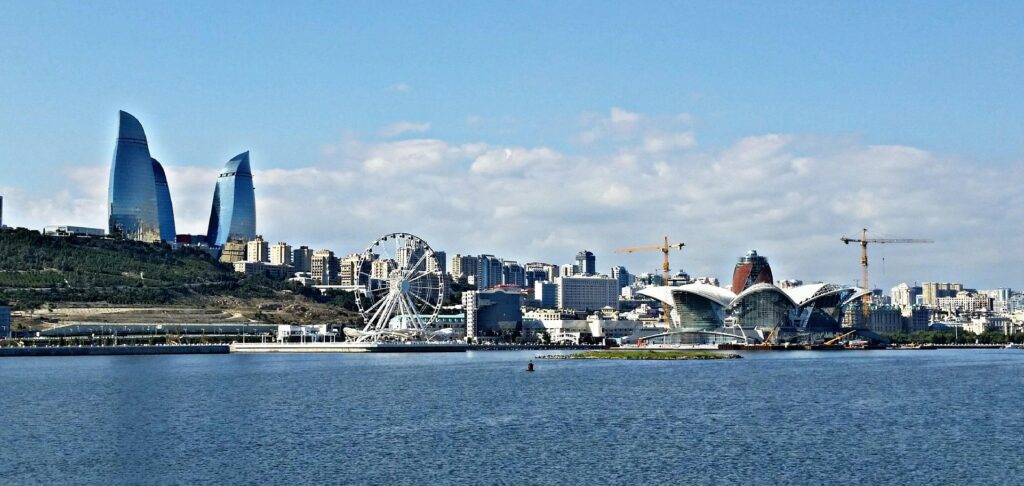
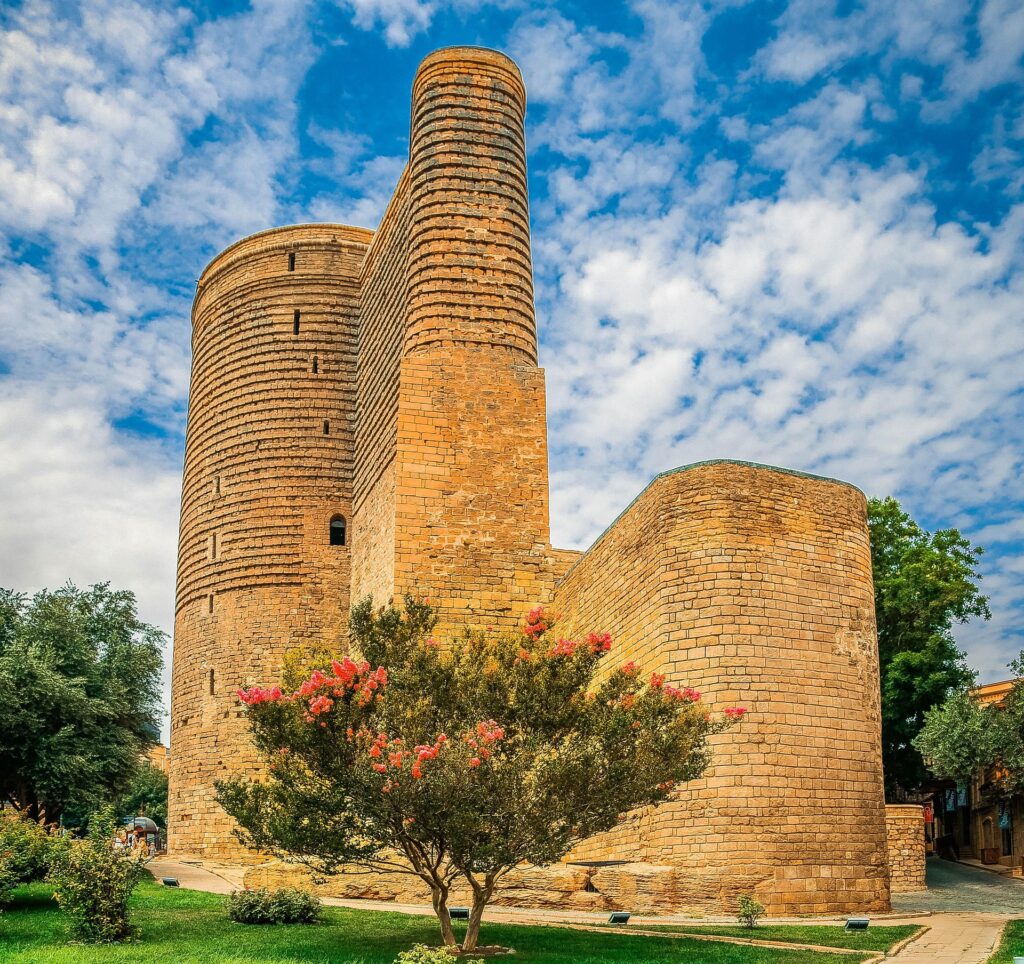
Walk the walled Old City of Baku — Icheri Sheher — where the twelfth-century Maiden Tower rises from medieval streets that have survived Mongols, Persians, Ottomans, Russians, and Soviets, then step outside the walls and see the Flame Towers, three skyscrapers shaped like tongues of fire, covered in LED screens that display rolling flames at night — the modern country’s answer to the eternal fires it can no longer sustain naturally. Drive to the Ateshgah Fire Temple in Surakhani and stand in the pentagonal courtyard where Hindu ascetics once meditated on beds of caustic quickite beside natural flames, where inscriptions in Sanskrit, Persian, and Gurmukhi record centuries of devotion from three different faiths drawn to the same burning ground — and where the central altar now lights on command from a gas pipe because the original flame died the year humans landed on the moon. Visit Yanar Dag, the Burning Mountain, where a ten-meter wall of fire still rises naturally from a hillside — one of the last natural flames in a country that once had hundreds — allegedly ignited when a shepherd tossed a cigarette in the 1950s, burning ever since because the gas has not yet been tapped. Drive south to Gobustan, where over six thousand petroglyphs carved into rock by humans between five thousand and forty thousand years ago depict hunting scenes, ritual dances, and boats — a UNESCO World Heritage site surrounded by mud volcanoes that bubble and hiss with the same subterranean forces that feed the fires, because in Azerbaijan the ground itself has never been quiet. Then return to Baku and sit on the boulevard along the Caspian at sunset, where the city performs its contradiction in real time — ancient fire temple behind you, oil derricks on the horizon, Flame Towers above you lit by electricity, the smell of natural gas occasionally drifting in from the peninsula, and the knowledge that everything beautiful about this place came from the same source as everything profitable.
Evolve — Who You Become in Azerbaijan
You leave Azerbaijan understanding that the resource and the sacred are often the same thing — and that the decision to extract one kills the other. The pilgrims who walked to Ateshgah came for fire that rose without human effort, a flame that needed nothing but the earth’s own breath. The moment that breath was redirected into pipelines, the flame became a museum exhibit and the pilgrimage became tourism. This is not a tragedy unique to Azerbaijan. It is the story of every founder who scaled the thing that made them different until it became the thing that made them the same. Every musician who polished the rawness out of their sound. Every city that demolished the neighborhood that gave it character to build the development that gave it revenue. You come home and look at whatever is burning in your work — the passion, the voice, the original impulse — and you ask: am I feeding it or extracting it? The Land of Fire still has fire. Yanar Dag still burns. But most of the flames are gone, and the ones that remain are accidents, not temples. Guard what burns naturally. The pipe from the mains is never the same.
Your practical guide to Azerbaijan starts bellow 👇
🕰️ Azerbaijan Historical Backdrop
Azerbaijan’s history is a compelling narrative of fire, faith, and strategic energy. Long a vital crossroads of the Great Silk Road, the nation has been shaped by its Zoroastrian roots—where natural gas vents inspired ancient fire-worship—and the subsequent influences of Persian, Turkic, and Russian empires. Its story is told in the medieval “Old City” of Baku, the 19th-century mansions built by the world’s first oil barons, and the sleek, fluid lines of the Heydar Aliyev Center. Having navigated a complex 20th-century path through the Soviet era to its vibrant independence in 1991, Azerbaijan stands today as a bridge between East and West. It is a nation that has successfully audited its rich past to fund a high-margin, futuristic vision, preserving a land where the resilience of the flame serves as the ultimate metaphor for the national spirit.
🌟 Azerbaijan Local Experiences
Beyond the “Paris of the East,” discover Azerbaijan’s soul in the ritual of the Chay (tea)—served in pear-shaped armudu glasses with lemon and fruit preserves, acting as a catalyst for slow conversation and hospitality. Experience the profound stillness of the mud volcanoes at dawn, the exhilarating scent of wild mountain thyme in the Greater Caucasus, or the simple joy of sharing a Shah Plov (King Pilaf) in a traditional caravanserai. Whether it’s witnessing the intricate weaving of a Shirvan carpet or exploring the “Burning Mountain” of Yanar Dag, these moments reveal a nation that finds strength in its dualities: the high-speed energy of the city and the timeless, rhythmic peace of the rural highlands.
🌄 Azerbaijan Natural Wonders
- Mud Volcanoes: Azerbaijan is home to nearly half of the world’s mud volcanoes, bubbling, extraterrestrial landscapes located primarily in the Gobustan region.
- Yanar Dag (Burning Mountain): A natural gas fire that has been burning continuously for millennia on a hillside on the Absheron Peninsula.
- The Greater Caucasus: A majestic mountain range offering alpine meadows, hidden villages like Khinalug, and dramatic peaks.
- The Caspian Sea: The world’s largest inland body of water, defining the country’s climate and coastal identity.
- Lake Goygol: A stunning, deep blue mountain lake formed by a 12th-century earthquake, surrounded by dense forests.
- Candy Cane Mountains: Unique, shale-colored hills in the Khizi district that resemble giant sticks of candy due to groundwater oxidation.
🏙️ Azerbaijan Must-See Cities & Regions
- Baku: (Capital) A sophisticated metropolis where the UNESCO-listed Icherisheher (Old City) meets the futuristic architecture of Zaha Hadid. (Modern, Historic, Coastal)
- Sheki: A historic Silk Road hub famous for its stained-glass palace, cobblestone streets, and traditional silk weaving. (Historic, Artisanal, Scenic)
- Gabala: A premier mountain resort destination offering ancient ruins, cable cars, and lush green forests. (Alpine, Adventurous, Lush)
- Ganja: The country’s second city, known for its red-brick architecture, the Bottle House, and its role as the birthplace of the poet Nizami. (Historic, Cultural, Traditional)
- Quba: A gateway to the northern mountains, famous for its apple orchards, carpet weaving, and the unique Jewish settlement of Red Village. (Scenic, Cultural, Highland)
🏞️ Azerbaijan National Parks & Nature Reserves
Managed with an emphasis on protecting unique biodiversity by the Ministry of Ecology and Natural Resources.
- Gobustan National Park: A UNESCO site featuring more than 6,000 prehistoric rock carvings and the famous mud volcanoes.
- Shahdag National Park: The largest national park in Azerbaijan, home to the country’s highest peaks and premier ski resorts.
- Shirvan National Park: A semi-desert reserve famous for its gazelles and diverse birdlife.
🏛️ UNESCO World Heritage Sites
- Walled City of Baku with the Shirvanshah’s Palace and Maiden Tower — The historic core of the capital reflecting architectural influences from Zoroastrian to Russian.
- Gobustan Rock Art Cultural Landscape — Documenting 40,000 years of rock art and human settlement.
- Historic Centre of Sheki with the Khan’s Palace — A testament to the city’s role as a major silk trade center.
- Hyrcanian Forests — Shared with Iran, these ancient forests are a refuge for many globally threatened species.
- For more information, visit the UNESCO Azerbaijan Portal.
🖼️ Azerbaijan Museums & Galleries
- Heydar Aliyev Center (Baku): A world-renowned fluid architectural masterpiece housing cultural exhibits and contemporary art.
- Azerbaijan National Carpet Museum (Baku): Housed in a building shaped like a rolled carpet, featuring the world’s largest collection of Azerbaijani carpets.
- National Museum of History of Azerbaijan: Located in the former mansion of oil magnate Zeynalabdin Taghiyev.
🎉 Azerbaijan Festivals & Celebrations
- Novruz Bayrami: (March) The most significant national holiday celebrating the Persian New Year and the arrival of spring with bonfires and traditional sweets like Pahklava.
- Baku Jazz Festival: (October) A world-class event highlighting Azerbaijan’s unique “Jazz-Mugham” fusion.
- Goychay Pomegranate Festival: (November) A vibrant harvest festival celebrating the “King of Fruits” in the region of Goychay.
- Formula 1 Azerbaijan Grand Prix: (Variable) One of the fastest street circuits in the world, weaving through the heart of Baku.
🧽 How to Arrive
- ✈️ By Air
- Heydar Aliyev International (GYE) in Baku is the primary gateway, frequently voted the best airport in Central Asia/CIS.
- Airlines: Azerbaijan Airlines (AZAL) and major international carriers (Turkish Airlines, Qatar Airways, Lufthansa, Emirates) connect Baku to the world.
- 🚢 By Sea
- The Port of Baku offers ferry and cargo connections across the Caspian Sea to Aktau (Kazakhstan) and Turkmenbashi (Turkmenistan).
- 🚗 By Road
- Azerbaijan shares land borders with Georgia, Turkey, Iran, and Russia. (Note: Land borders can be subject to closures; always check current status). Driving is on the right.
📶 Stay Connected
- SIM Cards: Major providers are Azercell, Bakcell, and Nar.
- Where to buy: Official stores are abundant in Baku city center and at the airport. Registration with a passport is mandatory.
- eSIM: Supported by Azercell and Bakcell; also available via international platforms like Airalo.
- Connectivity: High-speed Wi-Fi is standard in Baku, though remote mountain villages like Khinalug offer a true “unplugged” experience.
🏨 Where to Stay
Azerbaijan offers everything from ultra-luxury “Flame Tower” suites to historic caravanserais and mountain eco-lodges.
- Four Seasons Hotel Baku: A neoclassical landmark on the Caspian waterfront.
- Fairmont Baku, Flame Towers: Offering panoramic views from the city’s most iconic modern structure.
- Sheki Karvansaray Hotel: Stay in an authentic 18th-century Silk Road trading post.
- Shahdag Mountain Resort: For a high-altitude luxury experience in the Caucasus.
⛳ Unique Finds
- Naftalan Oil Baths: Visit the town of Naftalan to experience “therapeutic” crude oil baths—a unique medical tourism legacy.
- Diri Baba Mausoleum: A 15th-century two-story monument built into a cliff, an architectural mystery of the Maraza region.
- Sheki Halva: Taste the unique, sugary nut-and-rice-flour dessert that is the pride of Sheki.
- Baku’s Little Venice: A charming system of man-made waterways in the seaside park where you can ride gondolas.
🤝 Azerbaijan Cultural Guidance
- Hospitality: A guest is seen as a blessing. If offered tea, it is polite to accept at least one glass.
- Tea Etiquette: Do not add sugar directly to the tea; traditionally, you dip a sugar cube into the tea and then place it under your tongue or between your teeth while drinking.
- Dress Code: Baku is very modern and liberal, but dress modestly (shoulders and knees covered) when visiting mosques or rural, traditional villages.
- Basic Phrases:
- Hello: “Salam”
- Thank you: “Chokh sag olun” (Chok sah-ol-un)
- Please: “Ze hmet olmasa”
- Cheers: “Nush olsun!” (May it be nourishing)
🛂 Azerbaijan Entry & Visa Requirements
- ASAN Visa: Most nationalities can apply for a 30-day e-visa via the official ASAN Visa Portal.
- Official Source: Consult the State Migration Service of Azerbaijan.
💰 Practical Essentials
- Currency: Azerbaijani Manat (AZN). Cards are widely accepted in Baku, but cash is essential for rural markets and taxis.
- Electricity: Type C and F (Two round pins). Voltage is 230V.
- Safety: Azerbaijan is very safe for travelers with a low crime rate.
- Climate: Diverse (9 out of 11 climate zones). Best visited in Spring (April-June) for nature or Autumn (September-October) for mild weather and harvest.
✨ Bonus Tip: The Tectonic Analogy
To truly embrace Azerbaijan, you must understand the “Flame and the Mud.” One represents the vertical ambition of the city—reaching for the sky with steel and light. The other represents the primal, bubbling earth of the volcanoes—raw, messy, and ancient. Don’t just stay in the glass towers of Baku. Go to Gobustan and touch the cold mud. It is in this balance between human achievement and the untamed power of the earth that the true, transformative magic of the country reveals itself. Azerbaijan is a lesson in how a nation can be both a high-margin modern success and a deeply grounded ancestral home.
🔗 Featured Links
- Official Tourism: Experience Azerbaijan.
- Visa Application: ASAN Visa Official.

Beyondia
Trusted Travel CompanionReal digital nomad. I travel. I learn. I grow.
What about you? Where are you going?