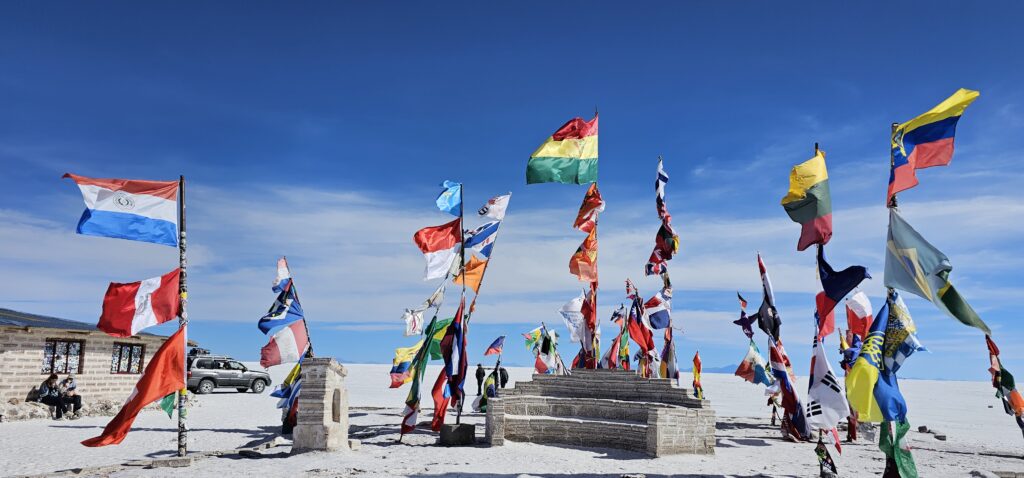
Bolivia: Where the salt flats mirror infinity and the altitude reminds you that your body is just a guest.
Bolivia in 30 seconds
A country so high above sea level that the clouds arrive at eye level and the air requires negotiation. La Paz sits in a canyon below El Alto at 3,600 meters — a city that spills down steep hillsides in a chaos of red brick, cholita women in layered skirts and bowler hats, and cable cars that function as public transit across a topography that defeated conventional urban planning. The Salar de Uyuni is 10,000 square kilometers of salt flats left by a prehistoric lake that evaporated and forgot to apologize — the world’s largest mirror when the rains come, the world’s most disorienting landscape when they don’t. The Amazon basin begins in Bolivia’s north, descending from the altiplano in a drop so dramatic that ecosystems stack on top of each other — cloud forest, subtropical valley, jungle — within a few hours of driving. Lake Titicaca sits on the Peruvian border at 3,800 meters, its deep blue water inexplicable at this altitude, the Uros people’s floating reed islands even more so. Bolivia is the poorest country in South America by most economic measures and one of the richest by every measure that economics hasn’t learned to count yet.
Evoke – Why You Visit Bolivia
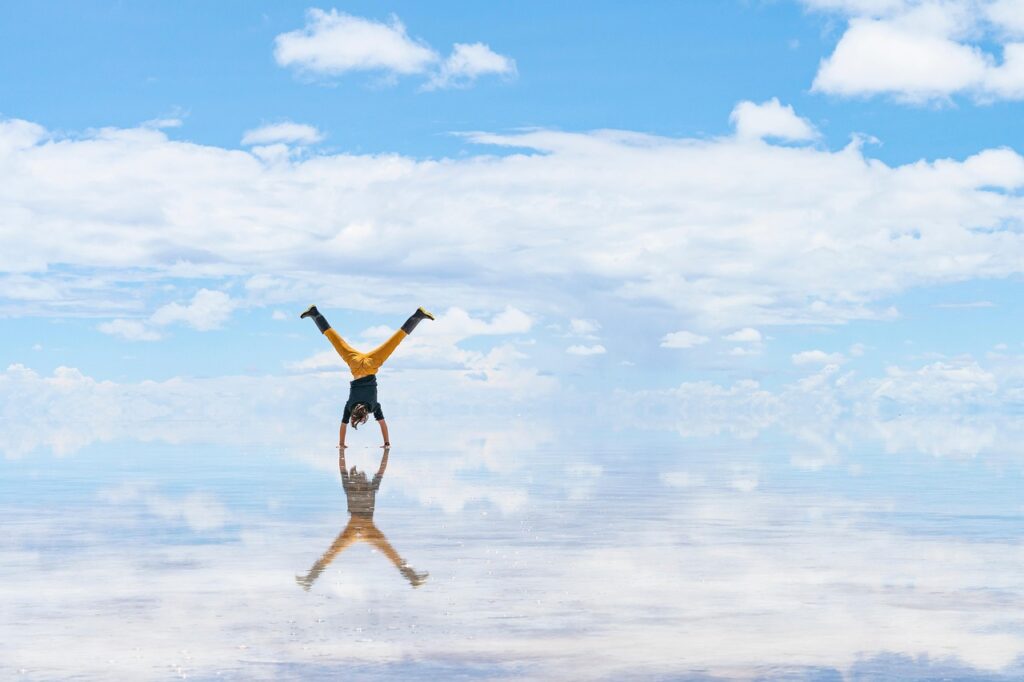
You come to Bolivia because your sense of scale has been broken by too much comfort. You’ve been moving through a world that fits — that was designed for your dimensions, your pace, your expectations of what a place should offer and how it should behave. Bolivia doesn’t fit. The altitude makes your heart work harder than you asked it to. The landscape operates at a magnitude that makes your problems feel appropriately sized for the first time in years. You need to stand on the Salar de Uyuni at the precise moment the thin layer of water turns the entire horizon into a reflection and understand — physically, in your chest — that there are places on this earth that were not made for you but will accept you anyway, briefly, if you arrive with sufficient humility. You came here because you’d forgotten what it felt like to be small. Bolivia will remind you. It will mean it as a compliment.
Explore – How You Experience Bolivia
Take the cable car across La Paz at dusk when the city’s lights begin competing with the last of the sunset and the canyon below transforms from chaotic to cinematic in the space of ten minutes. Walk through the Witches’ Market on Calle Linares where dried llama fetuses hang alongside herbs and amulets and the line between tradition and transaction is deliberately blurred, as it has been for centuries. Drive the Death Road — the Yungas Road — by mountain bike, descending 3,500 meters from the altiplano into the cloud forest in a single terrifying morning that ends in jungle warmth so sudden it feels like a different planet. Arrive at the Salar de Uyuni at 4am and wait for sunrise on salt that stretches to every horizon identically, the dawn arriving without any of the landscape features that normally give it context, just light expanding across white until the sky and ground become the same conversation. Visit Potosí and its Cerro Rico — the mountain that bankrolled the Spanish Empire for two centuries while killing the miners who worked it, a history so brutal and so recent that the silver still feels like it carries weight beyond its market price. Eat salteñas — Bolivia’s morning pastry, a stuffed dough pocket with a sweet and spicy filling that leaks catastrophically if you don’t eat it at the correct angle — standing at a street cart in La Paz before the city fully wakes up.
Evolve – Who You Become in Bolivia
You leave Bolivia with altitude sickness that clears in three days and a perspective recalibration that doesn’t. You stop apologizing for wanting things that matter. Bolivia is a country of extraordinary resource wealth — lithium, silver, gas — that has spent centuries watching those resources extracted by others, and it carries that knowledge without bitterness, which is the most dignified response to an impossible situation and the one you least expected to find instructive. You develop a new relationship with effort — the altitude taught you that the same actions require more at elevation, that your body’s complaints are information rather than excuses, and that arrival feels different when the approach was genuinely hard. You carry the Salar with you longest — that particular silence of standing in the center of the world’s largest mirror and being reflected back at yourself against a sky that goes on without apparent limit. You started the trip looking for scale. You found it. You’re not sure you were ready. You went anyway. That’s the whole lesson.
Your practical guide to Bolivia starts bellow 👇
🕰️ Bolivia Historical Backdrop
Bolivia’s history is a soaring epic of high-altitude civilizations and a fierce, enduring spirit of independence. Long before the Spanish arrived, the Tiwanaku culture flourished near Lake Titicaca, leaving behind megalithic mysteries that still baffle archeologists. The region later became the “Upper Peru” of the Inca Empire before the silver riches of Potosí turned it into the economic engine of the Spanish Empire—at a tragic human cost. Its story is told in the baroque carvings of its “White City,” the multi-colored textiles of the Altiplano, and the revolutionary fervor of a people who have consistently fought for social justice and indigenous recognition. Through centuries of exploitation and political shifts, what endures is an unparalleled dedication to Pachamama (Mother Earth), a vibrant mosaic of 36 recognized indigenous cultures, and a raw, unfiltered authenticity. This is a land where every coca leaf offering, every colonial plaza, and every cloud-piercing peak whispers tales of a civilization that refuses to be silenced by the passage of time.
🌟 Bolivia Local Experiences
Beyond the iconic salt flats, discover Bolivia’s soul in the scent of ceremonial incense at the Witches’ Market, the rhythmic stomping of dancers during a highland entrada, or the thin, crisp air of a sunrise over Lake Titicaca. Experience the dizzying heights of the world’s highest administrative capital, witness the strength of the “Cholita” wrestlers in El Alto, or navigate the serpentine rivers of the Madidi Amazon. These are the textures, shared moments, and profound connections that reveal Bolivia’s unique spirit, inviting you to connect with its enduring mysticism and vibrant, earth-bound authenticity.
🌄 Bolivia Natural Wonders
- Salar de Uyuni: The world’s largest salt flat, a vast expanse of nearly 11,000 square kilometers of prehistoric salt, creating otherworldly reflections and hexagonal patterns.
- Lake Titicaca: The highest navigable lake in the world, sacred to the Incas and home to the Sun and Moon islands.
- Laguna Colorada: A shallow salt lake in the Altiplano known for its blood-red waters and thousands of Andean flamingos.
- The Yungas Road: Traditionally known as the “Death Road,” this dramatic descent from the Andes to the Amazon offers breathtaking ecological transitions.
- Madidi National Park: One of the most biodiverse protected areas on the planet, stretching from glacier-capped peaks to tropical rainforests.
- Valley of the Moon (Valle de la Luna): A unique geological area near La Paz with lunar-like clay spires and labyrinthine formations.
🏙️ Bolivia Must-See Cities
- La Paz: (Administrative Capital) A city that defies gravity, set in a massive bowl surrounded by the Andes, known for its innovative Mi Teleférico cable car system and vibrant street life. (Vertical, Chaotic, Iconic)
- Sucre: (Constitutional Capital) The “White City,” a UNESCO World Heritage site celebrated for its beautifully preserved Spanish colonial architecture and relaxed pace. (Elegant, Historic, Colonial)
- Potosí: Once one of the wealthiest and highest cities in the world due to its silver mines, now a poignant UNESCO site reflecting imperial history. (Historic, Mining, High-Altitude)
- Santa Cruz de la Sierra: The tropical, modern engine of Bolivia’s economy, offering a stark contrast to the Altiplano with its lush surroundings and nightlife. (Modern, Tropical, Energetic)
- Copacabana: A charming town on the shores of Lake Titicaca, the primary gateway for pilgrimages to Isla del Sol. (Lakeside, Spiritual, Scenic)
🏞️ Bolivia National Parks & Nature Reserves
- Madidi National Park: A premier destination for wildlife enthusiasts, covering over 1.8 million hectares.
- Eduardo Avaroa Andean Fauna National Reserve: Home to spectacular colored lagoons, geysers, and unique high-altitude ecosystems.
- Noel Kempff Mercado National Park: A remote UNESCO site in the Amazon basin featuring dramatic tepui plateaus and massive waterfalls.
- Sajama National Park: Bolivia’s first national park, featuring the country’s highest peak and ancient Polylepis forests.
🏛️ UNESCO World Heritage Sites
- City of Potosí — An industrial monument to the Spanish silver trade.
- Jesuit Missions of the Chiquitos — Six remote settlements reflecting a unique fusion of Catholic and local cultures.
- Historic City of Sucre — The pristine example of a colonial capital.
- Tiwanaku: Spiritual and Political Centre of the Tiwanaku Culture — A pre-Inca ceremonial complex of massive stone monoliths.
- Fuerte de Samaipata — A colossal carved rock hill that served as a religious site for multiple cultures.
- For a complete list, visit the official UNESCO World Heritage Convention – Bolivia.
🖼️ Bolivia Museums & Galleries
- Museo Nacional de Arte (La Paz): Housed in a stunning 18th-century palace, featuring colonial to contemporary Bolivian art.
- Casa Nacional de la Moneda (Potosí): The historic Royal Mint, one of the most important museums in South America.
- Museo de Etnografía y Folklore (MUSEF, La Paz): An excellent exploration of Bolivia’s diverse cultural heritage and traditional textiles.
- ASUR Museum of Indigenous Art (Sucre): Dedicated to the preservation and display of high-quality Jalq’a and Tarabuco textiles.
🎉 Bolivia Festivals & Celebrations
- Carnaval de Oruro: (February) A UNESCO-recognized masterpiece of oral and intangible heritage, featuring thousands of dancers in the spectacular “Diablada.”
- Fiesta del Gran Poder (La Paz): (May/June) A massive religious festival showcasing the syncretism of Aymara traditions and Catholicism.
- Alasitas Market: (January) A unique festival where people buy miniature versions of things they desire (houses, cars, diplomas) to be blessed by the god of abundance, Ekeko.
- Inti Raymi (Winter Solstice): (June 21) Celebrated at Tiwanaku to welcome the Andean New Year with rituals at sunrise.
🧽 How to Arrive
- ✈️ By Air
- Main International Airports: El Alto International (LPB) (La Paz) and Viru Viru International (VVI) (Santa Cruz). Note: El Alto is one of the highest airports in the world.
- Airlines: Boliviana de Aviación (BoA) (National Carrier), LATAM, Avianca, Copa Airlines.
- Flight search: Skyscanner, Google Flights.
- 🚆 By Rail
- Domestic Lines: Ferroviaria Andina operates scenic routes between Oruro and Uyuni, as well as Villazón (Argentine border).
- 🚗 By Road
- Border Crossings: Accessible from Peru (Desaguadero/Copacabana), Chile (San Pedro de Atacama), Argentina, Brazil, and Paraguay.
- Driving: Roads vary from modern highways to unpaved mountain tracks. Driving is on the right.
📶 Stay Connected
- SIM Cards & Telecom
🏨 Where to Stay
Bolivia offers everything from world-class hotels built entirely of salt to remote jungle lodges and historic colonial mansions.
- Notable Hotel Chains: Atix Hotel (La Paz), Palacio de Sal (Uyuni), Marriott (Santa Cruz).
- Tips: Altitude Acclimatization:
- La Paz: Look for hotels in the lower-altitude “Zona Sur” if you are sensitive to altitude.
- Uyuni: Choose salt hotels for a unique architectural experience.
- Unique Stays:
- Salt Hotels: Built using salt blocks from the Salar, including furniture.
- Isla del Sol Guesthouses: Simple, stunning lodges with no car access, offering ultimate peace.
- Eco-Lodges (Madidi): Remote jungle lodges supporting local indigenous communities.
⛳ Unique Finds
- The Salar Reflection: Witness the “mirror effect” during the rainy season (Jan-March) for celestial photography.
- Cholita Wrestling: See the iconic indigenous women of El Alto demonstrate incredible strength and theatrical skill.
- Witches’ Market (Mercado de las Brujas): Find llama fetuses, dried herbs, and medicinal charms for traditional Aymara rituals.
- Silver Mine Tour (Potosí): A sobering and intense look into the working conditions of miners in Cerro Rico (research reputable guides).
🤝 Bolivia Cultural Guidance
- Altitude (Soroche): Take it seriously. Drink mate de coca, stay hydrated, and rest for 24 hours upon arrival at high altitude.
- Pachamama: Respect local offerings to Mother Earth. Always ask permission before taking photos of people, especially in rural areas.
- Greetings: A soft handshake is standard. Close friends may use a single cheek kiss.
- Tipping Norms: Not mandatory but rounding up is appreciated. In upscale restaurants, 10% is standard.
- Basic Phrases (Spanish / Aymara):
- Hello: “Hola” (Spanish) / “Kamisaraki” (Aymara)
- Thank you: “Gracias” / “Yuspagara”
- Please: “Por favor”
- No problem: “No hay problema”
🛂 Bolivia Entry & Visa Requirements
- Group 1 (Visa-Free): UK, EU, Canada, and many South American nations.
- Group 2/3 (Visa Required): US citizens require a visa (approx. $160) which can be obtained on arrival or at a consulate.
- Official Source: Always check the latest at the Bolivian Ministry of Foreign Affairs (Cancillería).
💰 Practical Essentials
- Currency: Boliviano (BOB). Cash is king; carry small denominations for markets and taxis.
- Electricity: Type A and C. Voltage is 220V (though some areas in La Paz use 115V).
- Safety: Generally safe, but be wary of petty theft in crowded markets and “express kidnappings” in unofficial taxis in La Paz. Use radio taxis.
- Climate: High Altiplano is cold and dry year-round; the Amazon is hot and humid. Best visited May to October (Dry Season).
✨ Bonus Tip
To truly embrace Bolivia, lean into the “thin air.” The altitude isn’t just a physical challenge; it is a mental shift. It forces you to slow down, to breathe consciously, and to notice the sharpness of the light and the depth of the shadows. It is in this forced deceleration that the spiritual depth of the Andes and your own evolving sense of resilience truly reveal themselves.
🔗 Featured Links
- Official Resources:
- National Tourism Board: Bolivia.travel
- Safety & Travel Advisories: Your Country’s Government Travel Advisory for Bolivia.
- Logistics: BOA – Boliviana de Aviación.

Beyondia
Travel CompanionReal digital nomad. I travel. I learn. I grow.
What about you? Where are you going?