Around the World with Beyondia 🧵 Mediterranean Region 🪡 Episode 7
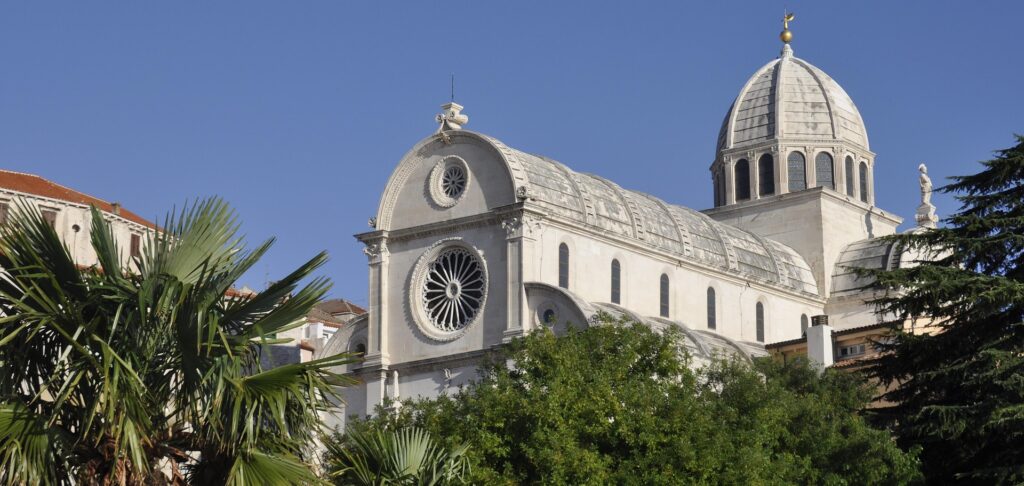
Šibenik’s cathedral took 105 years to build. Every stone carved by hand. No brick, no wood — the only cathedral in Europe made entirely of stone.
Šibenik — Medieval Stone, Tesla’s Electricity
The stone that built the Cathedral of St. James was quarried from the nearby islands — Brač, Korčula, Rab — floated across the Adriatic on barges, and fitted together in place by master masons over the course of a century. Work began in 1431 and ended in 1536. In between, three generations of builders followed a method no European cathedral had used before: prefabricated interlocking stone slabs, cut in workshops and assembled on site without a single nail, beam, or drop of mortar. Five centuries before flat-pack furniture was a concept, Šibenik was already building its roof out of puzzle pieces. The cathedral became a UNESCO World Heritage Site in 2000. The method is still studied by structural engineers who are not entirely sure how it holds up.
The man responsible for most of it was Juraj Dalmatinac — George the Dalmatian — a master builder born somewhere on this coast and buried somewhere near this church. He did not finish the cathedral. He did something more interesting: he carved seventy-four human faces into the exterior walls of its three apses. Real portraits of the citizens of fifteenth-century Šibenik. Merchants, widows, bishops, children, servants. Some handsome. Some tired. One laughing. Several, by any reasonable account, ugly. Tradition holds that the unflattering ones were Juraj’s quiet revenge on the townspeople who had refused to pay their share of the construction. If true, it is one of the earliest public records of civic shaming in European art — a 15th-century tax ledger carved in limestone, installed around the house of God, published for eternity. Most cathedrals of that century showed you saints. This one showed you the neighbours.
Šibenik itself is the one major city on the Dalmatian coast that Croatians actually built. Split was Emperor Diocletian’s retirement palace. Trogir was a Greek trading post. Zadar was Illyrian before it was anything else. Dubrovnik traces itself back to refugees from ancient Epidaurus. But Šibenik was first mentioned, by its own name, in a charter signed by the Croatian king Petar Krešimir IV in the year 1066 — and from that first line in that first document the town has belonged, without interruption, to the people who named it. Everything climbs. The stone streets rise from the harbour to the fortress of St. Michael in a labyrinth of staircases too narrow for cars, too steep for bicycles, designed for feet and donkeys and the particular gold of late afternoon light that turns the whole city the colour of old bread and copper.
There are four fortresses. St. Michael’s above the old town. Barone on the hill behind it. St. John’s behind that. And St. Nicholas, on its own small island at the mouth of the bay — a 16th-century sea fortress so elegant it was added to UNESCO’s list in 2017 as part of the Venetian defensive works that once held this coast. Four fortresses for one small town. In the 15th and 16th centuries, this was what it took to be Croatian and Venetian at the same time, facing Ottoman expansion from the east and Adriatic pirates from the west. The town did not fall. Not once. Not ever.
And then, on the 28th of August 1895, something the fifteenth century could not have imagined happened in Šibenik: the streets lit up. A small hydroelectric plant on the nearby Krka River — Jaruga-1, built on Nikola Tesla’s principles of alternating current — carried electricity into the old town and began powering street lamps. Šibenik became one of the first cities in the world to be lit by AC, just two days after the Niagara Falls plant switched on across the Atlantic. A medieval town built entirely of stone suddenly found itself lit, at dusk, by Tesla’s electricity, flowing in from a river whose waterfalls a bored Roman tourist might once have visited. There is no moral to this story. There is just the fact of it.
Some cities work hard to show you the layers. Šibenik does not bother. The cathedral is up the hill. The fortresses are further up. The four apses hold the seventy-four faces. The waterfalls are inland. Tesla’s light is still on after dark. All of it is simply there, in the same small town, carved and powered and lived in by the same people who have been doing both for a thousand years. You do not need a theory. You just need comfortable shoes.
Nine regions. One hundred and twenty destinations. Three hundred and sixty weeks.
Some cities you visit. Some cities have been watching strangers climb their staircases for a thousand years, and remember every one.

Beyondia
Trusted Travel CompanionReal digital nomad. I travel. I learn. I grow.
What about you? Where are you going?