🌐 Around the World with Beyondia 🧵 Mediterranean Region 🪡 Episode 36: La Rochelle
In 1628, the king of France killed more than three-quarters of a French city’s population to prove a point. The city was La Rochelle. The point was that France would, henceforth, be Catholic.
La Rochelle’s strength as a France Protestant stronghold
In August 1627, an army of approximately twenty-one thousand men commanded by the Cardinal-Duke Armand-Jean du Plessis de Richelieu — chief minister to King Louis XIII, and one of the most consequential political figures of the seventeenth century — arrived outside the walls of the Atlantic port of La Rochelle. The city had been, for the previous three decades, the principal stronghold of the Huguenots — the French Calvinist Protestants — and effectively a self-governing Protestant republic operating inside the territory of the Catholic Kingdom of France. La Rochelle was protected, in theory, by the Edict of Nantes of 1598, which had granted French Protestants freedom of worship and a series of fortified strongholds — places de sûreté — to defend that worship. La Rochelle was the most important of those strongholds. The city had its own walls, its own militia, its own civic government, its own treaty relations with the Protestant powers of northern Europe — England and the Dutch Republic in particular — and its own merchant fleet trading independently of royal control. It had, by the 1620s, become an embarrassment to a French monarchy increasingly committed to political centralisation and religious uniformity. Richelieu, who in his political memoirs called it l’exemple nécessaire — the necessary example — decided that La Rochelle’s continued autonomy was incompatible with the existence of a modern French state. In the spring of 1627 he persuaded Louis XIII to authorise the siege. By August, the army was in position. By December, the city was sealed. The siege lasted fourteen months.
The single most extraordinary feature of the siege was the dyke. La Rochelle’s strength as a Protestant stronghold was its access to the sea: as long as English ships could supply the city from the Atlantic, the city could outlast any land army. Richelieu, who had studied military engineering, ordered the construction of a stone dyke across the entire mouth of La Rochelle’s harbour. The dyke was 1,400 metres long, built of quarried stone and sunken ship hulks, and rose above the water level except for two narrow channels that French warships could close at will. It was completed in approximately seven months between November 1627 and June 1628. The English relief fleet, under the Duke of Buckingham, arrived in October 1627 and failed to break through the dyke. A second English fleet arrived in May 1628 under the Earl of Denbigh and also failed. A third fleet arrived in September 1628 and made one final attempt. It failed too. The dyke held. The English withdrew. La Rochelle was alone. The fortification ranks among the most ambitious pieces of military engineering of the seventeenth century, and its remains are still visible at low tide in the harbour today, four hundred years after Richelieu’s masons laid the last stones.
Inside the walls, the population starved. La Rochelle’s pre-siege population was approximately twenty-eight thousand. By late summer 1628, the city’s food supplies were exhausted. Eyewitness accounts describe people eating leather, candle wax, boiled grass, rats, dogs, cats, and in the final months, according to several sources, the bodies of the dead. The mayor, Jean Guiton — a former merchant ship captain who had been elected after the siege began on the strength of his personal severity — drove a dagger into the council table at the meeting that elected him, declaring that he would use it on anyone, including himself, who proposed surrender. He held the city for nearly fifteen months. On the 28th of October 1628, with approximately five thousand survivors left, Guiton finally surrendered. Of the city’s original population of about twenty-eight thousand, an estimated twenty-two to twenty-three thousand had died of starvation. Approximately five to six thousand survived the siege. The king, who arrived at the city the following day, granted clemency — the survivors were allowed to keep their lives and their property, and were technically permitted to continue practising their Protestant faith. But the city’s autonomy was over. The walls were demolished. The city’s special privileges were revoked. La Rochelle was incorporated, fully and finally, into the Catholic French state.
This is the foundational political fact about La Rochelle and the moment that most casually-informed readers do not carry: the destruction of La Rochelle’s autonomy in 1628 was the single most consequential episode in the consolidation of French absolutism. Before La Rochelle, France was a kingdom containing dozens of semi-autonomous corporate bodies — Protestant cities, aristocratic provinces, parliamentary assemblies, ecclesiastical estates, walled bourgeois towns — that could and frequently did defy royal authority. The wars of religion of the late sixteenth century had nearly torn the kingdom apart; the Edict of Nantes had patched it back together by recognising the legitimacy of these semi-autonomous bodies. After 1628, none of them could defy the crown without the same fate as La Rochelle. The absolutist France of Louis XIV — the France of Versailles, of the Revocation of the Edict of Nantes in 1685, of the persecution of the Camisard Protestants in the Cévennes, of the export of Catholic ultraroyalism across Europe — is unthinkable without the precedent set at La Rochelle. Richelieu was correct in his political assessment. The example was indeed necessary, in the sense that without it, the centralised modern French state would have taken a different and probably weaker form. Whether the example was worth the deaths of twenty-two thousand people in fourteen months is a different question that the seventeenth century did not feel obliged to answer and that the twenty-first century is still negotiating. The article does not propose to resolve it. The article proposes only that the visitor should know what happened, here, in this small Atlantic port, between August 1627 and October 1628.
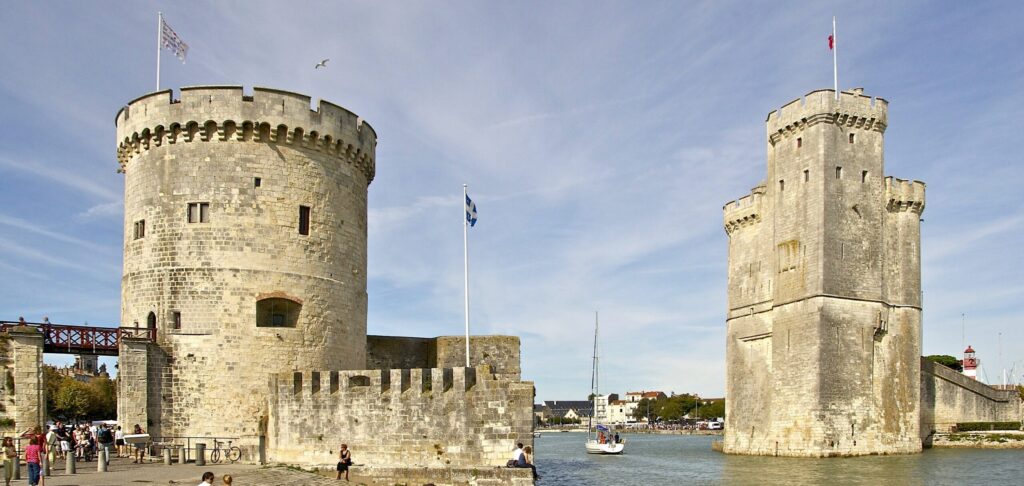
After the siege, La Rochelle rebuilt. Within forty years, it was once again one of France’s most important Atlantic ports — particularly for the transatlantic trade with New France in Canada and the French Caribbean colonies of Martinique, Guadeloupe, and Saint-Domingue. The city’s merchants, now mostly Catholic but still operating with the disciplined commercial culture inherited from the Protestant period, built one of the most successful eighteenth-century shipping economies in France. By the mid-1700s, La Rochelle was the third-largest Atlantic French port, after Nantes and Bordeaux. The city’s elegant arcaded streets — the Rue du Palais, the Rue des Merciers, the Rue Chaudrier — were lined with merchant town houses built in the late seventeenth and eighteenth centuries from the profits of this trade. The City Hall, the Hôtel de Ville, was rebuilt with a flamboyant Renaissance courtyard façade. The Protestant Temple — the city’s first permitted post-revocation Protestant church — was constructed in 1709, two decades after Louis XIV had outlawed Protestantism, on terms that quietly recognised that La Rochelle’s commercial elite was still substantially Calvinist and that suppressing them entirely would damage the king’s tax base. The city’s three medieval towers — the Tour Saint-Nicolas, the Tour de la Chaîne, and the Tour de la Lanterne — survived both the siege and the subsequent demolition of the walls and still guard the entrance to the old harbour, three of the most distinctive medieval maritime structures still standing in France.
A significant portion of the wealth that financed this reconstruction came from a trade the article must name honestly. La Rochelle was a major French slaving port. Between 1643 and 1792, approximately 427 slaving expeditions departed from La Rochelle, transporting an estimated 125,000 enslaved Africans from the West African coast to the French Caribbean colonies, primarily Saint-Domingue (modern Haiti), which by the late eighteenth century was the most profitable slave colony in the world. La Rochelle was the third-largest French slaving port, after Nantes (approximately 1,800 expeditions) and Bordeaux (approximately 500). The trade enriched specific La Rochelle merchant families — the Belin, Carayon, Garesché, Rasteau, and Van Hoogwerff families, among others — whose mansions still line the streets of the old town. The local maritime museum, the Musée d’histoire de La Rochelle and the Musée du Nouveau Monde, both opened in the 1980s, address the trade directly with extensive displays and historical documentation. France formally apologised for its role in the slave trade in 2001 with the Loi Taubira, which declared the transatlantic slave trade a crime against humanity. La Rochelle has installed historical interpretive plaques at several of the merchant houses on the Quai Duperré and elsewhere in the old town. The city’s prosperity in the eighteenth century cannot be separated from the trade that financed it. Any honest account of the architecture the visitor admires today has to acknowledge this. The Evoke article will not omit it.
The contemporary city is one of the most progressive in France. Population approximately seventy-six thousand in the commune, with a metropolitan area of about two hundred and fifteen thousand. The mayor Michel Crépeau, who held office from 1971 to 1999, pioneered an unusually long series of urban environmental initiatives that have since been adopted across France and Europe. In 1976 — thirty-one years before the Vélib’ bicycle-sharing system was launched in Paris in 2007 — La Rochelle introduced the first urban bicycle-sharing scheme in France, with three hundred bicycles distributed across the city for free public use. In 1986, the city introduced one of France’s first fleets of electric municipal cars, which Crépeau called Liselec and which served as one of the early models for what is now widely called “soft mobility.” In 1985, La Rochelle made its old town largely pedestrian-only, decades before similar policies were adopted elsewhere in France. The city’s environmental record extends to its marina — the Port des Minimes, with capacity for approximately 4,500 boats, one of the largest pleasure marinas in Europe — and to the harbour, which still operates as a working fishing port. The annual Francofolies music festival, held every July since 1985, has become one of France’s most important Francophone popular music events, attracting between 80,000 and 150,000 visitors over five days depending on the year. The Festival International du Film de La Rochelle runs every summer, the Grand Pavois boat show every September draws around 80,000 visitors, and the Jazz entre les Deux Tours festival fills the towers’ courtyards with music every October. La Rochelle, in short, has become one of the most cultured, environmentally progressive, and quietly successful medium-sized cities in France — a quality of urban life that consistently places it in the top ten in French quality-of-life rankings.
The Île de Ré, the long narrow island connected to La Rochelle by a 2.9-kilometre bridge completed in 1988, deserves its own paragraph and probably its own article. The island is twenty-six kilometres long and barely five kilometres wide at its widest, with a permanent population of approximately eighteen thousand that swells to over two hundred thousand in the summer months. The island’s distinct character — white-painted houses with green shutters, hollyhocks growing wild along the lanes, ancient salt marshes producing fleur de sel and sel gris by hand-rake harvest using techniques unchanged since the medieval period, oyster beds in the lagoons, vineyards on the dry inland soils, traditional fishing villages — has been protected by a local building code as strict as the one Sidi Bou Said imposed in 1915. White walls. Green shutters. Traditional flat-tiled roofs. No exceptions. The island’s working donkeys, traditionally dressed in striped trousers to protect their legs from the salt-marsh biting flies, are still bred at the Asinerie du Baudet du Poitou and paraded through the streets during local festivals. The Île de Ré is the kind of place travel writers reach for the word unspoiled, which is usually a sign that significant municipal effort has gone into making it appear so. In Ré’s case the appearance corresponds reasonably closely to the reality. The construction restrictions are real. The salt marshes are still worked. The donkeys still wear their trousers.
This is the deeper character of La Rochelle. The city is one of the four or five most consequential sites in the formation of the modern French state, the place where French centralisation taught itself how to crush a rival corporate body and where Protestant France entered its long decline. The city is also one of France’s most successful merchant cities of the eighteenth century, with a wealth that came partly from the slave trade and a built environment that still reflects both that wealth and that complicity. The city is also, in 2026, one of the most environmentally progressive and culturally lively medium-sized cities in France, with a quality of urban life that consistently outperforms its size and a quality of light over the Atlantic harbour that has drawn painters from the seventeenth century onward. None of these facts cancels any of the others. The three medieval towers at the harbour mouth have looked out over Protestants starving in 1628, slavers loading captives in 1740, sailors leaving for New France in 1664, and electric municipal vehicles humming through pedestrianised streets in 2026. The towers do not comment. The harbour continues. The Atlantic still arrives at the dyke that Richelieu built four centuries ago, in pieces still visible at low tide, the most enduring single object in the city’s history.
Some cities are remembered for what they built. This one is remembered for what was built around it — a wall of stone across a harbour, a wall of policy across a continent, a wall of silence around what was carried across the sea.
Nine regions. One hundred and twenty destinations. Three hundred and twenty-five weeks remaining.
The journey continues south. The next stop is a port whose name is on every bottle of wine the world considers serious — and whose own history with the same Atlantic trade is no less complicated.

Beyondia
Trusted Travel CompanionReal digital nomad. I travel. I learn. I grow.
What about you? Where are you going?