GoBeyondia Atlas 🗺️ Africa Region 🗾
Ghana: Where Elmina Castle was built by the Portuguese in 1482 as a gold trading post and became a fortress for the transatlantic slave trade — the oldest European structure still standing in sub-Saharan Africa — and where Cape Coast Castle held up to a thousand enslaved Africans at a time in underground dungeons so overcrowded that many suffocated before the ships even arrived, and the narrow passage through which they were led to the ocean was called the Door of No Return — and where on March 6, 1957, the Gold Coast became Ghana, the first sub-Saharan African colony to gain independence, and Kwame Nkrumah declared that “the independence of Ghana is meaningless unless it is linked up with the total liberation of the African continent” — and where in 2019 the government declared the Year of Return, inviting the descendants of enslaved Africans to come back through what is now called the Door of Return — because Ghana is the country where the door through which millions were taken was given a new name by the nation that stood up first.
Ghana in 30 Seconds
A West African nation on the Gulf of Guinea, formerly called the Gold Coast because gold was what the Europeans came for first. The Portuguese arrived in 1471. By 1482 they had built Elmina Castle — originally for gold, later for human beings. The Dutch took Elmina in 1637 and expanded it for the slave trade. The British built Cape Coast Castle from a Swedish timber fort and made it one of their principal slave trading centers. At its peak, approximately thirty thousand enslaved Africans passed through Elmina annually. Over more than thirty forts and castles were constructed along Ghana’s coast by competing European nations — Portuguese, Dutch, British, Swedish, Danish, German — each trying to secure a share of the trade. The governor’s quarters at Cape Coast Castle sat directly above the male dungeons. A church stood within Elmina’s walls where Europeans worshipped while enslaved people suffered in darkness below. A secret staircase in the governor’s quarters at Elmina led directly to the women’s dungeons. The architecture was not careless. It was precise. The cruelty was a design choice. Then, on March 6, 1957, the Gold Coast became Ghana — named after an ancient West African empire — and became the first colony in sub-Saharan Africa to achieve independence. Kwame Nkrumah, who had studied in the United States and Britain for twelve years, returned to lead a nonviolent “positive action” campaign influenced by Gandhi. He was imprisoned by the British and won a landslide election from his cell. At the independence ceremony, Martin Luther King Jr. was in the crowd. King later said of that night: “It reminds us of the fact that a nation or a people can break loose from oppression without violence.” Nkrumah’s constitution included a clause allowing Ghana to surrender part of its sovereignty to form a United States of Africa. He was not building a nation. He was building a launchpad. In 2019, Ghana declared the Year of Return — a formal invitation to the descendants of enslaved Africans to come home, four hundred years after the first enslaved Africans were taken to the American colonies. Nearly a million tourists visited Ghana that year, most of them from the United States. On the seaward side of Cape Coast Castle, the other side of the Door of No Return now bears a new name: the Door of Return.
Evoke — Why You Visit Ghana
You come to Ghana because you were taken from something — a role, a community, a version of yourself — and you need the country that understood, before anyone else, that the way back is through the same door. The renaming of the Door of No Return is not a symbolic gesture. It is an architectural argument. The same stone passage. The same narrow opening to the Atlantic. The same threshold that millions of people crossed in one direction. Now it carries a sign that says you can cross it in the other. This does not undo what happened. It does not erase the dungeons or the ships or the four centuries between departure and return. What it does is something more radical than erasure: it asserts that the direction of a door is not permanent. That a passage built for removal can be reclaimed for reunion. Nkrumah understood this instinctively. When he declared independence meaningless without the liberation of the entire continent, he was saying that Ghana’s freedom was a door, not a destination — and that a door only matters if other people can walk through it. His constitution contained a clause for self-dissolution into a larger African union. He built a nation designed to give itself away. That is the most generous act of sovereignty in the library of modern nations: a country that wrote into its founding document the willingness to become part of something larger than itself. You come because you lost something through a door that was supposed to be one-way. Ghana will show you that the door is still there. The direction changed.
Explore — How You Experience Ghana
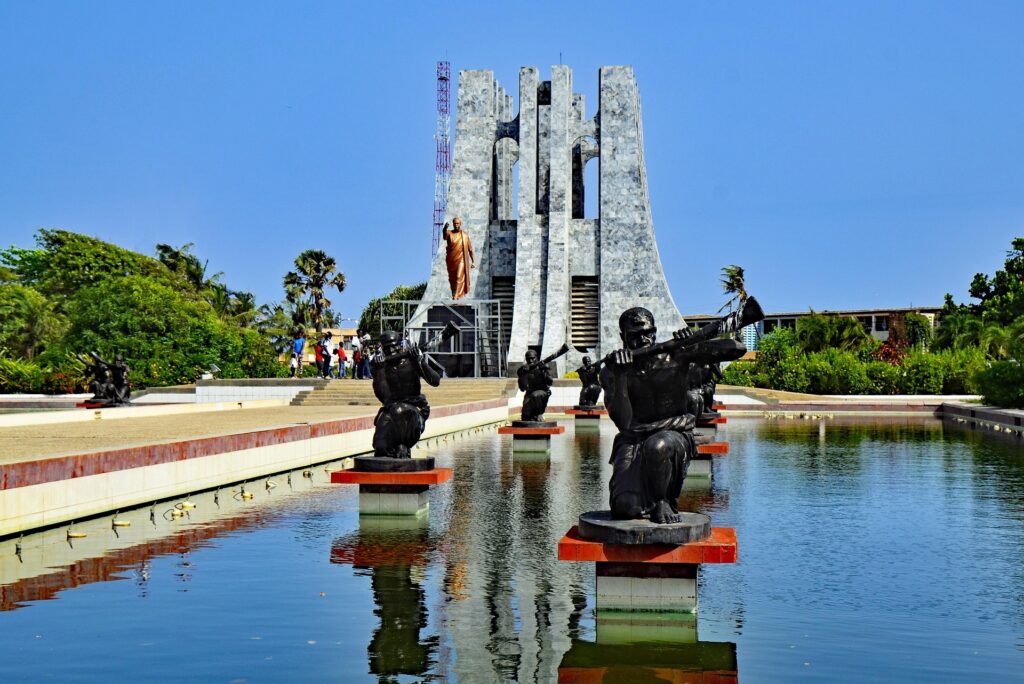
Fly into Accra and feel the energy of a West African capital that has become a hub for the returning diaspora — restaurants, galleries, and neighborhoods shaped by African Americans, Caribbeans, and others who came for the Year of Return and stayed. Then travel west along the coast to Cape Coast and stand at the castle that the British expanded into one of the largest slave-trading fortresses in West Africa. Descend into the dungeons — cut into rock beneath the parade ground — and understand that the floor you are walking on is layers of compacted human waste, because the dungeons were never cleaned, and the residue of centuries of suffering is literally beneath your feet. Stand at the Door of No Return — a narrow passage opening to the sea — and understand that this was the last ground their feet touched. Then turn around. The other side says Door of Return. Walk through it in the direction your ancestors could not. Continue to Elmina, thirteen kilometers away, and enter the oldest European building in sub-Saharan Africa — a castle where a church and a dungeon shared the same walls, where the governor could descend a private staircase from his quarters to the women held below. The architecture made complicity effortless. The stairs are still there. Then visit Nkrumah Memorial Park in Accra, where Nkrumah’s mausoleum stands on the spot where he declared independence. The statue shows him with his hand pointing forward. The inscription reads: “Seek ye first the political kingdom.” He meant it as a beginning, not an end. He meant that once you have the kingdom, you use it to free everyone else. That was the plan. The plan did not survive his overthrow in 1966. But the direction he pointed — toward continental unity, toward the return of the scattered, toward doors that open in both directions — is still the direction Ghana faces.
Evolve — Who You Become in Ghana
You leave Ghana understanding that the most powerful act of reclamation is not destruction. It is renaming. The castles still stand. The dungeons are intact. The stairs from the governor’s quarters to the women’s cells have not been demolished. Ghana did not tear down the architecture of its trauma. It repurposed it. It turned slave castles into UNESCO World Heritage Sites, into museums, into pilgrimage destinations where the descendants of the people who were taken can stand in the same rooms and choose their own meaning. The Door of No Return is now the Door of Return — not because the history has been rewritten, but because the future has been redirected. Nkrumah won an election from a prison cell and declared that Ghana’s independence was meaningless unless the entire continent was free. King watched from the crowd and took the lesson home to a country that would spend the next decade fighting for the rights Nkrumah had just won. The Year of Return brought nearly a million people to a coast that had exported millions. And the Akwamu people — one of the ethnic groups whose ancestors participated in the slave trade — publicly apologized and offered land to returning African Americans. Ghana holds all of it: the complicity, the castles, the independence, the apology, the invitation, the return. It does not pretend the door was never there. It does not pretend the door only opens one way. You come home and look at the thing that was taken from you — the connection, the identity, the belonging that was severed by someone else’s design — and you stop waiting for the wall to come down. You rename the door. You walk through it in the direction you choose. The passage is the same stone. The opening is the same width. The ocean is still on the other side. But the name on the door is different now, and the name is yours to give.
Your practical guide to Ghana starts bellow 👇
🕰️ Ghana Historical Backdrop
Ghana’s history is a powerful narrative of imperial majesty and profound resilience. Long before European arrival, the region was home to the sophisticated Ashanti Empire, known for its incredible wealth in gold and its advanced social structures. In the 15th century, the coastline became a strategic European hub, leading to the construction of massive stone castles that served as the tragic epicenters of the transatlantic slave trade. In 1957, led by Kwame Nkrumah, Ghana became the first nation in sub-Saharan Africa to break the bonds of colonial rule, sparking a pan-African movement that redefined the continent. Today, Ghana is one of Africa’s most stable democracies—a land where the “Year of Return” has invited the global diaspora to reconnect with their roots, preserving a nation that honors its ancestors while leading a modern African renaissance.
🌟 Ghana Local Experiences
Beyond the historic landmarks, discover Ghana’s soul in the communal energy of a Sunday beach gathering in Labadi, where the scent of spicy Jollof rice and grilled tilapia fills the air. Experience the profound stillness of the Ashanti heartland in Kumasi, the sensory explosion of the Makola Market in Accra, or the simple joy of learning the intricate meanings behind Adinkra symbols. Whether it’s witnessing the rhythmic process of Kente weaving in a village workshop or joining the avant-garde celebration of the Chale Wote Street Art Festival, these moments reveal a nation that finds richness in storytelling, vibrant color, and an unshakeable sense of community.
🌄 Ghana Natural Wonders
- Kakum National Park: A spectacular tropical rainforest featuring one of Africa’s only canopy walkways, suspended 40 meters above the forest floor.
- Lake Volta: The world’s largest man-made reservoir by surface area, offering tranquil boat journeys and island retreats.
- Wli Waterfalls: The highest waterfall in West Africa, located in the lush Volta Region, accessible through a scenic forest trek.
- Mole National Park: A vast savanna sanctuary in the north, famous for its pedestrian-friendly elephant safaris and diverse wildlife.
- The Boti Falls: A unique “twin” waterfall system in the Eastern Region, home to the mysterious “Umbrella Rock.”
- Mount Afadja (Afadjato): The highest peak in Ghana, offering panoramic views of the surrounding valleys and neighboring Togo.
🏙️ Ghana Must-See Cities & Regions
- Accra: (Capital) A high-energy coastal metropolis where colonial history, modern skyscrapers, and world-class nightlife coexist with traditional fishing villages. (Dynamic, Urban, Cultural)
- Kumasi: The capital of the Ashanti Region and the kingdom’s cultural heart, home to the massive Kejetia Market and the Manhyia Palace. (Historic, Royal, Artisanal)
- Cape Coast & Elmina: Historic coastal towns defined by their UNESCO-listed castles and a vibrant, traditional fishing industry. (Poignant, Maritime, Educational)
- The Volta Region: A landscape of mountains, waterfalls, and coffee plantations, offering a more serene and adventurous pace. (Scenic, Highland, Natural)
- Busua & Dixcove: Relaxed coastal villages in the West, famous for their surf breaks and eco-friendly beach retreats. (Relaxed, Coastal, Tropical)
🏞️ Ghana National Parks & Nature Reserves
Managed with a focus on community-led eco-tourism by the Wildlife Division of the Forestry Commission.
- Mole National Park: Ghana’s premier wildlife destination.
- Kakum National Park: Essential for rainforest biodiversity and canopy exploration.
- Boabeng-Fiema Monkey Sanctuary: A unique community-protected area where monkeys are considered sacred by the locals.
🏛️ UNESCO World Heritage Sites
- Forts and Castles, Volta, Greater Accra, Central and Western Regions — A series of fortified trading posts that bear witness to the tragic history of the transatlantic slave trade.
- Asante Traditional Buildings — The last remaining examples of the traditional Ashanti architectural style, featuring intricate bas-relief decorations.
- For more information on heritage preservation, visit the UNESCO Ghana Portal.
🖼️ Ghana Museums & Cultural Sites
- National Museum of Ghana (Accra): Recently renovated, housing the nation’s most important archaeological and ethnographic treasures.
- Kwame Nkrumah Memorial Park: A stunning monument and museum dedicated to the founding father of modern Ghana.
- Manhyia Palace Museum (Kumasi): Offering a deep look into the history and living traditions of the Ashanti Monarchy.
- Elmina Castle: The oldest European building in sub-Saharan Africa (1482), offering a profound historical audit of the past.
🎉 Ghana Festivals & Celebrations
- Akwasidae: (Every six weeks) A magnificent Ashanti festival held at the Manhyia Palace to honor ancestors and the Asantehene (King).
- Chale Wote Street Art Festival: (August) A vibrant, high-energy takeover of the James Town district in Accra, celebrating contemporary African art and performance.
- Hogbetsotso Festival: (November) A colorful celebration by the Ewe people in the Volta Region, commemorating their historic migration.
- Panafest: (Biennially) A major pan-African arts and culture festival held at Cape Coast, focused on the theme of “re-emergence.”
🧽 How to Arrive
- ✈️ By Air
- Kotoka International (ACC) in Accra is the primary gateway, frequently voted the best airport in West Africa.
- Airlines: Ghana Cities (Passion Air/Africa World) connect Accra to regional towns. Major international carriers (Emirates, Qatar Airways, Delta, British Airways, KLM) connect Ghana to the world.
- 🚗 By Road
- Ghana shares borders with Côte d’Ivoire, Togo, and Burkina Faso. The Atlantic coastal highway is a popular route for regional travel. Driving is on the right.
- 🚆 By Rail
- Limited domestic passenger rail exists between Accra and Tema; the network is currently undergoing significant expansion.
📶 Stay Connected
- SIM Cards: Major providers are MTN Ghana (best coverage) and Telecel (formerly Vodafone).
- Where to buy: Kiosks are abundant at Kotoka Airport and in every town square. Passport registration is mandatory for all SIM cards.
- eSIM: Supported by MTN; also available via global data platforms like Airalo.
- Digital Payments: Ghana is a leader in Mobile Money (MoMo). Setting up a local MoMo account is highly recommended for daily transactions.
🏨 Where to Stay
Ghana offers a diverse range of accommodations, from high-end urban luxury to remote eco-lodges and beach bungalows.
- Kempinski Hotel Gold Coast City (Accra): The pinnacle of five-star urban luxury in the capital.
- Lou Moon Resort (Axim): A secluded, high-end eco-retreat on a private bay in the Western Region.
- Zaina Lodge (Mole): West Africa’s first luxury safari lodge, overlooking the watering holes of Mole National Park.
- Guesthouses: Explore the widespread network of family-run guesthouses for an authentic look into Ghanaian hospitality.
⛳ Unique Finds
- Fantasy Coffins (Kane Kwei Workshop): Visit the workshop in Teshie to see world-famous coffins carved into the shapes of cars, fruits, or animals.
- Kente Weaving: Visit the village of Bonwire to see the traditional loom-weaving of the “Cloth of Kings.”
- Highlife Music: Seek out a live music venue in Accra (like the +233 Jazz Bar) to experience the genre that defined modern African sound.
- Black Star Square: Visit the massive parade ground in Accra, a symbol of the nation’s independence and sovereign pride.
🤝 Ghana Cultural Guidance
- Greetings: Manners are paramount. Always use your right hand for eating, greeting, and giving or receiving items.
- Akwaaba: This means “Welcome.” Respond with a smile and a warm greeting to every “Akwaaba” you receive.
- Photography: Always ask for permission before taking photos of people or government buildings.
- Basic Phrases:
- Hello: “Akwaaba” (Welcome/Hello)
- Thank you: “Medaase” (Me-daa-se)
- How are you?: “Eti sen?”
- Everything is good: “Eye” (A-ye)
🛂 Ghana Entry & Visa Requirements
- Visa Required: Most nationalities require a visa to enter Ghana, which must be obtained from a Ghanaian Embassy or Consulate before travel.
- Yellow Fever: A valid Yellow Fever Vaccination Certificate is a mandatory requirement for entry for all travelers.
- Official Source: Consult the Ghana Immigration Service.
💰 Practical Essentials
- Currency: Ghanaian Cedi (GHS). While cards are accepted in major hotels and Accra malls, cash is king for markets and local transport.
- Electricity: Type G (Three rectangular pins—same as UK). Voltage is 230V.
- Safety: Ghana is widely considered one of the safest countries in Africa for international travelers. Exercise standard urban vigilance.
- Climate: Tropical. Best visited from November to March (Dry Season) when the weather is less humid.
✨ Bonus Tip: The Rhythm of Presence
To truly embrace Ghana, you must surrender to the “Rhythm of the Walk.” In Ghana, the shortest distance between two points is never a straight line—it is a series of conversations. Don’t rush through the markets or the museums. Allow yourself to be distracted by a greeting or a street-side snack. It is in these unscripted human exchanges, away from the historical weight of the castles, that the true, joyful spirit of the nation reveals itself. You will realize that in Ghana, time is not something to be managed, but something to be shared.
🔗 Featured Links
- Official Tourism: Visit Ghana (Ghana Tourism Authority).
- Heritage Conservation: GMMB (Ghana Museums and Monuments Board).

Beyondia
Trusted Travel CompanionReal digital nomad. I travel. I learn. I grow.
What about you? Where are you going?