🌐 Around the World with Beyondia 🧵 Nordic & Western Europe Region 🪡 Episode 61: Dublin
Dublin is the capital and largest city of the Republic of Ireland, situated on the east coast of Ireland at the mouth of the River Liffey where it enters Dublin Bay. The city commune population is approximately 550,000; the Dublin metropolitan area is approximately 1.4 million, making Dublin substantially the largest urban region in Ireland (which has a total national population of approximately 5.1 million as of 2024). The city is the political capital (seat of the Oireachtas, Ireland’s parliament, and the President’s residence at Áras an Uachtaráin), the financial and commercial centre (International Financial Services Centre established 1987), and the substantial technology-sector centre for European operations of multiple US-headquartered multinationals (Google, Meta, Apple, Microsoft, Amazon, LinkedIn, and dozens of others have established substantial European headquarters or major operations in Dublin, driven substantially by Ireland’s specific corporate tax framework and its specific position as the only substantial English-speaking country in the European Union following the UK’s departure in 2020). Dublin is one of the most economically dynamic European cities of the 2020s, with substantial rapid growth combined with substantial contemporary tensions including housing affordability, income inequality, and the specific negotiations of Ireland’s economic model.
Dublin – The Nobel Prize Winners Producer
But the specific fact that most reorganises the reader’s mental model of Dublin is not the technology sector, the Georgian squares, the Guinness brewery, or the specific tourism destinations. It is that this city — with a population of approximately 1.4 million in its metropolitan area, in a country of approximately 5 million total population — has produced four Nobel Prize winners in Literature within a specific 130-year window. William Butler Yeats (born Dublin 1865, Nobel Prize 1923), George Bernard Shaw (born Dublin 1856, Nobel Prize 1925), Samuel Beckett (born Foxrock, Dublin 1906, Nobel Prize 1969), and Seamus Heaney (born Castledawson, County Londonderry 1939, but substantially educated and resident in Dublin from 1957 onwards, Nobel Prize 1995). Beyond the Nobel laureates, Dublin has produced or been substantially associated with James Joyce (born Dublin 1882, author of Ulysses 1922 and Finnegans Wake 1939, one of the most substantial modernist writers in any language), Oscar Wilde (born Dublin 1854, author of The Picture of Dorian Gray 1890, The Importance of Being Earnest 1895, and one of the most substantial wits of the late 19th century), Bram Stoker (born Dublin 1847, author of Dracula 1897), Jonathan Swift (born Dublin 1667, author of Gulliver’s Travels 1726 and A Modest Proposal 1729, one of the most substantial satirists in English), Sean O’Casey (born Dublin 1880, playwright of The Plough and the Stars 1926 and Juno and the Paycock 1924), Flann O’Brien (Brian O’Nolan, born 1911, author of At Swim-Two-Birds 1939), Colm Tóibín (born Enniscorthy 1955, substantial contemporary Irish novelist), Sally Rooney (born Castlebar 1991, substantial contemporary Irish novelist), and dozens of others. UNESCO designated Dublin as a City of Literature in 2010, one of the first cities to receive the designation, and the specific integrated literary heritage is one of the most substantial of any European city.
The specific historical mechanism that produced this literary concentration is worth substantive treatment because it is genuinely one of the more remarkable stories in modern European cultural history. Ireland was substantially colonised by England from the 12th century onwards — the specific Anglo-Norman invasion began in 1169 under King Henry II, and English administrative control was established over specific eastern Irish territories (the specific “Pale” around Dublin) throughout the medieval period. The specific systematic English colonisation of Ireland accelerated substantially under the Tudors (16th century) and reached a specific crisis point under Oliver Cromwell (1649-1653), whose military campaign in Ireland killed approximately 15-20% of the Irish population and established substantial English Protestant colonial control over Irish land and administration. The specific Penal Laws (implemented from 1695 onwards) systematically suppressed Irish Catholic and Gaelic culture — Catholics were barred from purchasing land, holding public office, practising as lawyers, serving in the military, voting, or attending Catholic education. Irish Gaelic — the indigenous language of Ireland spoken by essentially the entire population before English colonisation — was systematically discouraged in schools, courts, and administrative contexts. The specific consequence was that Irish Gaelic declined substantially through the 17th-19th centuries, with Anglicisation particularly rapid in the specific eastern and northern regions and among the specific merchant and professional classes.
The catastrophic collapse of Irish Gaelic came during the Great Famine (1845-1852). The Famine — caused specifically by the failure of the potato crop due to the specific fungus Phytophthora infestans, which had spread from North America to Europe in the 1840s — killed approximately 1 million Irish people out of a pre-Famine population of approximately 8.5 million (approximately 12% of the total population), and drove approximately 1 million people to emigrate (approximately 12% additional). The specific proportion — approximately 25% of Ireland’s population lost through death or emigration in a specific 7-year period — represents one of the largest single demographic catastrophes in modern European history. The specific colonial administrative circumstances substantially worsened the death toll: Ireland was under direct British rule during the Famine, and specific British administrative policy included the continued export of Irish food (particularly grain and livestock) during the Famine years, the specific ideological commitment to laissez-faire economics that constrained government relief efforts, and the specific administrative decisions that made access to workhouse relief conditional on impossible circumstances. The specific mortality was substantially concentrated in the specific Irish-speaking western and southwestern regions (Connacht, Munster, and West Ulster), where the specific rural Catholic peasant population that relied most heavily on the potato as staple food was decimated. The specific consequence for Irish Gaelic was catastrophic — the specific western Irish-speaking regions lost substantially higher proportions of their population to death and emigration, and the specific linguistic transmission from parents to children was substantially interrupted. By 1900, English had substantially replaced Irish Gaelic as the vernacular language across most of Ireland, with Gaelic surviving primarily in specific rural western districts (the Gaeltacht areas that continue today as officially recognised Irish-speaking regions).
The specific consequence for Irish literature was that the writers who emerged from Ireland in the late 19th and 20th centuries wrote substantially in English rather than in Irish Gaelic. But the specific character of their English-language writing was substantially shaped by the specific historical circumstances — the specific consciousness of colonial subordination, the specific loss of the indigenous language, the specific tensions between English literary tradition and Irish subject matter, and the specific paradox of using the language of the coloniser to produce work of substantial literary distinction. Yeats’s poetry substantially draws on Irish mythology, folklore, and specific historical themes while working in the English poetic tradition. Joyce’s Ulysses (1922) is written in English but reshapes the language substantially through specific Irish diction, syntax, and cultural reference — the specific novel is set in a single day in Dublin (16 June 1904, which is now celebrated annually as Bloomsday) and represents one of the most substantial modernist works in any language. Beckett’s early work is in English, then substantially in French (he moved to Paris in 1937 and lived there for most of his adult life), and then returns to English for major works — his specific bilingual literary practice reflects the specific complexity of his relationship to English as an Irish writer. Heaney’s poetry works substantially in English while drawing on specific Irish rural and cultural themes.
Dublin’s Literary Flowering
The specific paradox — that Dublin’s literary flowering happened in the specific language of the coloniser, using the specific subjects of the colonised — has been substantively debated in Irish literary criticism and post-colonial theory. Some critics argue that the specific literary output represents a genuine cultural triumph — Irish writers using English as an instrument to produce work of substantial distinction, effectively “conquering” the specific language that had been imposed. Others argue that the specific literary output reflects the specific tragedy of cultural loss — that Irish writers were forced to work in a language that was not their historical native tongue, and that the specific literary achievement is partially compensation for the substantial loss of the indigenous literary tradition. Both interpretations are substantially defensible, and the article acknowledges both. The specific consequence for contemporary Dublin — that the city carries the specific literary heritage as one of its central identity markers, that specific Dublin locations (the Martello tower at Sandycove that opens Ulysses, the Trinity College courts where Beckett studied, the specific pubs and streets that appear in the novels) are systematically preserved as literary tourism destinations, and that specific institutions (the James Joyce Centre, the Dublin Writers Museum, the Museum of Literature Ireland which opened 2019 in Newman House on St Stephen’s Green) maintain the specific literary heritage as active contemporary culture — is one of the more substantial cultural inheritances of any modern European city.
The specific Georgian planned district of Dublin is worth substantive treatment as the second hero fact. Between approximately 1720 and 1800, Dublin developed as one of the substantial European Georgian planned capitals. The specific development was funded substantially by the Anglo-Irish Protestant Ascendancy — the specific Protestant landowning class that governed Ireland during the specific period of the Irish Parliament (which existed as a substantial legislative body from 1782 to 1800, when the Act of Union merged the Irish Parliament with the Westminster Parliament and dissolved Irish legislative autonomy until the establishment of the Irish Free State in 1922). The specific Wide Streets Commission — established 1757 by Act of the Irish Parliament — was one of the earliest systematic urban planning bodies in Europe, coordinating the specific widening and standardisation of streets, the specific development of new residential squares, and the specific coherent architectural planning of central Dublin across the second half of the 18th century.
The specific Georgian squares of Dublin — Merrion Square (1762-1794), Fitzwilliam Square (1791-1825), Mountjoy Square (1792-1818), Parnell Square (originally Rutland Square, 1755 onwards), St Stephen’s Green (developed from 1660 onwards, substantially completed in Georgian form by the late 18th century) — represent one of the most substantial concentrations of Georgian residential planning in Europe. The specific architectural language — brick façades with classical proportions, uniform building heights, specific window arrangements (with the characteristic Dublin Georgian door with fanlight above), iron railings, and specific interior plaster decoration — has been substantially preserved in most of the squares. The specific character of the Dublin Georgian door — brightly coloured doors set in classical stone or brick surrounds with elaborate fanlights — has become one of the most photographed elements of Dublin architecture, and the specific “Doors of Dublin” imagery is one of the most reproduced tourism marketing images of the city.
The specific substantial Georgian public buildings include the Custom House (1781-1791, designed by James Gandon, one of the most substantial neoclassical public buildings in Britain and Ireland, damaged substantially by IRA fire in 1921 during the Irish War of Independence and subsequently restored), the Four Courts (1786-1802, also Gandon, the specific Irish supreme court complex, similarly damaged in 1922 during the Civil War and restored), the specific Bank of Ireland building on College Green (originally the Irish Parliament House, built 1729-1739 by Edward Lovett Pearce, the specific building where the Irish Parliament sat from 1729 to 1800), and the General Post Office on O’Connell Street (1814-1818 by Francis Johnston, the specific site of the 1916 Easter Rising proclamation of the Irish Republic). The specific concentration of substantial Georgian public and private architecture within a small central urban area is one of the most substantial European Georgian inheritances.
Dublin Georgian Architectural Anheritance
The specific complexity of the Dublin Georgian architectural inheritance is worth acknowledging substantively. The specific wealth that funded the Georgian development was substantially derived from the specific colonial extraction from the Irish Catholic peasant majority — through specific land ownership arrangements (the specific plantation system that had transferred substantial Irish land from Catholic to Protestant ownership), through specific administrative revenues (the specific tithe system that required Irish Catholics to pay taxes to the established Anglican Church of Ireland), and through specific commercial arrangements that favoured Protestant merchants. The specific consequence — that the substantial Georgian architectural achievement was funded by specific colonial exploitation — has been substantively critiqued in Irish post-colonial cultural memory. The specific 20th-century Irish nationalist movement had substantially ambivalent relationships to the specific Georgian buildings — some were preserved as substantial national heritage, some were substantially damaged during the Irish War of Independence and Civil War (1919-1923), and specific 20th-century tourism marketing has substantially rehabilitated the Georgian inheritance as an aesthetic distinction while continuing to acknowledge the colonial context. The article names this complexity honestly.
Beyond the literary heritage and the Georgian architecture, Dublin preserves specific additional substantial character worth naming. Trinity College Dublin — founded 1592 by Queen Elizabeth I as a Protestant university, and one of the specific ancient universities of the British Isles — has been the intellectual centre of Dublin for approximately 430 years. Trinity’s specific ancient library (the Old Library, built 1712-1732, contains the specific Long Room which is one of the most photographed library interiors in the world) contains approximately 6 million printed volumes and substantial manuscript collections. The specific Book of Kells — the illuminated manuscript of the four Gospels produced by Celtic monks around 800 AD, one of the most substantial surviving examples of Insular Celtic Christian illumination — is displayed at Trinity’s Old Library and is one of the most-visited single objects in Irish tourism (approximately 1 million visitors per year). The specific Book of Kells is believed to have been produced substantially at the specific Iona monastery in the Inner Hebrides of Scotland (founded by the specific Irish monk Colmcille / St Columba in 563 AD as part of the specific Irish monastic missionary tradition that had substantial impact on the Christianisation of Scotland and northern England), transferred to the specific Kells monastery in County Meath around 806 AD to escape Viking raids on Iona, and eventually transferred to Trinity College Dublin for safekeeping in 1661.
The specific Guinness Brewery at St James’s Gate — founded 1759 by Arthur Guinness (1725-1803), who signed a specific 9,000-year lease on the specific brewery property for £45 per year annual rent — has been continuously producing the specific stout beer for approximately 265 years. The specific stout beer style — dark, roasted, moderately alcoholic (approximately 4.2% ABV for standard Guinness Draught) — became substantially globally exported through the 19th and 20th centuries and is now one of the most globally recognised Irish products. The Guinness Storehouse (opened 2000 as a specific visitor centre in a former grain storage building) is one of the most-visited tourism attractions in Ireland (approximately 1.7 million visitors per year), with the specific Gravity Bar at the top providing a substantial panoramic view over Dublin. The specific Guinness advertising history (including the specific “Guinness is Good for You” campaign from the 1920s, the specific animated toucan mascot from 1935 onwards, and the more recent global advertising work) has been substantially influential in advertising history.
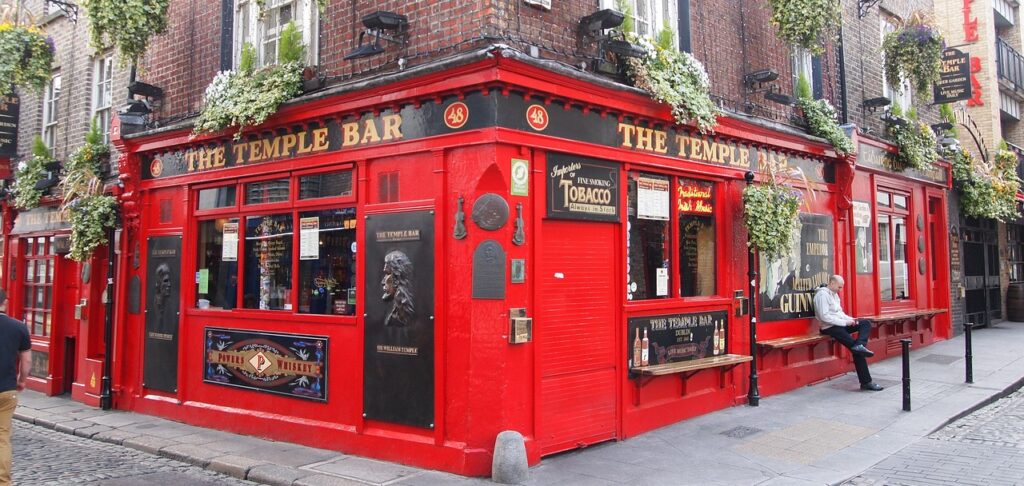
The specific pub culture of Dublin is one of the most substantial cultural continuities in the city. The traditional Irish pub — the specific institutional form combining beer service, food service, live music venue, and neighbourhood gathering place — has been substantially preserved in Dublin across centuries. The specific Brazen Head (established 1198, claimed to be the oldest pub in Ireland, though the specific continuous licensing history is somewhat complicated) is one of several Dublin pubs claiming substantial medieval origins. The specific Temple Bar district (a specific medieval area of central Dublin, redeveloped in the 1990s as a specific cultural quarter) contains substantial concentration of pubs, though the specific district’s transformation into a substantial tourism destination has produced specific tensions between traditional pub culture and mass tourism. Other specific Dublin pubs of substantial cultural distinction include Mulligan’s (established 1782, the specific pub where James Joyce was substantially a customer), Grogan’s (a specific literary and artistic pub), The Long Hall (a specific Victorian-era preserved pub interior), Kehoe’s, The Palace Bar, and dozens of others. The specific Irish traditional music tradition — preserved through the 18th-19th centuries despite colonial cultural suppression, and substantially revived through the 20th century — remains substantially alive in specific Dublin pubs (The Cobblestone in Smithfield, O’Donoghue’s on Merrion Row, The Auld Dubliner, and others) and other music venues.
The contemporary Dublin combines the substantial historical inheritance with one of the most economically dynamic urban environments in contemporary Europe. The specific technology sector concentration has been transformative — the specific European headquarters of Google (established in Dublin 2003), Meta (Facebook, 2008), Apple (2015 for European operations, though Apple has been in Cork since 1980), Microsoft (2014 for European headquarters), Amazon (2004), LinkedIn (2010 for European headquarters), and dozens of other multinational corporations have transformed the specific Dublin economy and demographic character. Approximately 100,000 people work in the specific technology sector in Dublin (out of a metropolitan workforce of approximately 700,000), and the specific concentration of American technology corporate presence has substantially shaped the specific cultural character of contemporary central and southeast Dublin. The specific consequence — substantial economic growth combined with substantial housing pressure (housing prices have increased approximately 130% over the past decade, one of the most rapid increases in any European capital), specific gentrification of central districts, and specific tensions between long-established Dublin communities and incoming international professionals — is one of the specific ongoing negotiations of contemporary Dublin.
The specific post-Brexit position of Dublin is worth naming substantively. When the United Kingdom completed its departure from the European Union in 2020, Dublin’s specific position as the only substantial English-speaking capital in the European Union produced substantial commercial and demographic consequences. Substantial UK financial services relocated to Dublin (particularly specific insurance, asset management, and banking operations). Substantial European technology sector activity concentrated in Dublin. Substantial international professional migration flowed to Dublin as an English-speaking EU location. The specific consequence — that Dublin has emerged as one of the most substantial post-Brexit European capitals — has produced substantial contemporary opportunities and specific tensions in equal measure.
This is the deeper character of Dublin, and the article proposes to close on it. The city is the capital of the Republic of Ireland, an English-speaking European capital that produced more Nobel Prize winners in Literature per capita than almost any city on Earth (Yeats, Shaw, Beckett, Heaney within a 130-year window), plus Joyce, Wilde, Stoker, Swift, and dozens of substantial others. The specific literary flowering happened in the specific language of the country that had colonised Ireland for approximately seven centuries — Irish Gaelic collapsed catastrophically during the Great Famine of 1845-1852, and English became the vernacular that Dublin writers subsequently used to produce work of substantial international distinction. The specific 18th-century Georgian planned district of Dublin — the specific squares, the specific public buildings, the specific Wide Streets Commission urban planning — represents one of the most substantial European Georgian inheritances, funded substantially by the specific Anglo-Irish Protestant Ascendancy and now substantially preserved as national heritage despite the specific colonial context that produced it. Trinity College Dublin (founded 1592) provides substantial specific intellectual continuity, with the Book of Kells (approximately 800 AD) representing the substantial pre-colonial Irish monastic cultural inheritance. The specific Guinness Brewery at St James’s Gate (founded 1759) has been continuously producing the specific stout beer for approximately 265 years. The specific Dublin pub culture — one of the most substantial neighbourhood pub cultures in Europe — provides substantial contemporary social infrastructure. The specific contemporary Dublin — one of the most economically dynamic European cities of the 2020s, with substantial technology sector concentration and specific post-Brexit demographic changes — combines the substantial historical inheritance with rapid contemporary transformation.
Some cities have specific literary heritages that reflect their specific national cultural circumstances. This one produced four Nobel laureates in Literature, plus Joyce and Wilde, in the specific language of the country that had colonised it — writing about specifically Irish subjects, in the specific English that had substantially replaced Irish Gaelic during the Famine, producing work that reshaped English literature itself. It is a specific paradox at the heart of modern Irish cultural identity. It is also one of the more substantial cases of cultural creativity emerging from cultural loss in modern European history. And every specific pub, every specific Georgian square, every specific street corner in central Dublin carries some fragment of this specific literary inheritance — the specific Ulysses walking tours, the specific Joyce statues, the specific Yeats bookshops, the specific Beckett courts at Trinity College. The city is a specific working monument to what a culture produces when it has substantially lost what it was and must decide what it will become. Dublin’s answer, across the specific 130 years between Wilde’s birth in 1854 and Heaney’s Nobel Prize in 1995, was: literature. Some of the most substantial literature produced anywhere in the English-speaking world.
Nine regions. One hundred and twenty destinations. Three hundred weeks remaining.
The journey continues north. The next stop is Scotland’s historic capital — a city built on volcanic bedrock, split between an ancient royal fortress on a rock and an 18th-century planned New Town that was the specific site of one of the most substantial Enlightenment intellectual centres in Europe.
Where are you going?

Beyondia
Trusted Travel CompanionReal digital nomad. I travel. I learn. I grow.
What about you? Where are you going?