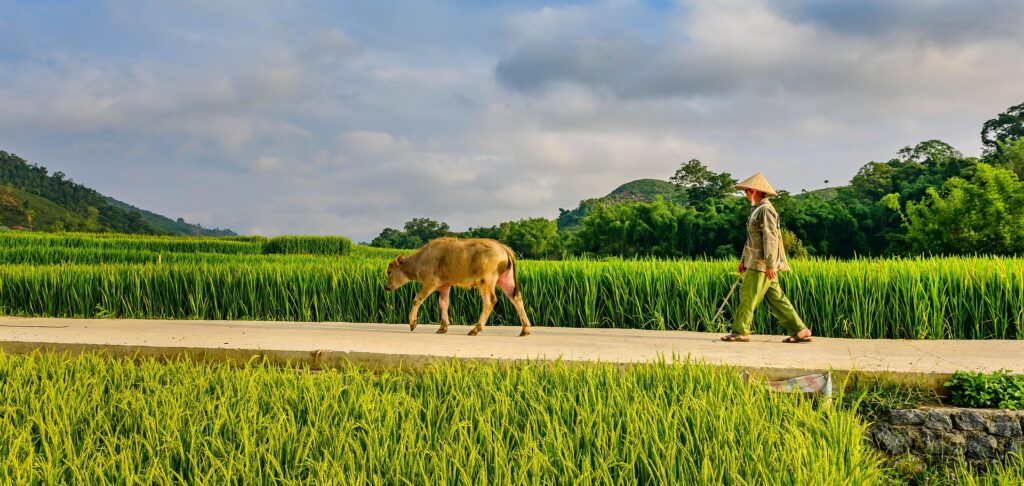
GoBeyondia Atlas 🗺️ South-East Asia 🗾
Laos: Where the most bombed nation per capita in human history — a planeload of bombs every eight minutes, twenty-four hours a day, for nine years — wakes each morning before dawn to feed monks walking barefoot in silence, eighty million unexploded bombs still sleep in the soil beneath rice paddies and schoolyards, and the people who farm that soil turned the bomb casings into spoons, boats, house stilts, and fences, because Laos does not forget what happened but refuses to let it be the only story.
Laos in 30 Seconds
A landlocked country the size of Minnesota, once called Lan Xang — the Kingdom of a Million Elephants — founded in 1353, wedged between China, Vietnam, Thailand, Cambodia, and Myanmar at the crossroads of every power that ever wanted to control Southeast Asia. From 1964 to 1973, in a campaign the American public was never told about, the United States flew 580,000 bombing sorties over Laos and dropped more than two million tons of ordnance — more than was dropped on Germany and Japan combined in all of World War II — to disrupt the Ho Chi Minh Trail and fight a proxy war against communism. Thirty percent of the 270 million cluster munitions never detonated. Eighty million bomblets remain in the ground today, contaminating all seventeen provinces, killing and maiming people every year — forty percent of them children. And yet. In Luang Prabang, a UNESCO World Heritage city at the confluence of the Mekong and the Nam Khan, a tradition older than the bombing, older than French colonialism, older than the memory of anyone alive, continues every single morning: the Tak Bat, where hundreds of saffron-robed monks walk barefoot through the streets at dawn in complete silence while kneeling residents place handfuls of sticky rice into their bowls. On the Xieng Khouang plateau, thousands of megalithic stone jars up to three meters tall and ten metric tons heavy sit in fields still marked with bomb craters — the Plain of Jars, a UNESCO World Heritage site dating to the Iron Age, whose builders and purpose remain unknown, surrounded by ordnance that has made much of the landscape too dangerous to excavate.
Evoke — Why You Visit Laos
You come to Laos because you need to understand how a country absorbs the worst thing that can happen and still chooses gentleness as its defining posture. This is not resilience in the way the word is usually used — bouncing back, recovering, rebuilding. This is something the language does not have a word for: the decision to continue a six-hundred-year-old spiritual practice every morning in a country where the ground beneath your feet may still kill you. The monks who walk at dawn do not walk in spite of the bombs. They walk because the walking is the point — the daily renewal of a covenant between those who give and those who receive, a symbiotic relationship where feeding a monk generates merit for the giver and the monk grants blessings in return, and both parties do this in silence because the exchange is too sacred for words. You come because somewhere in the Xieng Khouang highlands, a jar carved from sandstone two thousand years ago by people whose names are lost sits three meters from a crater left by a bomb dropped fifty years ago by a pilot whose name is classified, and both objects share the same field, and the field is still farmed, and the farmer is still alive, and the jar is still unexplained. You come because you have been holding onto an injury — a betrayal, a failure, a loss — and you have made it your entire identity, and Laos will show you a country that received the most concentrated violence in the history of warfare and made spoons from the shrapnel.
Explore — How You Experience Laos
Arrive in Luang Prabang where French colonial architecture lines streets shared with thirty-five Buddhist temples, and wake before dawn to witness the Tak Bat — not from the main tourist road but from a quiet side street where you can watch the real exchange between local families who rose at three in the morning to cook sticky rice and monks who have been meditating since four, the saffron robes emerging from river mist like something between memory and prophecy. Kneel if you participate. Stay silent. Understand that this is not a performance but a meal — the only food these monks will receive before their eighteen-hour fast begins again. Climb Mount Phousi at sunset to see the Mekong and the Nam Khan embrace the peninsula from above, then take a slow boat up the river itself, because in Laos the Mekong is not a waterway but a civilization — the thread that connects rice paddies to fishing villages to temple towns to the border where everything changes. Travel to the Plain of Jars and walk among the megalithic vessels that an Iron Age civilization carved, transported, and arranged across hilltops for reasons archaeology has not yet decoded — staying within the cleared paths, because the red and white markers remind you that the ground between the ancient jars still contains modern death. Visit the COPE center in Vientiane, where prosthetic limbs are fitted for UXO survivors, and see the bomb casings displayed not as memorials but as facts — the quiet Lao insistence that what happened must be known even if it cannot be undone. Then drive through the countryside where bomb craters have become fish ponds, where cluster munition casings serve as stilts for houses and planters for gardens, because the Lao people looked at the instruments of their destruction and asked: what else can this become?
Evolve — Who You Become in Laos
You leave Laos understanding that the most radical response to destruction is not revenge, not forgetting, but transformation. The farmers who turned bomb casings into fences did not forgive the bombing. They repurposed it. The monks who walk at dawn did not overcome the war. They outlasted it — by doing the same thing every morning for six hundred years regardless of who was dropping what from above. The jars that have survived two thousand years now share their plateau with craters fifty years old, and neither has won, and neither has lost, and the field continues. You come home and look at the thing that damaged you — the project that failed, the relationship that ended, the trust that was broken — and you stop asking why it happened. You ask what else it can become. A planeload every eight minutes, and the monks still walk. The ground still holds death, and the rice still grows. What are you carrying that could be turned into something the original violence never intended?
Your practical guide to Laos starts bellow 👇
🕰️ Laos Historical Backdrop
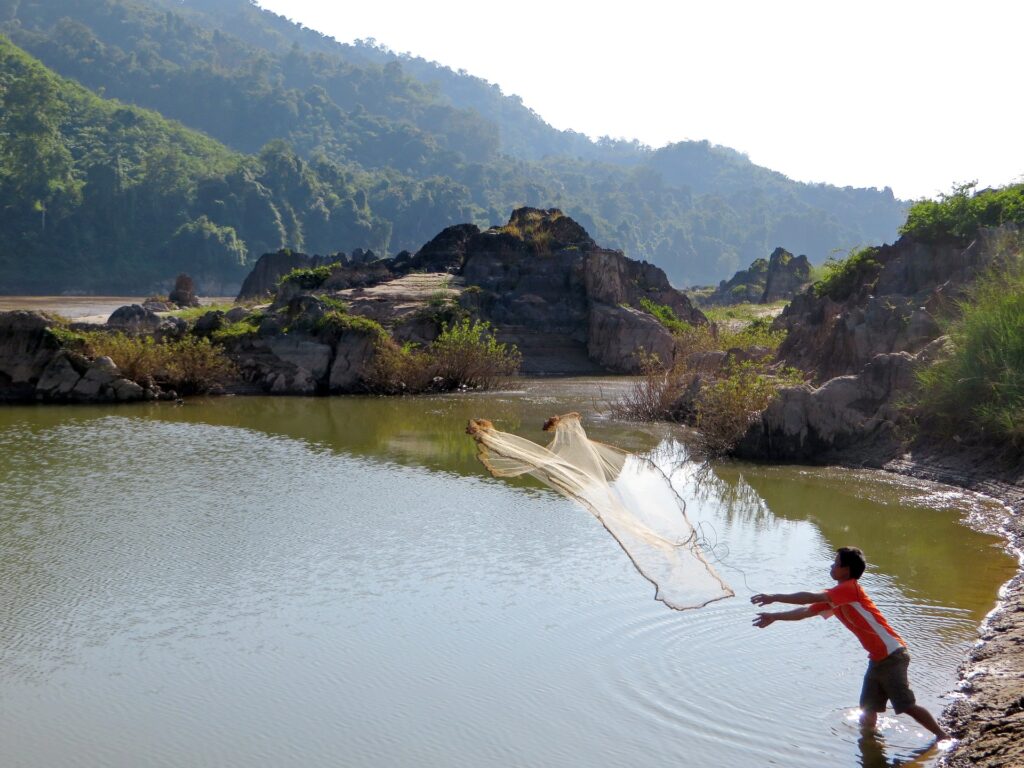
Laos’ history is a lyrical narrative of the “Land of a Million Elephants” (Lan Xang), a powerful kingdom founded in the 14th century that served as a cultural and religious heart of Southeast Asia. Nestled between titans like Thailand, Vietnam, and China, the nation has navigated centuries of Siamese influence, French colonial administration, and the profound scars of the 20th-century “Secret War.” Its story is told in the ancient temple architecture of Luang Prabang, the mysterious megalithic jars of the Xieng Khouang plateau, and the resilient, gentle spirit of a people who have maintained their Buddhist identity through every shift. Today, Laos is a nation emerging from its land-locked isolation, transforming into a “land-linked” hub through modern infrastructure while fiercely protecting the serene, slow-paced lifestyle that has become its global signature.
🌟 Laos Local Experiences
Beyond the waterfalls, discover the soul of Laos in the Tak Bat—the silent, dawn ritual of alms-giving where saffron-robed monks glide through the streets in a moving meditation of community and faith. Experience the profound stillness of a slow-boat journey down the Mekong, the intoxicating aroma of freshly roasted Arabica coffee in the Bolaven Plateau, or the simple joy of sharing a meal of Khao Niew (sticky rice) in a remote Hmong village. Whether it’s participating in a traditional Baci ceremony to “call the spirits” or exploring the reclaimed industrial-chic cafes of Vientiane, these moments reveal a nation that finds strength in silence and richness in the slow passage of time.
🌄 Laos Natural Wonders
- Kuang Si Falls: A spectacular three-tiered waterfall with shallow pools of brilliant turquoise water set in a lush tropical forest.
- Vang Vieng Karst Landscapes: Dramatic limestone mountains and winding rivers, offering some of the world’s most scenic kayaking and hot-air ballooning.
- Si Phan Don (4,000 Islands): A riverine archipelago in the far south where the Mekong widens, home to the rare Irrawaddy dolphins and the thunderous Khone Phapheng Falls.
- The Bolaven Plateau: A high-altitude volcanic region known for its cool climate, dramatic twin waterfalls (Tad Fane), and world-class coffee plantations.
- Kong Lor Cave: A 7.5-kilometer subterranean river cave that can be navigated by longtail boat, revealing massive limestone chambers.
- The Annamite Range: The rugged mountain border with Vietnam, home to some of the world’s rarest biodiversity.
🏙️ Laos Must-See Cities & Regions
- Luang Prabang: (UNESCO World Heritage) A breathtakingly beautiful town blending traditional Lao architecture with French colonial charm. (Spiritual, Elegant, Timeless)
- Vientiane: (Capital) The world’s most relaxed capital, home to the golden Pha That Luang stupa and a vibrant riverside night market. (Relaxed, Historic, Eclectic)
- Vang Vieng: A former backpacker haunt transformed into a premier eco-adventure hub amidst stunning karst mountains. (Adventurous, Scenic, Revitalized)
- Pakse: The gateway to the southern islands and the Bolaven Plateau, reflecting a unique mix of French and Lao influences. (Gateway, Tropical, Regional)
- Phonsavan: The base for exploring the mysterious “Plain of Jars” and learning about the country’s modern history. (Mysterious, Historic, Highland)
🏞️ Laos National Protected Areas & Reserves
Managed with an increasing focus on sustainable community-led tourism by the Lao Department of Forestry.
- Nam Et-Phou Louey National Park: Home to the “Nam Nern Night Safari,” an award-winning wildlife viewing project.
- Phou Hin Poun National Protected Area: Protecting the dramatic karst scenery of central Laos.
- Bokeo Nature Reserve: Famous for “The Gibbon Experience,” where visitors stay in the world’s highest treehouses.
🏛️ UNESCO World Heritage Sites
- Town of Luang Prabang — An exceptional example of the fusion of traditional architecture and 19th-century colonial structures.
- Vat Phou and Associated Ancient Settlements within the Champasak Cultural Landscape — A spectacular pre-Angkorian temple complex at the foot of Mount Phou Khao.
- Megalithic Jar Sites in Xiengkhuang – Plain of Jars — Over 2,100 giant stone jars used for funerary practices in the Iron Age.
- For a full list, visit the UNESCO Laos Portal.
🖼️ Laos Museums & Galleries
- Royal Palace Museum (Luang Prabang): Housed in the former king’s residence, displaying the sacred Prabang Buddha image.
- COPE Visitor Centre (Vientiane): A deeply moving museum focusing on the history of unexploded ordnance (UXO) and rehabilitation efforts.
- Lao National Museum (Vientiane): Detailing the nation’s journey from prehistoric times to the revolutionary era.
🎉 Laos Festivals & Celebrations
- Pi Mai Lao (Lao New Year): (April) A joyful nationwide water festival celebrating the onset of the monsoon.
- Boun Bang Fai (Rocket Festival): (May/June) A wild and colorful traditional event where homemade bamboo rockets are launched to encourage rainfall.
- Boun That Luang (Vientiane): (November) The country’s most significant religious festival, held at the national stupa during the full moon.
- Boat Racing Festival (Boun Suang Heua): (October) Celebrated at the end of Buddhist Lent with dramatic races on the Mekong.
🧽 How to Arrive
- ✈️ By Air
- Hubs: Wattay International (VTE) in Vientiane and Luang Prabang International (LPQ).
- Airlines: Lao Airlines (Flag carrier) and major regional carriers (Thai Airways, Vietnam Airlines, AirAsia) connect Laos to the world.
- 🚆 By Rail
- The LCR (Laos-China Railway) is a high-speed game-changer, connecting Vientiane to Luang Prabang, Vang Vieng, and the Chinese border in record time.
- 🚗 By Road
- Laos shares land borders with Thailand, Vietnam, Cambodia, China, and Myanmar. The “Friendship Bridges” with Thailand are the most popular entry points. Driving is on the right.
📶 Stay Connected
- SIM Cards: Major providers include Unitel (best coverage), Lao Telecom, and Tplus.
- Where to buy: Kiosks are available at all arrival airports and in town centers. Registration with a passport is mandatory.
- eSIM: Supported by Lao Telecom and Unitel; also available via international apps like Airalo.
🏨 Where to Stay
Laos offers everything from boutique heritage hotels to remote sustainable luxury lodges.
- Amantaka (Luang Prabang): A colonial-era sanctuary offering the pinnacle of luxury and spiritual integration.
- Rosewood Luang Prabang: Luxury hilltop tents and villas set in a lush jungle waterfall valley.
- The River Resort (Champasak): An eco-friendly retreat on the banks of the Mekong.
- Heritage Guesthouses: Explore the “French Quarter” of Luang Prabang for authentic stays in restored 19th-century villas.
⛳ Unique Finds
- UXO Sculptures: See how local blacksmiths in Xieng Khouang have repurposed scrap metal from the war into beautiful, everyday items.
- Sa Paper Workshops: Learn how traditional Lao paper is handmade from the bark of mulberry trees.
- Traditional Herbal Saunas: Visit a community-run herbal sauna in Vientiane or Luang Prabang for an authentic Lao wellness ritual.
🤝 Laos Cultural Guidance
- The Nop: The traditional greeting involving palms pressed together and a slight bow. The higher the hands, the more respect shown.
- Dress Code: When visiting temples, shoulders and knees must be covered. Women are often asked to wear a Sinh (traditional skirt), which can be rented at entrances.
- Feet Etiquette: Never point your feet at people or religious objects (especially Buddhas). Remove shoes before entering homes and temples.
- Basic Phrases:
- Hello: “Sabaidee” (Sa-bye-dee)
- Thank you: “Khop Chai” (Kop Chye)
- Yes/No: “Man / Bo”
- Cheers: “Tam Jok!”
🛂 Laos Entry & Visa Requirements
- e-Visa: Most nationalities can apply for an e-Visa online for stays up to 30 days.
- Visa on Arrival: Still available at most international airports and major land border crossings.
- Official Source: Apply via the official Lao e-Visa Portal.
💰 Practical Essentials
- Currency: Lao Kip (LAK). Due to high inflation, Kip is for small daily purchases; USD and Thai Baht are widely used for larger expenses. Cards are accepted in major hotels and upscale restaurants.
- Electricity: Type A, B, C, E, and F. Voltage is 230V.
- Safety: Laos is very safe for travelers. The primary caution is for unexploded ordnance (UXO) in rural areas—always stick to marked trails.
- Climate: Tropical. Best visited November to March (Dry and cool).
✨ Bonus Tip
To truly embrace Laos, learn to “Walk the Middle Way.” Don’t rush through the country with a checklist. Laos is the only place in Southeast Asia that will actively fight your attempts to hurry. If a boat is late, or a ceremony takes longer than expected, lean into it. It is in this surrender to the “Lao Pace”—the unhurried, rhythmic flow of a nation that measures wealth in merit rather than minutes—that your own evolving sense of deep presence will finally reveal itself.
🔗 Featured Links
- Official Tourism: Lao Tourism Board.
- Railway Tickets: LCR Ticket App Info.

Beyondia
Trusted Travel CompanionReal digital nomad. I travel. I learn. I grow.
What about you? Where are you going?