When Continents Collide in Paradise
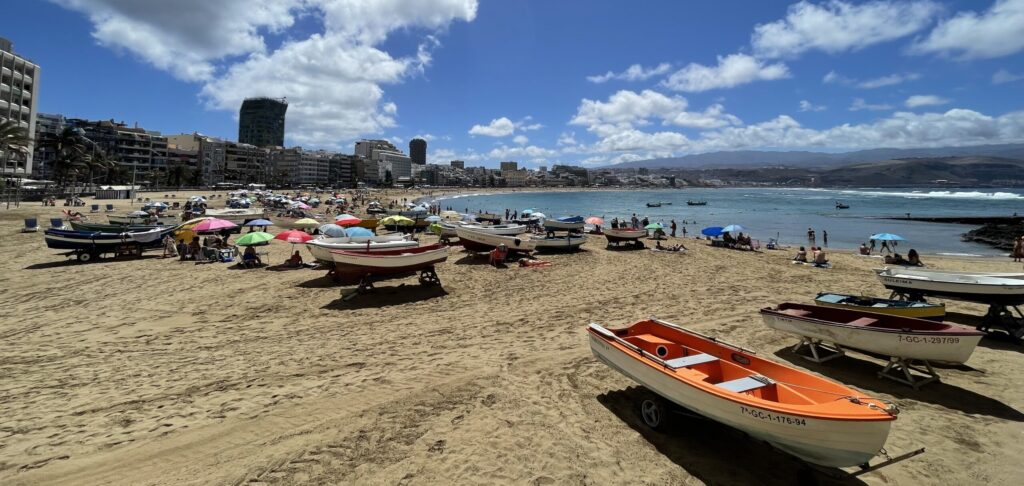
The Iberia flight descends through Atlantic trade winds as Gran Canaria materializes from ocean mist like a geological rebellion—volcanic peaks piercing cloud layers while golden dunes from the Sahara meet black lava beaches in combinations that shouldn’t exist on one island. Below, Las Palmas stretches along the northeastern coast like a secret European capital that forgot to tell anyone it achieved perfection. The pilot banks over Playa de Las Canteras just as morning light transforms three kilometers of urban beach into what locals call “the best city beach in the world”—a claim that sounds like marketing until you witness surfers catching waves while bankers eat breakfast twenty meters away.
This isn’t vacation. This is Europe’s test laboratory for permanent paradise.
Las Canteras: The Beach That Built a City
The taxi from Gran Canaria Airport delivers you to Las Canteras promenade just as the morning swimming brigade—locals aged eight to eighty—performs their daily ritual in waters that never drop below 18°C. Nothing prepares you for this collision of urban sophistication and raw Atlantic power: a natural reef barrier called La Barra creates a massive saltwater lagoon where children learn to swim while Atlantic swells crash harmlessly beyond, turning this into nature’s own infinity pool.
I arrive at La Puntilla as the sunrise swimmers finish their circuits. Manuel, a retired banker who hasn’t missed his morning swim in thirty-seven years, notices my amazement at the scene.
“First time?” When I nod, he gestures toward businesspeople changing from wetsuits to suits behind beach umbrellas. “Other cities have gym memberships. We have the Atlantic. Same price—free. Better results—you live forever.”
The three-kilometer promenade reveals Las Palmas’ genius: a city that built itself around a beach rather than despite it. At Playa Chica, scuba instructors prepare morning dives to underwater volcanic formations. In the middle section, La Cícer, surfers queue for waves while digital nomads type on laptops from beachfront coworking spaces. The northern stretch hosts volleyball tournaments while retired Germans practice tai chi at sunset.
But the revelation comes at sunset from the Alfredo Kraus Auditorium, a modernist concert hall built on volcanic rock jutting into the Atlantic. Standing here, watching surfers silhouetted against African sunsets while the Philharmonic Orchestra rehearses inside, you understand Las Palmas’ impossible achievement: high culture balanced on surfboards.
Vegueta: Where Columbus Dreamed America
The walk from Las Canteras to Vegueta—forty minutes through the Triana shopping district where Art Nouveau facades host Korean taco shops—delivers you to Spain’s first colonial city, the blueprint for every Spanish city in the Americas. These cobblestones knew Columbus’s footsteps in 1492 when he stopped here for ship repairs, accidentally establishing Las Palmas as the last European city before the New World.
The Casa de Colón (Columbus House) preserves rooms where the navigator allegedly stayed, though locals admit the connection might be “enhanced” for tourism. What’s undeniable: these courtyards, with their wooden balconies and dragon trees, established architectural DNA that would replicate from Havana to Lima.
At the Cathedral of Santa Ana, I climb the bell tower just as afternoon light angles through Gothic arches. The view reveals Las Palmas’ split personality: medieval streets flowing into modernist boulevards, European architecture facing African horizons. The cathedral’s interior holds another secret—dog sculptures that gave the Canary Islands their name (from Latin “canariae insulae”—islands of dogs), though the indigenous Guanche people who worshipped here before Christianity knew them as sacred animals connecting earthly and spirit realms.
The Vegueta Market explodes with impossible abundance: tropical fruits that shouldn’t grow this far north (but do), African spices from markets 100 kilometers away (but feels like thousands), Venezuelan arepas next to Korean kimchi next to traditional Canarian gofio. This isn’t mere multiculturalism—it’s what happens when geography makes you the last stop before everywhere else.
The Caldera de Bandama: When Volcanoes Become Gardens
The journey to Caldera de Bandama reveals Gran Canaria’s defiant character. The tourist bus was full, the taxi wanted 60 euros, and the hiking trail from the city—15 kilometers uphill in 34°C heat—seemed designed for masochists. So I chose the ridiculous option: an electric scooter meant for city streets.
Two hours of volcanic switchbacks, wrong turns through banana plantations, and battery anxiety later, I reached the caldera rim with 15% power remaining. Local farmers stared. Cyclists in professional gear passed laughing. But standing at the edge of this perfect volcanic crater—1000 meters wide, 200 meters deep, with abandoned farms inside from families who lived in a volcano until the 1950s—the absurd journey transformed into the trip’s defining revelation.
The descent into the caldera (on foot, scooter abandoned) delivers you to another world: microclimates creating tropical vegetation, endemic species found nowhere else, absolute silence except wind through dragon trees. At the bottom, the abandoned farmhouse of Los Olivos tells Gran Canaria’s story: humans attempting impossible agriculture in impossible places, succeeding through sheer stubbornness.
The return journey—scooter at 3% battery, coasting downhill on pure gravity and prayer—taught me that sometimes the unconventional path reveals what the sensible route conceals. The crater isn’t just geological; it’s philosophical—proof that life thrives in the most unlikely places.
Roque Nublo: Sacred Stone in African Skies
The rental car journey from Las Palmas to Roque Nublo—ninety minutes through landscapes that shift from coastal desert to alpine forest—demonstrates why locals call Gran Canaria “the miniature continent.” Within two hours, you traverse fourteen of Earth’s thirty-two climate zones, each transition violent and absolute.
Roque Nublo itself—an 80-meter volcanic rock formation worshipped by indigenous Guanches as a petrified god—requires a moderate hike that becomes transcendent at sunset. The path winds through Canarian pine forests that smell like vanilla (seriously, break a needle and sniff), past endemic blue chaffinches found nowhere else on Earth.
Standing beside this volcanic monument as clouds flow below you—yes, below—while Tenerife’s Mount Teide floats on the horizon like a distant planet, you grasp Gran Canaria’s indigenous truth: this isn’t Europe or Africa but something entirely other, a laboratory where Earth experiments with impossible combinations.
Digital Nomad Paradise: The Future Lives Here
Back in Las Palmas, the Distrito Digital near the port reveals the city’s new identity: Europe’s most sophisticated remote working infrastructure disguised as a beach town. Coworking spaces with ocean views, 5G coverage on beaches, apartments with fiber optic internet standard—this isn’t digital nomad adaptation but design.
At The House coworking space, I meet developers from Estonia, designers from Korea, traders from London, all here for the same reason: European infrastructure with African sun, metropolitan culture with beach access, first-world services at second-world prices. They’ve discovered what locals always knew: paradise isn’t a vacation destination but a daily practice.
The Atlantic Truth
The evening flight to Madrid carries me away from an island that solved the unsolvable: how to be simultaneously European and African, urban and natural, ancient and futuristic, local and global. Through my window, Las Palmas glows against the Atlantic darkness—three hundred thousand people who chose the impossible combination of metropolitan ambition and daily beach swims.
This Canarian journey doesn’t just show you perfect climate—it demonstrates that paradise isn’t about escaping civilization but finding where civilization achieved balance with nature. You return not just with a tan and surf stories, but with proof that cities can prioritize beaches over business districts, that European sophistication can dance with African rhythms, that eternal spring isn’t just meteorological but psychological.
In Las Palmas, they say the city makes you younger. After two weeks between boardrooms and surfboards, I understand this isn’t mythology—it’s what happens when humans stop choosing between ambition and paradise and decide to have both.
Ready to discover your own laboratory for permanent perfection? Beyond imagination. First class for the curious. 🌊
Cultural Integration:
- Learn basic Spanish phrases (English works but Spanish opens doors)
- Respect siesta time (2-5 PM when many shops close)
- Try gofio (roasted grain flour) – the Canarian superfood
- Attend a Lucha Canaria (traditional wrestling) match
- Shop at Mercado del Puerto for local life immersion
Digital Nomad Essentials:
- EU visa allows 90-day stays (extensions possible)
- Coworking spaces: €150-300/month
- Beachfront apartments: €800-1500/month
- Fiber internet standard in most buildings
- Year-round 18-24°C temperature range
Budget Expectations:
- Digital nomad monthly: €1,500-2,500 all-in
- Hotel stay: €60-150 per night
- Rental car: €25-40 per day
- Restaurant meals: €10-25 per person
- Coworking day pass: €15-25
- Surf lessons: €35-50 per session
- Scuba diving: €40-60 per dive
The Canarian Secret: This journey doesn’t just show you island life—it proves that paradise can have fiber optic internet, that beaches can be boardrooms, that Europe and Africa can merge into something neither continent imagined possible. You return understanding that permanent vacation isn’t about not working—it’s about working where life itself feels like a celebration.

Beyondia
Travel CompanionReal digital nomad. I travel. I learn. I grow.
What about you? Where are you going?