GoBeyondia Atlas 🗺️ South-East Asia 🗾
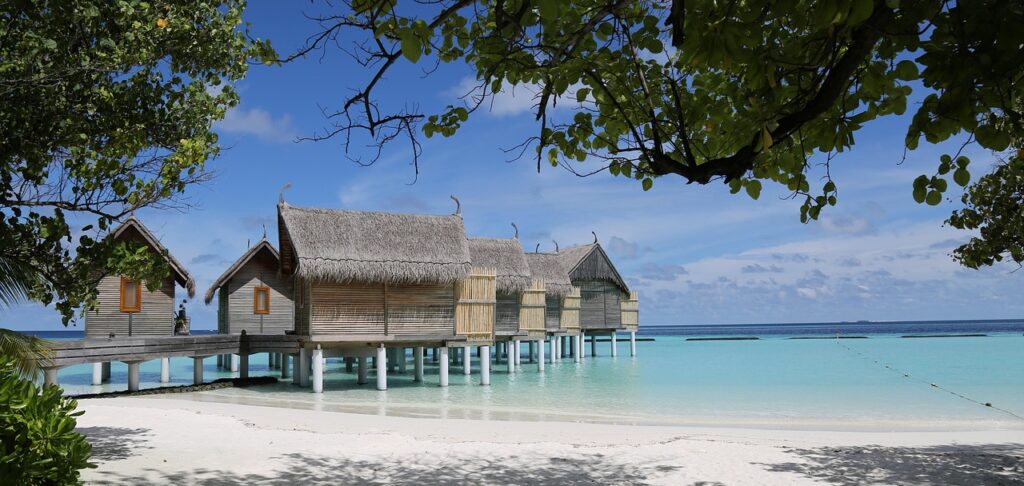
Maldives: Where overwater bungalows float above turquoise lagoons and the reef below your breakfast table contains more life than most countries contain on land.
Maldives in 30 Seconds
An archipelago of 1,200 islands spread across 900 kilometers of the Indian Ocean, none of them rising more than two meters above sea level, making the Maldives the world’s lowest-lying country and the one most immediately in conversation with climate change — a civilization built entirely on coral and negotiating its own future with the rising water that surrounds it on every side. Twenty-six atolls contain the full range of what the Indian Ocean produces at its most generous: lagoons so turquoise the color seems manufactured, coral reefs hosting fourteen percent of the world’s coral species, whale sharks cruising the outer atolls on plankton blooms with the unhurried confidence of animals that have been doing this for sixty million years, manta rays performing barrel rolls in cleaning stations with a grace that makes everything else in the ocean look effortful. Malé is one of the world’s most densely populated cities — 200,000 people on an island two kilometers long, a compression of Islamic architecture, fish markets, and Dhivehi culture that most visitors fly over without stopping, which is their loss. The resort islands occupy their own geography — private lagoons, overwater villas, house reefs that begin where the jetty ends — a hospitality model so refined it created a category of travel that every tropical destination has spent forty years attempting to replicate and none has quite managed. The local islands offer a different Maldives entirely — guesthouses, fishing communities, Friday mosques, and the particular ease of a culture that has been living between ocean and sky for three thousand years and found the arrangement acceptable.
Evoke — Why You Visit the Maldives
You come to the Maldives because you have earned something you keep postponing. Not a reward for suffering — a recognition that sustained effort without deliberate restoration is not discipline but depletion, and you have been depleted for longer than you’ve admitted to anyone including yourself. You need water the color that water is in your imagination of paradise — and then to discover that the imagination was conservative. You need a morning with no agenda earlier than the tide. You need to snorkel a house reef alone at 7am when the parrotfish are still sleeping in their mucus cocoons and the reef sharks are making their final circuit before the sun climbs high enough to send them deeper and the whole system is operating in the mode it uses when humans aren’t watching, which is the mode worth seeing. But underneath the restoration — and this is the part the Maldives will teach you that you didn’t expect — you need to be somewhere that is reckoning honestly with its own impermanence. The Maldives is disappearing. Not metaphorically, not eventually — measurably, documentably, within the lifetime of children born on these islands today. A civilization three thousand years old is negotiating its survival with the physics of thermal expansion and you are floating above a reef that is doing the same negotiation at the biological level. Beauty and urgency occupying the same water. You came here to rest. The Maldives will also make you think. Both are necessary.
Explore — How You Experience the Maldives
Wake before sunrise and walk to the end of your overwater villa’s jetty while the sky moves through the sequence it performs before committing to blue — the Indian Ocean absolutely flat in the windless pre-dawn, bioluminescent plankton still visible in the water below your feet, the reef’s shapes resolving as the light arrives and the first parrotfish begin their morning excavation of coral that they will digest and deposit as the white sand beaches that made this place famous, which means the beach you walked on yesterday was once a coral reef and was once a parrotfish and the cycle has been running long enough that the distinction no longer applies. Dive Hanifaru Bay in Biosphere Reserve when the plankton bloom coincides with the spring tide and the manta rays arrive — sometimes two hundred individuals in a single bay, barrel rolling and chain feeding in formations so coordinated they appear choreographed, except choreography requires instruction and this requires only hunger and geometry and sixty million years of practice. Take a local ferry to Maafushi or Guraidhoo and walk streets where children cycle home from the Friday mosque and women hang washing in the salt air and the fish market empties by 9am because everything was caught at 5am and the freshness is non-negotiable, a Dhivehi standard that the resort world charges premium prices to approximate. Night snorkel your house reef with a torch when the nocturnal reef operates its entirely separate shift — octopus hunting, lionfish hunting octopus, the coral polyps extending their feeding tendrils into water they retract from during daylight, the whole system running a program that the daytime reef obscures. Eat garudhiya — the Maldivian tuna broth, clear and clean and deep, served with rice and lime and chili and fresh tuna scraped from the bone — at a local island café where the fish was in the ocean four hours ago and the recipe has been unchanged since the dhow trading routes made tuna the currency of the Indian Ocean. Watch the sunset from a sandbank that will exist for approximately three more years before the tide reclaims it, drinking fresh coconut water, understanding that impermanence is not a problem to be solved but a condition to be witnessed with the full attention it deserves.
Evolve — Who You Become in the Maldives
You leave the Maldives restored in the cellular way that only sustained proximity to water and light and biological abundance produces — not relaxed, which is temporary, but reset, which persists. You also leave with something heavier and more important than the restoration: a direct, personal, embodied understanding of what climate change means at the human scale. The Maldives is not a statistic about sea level rise. It is 500,000 people with a 3,000-year civilization, a language spoken nowhere else on earth, a cuisine built on specific fish from specific atolls, a textile tradition called libaas, a music called bodu beru — all of it existing two meters above a rising ocean that the Maldivian government has been negotiating with, literally, by purchasing land in other countries as contingency. You came here and floated above a reef and ate their fish and slept in their water and left with their sunset in your camera. You go home different about single-use plastic. You go home different about energy consumption. Not performatively — quietly, personally, as someone who has now seen what is at stake with their own eyes rather than through someone else’s data. The Maldives gave you beauty as an argument. The argument is irrefutable. You start acting accordingly.
Your practical guide to Maldives starts bellow 👇
🕰️ Maldives Historical Backdrop
The Maldives’ history is a lyrical saga of seafaring people navigating the vast Indian Ocean. Long a vital crossroads for ancient maritime trade routes, the archipelago transitioned from its early Buddhist roots to Islam in 1153 AD—a pivotal moment that still defines its cultural fabric today. Its story is told in the ancient coral-stone mosques of Malé, the intricate lacquerware of the southern atolls, and the legendary resilience of a nation that has thrived amidst the shifting tides of sultanates and protectorate status. Today, the Maldives is a global pioneer in sustainable tourism and marine protection, standing as a living testament to the beauty and fragility of our planet. It is a land where the rhythm of the Boduberu drums and the whisper of the monsoon winds tell a story of harmony between man and the deep blue sea.
🌟 Maldives Local Experiences
Beyond the luxury of overwater villas, discover the soul of the Maldives in the “inhabited” islands where local life thrives. Experience the warmth of a Maldivian afternoon tea (hedhikaa) in a village café, the meditative quiet of a sunrise fishing trip on a traditional dhoni, or the exhilarating grace of swimming alongside manta rays in a protected biosphere. Witness the artisanal skill of mat-weaving on Gadhdhoo, participate in a community-led coral restoration project, or simply sit on a “joali” (traditional rope swing chair) and engage in conversation with the locals about the island’s seafaring legends. These moments reveal a nation that finds profound richness in community, faith, and a deep respect for the ocean.
🌄 Maldives Natural Wonders
- Hanifaru Bay (Baa Atoll): A UNESCO Biosphere Reserve famous for the world’s largest gatherings of manta rays and whale sharks during the southwest monsoon.
- Bioluminescent Beaches (Vaadhoo Island): A magical natural phenomenon where the shoreline glows with “blue stars” caused by bioluminescent phytoplankton.
- The Deep South Atolls: Remote and pristine, offering some of the most untouched coral reefs and world-class shark diving in the archipelago.
- Banana Reef: One of the oldest and most famous dive sites in the North Malé Atoll, known for its dramatic cliffs, caves, and abundant marine life.
- Fuvahmulah: A unique, solitary island in the south featuring freshwater lakes and a distinct ecosystem unlike any other atoll in the country.
🏙️ Maldives Must-See Areas & Atolls
- Malé: (Capital) One of the world’s smallest and most densely populated capitals, offering a vibrant contrast of colorful skyscrapers, historic mosques, and bustling fish markets. (Urban, Historic, Cultural)
- Baa Atoll: A world-renowned hub for marine conservation and luxury eco-resorts, centered around the Hanifaru Bay sanctuary. (Marine-rich, Sustainable, Iconic)
- Ari Atoll: Divided into North and South, this area is a favorite for divers due to its reliable whale shark sightings and accessible reefs. (Adventurous, Diverse, Popular)
- Maafushi & Local Islands: The pioneer of “guesthouse tourism,” offering a window into authentic Maldivian culture and more accessible travel options. (Authentic, Social, Vibrant)
- Addu Atoll: The southernmost atoll, featuring a unique history as a former British base and some of the best cycling routes through interconnected islands. (Historic, Unique, Southern)
🏞️ Maldives Marine Protected Areas & Reserves
Managed by the Environmental Protection Agency (EPA) Maldives.
- Baa Atoll UNESCO Biosphere Reserve: A global model for marine conservation and community-based management.
- South Ari Marine Protected Area (SAMPA): A critical habitat for the year-round population of whale sharks.
- Rasdhoo Madivaru: Famous for its hammerhead shark sightings and dramatic reef walls.
🏛️ UNESCO World Heritage Sites
The Maldives currently has no sites on the World Heritage List, but several are on the Tentative List, including:
- Coral Stone Mosques of Maldives: A unique architectural tradition using porites coral stone with intricate carvings.
- For more information on conservation, visit the UNESCO Maldives Portal.
🖼️ Maldives Museums & Galleries
- National Museum (Malé): Housed in the Sultan Park, it displays artifacts from the country’s Buddhist and Islamic eras.
- Esjehi Art Gallery (Malé): A small but significant gallery showcasing contemporary Maldivian art in a historic setting.
🎉 Maldives Festivals & Celebrations
- Eid al-Fitr & Eid al-Adha: Celebrated with island-wide feasts, traditional dances, and “Maali” (costumed parades).
- Republic Day (November 11): Commemorates the founding of the republic with parades and cultural events in the capital.
- Fishermen’s Day (December 10): A national tribute to the lifeblood of the Maldivian economy and heritage.
🧽 How to Arrive
- ✈️ By Air
- Velana International (MLE) in Malé is the primary gateway.
- Airlines: Maldivian (Flag carrier) and major international carriers (Emirates, Qatar Airways, Singapore Airlines, Turkish Airlines) connect the islands to the world.
- 🚢 By Water
- Transfers to resorts are typically by Seaplane or Speedboat.
- Public Ferries (MTCC): Provide an affordable way to travel between local inhabited islands. (Note: These have limited schedules and are subject to weather).
- 🚆 By Rail
- Not applicable.
📶 Stay Connected
- SIM Cards: Major providers are Dhiraagu and Ooredoo.
- Where to buy: Kiosks are located directly in the arrival hall at Velana Airport. Registration with a passport is required.
- eSIM: Widely supported by both major providers for instant activation.
🏨 Where to Stay
The Maldives offers a dual experience: world-leading luxury resorts on private islands and authentic guesthouses on local inhabited islands.
- Soneva Fushi (Baa Atoll): A pioneer of “Barefoot Luxury” and environmental sustainability.
- The Ritz-Carlton Maldives, Fari Islands: A masterpiece of modern architecture and circular design.
- Local Guesthouses: Located on islands like Maafushi, Dhigurah, or Thulusdhoo, offering a more integrated cultural experience.
⛳ Unique Finds
- Underwater Dining: Experience world-first restaurants like Ithaa Undersea Restaurant, located five meters below the surface.
- Sandbank Picnics: Private dining on a temporary strip of sand that disappears with the tide—the ultimate in seclusion.
- Dhigurah Whalesharks: One of the few places where you can swim with whale sharks from a local beach.
🤝 Maldives Cultural Guidance
- Respect local customs: The Maldives is a 100% Muslim country. On local islands (outside of resorts), alcohol is strictly prohibited, and modest dress (covering shoulders and knees) is required.
- “Bikini Beaches”: Most local islands have designated “Bikini Beaches” where tourists can wear standard swimwear.
- Environment: Never touch or step on coral, and do not collect shells or sand to take home.
- Basic Phrases (Dhivehi):
- Hello: “Assalaamu Alaikum”
- Thank you: “Shukuriyya” (Shoo-koo-ree-ya)
- How much?: “Kihaavareh?”
- Everything is good: “Hurihaa kumeh rangalhu”
🛂 Maldives Entry & Visa Requirements
- Visa on Arrival: All nationalities are granted a free 30-day tourist visa on arrival, provided they have a valid travel document and a confirmed booking.
- IMUGA: All travelers must fill out the digital IMUGA Traveler Declaration 96 hours before arrival and departure.
- Official Source: Consult the Maldives Immigration website.
💰 Practical Essentials
- Currency: Maldivian Rufiyaa (MVR), but US Dollars and major credit cards are widely accepted (and often preferred) in resorts and tourist areas.
- Electricity: Type G (Three rectangular pins, UK style). Voltage is 230V.
- Safety: The Maldives is exceptionally safe for travelers. The primary caution is sun protection and water safety.
- Climate: Tropical. Best visited from November to April (Dry Season). The “monsoon” season (May-October) offers lower prices and the best surfing/diving conditions.
✨ Bonus Tip
To truly embrace the Maldives, don’t just stay in one place. Split your stay between a private resort for the “dream” experience and a local island for the “real” experience. It is in the transition from the manicured luxury of a spa to the sandy streets of a fishing village that the true, multifaceted heart of the Maldives—and your own evolving perspective on island life—truly reveal themselves.
🔗 Featured Links
- Official Tourism: Visit Maldives.
- Marine Research: Manta Trust Maldives.

Beyondia
Trusted Travel CompanionReal digital nomad. I travel. I learn. I grow.
What about you? Where are you going?