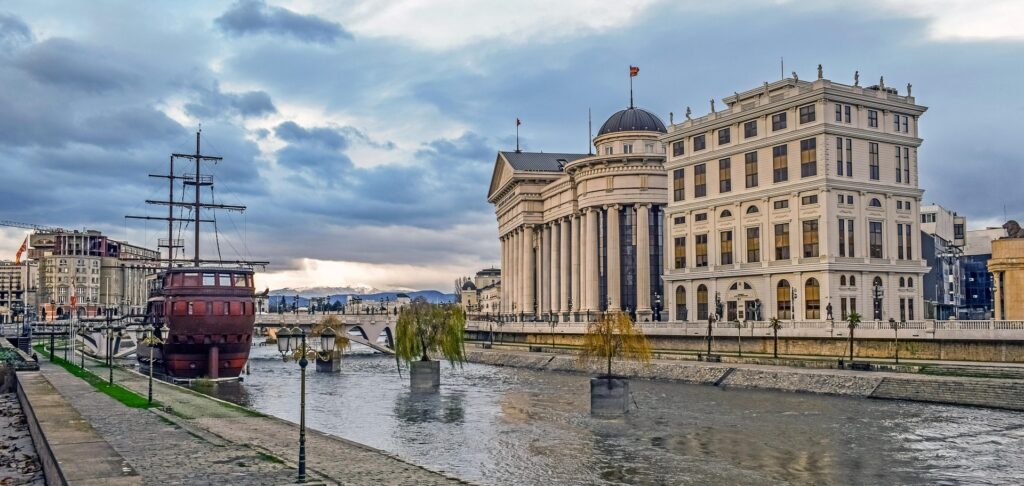
North Macedonia: Where a nation spent twenty-seven years negotiating with its neighbor over the right to use its own name, changed its constitution, renamed its airport, relabeled its statues, and added a single word to its identity — not because it lost but because it decided that being included was worth more than being right — while sitting on the shore of a lake three million years old that has never needed anyone’s permission to exist.
North Macedonia in 30 Seconds
A landlocked Balkan country smaller than Maryland, wedged between Greece, Albania, Kosovo, Serbia, and Bulgaria — each of which has, at various points, claimed some portion of its territory, its history, or its name. When the country declared independence from Yugoslavia in 1991 and called itself the Republic of Macedonia, Greece objected. The name Macedonia, Greece argued, belonged to the northern Greek province that was the cradle of Alexander the Great’s empire — and a neighboring country using the same name implied territorial claims on Greek land and appropriation of Greek heritage. For twenty-seven years, the dispute blocked the country from joining NATO and the European Union. At the United Nations, it was forced to sit under the provisional title Former Yugoslav Republic of Macedonia. In 2018, after negotiations mediated by the UN for over two decades, the two prime ministers signed the Prespa Agreement at a lake on their shared border. The country became North Macedonia. It changed its constitution. It renamed its airport, which had been called Alexander the Great. It relabeled its highway, which had been called Philip II. Statues of ancient Macedonian kings erected in Skopje were rededicated to Greek-North Macedonian friendship. The agreement explicitly stated that North Macedonia’s language and culture are not related to the ancient Hellenic civilization. Nationalists on both sides called it betrayal. The referendum in North Macedonia drew only thirty-seven percent turnout. Both governments that signed it were voted out of office. And in 2020, North Macedonia became NATO’s thirtieth member.
Evoke — Why You Visit North Macedonia
You come to North Macedonia because you have been holding onto the name of the thing you built — the original brand, the first vision, the version that felt like yours — and a more powerful entity told you it could not be called that. You have been wondering whether changing the name means losing the identity. North Macedonia will show you it does not. The Prespa Agreement was not a surrender. It was a transaction — the most coldly rational act of self-interest a young nation has ever performed. For twenty-seven years, insisting on the name Macedonia meant being locked out of NATO and the EU while Greece, already inside both, held the veto. The name was beautiful. The name was historically defensible. The name was also a wall. Adding North to Macedonia cost the country nothing it had not already been denied. It cost the country nothing it actually possessed. The lake is still Ohrid. The language is still Macedonian. The people still call themselves Macedonian. What changed was a single word on a passport and the removal of a veto that had frozen the country in diplomatic limbo for a generation. You come because you have been told that compromise is defeat. North Macedonia will show you that compromise is a door — and that the people who refuse to walk through it are still standing in the hallway.
Explore — How You Experience North Macedonia
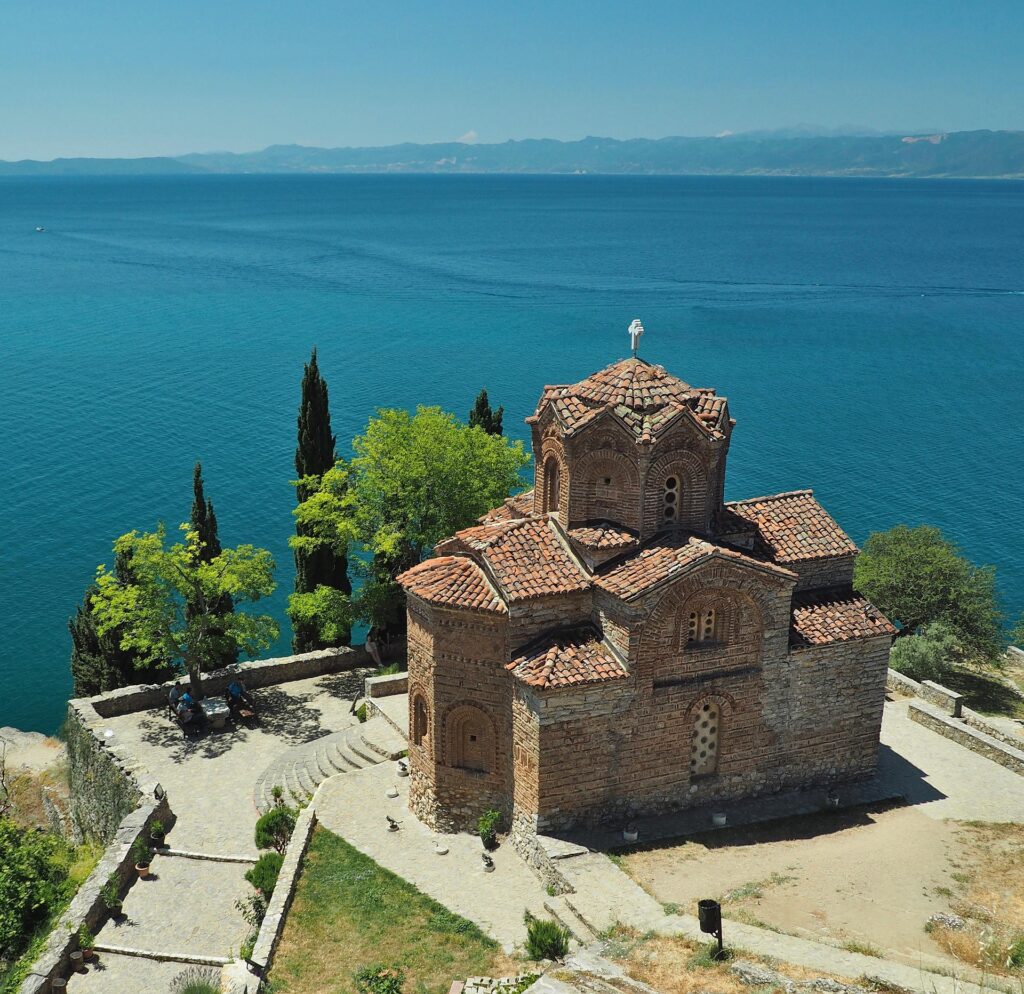
Travel to Lake Ohrid — three million years old, nearly three hundred meters deep, one of the oldest and deepest lakes in Europe, home to over two hundred endemic species that exist nowhere else on earth, its waters so clear that visibility extends twenty meters, fed by underground springs that filter through limestone from neighboring Lake Prespa. On its shores sits the town of Ohrid, one of the oldest continuously inhabited settlements in Europe, once called the Jerusalem of the Balkans for the three hundred and sixty-five churches it reportedly contained — one for every day of the year. The Church of Saint John at Kaneo perches on a cliff above the water, one of the most photographed sites in the Balkans, built in the thirteenth century in a location so beautiful that no renovation has ever improved on the original placement. This is where Saint Clement of Ohrid — the same Clement who helped create the Cyrillic alphabet in Bulgaria — established the first Slavic university, training thirty-five hundred students in a single generation. Walk through Skopje, the capital rebuilt in brutalist concrete after a catastrophic earthquake in 1963 destroyed eighty percent of the city, then overlaid in the 2010s with a controversial nation-building project called Skopje 2014 that added neoclassical facades, baroque bridges, and dozens of statues — including the enormous Warrior on a Horse in the central square, widely understood to represent Alexander the Great though never officially named as such. After the Prespa Agreement, a plaque was added identifying it as a monument to Greek-North Macedonian friendship. The horse did not move. The warrior did not change. Only the label changed. And the country moved forward.
Evolve — Who You Become in North Macedonia
You leave North Macedonia understanding that identity is not the label — it is the thing beneath the label. The lake is three million years old and has never been called the same name by any two empires that ruled its shores. The Cyrillic alphabet was refined here by the same scholars Bulgaria claims. The ancient kingdom that gives the region its name is claimed by Greece. The language is disputed by Bulgaria. The territory has been divided, conquered, renamed, and reassigned so many times that the only constant is the people who remained. And they remained. Not by holding the name but by holding the ground. You come home and look at the thing you renamed — the project that was rebranded, the company that pivoted, the identity you changed because someone with more leverage told you to — and you stop treating the name change as a wound. North Macedonia did not lose Macedonia. It added North. The warrior is still on the horse. The lake is still three million years old. The airport is still in Skopje. Only the sign changed. And the planes finally take off.
Your practical guide to North Macedonia starts bellow 👇
🕰️ North Macedonia Historical Backdrop
North Macedonia’s history is a “Multi-Layered Audit” of the Balkan experience. Positioned as a “Strategic Buffer” between the Byzantine and Ottoman Empires, it has managed “Core Asset Preservation” of its identity for millennia. Its story is told in the ancient theater of Ohrid, the monumental stone bridges of Skopje, and the 19th-century “Consular Glory” of Bitola. Following its peaceful “Portfolio Spin-off” from Yugoslavia in 1991, the nation has navigated a “High-Volatility Evaluation Period” to re-emerge as a modern candidate for European integration. Today, it stands as a “Historical Vault”; a land where the legacy of Alexander the Great and the humility of Mother Teresa reflect a nation that has mastered the art of the “Resilient Roadmap.”
🌟 North Macedonia Local Experiences
Beyond the monuments, discover Macedonia’s soul in the ritual of the “Ajvar Audit”—the communal autumn tradition of roasting red peppers to create “Macedonian Caviar,” a proven example of “Slow-Yield” culinary excellence. Experience the profound “Acoustic Stillness” of the Monastery of Saint Naum, the intoxicating scent of Turkish coffee in the Old Bazaar, or the simple joy of sharing a Tavče Gravče (baked beans) in a village tavern. Whether it’s participating in the exuberant “Galichnik Wedding” or exploring the trendy “Debar Maalo” district in Skopje, these moments reveal a nation that finds its greatest margin in the balance of unhurried living and intense communal warmth.
🌄 North Macedonia Natural Wonders
- Lake Ohrid: A UNESCO-listed “Primary Asset,” one of the oldest and deepest lakes in Europe, home to 200 endemic species and prehistoric “natural data.”
- Matka Canyon: A spectacular gorge just outside the capital, featuring emerald waters, hidden caves, and medieval monasteries tucked into the cliffs.
- The Painted Mosque (Šarena Džamija): A masterpiece of Ottoman design in Tetovo, decorated with over 30,000 egg-tempera paintings.
- Kokino Megalithic Observatory: A 4,000-year-old “Scientific Infrastructure” site ranked by NASA as the world’s fourth oldest astronomical observatory.
- Vevčani Springs: A powerful natural “Water Asset” where dozens of springs emerge from the mountain, celebrated in an annual pagan-rooted carnival.
🏙️ North Macedonia Must-See Cities & Regions
- Skopje: (Capital) A fascinating “Architecture Audit” where a massive neoclassical face-lift meets an authentic 15th-century Ottoman Bazaar and brutalist Soviet-era landmarks. (Dynamic, Eclectic, Historic)
- Ohrid: The “Jerusalem of the Balkans,” a spiritual Tier 1 asset featuring 365 churches—one for every day of the year—set against a pristine lake. (Spiritual, Picturesque, Ancient)
- Bitola: The “City of Consuls,” known for its elegant Shirok Sokak promenade and the ancient ruins of Heraclea Lyncestis. (Elegant, Neoclassical, Archaeological)
- Kruševo: The highest town in the Balkans, a “Defensive Staple” of Macedonian independence and home to the futuristic Makedonium monument. (Highland, Historic, Quirky)
- Strumica: The center of the fertile southeast, famous for its Roman baths and vibrant agricultural culture. (Lush, Sunny, Traditional)
🏞️ North Macedonia National Parks & Nature Reserves
Managed with a focus on preserving the “Fundamental Quality” of the Dinaric Alps.
- Mavrovo National Park: The largest park in the country, home to the sunken church of St. Nicholas and the nation’s premier ski resort.
- Pelister National Park: Famous for its “Stone Rivers” and the rare five-needle Molika pine trees.
- Galičica National Park: A “Strategic Bridge” between Lake Ohrid and Lake Prespa, offering 360-degree views of two countries from its peaks.
🏛️ UNESCO World Heritage Sites
- Natural and Cultural Heritage of the Ohrid Region — One of the few sites in the world inscribed for both its natural and cultural significance.
- Ancient and Primeval Beech Forests — Protecting the Dlboka Reka region as a “Biological Reserve.”
- For more information, visit the UNESCO North Macedonia Portal.
🖼️ North Macedonia Museums & Cultural Sites
- Mother Teresa Memorial House (Skopje): Built on the site of the church where the Nobel laureate was baptized.
- Museum of the Macedonian Struggle: A “Data-Driven Validation” of the nation’s 20th-century path to sovereignty.
- Bay of Bones (Museum on Water): A reconstruction of a prehistoric pile-dwelling settlement on Lake Ohrid.
- Stone Bridge (Skopje): A 15th-century “Operational Connector” linking the old and new parts of the city.
🎉 North Macedonia Festivals & Celebrations
- Ohrid Summer Festival: (July–August) A world-class “Cultural Reallocation” of music and drama held in the ancient theater and churches.
- Galichnik Wedding Festival: (July) A high-intensity “Traditional Audit” where a single couple is chosen to wed using centuries-old rituals in a remote mountain village.
- Strumica Carnival: (Spring) A vibrant masked parade reflecting ancient fertility rites and modern satire.
- Skopje Jazz Festival: (October) Showcasing the capital’s high-frequency artistic energy.
🧽 How to Arrive
- ✈️ By Air
- Skopje International (SKP) and Ohrid St. Paul the Apostle (OHD) are the primary gateways.
- Tactical transits via Istanbul (Turkish Airlines/Pegasus) offer a seamless, sub-7 hour “Total Flight Time” to Skopje.
- 🚗 By Road
- North Macedonia is a key “Logistics Node” on Corridor 10. Driving is on the right.
- 🚆 By Rail
- Limited international service; however, the domestic line from Skopje to Bitola offers a “Low-Friction” scenic overview of the interior.
📶 Stay Connected
- SIM Cards: Major providers are Makedonski Telekom and A1.
- Where to buy: Kiosks (Tobacco shops) and official stores are 24/7 at the airport and throughout the city. Registration with a passport is standard.
- eSIM: Supported by major providers and available via global platforms like Airalo.
- Digital Infrastructure: High-speed Wi-Fi is a “Standard Provision” in all Skopje and Ohrid cafes.
🏨 Where to Stay
North Macedonia offers a “Diversified Portfolio” ranging from five-star brutalist-luxe to “High-Margin” lakeside boutique stays.
- Skopje Marriott Hotel: A Tier 1 asset in the heart of Macedonia Square.
- Villa Malo Ohrid: A boutique, art-filled “Core Asset” in the historic Old Town of Ohrid.
- Bushi Resort & Spa (Skopje): Located in the Old Bazaar, offering a high-margin fusion of Ottoman atmosphere and modern wellness.
- Mountain Huts (Mavrovo): For an authentic “Off-Grid Audit,” stay in traditional stone houses in the village of Janče.
⛳ Unique Finds
- Ohrid Pearls: Learn why these “Synthetic-Natural” hybrids—made using the scales of the Plasica fish—are a “Proven Example” of secret family industrial patents.
- Opanci: Purchase traditional leather footwear, a “Primary Commodity” of the Balkan shepherd.
- Mastika: Sample the anise-flavored liqueur, the “Defensive Staple” of Macedonian social gatherings.
🤝 North Macedonia Cultural Guidance
- Merak: The most important “Health Benchmark.” It refers to the feeling of bliss derived from simple pleasures. Don’t rush; practice Merak.
- Coffee Etiquette: A coffee invitation is a “Mandatory Review” of your social standing. It can last for hours—budget your time accordingly.
- Directness: Macedonians are warm and informal but appreciate “Fundamental Respect” for their history and name.
- Basic Phrases:
- Hello: “Zdravo”
- Thank you: “Fala”
- How are you?: “Kako si?”
- Cheers: “Nazdravje!”
🛂 North Macedonia Entry & Visa Requirements
- Visa Policy: Citizens of the UK, US, Canada, EU, and many GCC nations (including Qatar) can enter visa-free for up to 90 days.
- Schengen Alignment: A valid multiple-entry Schengen visa often allows entry—check the Ministry of Foreign Affairs for current “Operational Updates.”
💰 Practical Essentials
- Currency: Macedonian Denar (MKD). It is a “Stable Asset” pegged to the Euro. Cash is essential for bazaars and small towns.
- Electricity: Type F (European round pins). Voltage is 230V.
- Safety: Consistently ranked as a safe, low-volatility destination for travelers. Use the Cammeo or Global Taxi apps in Skopje for pricing transparency.
- Climate: Best visited in Late Spring (May-June) or September for the “Golden Harvest” and mild “Defensive” temperatures.
✨ Bonus Tip: The Merak Audit
To truly embrace North Macedonia, you must perform a “Merak Audit.” Most travelers treat Skopje as a 24-hour layover. Instead, take a seat in the Old Bazaar at 10:00 AM. Order a Turkish tea and watch the sun move across the stone cobbles. Do nothing else for one hour. It is in this “Intentional Deceleration”—away from the noise of the global markets—that your own internal “Fundamental Quality” and long-term strategic clarity will finally reveal themselves.
🔗 Featured Links
- Official Tourism: Explore Macedonia.
- National Parks: NP Mavrovo Official.

Beyondia
Travel CompanionReal digital nomad. I travel. I learn. I grow.
What about you? Where are you going?