GoBeyondia Atlas 🗺️ Nordic-Western Europe 🗾
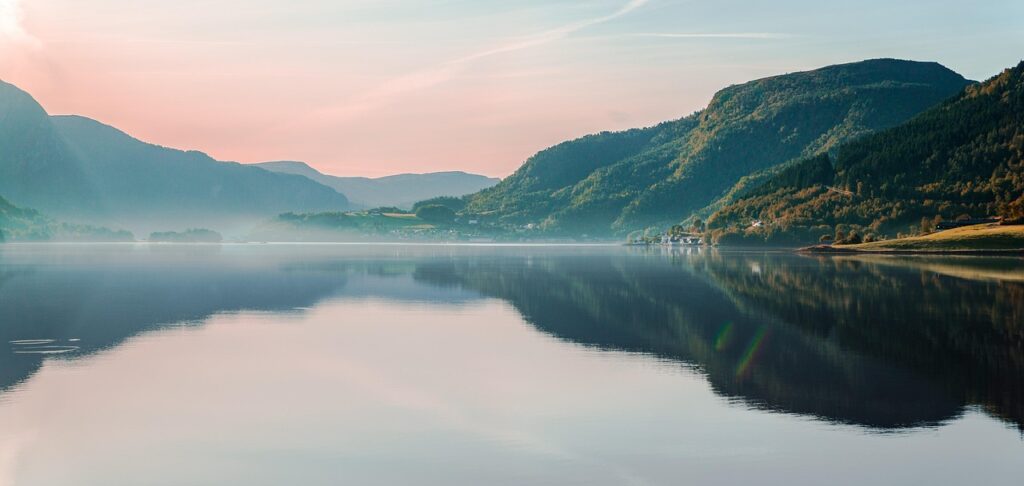
Norway: Where glaciers carved corridors through mountains that the ocean filled and the northern lights perform above fishing villages that have been watching them for a thousand years.
Norway in 30 Seconds
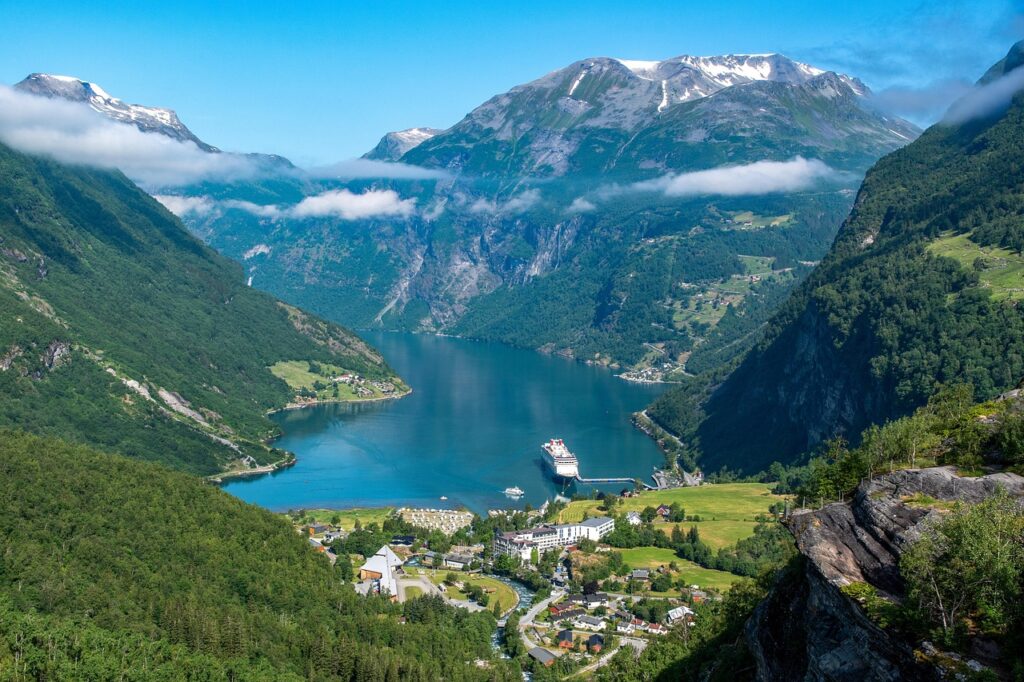
A country that runs 2,500 kilometers from southern forests to Arctic archipelago, its western edge dissolved into 50,000 islands and a coastline so indented by fjords that if straightened it would wrap around the equator twice — a geographical excess that the Norse settlers of the ninth century navigated by longship with a precision that modern GPS users find humbling. The fjords are Norway’s defining argument with the rest of the world’s landscapes — Sognefjord runs 204 kilometers inland and drops 1,300 meters deep, its walls rising sheer from black water to snowfield in a vertical compression of geology that makes every other scenic drive feel like a parking lot. Bergen sits at the western gateway, its Bryggen wharf of painted wooden Hanseatic trading houses leaning slightly into each other like old friends sharing weight, the fish market below selling the same species from the same waters it has sold since the twelfth century. Oslo operates as a different Norway — the capital city running on oil fund confidence, its waterfront museums housing Viking ships and Munch’s Scream and a city that managed to become genuinely contemporary without apologizing for its Norse foundations. The Lofoten Islands in the Arctic Circle are the Norway that Instagram discovered and couldn’t adequately represent — red and yellow fishing villages on stilts above water so still it produces perfect inversions, the midnight sun turning everything gold at 2am, the winter darkness broken by aurora displays so intense they cast shadows. Svalbard at 78 degrees north is where Norway becomes something else entirely — polar bears outnumber people, the sun disappears for four months, glaciers calve into fjords with sounds like artillery, and the silence between those sounds is the most complete silence available to a person who isn’t an astronaut.
Evoke — Why You Visit Norway
You come to Norway because your relationship with beauty has become passive. You consume it — through screens, through other people’s photographs, through windows of moving vehicles — without being inside it, without letting it cost you anything. Norway requires physical participation. The fjords don’t deliver themselves to you from a comfortable distance — you kayak them, hike above them, take ferries through them in weather that has opinions about your plans. The Besseggen ridge above Jotunheimen requires four hours of hiking with your hands as much as your feet, and the view from the top — two lakes of different colors on either side of a ridge narrow enough to straddle — is available only to people who arrived with their bodies, not their cameras extended at arm’s length from a parking area. You’ve been consuming experiences rather than having them and you know the difference by now. Norway will close that gap. It will make you earn what you see and the earning will be the best part, which is what the Norse concept of friluftsliv — open air life as a philosophical practice rather than a recreational activity — has been arguing since Ibsen and Nansen formalized what Norwegian farmers had been doing since before philosophy had a name for it.
Explore — How You Experience Norway
Take the Flåm Railway from Myrdal down to the Sognefjord — twenty kilometers of track that descends 865 meters through mountain passes, past waterfalls that emerge directly from rock faces, through tunnels bored by hand in the 1940s, arriving at the fjord’s edge in Flåm where the water is so calm and the mountains so vertical that the reflection below is indistinguishable from the original above, and you stand at the edge understanding that the planet produced this without assistance and you have been taking that for granted. Kayak the Nærøyfjord — the narrowest of the major Norwegian fjords, UNESCO listed, its walls so close overhead that the sky becomes a strip of light between cliff faces that rise 1,700 meters from the water — in a silence broken only by your paddle’s entry and exit and the occasional waterfall arriving from a height so extreme it has atomized into mist before reaching the fjord’s surface. Hike Trolltunga — the troll’s tongue rock formation projecting horizontally over Lake Ringedalsvatnet 700 meters below — in the window between July and September when the snow has retreated enough to make the ten-hour return trail passable, arriving at the platform to find the view so disorienting that your body refuses to approach the edge before your mind has processed what it’s seeing, which takes longer than you expect. Drive the Atlanterhavsveien — the Atlantic Road — across a series of bridges between small islands in weather that produces waves crashing over the road surface in salt explosions that other countries would close the road for and Norway considers scenery. Sit in a Lofoten fishing village at 1am in late June when the midnight sun has turned the harbor gold and the fishing boats are still because the day never ended and time has stopped being a reliable navigational tool, and eat stockfish — air-dried cod that has been preserving itself in Arctic wind since the Viking age — with butter and flatbread at a table outside because there is no reason to be inside when the light is doing this. Take the Hurtigruten coastal ferry from Bergen northward through eleven days of fjords and fishing towns and Arctic ocean, arriving in Kirkenes near the Russian border having watched Norway’s full geographic biography pass by a window that required no itinerary and no decisions except which side to sit on, which is always starboard heading north.
Evolve — Who You Become in Norway
You leave Norway with friluftsliv not as a word you learned but as a practice you adopted — the Norwegian understanding that the natural world is not a backdrop for human activity but the activity itself, that being outside in genuine weather with your actual body is not a hobby but a psychological necessity that urban life has been substituting with inferior alternatives. You stop waiting for perfect conditions to go outside. You buy better rain gear and go anyway, which is the Norwegian solution to the Norwegian weather and the Norwegian approach to most problems. You carry the fjords’ specific lesson about scale — the way Sognefjord’s 204-kilometer length and 1,300-meter depth makes the word impressive retire from your vocabulary because nothing in your ordinary life will qualify for it again, which is clarifying rather than disappointing. The aurora stays with you longest — not the photographs, which flatten it into a green smear against black sky, but the physical experience of standing in Lofoten cold watching light that is simultaneously color, movement, sound at a frequency below hearing, and the visible evidence of the sun’s relationship with the earth’s magnetic field, which is the most romantic thing physics has ever produced. You develop a permanent preference for difficulty that delivers something real over comfort that delivers nothing. Norway made that distinction impossible to unknow. You start applying it to choices that have nothing to do with mountains and everything to do with how a life accumulates meaning versus how it accumulates ease.
Your practical guide to Norway starts bellow 👇
🕰️ Norway Historical Backdrop
Norway’s history is a legendary saga of seafaring exploration and resilience at the edge of the world. From the daring Viking age and the medieval grandeur of the Hanseatic wharf in Bergen to the peaceful dissolution of its union with Sweden in 1905, Norway has always been defined by its relationship with the sea and the rugged terrain. Its story is told in the intricate carvings of stave churches, the perfectly preserved polar exploration ships in Oslo, and the colorful, wind-swept fishing villages of the Lofoten Islands. Today, Norway is a global leader in sustainability and social well-being, a nation that has successfully balanced its vast natural wealth with a profound commitment to environmental preservation and a high-tech, egalitarian society.
🌟 Norway Local Experiences
Beyond the panoramic viewpoints, discover Norway’s soul in the cherished daily ritual of friluftsliv—the philosophical commitment to “outdoor life” that sees locals heading into the mountains regardless of the weather. Experience the profound stillness of a kayak journey through a silent fjord, the exhilarating warmth of a wood-fired sauna followed by a plunge into the Arctic Sea, or the simple joy of kos (coziness) with a warm drink by a fireplace in a remote cabin. Whether it’s foraging for cloudberries in the summer tundra or chasing the Aurora Borealis across a frozen plateau, these moments reveal a nation that finds its greatest strength and peace in the rhythm of the wilderness.
🌄 Norway Natural Wonders
- Geirangerfjord & Nærøyfjord: UNESCO-listed fjords famous for their dramatic steep walls and magnificent waterfalls.
- Preikestolen (Pulpit Rock): A massive flat-topped cliff rising 604 meters above Lysefjord, offering one of the world’s most spectacular natural viewing platforms.
- The Lofoten Islands: An archipelago known for its jagged peaks, turquoise waters, and traditional red fishing huts (rorbuer).
- North Cape (Nordkapp): The northernmost point of mainland Europe, where the Atlantic and Arctic oceans meet under the midnight sun.
- Trolltunga (Troll’s Tongue): A spectacular rock formation hovering 700 meters above Lake Ringedalsvatnet, a magnet for serious hikers.
- Svalbard: A remote Arctic territory home to polar bears, glaciers, and the midnight sun, offering a true frontier experience.
🏙️ Norway Must-See Cities & Regions
- Oslo: (Capital) A sophisticated, green capital blending world-class architecture like the Opera House with the historic Akershus Fortress and vast city forests. (Modern, Cultural, Green)
- Bergen: The “Gateway to the Fjords,” famous for the UNESCO-listed Bryggen wharf, its vibrant fish market, and the seven mountains that surround the city. (Historic, Maritime, Atmospheric)
- Ålesund: An architectural jewel rebuilt in the Art Nouveau style, set across several islands at the mouth of the Geirangerfjord. (Architectural, Coastal, Picturesque)
- Tromsø: The “Paris of the North,” a vibrant Arctic city and a premier hub for Northern Lights hunting and polar research. (Arctic, Lively, Scientific)
- Trondheim: The nation’s historical and religious capital, home to the magnificent Nidaros Cathedral and colorful old warehouses along the river. (Historic, Academic, Traditional)
🏞️ Norway National Parks & Nature Reserves
Managed with a “Right to Roam” philosophy by the Norwegian Environment Agency.
- Jotunheimen National Park: Home to Norway’s highest peaks and iconic hiking routes like Besseggen Ridge.
- Hardangervidda National Park: Europe’s largest mountain plateau and home to massive wild reindeer herds.
- Svalbard Archipelago: Protecting the unique Arctic wilderness and its endangered polar wildlife.
🏛️ UNESCO World Heritage Sites
- Bryggen — The historic Hanseatic wharf of Bergen.
- Urnes Stave Church — A masterpiece of wooden architecture dating back to the 12th century.
- Røros Mining Town and the Circumference — An exceptionally preserved 17th-century wooden mining settlement.
- West Norwegian Fjords – Geirangerfjord and Nærøyfjord — Among the world’s longest and deepest fjords.
- Vegaøyan – The Vega Archipelago — A cultural landscape reflecting sustainable living on the Arctic edge.
- For a full list, visit the UNESCO Norway Portal.
🖼️ Norway Museums & Galleries
- MUNCH (Oslo): Dedicated to the life and works of Edvard Munch, featuring multiple versions of The Scream.
- The Fram Museum (Oslo): Tells the story of Norwegian polar exploration, housing the strongest wooden ship ever built.
- KODE Art Museums (Bergen): One of the largest museums for art, design, and music in the Nordic countries.
- Norwegian Museum of Cultural History (Norsk Folkemuseum): An open-air museum in Oslo showcasing historic buildings from across the country.
🎉 Norway Festivals & Celebrations
- Constitution Day (May 17): The most significant national holiday, celebrated with colorful children’s parades and traditional costumes (bunad) in every town.
- Bergen International Festival: (May/June) A major performing arts festival featuring music, theatre, and dance.
- Midnight Sun Marathon (Tromsø): (June) An extraordinary race run in broad daylight in the middle of the night.
- Øya Festival (Oslo): (August) One of Norway’s largest and most sustainable music festivals.
🧽 How to Arrive
- ✈️ By Air
- 🚆 By Rail
- Vy (formerly NSB) operates a spectacular rail network. The Bergen Railway (Oslo-Bergen) is often cited as one of the world’s most beautiful train journeys.
- 🚢 By Sea
- Hurtigruten and Havila Voyages operate the legendary coastal express route between Bergen and Kirkenes.
- 🚗 By Road
- Norway is part of the Schengen Area. Roads are exceptionally well-maintained but winding. Driving is on the right. Electric vehicles (EVs) are ubiquitous, and charging infrastructure is world-leading.
📶 Stay Connected
- SIM Cards: Major providers are Telenor, Telia, and Ice.
- Where to buy: Kiosks (Narvesen or 7-Eleven) at airports and city centers. Passport registration is required.
- eSIM: Supported by all major providers and available via global platforms like Airalo.
🏨 Where to Stay
Norway offers everything from minimalist design hotels to historic wooden hotels and remote wilderness lodges.
- The Thief (Oslo): A design-led hotel in the Tjuvholmen district, housing original artworks.
- Juvet Landscape Hotel: An architectural icon near Geirangerfjord where glass walls bring the forest into your room.
- Sorrisniva Igloo Hotel (Alta): The world’s northernmost ice hotel, rebuilt every winter.
- DNT Cabins: The Norwegian Trekking Association manages over 500 cabins in the mountains for hikers of all levels.
- Major international hotel chains Accor, Marriott, Radisson
⛳ Unique Finds
- The Atlantic Ocean Road: A breathtaking stretch of road hopping across islands with iconic “stairway to heaven” bridges.
- Fjord Floating Saunas: Experience the “sauna-and-plunge” ritual in the heart of Oslo harbor or Bergen’s fjords.
- The Global Seed Vault (Svalbard): Visit the outside of the “Doomsday Vault,” designed to protect the world’s plant biodiversity.
🤝 Norway Cultural Guidance
- Law of Jante: A social philosophy emphasizing equality and humility; avoid flashy displays of wealth or bragging.
- Punctuality: Being on time is highly valued in both social and business settings.
- Outdoor Etiquette: Follow the “Leave No Trace” principle. Norwegians take environmental stewardship very seriously.
- Basic Phrases:
- Hello: “Hei” (Hay)
- Thank you: “Takk” (Tah-k)
- Yes / No: “Ja” / “Nei”
- Cozy: “Koselig” (Koo-se-lee)
🛂 Norway Entry & Visa Requirements
- Schengen Area: Norway is a full member of the Schengen Area. Citizens of the UK, US, Canada, Australia, and EU member states do not require a visa for stays up to 90 days.
- Official Source: Consult the Norwegian Directorate of Immigration (UDI).
💰 Practical Essentials
- Currency: Norwegian Krone (NOK). Norway is virtually cashless. Even the smallest street vendors and mountain huts accept cards or mobile payments.
- Electricity: Type C and F (Two round pins). Voltage is 230V.
- Safety: One of the safest countries in the world. The primary danger is the unpredictable nature—always check mountain weather forecasts at Yr.no.
- Climate: Warmed by the Gulf Stream, the coast is milder than the latitude suggests. Best visited in June-August for hiking or January-March for winter sports and Northern Lights.
✨ Bonus Tip
To truly embrace Norway, you must surrender to the weather. Norwegians have a saying: “Det finnes ikke dårlig vær, bare dårlige klær” (There is no such thing as bad weather, only bad clothing). Don’t wait for the sun to come out to start your adventure. Put on your wool layers and waterproofs, and head outside. It is in the damp moss of a forest or the biting wind of a mountain pass that the true, resilient spirit of Norway reveals itself—and where you will find your own evolving sense of vitality.
🔗 Featured Links
- Official Tourism: Visit Norway.
- Weather Forecasts: Yr.no.
- Mountain Safety: Varsom.no.
🔍 Related GoBeyondia Stories
🌐 Around the World with Beyondia Video Episodes
- Oslo 🇳🇴 The city that owns a piece of everything you buy
- Ålesund 🇳🇴 Why this Norwegian town looks like a painting
- Trondheim 🇳🇴 The Cathedral Where a Viking King Is Buried — and Nobody Knows Where
- Lofoten 🇳🇴 Why the Arctic isn’t just ice and snow
- Alta 🇳🇴 They Lost the Dam. They Won Everything Else.
- Nordkapp 🇳🇴 The Most Famous Point in Europe Is on the Wrong Piece of Land

Beyondia
Trusted Travel CompanionReal digital nomad. I travel. I learn. I grow.
What about you? Where are you going?