🌐 Around the World with Beyondia 🧵 Nordic & Western Europe Region 🪡 Episode 54: Évora
Inside the Igreja de São Francisco in Évora, three Franciscan friars in the early 1600s built a small chapel eighteen metres long by eleven metres wide. They decorated its walls, columns, and ceiling with the exhumed skeletons of approximately five thousand people from the town’s forty-three overcrowded cemeteries. They arranged the bones geometrically — skulls in the walls at regular intervals, femurs stacked as pillars, ribs in decorative bands — and inscribed over the entrance: ‘We bones that are here, for yours we wait.’ It is small, dim, and quiet. Every visitor slows down when they enter. Some cry. Some pray. Some — like me — stand still for a long time and are honestly not sure what to feel. This is what the chapel was designed to do. Four hundred years later, it is still doing it.
Évora is a small city in the Alentejo
Évora is a small city in the Alentejo — Portugal’s largest region by area, one of its least densely populated, and one of the most agriculturally distinctive parts of Europe. The city sits approximately 130 kilometres east of Lisbon and 100 kilometres inland from the Atlantic coast, at the centre of a landscape of golden-brown rolling plains, scattered cork-oak and holm-oak forests, and the specific silence that comes from population densities of around 20 people per square kilometre. The walled town itself has a permanent population of approximately 55,000, most of it inside or immediately outside the medieval walls, and receives approximately 700,000 visitors per year — a ratio that would overwhelm many Alentejo towns but that Évora absorbs without losing its lived-in character. The town is a UNESCO World Heritage Site (inscribed 1986), and the inscription covers not individual monuments but the entire walled city and its accumulated architectural layers. This is significant. Most UNESCO inscriptions in Portugal cover specific buildings or complexes — the Monastery of Batalha, the Convent of Christ at Tomar, the Belém Tower in Lisbon, the historic centre of Porto. Évora is inscribed as an integrated urban ensemble. What UNESCO recognised in 1986 is that the town itself — the walls, the streets, the buildings, the accumulated layers of Roman, Moorish, Reconquista, Renaissance, Habsburg, and modern Portuguese occupation — functions as a single continuous cultural artifact.
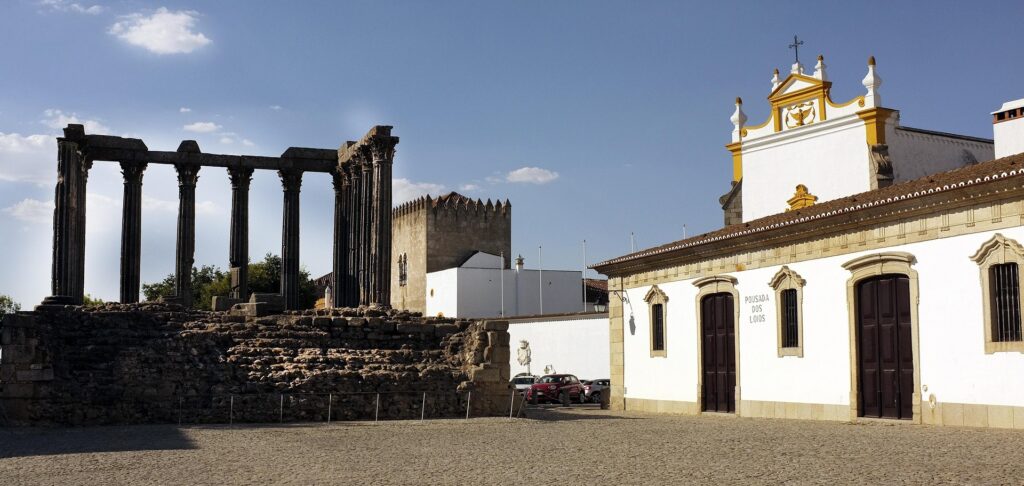
The layers are worth naming individually because their density is unusual even by European small-city standards. The Romans founded Évora as Ebora Cerealis — Ebora of the Cereals, referencing the agricultural productivity of the surrounding Alentejo plains — probably in the 1st century BC, and the town became a substantial regional centre under the empire. The Roman Temple at the highest point of the town — commonly called the Templo de Diana, though this attribution is medieval and probably incorrect, with the temple most likely originally dedicated to the Roman imperial cult — is one of the best-preserved Roman temples in the Iberian peninsula, with fourteen of its original Corinthian columns still standing on their original granite podium. The temple’s survival is due to a specific historical accident: in the medieval period it was walled up and used as a butcher’s shop and slaughterhouse, protecting its Roman fabric from the systematic dismantling for building stone that destroyed most Roman monuments in medieval Iberia. It was rediscovered and cleaned in the 19th century, and now stands in the small square below the cathedral as one of the most photographed monuments in Portugal.
Roman Évora was captured by the Visigothic Kingdom
Roman Évora was captured by the Visigothic Kingdom in the 5th century and by the Umayyad Caliphate in 715 AD, entering approximately four hundred years of continuous Islamic rule as Moorish Yeburah. The Moors expanded the town’s walls, developed the surrounding irrigation-agriculture, and made Évora a substantial regional centre in the Al-Andalus period. The town was recaptured for the Christian Kingdom of Portugal by the knight Geraldo Sem Pavor (“Geraldo the Fearless”) in September 1165 — a specific event that is now commemorated by the central Praça do Giraldo (named for Geraldo) in the heart of the walled town. Under Portuguese rule from 1165 onwards, Évora developed as a royal residence and a substantial ecclesiastical centre — the Sé de Évora cathedral was begun in 1186, expanded across the 13th century, and completed in its main form by the early 14th century, and it remains the largest medieval cathedral in Portugal by floor area. The distinctive fortress-like character of the cathedral — square granite towers, minimal ornamentation on the exterior, defensive rather than decorative walls — reflects both the frontier position of Évora during the ongoing Reconquista and the specific austere Cistercian architectural influence on Portuguese medieval religious building.
The medieval town was substantially expanded during the 14th and 15th centuries, and reached a distinct cultural peak in the late 15th and 16th centuries as one of the frequent royal residences of the Portuguese Aviz dynasty. Kings João II, Manuel I, and João III spent extended periods in Évora, and the town became a centre of Portuguese Renaissance humanism, court patronage, and religious institutional development. The Igreja de São Francisco was constructed between approximately 1480 and 1510, initially as a royal Franciscan monastery church under the patronage of King João II. The church itself is a substantial late-Gothic and Manueline structure — the Manueline being the distinctively Portuguese architectural style of the Aviz dynasty period, combining Gothic structural elements with maritime and exotic decorative motifs derived from the Portuguese overseas voyages. The church is worth visiting in its own right. But what most visitors come to see is a small side chapel added between approximately 1600 and 1610 by three Franciscan friars — the Capela dos Ossos, the Chapel of Bones, one of the more remarkable small religious spaces in Europe and the article’s central subject.
The chapel’s construction was a response to a specific practical problem. Sixteenth-century Évora had approximately 43 monastic cemeteries within and around the town walls, and by the late 16th century they were reaching capacity. Christian burial practice required interring the dead in consecrated ground, which was limited in a small walled town, and the cemeteries were becoming overcrowded, sanitary conditions were deteriorating, and the community faced a genuine urban-planning problem that had no easy religious solution. The Franciscan friars of the Igreja de São Francisco proposed a systematic response: exhume the accumulated remains from the overfull cemeteries, clean and sort the bones, and arrange them in a small chapel as an architectural memorial to human mortality — a memento mori meditation space that would honour the dead while freeing the cemetery space for continued use. Approximately 5,000 skeletons were exhumed and processed. The bones were sorted by type — skulls, long bones, ribs, vertebrae — cleaned, and arranged in the chapel’s walls, columns, and ceiling in specific geometric patterns. Skulls were set into the walls at regular intervals in horizontal bands. Femurs and tibias were used as vertical decorative pillars. Ribs and smaller bones were arranged in decorative geometric patterns filling the spaces between the larger elements. The chapel was consecrated in the early 17th century and has been open to visitors — first religious pilgrims, then general public — continuously since.
The famous inscription over the entrance — “Nós ossos que aqui estamos pelos vossos esperamos” (“We bones that are here, for yours we wait”) — was added at some point after the chapel’s initial construction; the exact date is uncertain but the inscription is well-documented from the 18th century onwards. It is one of the more memorable single sentences in European religious art. The inscription does not ask the visitor to imagine death abstractly. It addresses the visitor directly and states, without decoration or metaphor, the basic biological continuity between the bones in the chapel and the bones inside the visitor’s own body. This is what a memento mori is designed to do — to make mortality specific rather than abstract, personal rather than theoretical. The inscription accomplishes this in fourteen words.
Two mummified corpses hang on the wall opposite the entrance — one adult, one small child. Traditional local narrative identifies them as a father and son who were punished by a curse for cruelty, though the historical basis for this attribution is uncertain and probably folklore. What is documented is that both bodies were mummified rather than skeletonised — a result of specific desiccation conditions during their initial burial that preserved the skin and hair — and that they were added to the chapel some time after the initial 5,000-skeleton installation, probably in the 18th or 19th century, as objects of specific meditation. Their presence in the chapel is disturbing for most visitors in a way that the geometric bone-arrangements are not: the bones are architectural, formalised into decoration, and can be viewed with some emotional distance. The two mummified bodies are individually recognisable as former humans, with faces, hair, and clothing fragments still visible. They resist being read as decoration. They insist on being read as people who were once alive.
This is the article’s most delicate tonal moment, and it is worth handling honestly. Most visitors to the Capela dos Ossos have some form of specific emotional response — not tourism-consumption interest, but a genuine slowing-down of the usual visitor pace. Some pray. Some cry quietly. Some stand still for extended periods and are not sure what to feel. This is what the chapel was designed to produce, and four hundred years after its construction, it is still doing it. The chapel is not designed as a horror-tourism experience or as a curiosity to be photographed and consumed. It is designed as a religious meditation space on human mortality, and it works. Most visitors leave the chapel quieter than they entered. This is a specific cultural achievement, and it is worth taking seriously rather than treating as a novelty. The locked title — This Portugal Chapel Made Me Uncomfortable — is precise. The discomfort is the point. The chapel produces it deliberately. It has been producing it in visitors for approximately 400 years.
The chapel is not unique in European religious history. The Sedlec Ossuary in Kutná Hora, Czech Republic — one of the most-visited small religious sites in Central Europe — contains approximately 40,000 to 70,000 skeletons arranged as decoration, including a famous bone chandelier and elaborate bone coats-of-arms. Paris’s Catacombs, dating from the 1780s, contain the remains of approximately 6-7 million people transferred from overcrowded medieval cemeteries into former limestone quarries beneath the city. Rome’s Capuchin Crypt beneath Santa Maria della Concezione contains the bones of approximately 3,700 Capuchin friars, arranged as elaborate decoration across five small chapels. Palermo’s Capuchin Catacombs preserve approximately 8,000 mummified corpses of Sicilian citizens from the 16th through 20th centuries. All are late-medieval-through-early-modern European responses to the specific urban problem of overcrowded cemeteries, resolved through systematic ossuary and catacomb construction combined with religious memento mori traditions. Évora’s Chapel of Bones is the smaller and more restrained Portuguese entry in this pan-European institutional response — but its architectural integration into an active Franciscan monastery church, its specific inscription, and the presence of the two mummified bodies give it a distinct character that the larger ossuaries do not have.
The University of Évora
Beyond the chapel, Évora contains one of the richest small-city architectural inventories in Portugal. The University of Évora — founded in 1559 by King João III as the second Jesuit university in Portugal, closed in 1759 following the Marquês de Pombal’s expulsion of the Jesuits from the Portuguese empire, reopened as a modern university in 1973 — occupies a complex of 16th-century Renaissance buildings in the town centre, and is one of the most architecturally intact early-modern university complexes in Europe. The Praça do Giraldo — the central square, named for the Christian knight who recaptured the town from the Moors in 1165 — has been the town’s public gathering space continuously for over 700 years, and now contains the Church of Santo Antão (1557) at its northern end, the marble fountain (1571) at its centre, and the arcaded façades of Renaissance-era buildings on all four sides. The Aqueduct of Água de Prata (1531-1537), a 16th-century Manueline aqueduct built by King João III to bring water to the town from a spring 8 kilometres away, is partially preserved and enters the town at the northern gate, where houses have been built directly under and against its arches in a distinctive urban formation.
The town’s medieval walls — partially Roman in foundation, expanded by the Moors, and further extended and repaired by the Portuguese across the 12th through 16th centuries — form an almost complete walking circuit around the historic centre, and can be followed on a walking tour of approximately three kilometres. Multiple 16th-century convents and monasteries — the Convento dos Lóios (now a pousada historic hotel), the Igreja do Espírito Santo, the Igreja dos Anjos — are preserved and visitable. Small palaces of the Portuguese nobility of the 16th and 17th centuries — the Palácio de Vasco da Gama (where the explorer Vasco da Gama lived intermittently while serving at the royal court), the Palácio Cadaval — are open to visitors. The overall density of preserved historical buildings within the small walled town is genuinely unusual, and the walking experience is what UNESCO recognised in the 1986 inscription: not any single monument but the accumulated whole.
The Alentejo landscape surrounding Évora is a substantial part of the town’s contemporary character. The region produces approximately 50% of the world’s cork — Portugal is the world’s largest cork producer, and the Alentejo accounts for most of Portugal’s cork forests, growing the specific cork oak (Quercus suber) whose bark is harvested every 9-12 years without killing the tree, in one of the most sustainable traditional agroforestry systems in Europe. The montado — the specific Alentejo agroforestry system that combines cork oak and holm oak with grazing livestock (traditionally black Alentejo pigs producing the famous presunto cured ham), cereal crops, and small-scale mixed agriculture — has been sustained across approximately 1,000 years and is one of the most biodiverse traditional European agricultural landscapes. The Alentejo wine tradition, based primarily on the Aragonez, Trincadeira, and Alicante Bouschet grape varieties, produces distinctive red wines with substantial international recognition. The regional cuisine — açorda alentejana (bread soup with garlic, coriander, and poached egg), migas (fried bread with garlic and pork), carne de porco à alentejana (pork with clams — the same dish also central to the Algarve coastal cuisine covered in the Ep 53 Lagos article), and the famous pão alentejano (dense country bread) — reflects the region’s agricultural traditions. The town’s contemporary economy blends university, tourism, agricultural services for the surrounding Alentejo, and increasing wine tourism.
This is the deeper character of Évora, and the article proposes to close on it. The town is a small walled Alentejo city that preserves, in one of the more integrated small-city architectural ensembles in Portugal, continuous layers from Roman Ebora through Moorish Yeburah through medieval Portuguese to modern administrative capital of the Alentejo. It contains a well-preserved Roman temple that survived by being walled up as a medieval butcher’s shop. It contains the largest medieval cathedral in Portugal, a 16th-century Renaissance university complex, an intact 16th-century Manueline aqueduct with houses built under its arches, dozens of preserved churches and convents, and a walkable medieval walled circuit that connects them all. At its centre, in a small chapel added to the Igreja de São Francisco between approximately 1600 and 1610, three Franciscan friars arranged the exhumed bones of approximately 5,000 people from the town’s overcrowded cemeteries into a memento mori meditation space that has produced specific and considered emotional responses in its visitors continuously for the last four centuries. The chapel is small, the town is small, the Alentejo landscape around it is quiet, and the whole ensemble does not attempt to be dramatic — but the effect on the visitor who spends a day walking Évora and finishes at the Chapel of Bones is genuinely substantial. The town does not perform its own historical weight. It simply carries it, and lets the visitor discover it at their own pace. This is what UNESCO recognised in 1986. This is what the chapel accomplishes. This is why Évora is one of the most quietly consequential small cities in Portugal, and one of the more emotionally serious tourism destinations anywhere in the country.
Some cities perform their own history. This one lives inside it — quietly, continuously, with five thousand skeletons arranged as architecture in a small chapel at its heart, waiting for the ones that are still walking around.
Nine regions. One hundred and twenty destinations. Three hundred and seven weeks remaining.
The journey continues. The next stop is Portugal’s capital — a city built on seven hills, destroyed by an earthquake in 1755 that changed European philosophy, and rebuilt in a grid pattern that predated Barcelona’s by a century.

Beyondia
Trusted Travel CompanionReal digital nomad. I travel. I learn. I grow.
What about you? Where are you going?