St. Kitts & Nevis: Where the first permanent English colony in the Caribbean was planted in 1623 and became the launchpad from which Britain colonized the rest of the West Indies, a fortress called the Gibraltar of the Caribbean was designed by British engineers and built by enslaved Africans who would never be protected by it, and a bastard orphan born on Nevis in 1755 left the islands at sixteen and designed the financial system of the United States — because St. Kitts and Nevis is where empires were born and founding fathers were made, and neither one looked back.
St. Kitts and Nevis in 30 Seconds
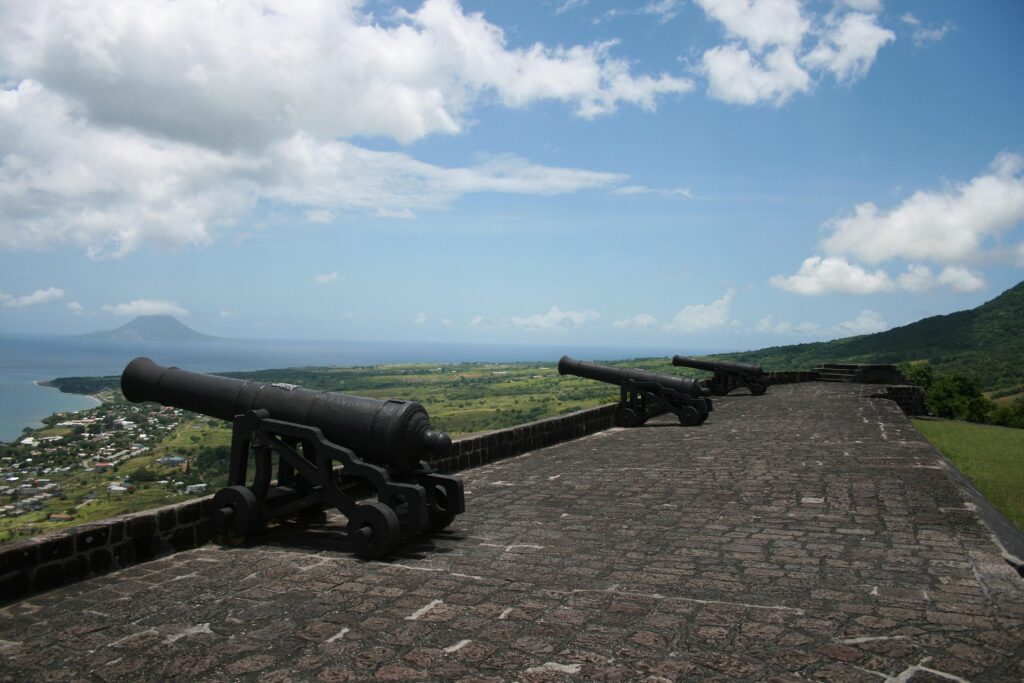
The smallest sovereign state in the Western Hemisphere — two volcanic islands in the eastern Caribbean with a combined population of fewer than fifty-five thousand people. In 1623, Sir Thomas Warner established the first successful English settlement on St. Kitts, making it the Mother Colony of the British West Indies — the base from which England launched its colonization of Antigua, Barbuda, Tortola, Montserrat, and beyond. A year later, the French settled alongside them, and for nearly a century the two empires shared the island while fighting over it, eventually displacing the indigenous Kalinago who had called it Liamuiga — fertile land. Sugar transformed the islands into one of the wealthiest corners of the colonial world, and the wealth was built entirely by enslaved Africans who were shipped across the Atlantic to work plantations so profitable they altered the course of European economics. Brimstone Hill Fortress, a UNESCO World Heritage Site rising two hundred and thirty meters above the coast, was designed by British military engineers to the most exacting standards of eighteenth-century defense — and built, stone by stone, by the enslaved people it was meant to protect against invasion by the French, not to protect at all. By 1780 it was called impregnable. In 1782 the French took it anyway. A year later, a treaty gave it back. And on the smaller island of Nevis, in 1755, a boy named Alexander Hamilton was born out of wedlock to a divorced mother and a failed Scottish merchant. Prohibited from attending Christian schools because of his illegitimacy, largely self-educated from a family library of thirty-four books, orphaned by eleven, working as an accounting clerk by thirteen — he left the Caribbean at sixteen on a scholarship raised by employers who recognized his intelligence, and never came back. He became George Washington’s chief aide-de-camp, the principal author of the Federalist Papers, and the first Secretary of the United States Treasury, architect of the American financial system. His face is on the ten-dollar bill. His birthplace on Nevis is a small stone house overlooking a harbor.
Evoke — Why You Visit St. Kitts and Nevis
You come to St. Kitts and Nevis because you have been the launchpad — the place where something important started before moving somewhere bigger — and you have been wondering whether the launchpad gets any credit after the rocket leaves. St. Kitts was the Mother Colony. Every British Caribbean territory traces its origin to this island. The sugar that financed the British Empire was perfected here before the model was exported to Jamaica, Barbados, and beyond. Hamilton was shaped here — his childhood of abandonment, illegitimacy, poverty, and disease in the Caribbean sugar economy gave him the urgency, the financial literacy from clerking in a trading house, and the outsider’s fury that drove him to build something permanent from nothing. He designed the U.S. Treasury. He did not design anything for Nevis. The Brimstone Hill Fortress is the most precise metaphor on the island: a structure of extraordinary engineering, built by people who received none of its protection, for the benefit of an empire that eventually abandoned the fortress when its strategic value declined. The enslaved Africans who carried the stones up that hill built something that would outlast everything — the empire, the sugar economy, slavery itself — and they are commemorated in a UNESCO plaque that credits them for their skill, strength, and endurance. You come because you built the launchpad. St. Kitts and Nevis will show you that launchpads are always the first thing the mission forgets and the last thing still standing when the mission is over.
Explore — How You Experience St. Kitts and Nevis
Climb Brimstone Hill and stand inside the Fort George Citadel, where walls of volcanic stone rise against a sky that holds views of six neighboring islands on a clear day — Nevis, Montserrat, Saba, St. Eustatius, St. Barths, and St. Martin — a fortress positioned to see everything approaching and designed by people who could not leave. Walk the Scenic Railway, the last railway in the West Indies, originally built to carry harvested sugar cane from plantations to the port — now a tourist train whose open-air carriages travel the route that enslaved and later free laborers traveled with the crop that made the island’s owners rich and the workers nothing. Cross to Nevis by ferry and visit the Museum of Nevis History in Charlestown, housed on the site where Hamilton was born — the original building destroyed by a natural disaster, the reconstruction completed in 1983, the year St. Kitts and Nevis gained independence, as if the nation and the founding father’s memory were reborn on the same timeline. Walk through the ruins of the Hamilton Estate in the hills, where the family’s sugar plantation operated until 1951 — one of the last intact sugar factories on the island. Hike to the cloud-wrapped summit of Mount Liamuiga on St. Kitts, the dormant volcano whose Kalinago name means fertile land — the name that existed before the English renamed the island after a patron saint and built their empire on top of it.
Evolve — Who You Become in St. Kitts and Nevis
You leave understanding that launchpads do not travel with the rocket — and that this does not diminish them. St. Kitts launched the British Caribbean. Nevis launched Hamilton. The sugar plantations launched an economic model that reshaped the Atlantic world. The fortress launched no one — it stayed on its hill, built by hands that were not credited, and it is still there, and the empire that built it is not. Hamilton left Nevis at sixteen with a scholarship from employers who saw something in a bastard orphan clerking in a trading house, and he never returned, and the island did not ask him to. The Mother Colony does not follow its children. It lets them go. You come home and look at the thing you launched — the protégé who outgrew you, the project that became someone else’s company, the idea that left and became famous elsewhere — and you stop measuring your importance by whether the rocket remembers the pad. Brimstone Hill was built by the people who got the least from it and has outlasted everyone who got the most. Hamilton’s birthplace is a small stone house. The Treasury he built is the financial architecture of the largest economy on earth. The distance between those two structures is the distance between where things start and where they end up — and St. Kitts and Nevis is proof that the starting point is always more interesting than the destination.
Your practical guide to St. Kitts & Nevis starts bellow 👇
🕰️ St. Kitts & Nevis Historical Backdrop
St. Kitts & Nevis’ history is a 500-year “Strategic Sovereignty Audit.” Known as the “Mother Colony” of the West Indies, St. Kitts served as the primary logistics hub for British and French expansion in the 17th century. Its story is told in the “Gibraltar of the West Indies”—Brimstone Hill Fortress—and the vast, emerald sugarcane fields that once defined the island’s economic “Core Asset” base. Following the 2005 decision to liquidate the national sugar industry, the federation performed a “Strategic Pivot” toward high-end tourism and sustainable development. Today, it stands as a “Boutique Portfolio” of two islands: St. Kitts, the vibrant engine of history and commerce; and Nevis, the “Queen of the Caribbees,” a secluded sanctuary of colonial manors and volcanic stillness.
🌟 St. Kitts & Nevis Local Experiences
Beyond the beaches, discover the soul of the federation in the ritual of the “Train Audit”—riding the St. Kitts Scenic Railway, the last of its kind in the West Indies, where the rhythmic “click-clack” over iron bridges provides a sensory history of the sugar era. Experience the profound “Vertical Stillness” of a hike up Mount Liamuiga, the intoxicating scent of aging rum in a stone-built distillery, or the simple joy of a “Lime” (socializing) at the beach bars of Frigate Bay. Whether it’s sharing a plate of Goat Water (savory stew) in a Nevis village or exploring the botanical wealth of Romney Manor, these moments reveal a nation that finds its greatest margin in the balance of historical weight and tropical lightness.
🌄 St. Kitts & Nevis Natural Wonders
- Mount Liamuiga: A spectacular 1,156-meter dormant volcano on St. Kitts, featuring a mile-wide crater known as the “Giant’s Salad Bowl.”
- Nevis Peak: The challenging, mist-shrouded volcanic heart of Nevis, offering a “Vertical Audit” of tropical biodiversity.
- The Black Rocks: A dramatic geological “Data Point” on the northern coast where jagged volcanic formations meet the crashing Atlantic.
- Oualie Beach (Nevis): A pristine, shallow bay representing the “Fundamental Quality” of Caribbean relaxation.
- Brimstone Hill: Not just a fort, but a high-altitude vantage point offering a 360-degree overview of the surrounding islands (Saba, St. Eustatius, St. Barts).
🏙️ St. Kitts & Nevis Must-See Towns & Districts
- Basseterre: (Capital) A historic port where the “Circus” (inspired by London’s Piccadilly) meets a vibrant Caribbean market spirit. (Historic, Vibrant, Commercial)
- Charlestown (Nevis): One of the most charming colonial towns in the region, famous as the birthplace of Alexander Hamilton. (Elegant, Secluded, Timeless)
- Frigate Bay: The island’s social “Operational Hub,” offering a dual-coast experience and a high-frequency nightlife scene. (Social, Coastal, Dynamic)
- Old Road Town: The site of the first British settlement in 1624, home to ancient Carib petroglyphs. (Ancient, Strategic, Historic)
🏞️ St. Kitts & Nevis National Parks & Nature Reserves
Managed with an emphasis on preserving the “Primary Heritage Assets” by theSt. Christopher National Trust.
- Brimstone Hill Fortress National Park: A UNESCO site representing the pinnacle of British military engineering in the Caribbean.
- Central Range Schools National Park: Protecting the high-altitude rainforest “Cloud Reserve” of St. Kitts.
🏛️ UNESCO World Heritage Sites
- Brimstone Hill Fortress National Park — A well-preserved example of 17th and 18th-century military architecture.
- For more information on the federation’s cultural inventory, visit the UNESCO St. Kitts & Nevis Portal.
🖼️ St. Kitts & Nevis Museums & Cultural Sites
- National Museum (Basseterre): Housed in the Old Treasury Building, detailing the transition from sugar to sovereignty.
- Alexander Hamilton Museum (Nevis): Located in the restored childhood home of the US Founding Father.
- Romney Manor & Caribelle Batik: A 17th-century estate featuring a 400-year-old Saman tree and traditional batik workshops.
🎉 St. Kitts & Nevis Festivals & Celebrations
- Sugar Mas (Carnival): (Dec/Jan) The premier “Social Reallocation” event, combining Christmas traditions with African-inspired masquerades and Soca energy.
- Culturama (Nevis): (July/August) A vibrant celebration of Nevisian heritage, craft, and folk art.
- St. Kitts Music Festival: (June) A world-class event highlighting the island’s “Operational Bandwidth” for international jazz, reggae, and soul.
🧽 How to Arrive
- ✈️ By Air
- Robert L. Bradshaw International (SKB) on St. Kitts is the primary gateway.
- Vance W. Amory International (NEV) on Nevis serves regional charters.
- Airlines: Major carriers (American, Delta, British Airways) connect the islands to North America and Europe. Inter-Caribbean travel is managed by Winair and Silver Airways.
- 🚢 By Water
- Frequent ferry services connect Basseterre and Charlestown (approx. 45 mins).
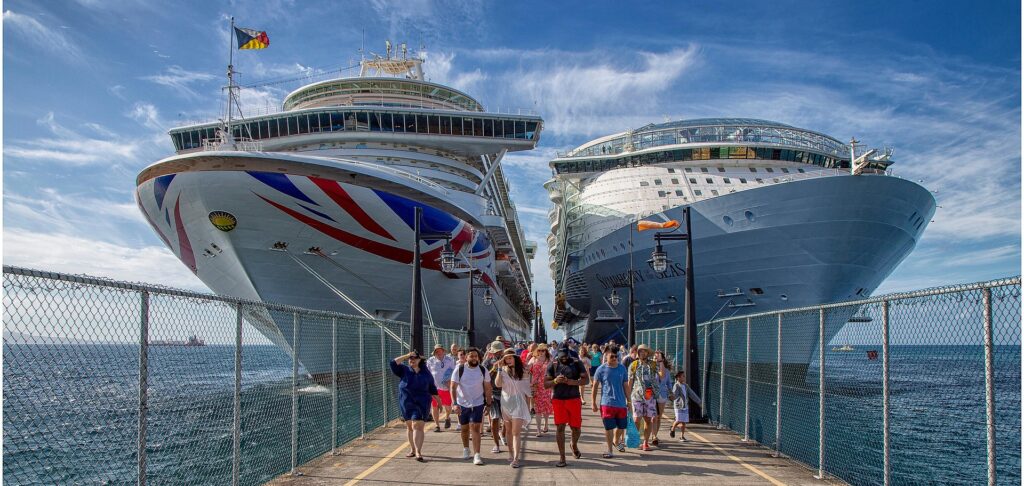
- Basseterre is a major cruise hub, with the Port Zante terminal serving “Tier 1” vessels.
📶 Stay Connected
- SIM Cards: The two main providers are Flow and Digicel.
- Where to buy: Kiosks are at the airport and in all shopping centers. Registration with a passport is standard.
- eSIM: Supported by Flow; international platforms like Airalo provide data-only “Tactical Access.”
- Logistics: Type G (Three rectangular pins—same as the UK, UAE, and Qatar). Voltage is 230V.
🏨 Where to Stay
St. Kitts & Nevis offers a “Diversified Portfolio” ranging from five-star modern luxury to “Heritage Manor” stays.
- Park Hyatt St. Kitts Christophe Harbour: A modern, high-margin Tier 1 asset in the secluded Banana Bay.
- Four Seasons Resort Nevis: The pinnacle of island sophistication—a “Long-Term Hold” for luxury travelers.
- Montpelier Plantation & Beach (Nevis): A Relais & Châteaux property set in a historic sugar mill—ultimate “Peace Acquisition.”
- Royal St. Kitts Hotel: A reliable “Defensive Staple” for business and leisure in Frigate Bay.
⛳ Unique Finds
- The Sugar Train: Experience the world’s only 360-degree rail circuit of a Caribbean island.
- Nevisian Hot Springs: Visit the Bath Village to soak in volcanic thermal waters used as a wellness “Asset” since 1778.
- Batik Workshops: See how the colors of the Caribbean are fixed in silk at Caribelle Batik.
- Alexander Hamilton Birthplace: A historical “Data Validation” point for fans of constitutional history.
🤝 St. Kitts & Nevis Cultural Guidance
- Rush Slowly: The national motto. Understand that efficiency is measured in quality of life, not speed.
- Dress Code: Beachwear is for the beach. When in Basseterre or Charlestown, modest attire (shoulders and knees covered) is a “Health Benchmark” for respect.
- Hospitality Equity: Locals are polite and value formal greetings. A “Good morning” or “Good afternoon” is a mandatory protocol before asking questions.
- Basic Phrases:
- Hello: “How you keepin’?”
- Thank you: “Bless up” / “Thank you”
- Wait a moment: “Hold a lime”
- Everything is good: “Direct” / “Safe”
🛂 St. Kitts & Nevis Entry & Visa Requirements
- Visa-Free: Citizens of the UK, US, Canada, EU, and many Gulf nations (including Qatar) generally do not require a visa for tourism stays up to 90 days.
- Entry Form: All travelers must complete the Online Immigration/Customs Form before arrival.
- Official Source: Consult the St. Kitts & Nevis Ministry of Foreign Affairs.
💰 Practical Essentials
- Currency: Eastern Caribbean Dollar (XCD). It is a “Stable Asset” pegged to the USD (1 USD ≈ 2.70 XCD). US Dollars are widely accepted.
- Safety: One of the safer “High-Margin” destinations in the Caribbean. Exercise standard urban vigilance.
- Driving: Driving is on the left (British legacy). A temporary local license is required for car rentals.
- Climate: Subtropical. Best visited December to May (Dry Season) for “Defensive” mild temperatures.
✨ Bonus Tip: The Dual Horizon Audit
To truly embrace St. Kitts & Nevis, you must perform a “Dual Horizon Audit.” Spend an hour at the summit of Timothy Hill. Look East at the Atlantic—raw, powerful, and volatile. Look West at the Caribbean—serene, clear, and stable. This is the perfect analogy for the federation: it is a nation that has mastered the art of managing the “Turbulence” of history to create a “Sanctuary” of modern peace. It is in this appreciation of the “Narrow Strip”—the delicate balance between the wild and the refined—that your own evolving sense of strategic balance will finally reveal itself.
🔗 Featured Links
- Official Tourism: Explore St. Kitts / Nevis Island.

Beyondia
Travel CompanionHelping you to find inspiration, discover authentic local customs and create experiences that go beyond the typical tourist trails.
What about you? Where are your thoughts wondering?
Let’s talk! Let’s explore!