A cup of tea in Japan that changed my understanding of time
I arrived to Japan, in Kyoto carrying the invisible weight of Western productivity culture—my phone buzzing with notifications, my mind calculating how many temples I could efficiently visit in a day, my travel journal filled with optimization strategies. I had scheduled the tea ceremony as a 90-minute cultural checkbox between Kinkaku-ji and Gion district. Japan was expecting me.
What I experienced instead was a four-hour masterclass in the radical sophistication of slowness, delivered through movements so deliberate they made rushing physically impossible.
The Japan Architecture of Anticipation
The tea ceremony—chanoyu or “the way of tea”—begins long before the first sip. My host, Yamada-san, spent twenty minutes simply arranging charcoal in the brazier. Not because she was inefficient, but because each piece of charcoal had an optimal position for heat distribution, aesthetic balance, and symbolic meaning.
“In the West, you have fast food,” she said, her movements unhurried despite my obvious restlessness. “In Japan, we have slow tea. Both fill a need. But only one fills the soul.”
This wasn’t quaint philosophy—it was sophisticated engineering. The deliberate pace in Japan wasn’t about tradition for tradition’s sake. Every slow movement served multiple purposes: the careful cleansing of utensils demonstrated respect for guests, created meditative focus for the host, and built anticipation that made the eventual tea taste transcendent.
I watched her fold a silk cloth with the precision of origami, using it to polish a tea scoop that already looked immaculate. The polishing took three minutes. Three minutes for a utensil that would be used for ten seconds. My productivity-trained mind screamed at the inefficiency. My body, surprisingly, began to relax.
The Violence of Efficiency
Modern life had taught me that speed equals sophistication. Faster processors, rapid delivery, instant communication—these were the markers of advanced civilization. The tea ceremony proposed a different model: that true sophistication means having enough mastery to move slowly, that’s Japan.
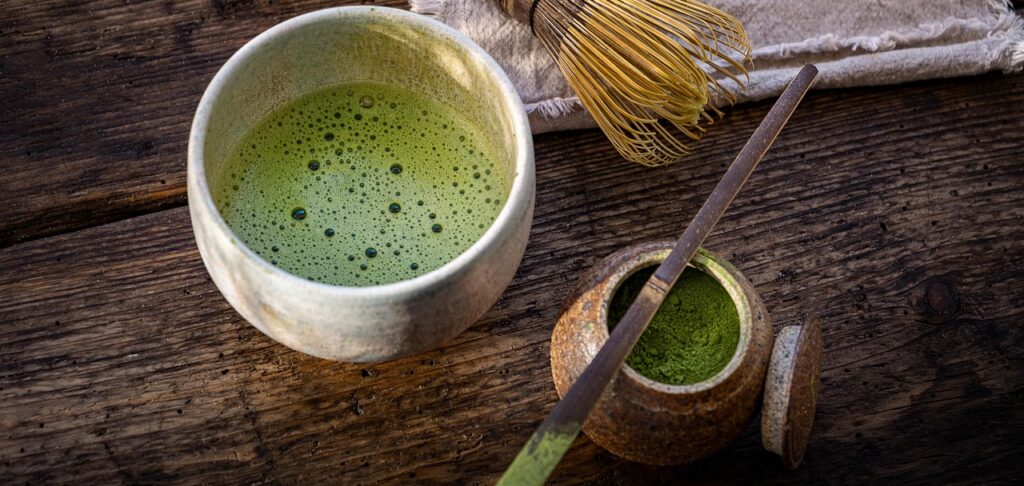
When Yamada-san whisked the matcha, she didn’t efficiently blend powder and water. She created a meditation in motion. The bamboo whisk moved in precise patterns—first slowly to incorporate the powder, then rapidly to create foam, then slowly again to gather the foam into the center. The whole process took two minutes for what a modern electric frother could accomplish in ten seconds.
But those two minutes weren’t lost time—they were found time. Time when my notifications couldn’t reach me. Time when my travel optimization spreadsheet became irrelevant. Time when the only thing that mattered was the emergence of jade-green foam in a ceramic bowl.
“Efficiency,” Yamada-san said, reading my Western impatience, “is violence against experience.”
The Discipline of Presence in Japan
What struck me most wasn’t the slowness itself, but the athletic discipline it required. Sitting in seiza position for extended periods demanded strength. Maintaining focus on simple movements required mental endurance. The tea ceremony wasn’t passive relaxation—it was active presence.
Each guest interaction followed choreographed patterns that seemed absurd until I understood their function. We admired the tea bowl by rotating it carefully in our hands, commented on its beauty, asked about its history. This wasn’t small talk—it was large talk compressed into small gestures.
The Swedish fika creates pause for conversation. The Japanese tea ceremony creates conversation through pause. Every slow movement communicates something: respect, attention, gratitude, presence. It’s a language where speed would be grammatically incorrect.
When I finally tasted the tea—bitter, frothy, somehow both energizing and calming—I realized I had been prepared for this moment for two hours. Not waiting for it, but being actively prepared through gradually descending levels of mental noise until I could actually taste something rather than just consume it.
The Economics of Attention
In Silicon Valley, where I normally worked, time was currency and attention was capital. We optimized everything: three-minute meditations, seven-minute workouts, meal replacement shakes to eliminate the inefficiency of chewing. We called it “biohacking.” The Japanese had been practicing actual life-hacking for five centuries through the tea ceremony.
The ceremony’s slowness isn’t about having more time—it’s about changing your relationship with time itself. When movements are deliberate, minutes expand. When attention is singular, experiences deepen. When rushing becomes physically impossible, anxiety finds no foothold.
Yamada-san explained that master tea practitioners train for decades. Not to make better tea—the physical technique can be learned in months. They train to maintain presence while performing familiar movements. To find newness in repetition. To host time rather than chase it.
“Your smartphones,” she said, “make you very fast at going nowhere. The tea ceremony makes you very slow at arriving somewhere.”
The Technology of Ritual
The tea ceremony predates electricity, but it’s a technology nonetheless—a sophisticated system for state change. Not from powder to liquid, but from scattered to centered, from anxious to grounded, from productive to present.
Every element serves this technology. The small entrance to the tea house forces you to bow, physically humbling yourself. The minimal decoration eliminates distraction. The seasonal scroll and flower arrangement provide just enough beauty to contemplate without overwhelming. The bitter tea shocks your palate awake.
It’s user experience design perfected over centuries, where the user isn’t consuming an experience but becoming one with it. The inefficiencies aren’t bugs—they’re features. The waiting isn’t loading time—it’s the program itself.
Modern Japan somehow maintains this temporal paradox: bullet trains that arrive within seconds of schedule, and tea ceremonies that stretch single moments into eternities. Both represent sophistication, but only one represents wisdom.
Slowness as Rebellion
Back in my Kyoto hotel room, I noticed something strange. Despite spending four hours on what should have been a 90-minute experience, I didn’t feel behind schedule. I felt ahead of myself. The slowness hadn’t consumed time—it had created it.
In a world where speed is constantly sold to us as progress, intentional slowness becomes an act of rebellion. Not the passive slowness of procrastination or the forced slowness of traffic, but the active choice to move at the pace of presence rather than productivity.
The tea ceremony taught me that slowness isn’t the absence of speed—it’s the presence of attention. It’s not about doing less, but about being more while doing. It’s not anti-modern, but rather a technology so advanced it doesn’t require electricity.
Integrating the Way of Tea
You don’t need a tea house or decades of training to apply these principles. The wisdom of the tea ceremony translates into any culture, any schedule, any life—if you understand that it’s not about tea.
Start with single-task rituals. Make your morning coffee with the attention of a tea master. Clean your workspace with the deliberation of purifying tea utensils. Eat one meal a day without any screens, tasting food like you’re experiencing it for the first time.
Create threshold ceremonies. The tea house entrance that forces guests to bow has a function: it creates physical transition between mental states. Design your own transitions. A breathing pattern before starting work. A gratitude practice before meals. A deliberate pause before entering your home.
Practice productive slowness. Choose one activity daily to perform at half speed. Not to waste time, but to discover what you miss at normal velocity. Notice how slowness in one area creates efficiency in others—how a slow morning routine leads to a focused workday, how a deliberate conversation prevents later misunderstandings.
The Paradox of Sophisticated Simplicity
The tea ceremony embodies a paradox that defines Japanese culture: the most sophisticated thing you can do is simple, but that simplicity requires tremendous sophistication to achieve. Anyone can make tea quickly. It takes mastery to make it slowly.
This isn’t about cultural appropriation or lifestyle optimization. It’s about recognizing that different cultures have developed different technologies for human flourishing. The West perfected external speed. Japan perfected internal stillness. We need both, but we’ve forgotten one.
The ceremony ended with a sweet cake served before the final bow. “The sweetness,” Yamada-san explained, “helps you remember the bitterness fondly.” She was talking about tea, but she wasn’t only talking about tea.
The Luxury of Limits
Three months after that Kyoto afternoon, I still carry the ceremony’s most profound lesson: in an infinite world, the ultimate luxury is limits. When you can do anything, choosing to do one thing slowly becomes the highest expression of freedom.
The tea ceremony doesn’t give you more time. It reveals that you already have enough. Not enough to do everything, but enough to do something with complete presence. Not enough to optimize every moment, but enough to inhabit some moments fully.
My productivity hasn’t decreased since learning the way of tea. If anything, it’s improved. But it’s a different kind of productivity—one that includes presence as a performance metric, that measures depth alongside speed, that recognizes stopping as a form of progress.
Time as a Garden, Not a Highway
The West treats time like a highway—linear, measured in distance covered, optimized for speed. The tea ceremony reveals time as a garden—circular, measured in depth experienced, optimized for beauty.
In a highway mindset, slowness is failure. In a garden mindset, slowness is exploration. You don’t rush through a garden to efficiently reach the exit. You wander, pause, return to spots that captivate you, sit with views that nourish you.
The tea ceremony creates a temporal garden in the middle of modern life’s highway. For four hours, time moves in spirals rather than straight lines. The same movements repeat but feel different each iteration. The destination isn’t the point—the journey isn’t even the point. The point is presence itself.
This isn’t about choosing gardens over highways. We need highways for practical life. But we also need regular exits into gardens, or we forget that time can be experienced rather than just consumed.
The Courage to Be Slow
It takes courage to move slowly in a fast world. Courage to appear unproductive while being deeply present. Courage to value experience over efficiency. Courage to trust that slowness isn’t falling behind but finding center.
The tea ceremony gave me that courage by revealing slowness not as the absence of sophistication but as its highest expression. Like a master martial artist who moves slowly because they can afford to, or a confident speaker who pauses because they know you’re listening.
Six months later, I practice my own simplified tea ceremony each morning. Not with matcha and traditional tools, but with regular tea and revolutionary attention. I take fifteen minutes for what could take three. I polish cups that are already clean. I wait for water to boil without checking my phone.
My colleagues think I’ve become less stressed. My family says I’m more present. My work has improved not despite the slowness but because of it. The tea ceremony didn’t teach me to do less. It taught me that doing less with total presence accomplishes more than doing more with divided attention.
“The way of tea,” Yamada-san told me as I left, “is not about tea. It’s about way.”
The way of moving through life as if you have enough time, because you do. The way of treating simple acts as ceremonies worthy of attention. The way of discovering that the most sophisticated response to modern acceleration isn’t to speed up but to slow down—deliberately, rebelliously, wisely.
In Kyoto, I learned that true travel isn’t about covering maximum distance but about achieving maximum depth. That cultural wisdom isn’t always found in monuments and museums but in the space between movements, the pause before sipping, the silence that makes conversation meaningful.
The ceremony ended, but the practice continues. Every day, in small ways, I resist the violence of efficiency and choose the rebellion of presence. I make tea slowly. I arrive somewhere instead of everywhere. I remember that in a world obsessed with having more time, the revolution is discovering we already have enough.

Beyondia
Trusted Travel CompanionReal digital nomad. I travel. I learn. I grow.
What about you? Where are you going?