GoBeyondia Atlas 🗺️ Africa Region 🗾
Cape Verde: Where ten volcanic islands in the middle of the Atlantic were uninhabited until the Portuguese arrived in the 1460s and filled them with enslaved Africans, then famine, then departure — so many people left over so many centuries that the diaspora now outnumbers the population at home, and the pain of that leaving was refined into morna, a music of longing so precise that Japanese audiences who understood no Creole wept when they heard it, performed by a barefoot woman from Mindelo who quit singing for a decade because it could not feed her children, was rediscovered at forty-four, and became the voice of an island she rarely saw again — because Cape Verde is the country that turned the act of missing into the most exportable thing it ever produced.
Cape Verde in 30 Seconds
Ten volcanic islands six hundred kilometers off the west coast of Africa, in the middle of the Atlantic, belonging to nowhere — too far from Africa to be African in the continental sense, too shaped by Portugal to be anything but Lusophone, too blended to be categorized. No one lived here before the Portuguese arrived around 1456. The islands were settled with enslaved Africans, became a major node in the transatlantic slave trade, and then, when the trade declined and drought came — and drought came often, killing hundreds of thousands over the centuries — the people began to leave. They signed onto whaling ships. They emigrated to New England, to Portugal, to France, to Senegal, to anywhere. Today, more Cape Verdeans live outside Cape Verde than in it. The diaspora is estimated at over seven hundred thousand. The population at home is roughly five hundred thousand. And from this culture of perpetual departure came morna — a lilting, melancholic music genre that emerged in the eighteenth century, probably on the island of Boa Vista, and became the country’s most recognizable cultural export. Morna’s central emotional concept is sodade — derived from the Portuguese saudade but sharper, saltier, more specific. Saudade is a romantic ache. Sodade tastes of harbors and mothers watching ships. It is the feeling of the person who left and the person who stayed, simultaneously. Its greatest interpreter was Cesária Évora, born in Mindelo in 1941, who began singing in sailors’ bars at sixteen, could not make a living from music, quit for a decade, was rediscovered at forty-four, and spent the rest of her life performing barefoot on stages around the world — Tokyo, Berlin, New York — singing about an island she was almost never on. She won a Grammy in 2004. She died in 2011. The airport in Mindelo was named after her.
Evoke — Why You Visit Cape Verde
You come to Cape Verde because you have left something — the hometown, the first career, the relationship, the version of yourself that existed before the departure — and you have been carrying the weight of that leaving without a word for it. Cape Verde has the word. Sodade is not nostalgia, which romanticizes the past. It is not homesickness, which implies you want to go back. Sodade is the acknowledgment that what you left and who you are now cannot be reconciled — that the leaving was necessary and the loss is permanent and the feeling does not resolve. It sits in the chest like a stone that is also somehow a song. Morna does not try to fix sodade. It does not offer closure or return. It gives the feeling a melody and lets it exist without solution, and that act of giving form to something unresolvable is the most sophisticated emotional technology Cape Verde has produced. Cesária Évora understood this. She performed barefoot — solidarity with the poor, she said, but someone close to her observed that shoes are for people going somewhere, and Cesária had already arrived at the only place that mattered: inside the song. She sang about Mindelo from Paris. She embodied Cape Verde for millions of people while existing mostly elsewhere. Even sodade had sodade. You come because you have been carrying something that does not have a name in your language. Cape Verde named it, set it to music, and exported it to the world. The feeling does not go away. But now it has a key signature.
Explore — How You Experience Cape Verde
Fly into Mindelo on São Vicente — the cultural capital, the port city where Cesária was born and where the tradition of morna still saturates the bars and restaurants of the waterfront. The airport bears her name. The city is built around Porto Grande, one of the finest natural harbors in the Atlantic, which once serviced coal ships and whalers and now holds fishing boats and the occasional yacht. Listen for morna in any bar after dark — the guitar, the violin, the voice that does not hurry. Cross by ferry to Santo Antão, the greenest and most mountainous island, where terraced valleys carved by centuries of agriculture drop from cloud-covered peaks to the sea in a landscape that feels like Madeira compressed into a smaller, wilder frame. Visit Santiago, the largest island, where Cidade Velha — the first European settlement in the tropics, founded in 1462 — holds the remains of the slave trade’s infrastructure: the pelourinho where enslaved people were displayed, the ruins of the cathedral, the fortress above the harbor. It is a UNESCO World Heritage Site and one of the most quietly devastating places in the Atlantic. Travel to Fogo, the volcanic island dominated by Pico do Fogo, an active volcano that last erupted in 2014, destroying the village of Chã das Caldeiras inside the caldera — a community that had built homes and vineyards on the floor of a volcano and, after the eruption, returned and rebuilt on the same lava. Stand on any coast at sunset and understand why this country produces the music it produces: the horizon is empty in every direction. There is nothing between you and the next continent except water and the memory of everyone who crossed it.
Evolve — Who You Become in Cape Verde
You leave Cape Verde understanding that some feelings are not problems to be solved — they are conditions to be composed. Sodade does not go away when you return. The people who come home still carry it. The people who stay carry it for the people who left. Morna does not resolve the tension between departure and belonging — it holds the tension in a melody and lets it breathe, and the breathing is the art. Cesária Évora did not overcome her difficult life to become a singer. She sang because the difficulty was the material. She performed barefoot because the stage was not separate from the street. She won a Grammy at sixty-three and died at seventy, and when she died, according to Cape Verdean tradition, the doors and windows of her house in Mindelo were left open so her spirit could find its way out. You come home and look at the thing you left — the place, the person, the self you were before the crossing — and you stop trying to get over it. You are not supposed to get over it. You are supposed to give it a melody. Cape Verde built an entire culture around the feeling that most cultures treat as a symptom. The islands are volcanic, barren, beautiful, and six hundred kilometers from the nearest continent. The diaspora outnumbers the homeland. The most famous song is called Sodade. The airport is named after a woman who spent her life singing about the place she was not. The feeling does not resolve. The song does not end. That is the point.
Your practical guide to Cape Verde starts bellow 👇
🕰️ Cape Verde Historical Backdrop
Cape Verde’s history is a 500-year “Strategic Sovereignty Audit.” Uninhabited until the Portuguese arrived in 1460, the archipelago functioned as a vital logistics hub for the transatlantic trade, creating a unique Creole identity—the first of its kind in the Atlantic. Its story is told in the ruins of Cidade Velha (the first European city in the tropics), the elegant Portuguese plazas of Mindelo, and the unyielding spirit of the 1975 independence movement led by Amílcar Cabral. Having navigated centuries of periodic drought and isolation, Cape Verde has emerged as a “Stable Growth Asset”—one of Africa’s most established democracies. It is a nation that has successfully pivoted from a transit point for empires into a “land-linked” maritime hub, proving that “Morabeza” (hospitality) is a non-negotiable core asset for a thriving, modern nation.
🌟 Cape Verde Local Experiences
Beyond the white sands, discover Cape Verde’s soul in the ritual of the “Morna Audit”—listening to the melancholic, soulful melodies of Cesária Évora in a Mindelo tavern, where “Sodade” (longing) serves as a sensory code for the nation’s history. Experience the profound “Vertical Stillness” of a hike through the ribeiras of Santo Antão, the intoxicating aroma of freshly ground coffee in Fogo, or the simple joy of sharing a Cachupa (slow-cooked stew) with a local family. Whether it’s witnessing the high-frequency windsurfing energy of Sal or navigating the quiet, cobblestone streets of a mountain village, these moments reveal a nation that finds its greatest margin in its unhurried pace and deep human connection.
🌄 Cape Verde Natural Wonders
- Pico do Fogo: An active stratovolcano offering an exhilarating “Vertical Audit” for hikers, featuring a unique viticulture scene inside the crater.
- Salinas de Pedra de Lume: A collapsed volcanic crater where you can float in salt-rich waters that are 26 times saltier than the ocean—a proven example of natural buoyancy.
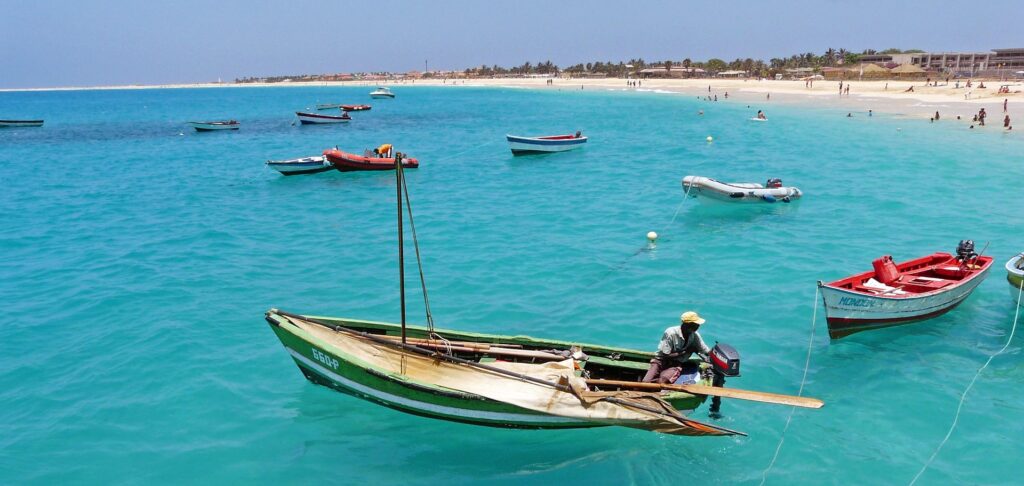
- Santa Maria Beach (Sal): An 8km stretch of pristine turquoise water, representing the “Fundamental Quality” of Atlantic relaxation.
- Cova Crater (Santo Antão): A massive dormant caldera filled with lush agricultural plots, surrounded by jagged peaks and pine forests.
- Shark Bay (Sal): A unique nursery where travelers can walk among juvenile lemon sharks in their natural habitat.
- Viana Desert (Boavista): An extension of the Sahara in the middle of the Atlantic, featuring spectacular white sand dunes.
🏙️ Cape Verde Must-See Cities & Islands
- Praia (Santiago): (Capital) The high-energy political heart of the nation, where the Plateau district overlooks the vibrant African markets of Sucupira. (Dynamic, Urban, Traditional)
- Mindelo (São Vicente): The cultural capital, famous for its colonial architecture, world-class jazz bars, and the most vibrant Carnival in the Atlantic. (Artsy, Sophisticated, Musical)
- Santa Maria (Sal): The primary tourism hub, offering a “No Stress” operational standard with world-class resorts and water sports. (Vibrant, Coastal, International)
- Cidade Velha: (UNESCO Site) The historic cradle of the nation, featuring the 15th-century Fort of São Filipe and the ruins of the first cathedral. (Ancient, Strategic, Poignant)
- Ribeira Grande (Santo Antão): The gateway to the island’s vertical wonders, characterized by sheer cliffs and winding mountain roads. (Scenic, Remote, Adventure)
🏞️ Cape Verde National Parks & Nature Reserves
Managed with an increasing focus on sustainable island governance by the Ministry of Environment.
- Fogo Natural Park: Protecting the volcanic ecosystem and the unique flora of the caldera.
- Serra Malagueta Natural Park (Santiago): A northern mountain range offering spectacular hiking through high-altitude mist forests.
- Santa Luzia Nature Reserve: An uninhabited island sanctuary for rare seabirds and marine life.
🏛️ UNESCO World Heritage Sites
- Cidade Velha, Historic Centre of Ribeira Grande — The first European colonial outpost in the tropics and a landmark of the early Atlantic history.
- For more information on the cultural inventory, visit the UNESCO Cape Verde Portal.
🖼️ Cape Verde Museums & Cultural Sites
- Cesária Évora Museum (Mindelo): A tribute to the “Barefoot Diva” and her global impact on music.
- Museu Etnográfico da Praia: Detailing the prehistoric and cultural origins of the Cape Verdean people.
- Tarrafal Camp (Santiago): A poignant former political prison that serves as a “Data-Driven Validation” of the independence struggle.
🎉 Cape Verde Festivals & Celebrations
- Mindelo Carnival: (February) A high-intensity celebration of color and rhythm modeled after the Brazilian Carnival but with a unique Creole identity.
- Baía das Gatas Music Festival: (August) A massive open-air world music festival held on the beaches of São Vicente during the full moon.
- Tabanka Festival: (May/June) A traditional, high-margin religious and social celebration in Santiago featuring rhythmic drumming and theater.
🧽 How to Arrive
- ✈️ By Air
- Hubs: Nelson Mandela International (RAI) in Praia, Amílcar Cabral International (SID) in Sal, and Cesária Évora International (VXE) in São Vicente.
- Airlines: Cabo Verde Airlines (Flag carrier) and major carriers (TAP Air Portugal, Royal Air Maroc, TUI) connect the islands to Europe, Africa, and North America.
- 🚢 By Sea
- Inter-island ferries (CV Interilhas) are the “Operational Standard” for moving between islands like São Vicente and Santo Antão.
- 🚗 By Road
- Rental cars and “Alugueres” (shared minibuses) are common. Driving is on the right.
📶 Stay Connected
- SIM Cards: The two main providers are CV Móvel and Unitel T+.
- Where to buy: Kiosks are abundant at RAI and SID airports and in every town square. Passport registration is standard.
- eSIM: Supported by CV Móvel; available via global platforms like Airalo for data.
- Operational Bandwidth: Fiber optic internet is surprisingly common in cities, reflecting the nation’s tech-forward roadmap.
🏨 Where to Stay
Cape Verde offers a “Diversified Portfolio” ranging from massive all-inclusive beach resorts to boutique colonial “hospedarias.”
- Hilton Cabo Verde Sal Resort: A Tier 1 asset in Santa Maria, offering five-star coastal luxury.
- Kira’s Boutique Hotel (Mindelo): A charming, family-run guesthouse in a restored colonial mansion.
- Hoteis Oasis Atlantico: A reliable regional chain with properties in Sal, Santiago, and São Vicente.
- Mountain Eco-lodges: Explore stays in Santo Antão like Aldeia Manga for ultimate nature integration.
⛳ Unique Finds
- Fogo Wine: Taste wine made from grapes grown in volcanic ash inside an active caldera—the ultimate “Resource Extraction” miracle.
- Grogue: The national spirit; visit a “trapiche” (mill) to see how sugarcane is transformed into this potent rum.
- Ponton of Santa Maria: Watch the daily “Asset Transfer” as fishermen bring in giant tuna and marlin directly to the pier.
🤝 Cape Verde Cultural Guidance
- Morabeza: The national “Health Benchmark” for kindness. If you are lost, a local will likely walk you to your destination.
- Pace of Life: The national motto is “No Stress.” Do not expect high-frequency service; lean into the slow, steady rhythm.
- Tipping: 10% is appreciated but not mandatory in restaurants.
- Basic Phrases (Kriolu):
- Hello: “Olá” / “Modi ki bu sta?”
- Thank you: “Obrigadu”
- No Stress: “Sabi” / “No Stress”
- Everything is good: “Tudu dretu”
🛂 Cape Verde Entry & Visa Requirements
- Visa-Free: Citizens of the UK, EU, US, and many African nations do not require a visa for stays up to 30 days.
- Mandatory TSA: All international travelers must register online via the EASE Platform and pay an Airport Security Tax (TSA) before arrival.
- Official Source: Consult the Cabo Verde Immigration Service.
💰 Practical Essentials
- Currency: Cape Verdean Escudo (CVE). It is a “Stable Asset” pegged to the Euro (1 EUR ≈ 110 CVE). Euros are widely accepted, but change is given in Escudos.
- Electricity: Type C and F (European round pins). Voltage is 230V.
- Safety: One of the safest countries in Africa. Exercise standard urban vigilance in Praia and Mindelo.
- Climate: Tropical dry. Best visited November to June (Pleasant “Defensive Period”) to avoid the rare humid rain window.
✨ Bonus Tip: The Horizontal Audit
To truly embrace Cape Verde, you must perform a “Horizontal Audit.” Most travelers stay on the flat, sandy plains of Sal. Instead, take the ferry to Santo Antão. Drive the “Estrada da Corda” (Rope Road) that runs along the very ridge of the mountains. It is in this transition—from the sea-level tourism of the coast to the cloud-level agriculture of the interior—that your own evolving sense of scale and strategic perspective will finally reveal themselves. Cape Verde is a lesson in how a few rocks in the ocean can contain a world of vertical depth.
🔗 Featured Links
- Official Tourism: Visit Cabo Verde.
- Maritime Logistics: CV Interilhas.

Beyondia
Trusted Travel CompanionReal digital nomad. I travel. I learn. I grow.
What about you? Where are you going?