🌐 Around the World with Beyondia 🧵 Mediterranean Region 🪡 Episode 9
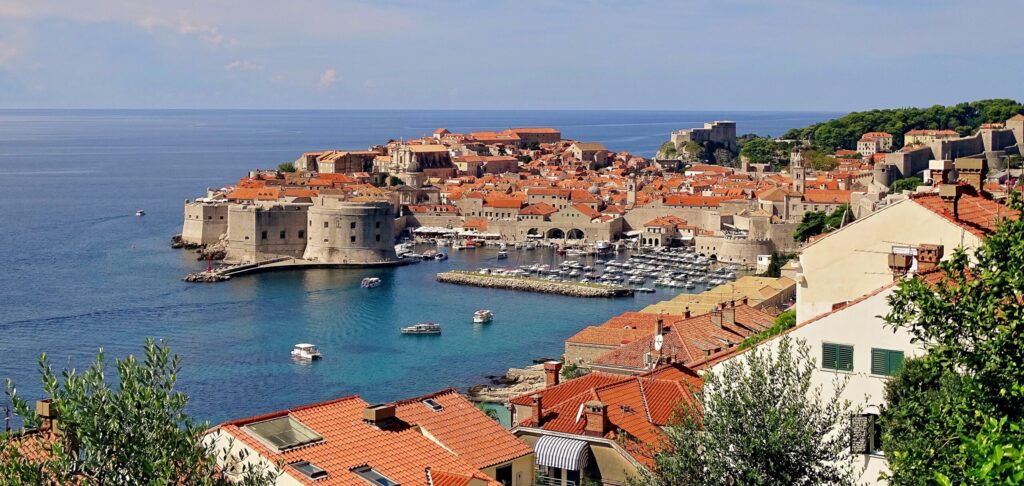
Dubrovnik’s city walls are over 600 years old. Two kilometres of stone, built to protect a republic that lasted longer than most empires. But the best part isn’t the view from the top. It’s getting lost in the streets below.
Ragusa — the old Italian name for Dubrovnik
In the year 1377, while plague moved through Europe the way news travels now, the small city-state of Ragusa passed a law. It said, plainly: any ship arriving at this harbour from an infected region must wait thirty days, with its crew, on the nearby island of Mrkan, before it will be allowed to unload. The word for thirty in medieval Italian is trenta. The law was called the Trentino. Later, when thirty days was judged insufficient, they extended it to forty, and they renamed it the Quarantino, from quaranta. Every time, for the last five years, that you have heard the word quarantine, you were using a word written in Dubrovnik in the fourteenth century. The city was not just surviving its epidemics. It was inventing the vocabulary we would use for ours.
Ragusa — the old Italian name for Dubrovnik, still written on some of the stones — was a republic for four and a half centuries, from 1358 until Napoleon arrived in 1808. That is longer than Byzantium’s final dynasty, longer than Tudor England, almost twice as long as the United States has existed. The republic held its independence by refusing to play any of the obvious games. It was too small to fight, so it did not fight. It was too rich to ignore, so it was not ignored. It paid tribute to the Ottoman sultan and the Pope in the same ledger year, signed trade treaties with Christian and Muslim powers simultaneously, and quietly built one of the largest merchant fleets in the Mediterranean — 180 ships at its peak, crewed by sailors who spoke Croatian at home and Latin at work. The republic’s motto, inscribed above the door of the Rector’s Palace, was Obliti privatorum, publica curate: forget your private affairs, attend to public ones. Whether they obeyed it matters less than the fact that they wrote it down.
The walls came later, or rather, they kept being added to — courses of stone piled on top of older courses from the thirteenth century through to the seventeenth. By the time they were finished, Dubrovnik was wrapped in nearly two kilometres of limestone, up to twenty-five metres tall, with sixteen towers and five bastions. Walking them is the thing every visitor is told to do. Getting lost in the streets below is the thing every visitor should do instead. Stradun, the long polished main street, was paved after a catastrophe: on the 6th of April 1667, an earthquake levelled most of Dubrovnik in the space of a morning. Roughly five thousand people died. The republic rebuilt itself in the Baroque style on top of its medieval bones, which is why the modern city is the oddly beautiful thing it is — a Gothic skeleton in a Baroque overcoat, with a few Renaissance buttons holding it together.
Dubrovnik Old Town
The old town is small enough to cross in twelve minutes and complicated enough to get lost in for three days. A pharmacy has operated continuously inside the Franciscan monastery on Stradun since 1317. That pharmacy has been making and selling medicine longer than most European nations have existed, uninterrupted by plague, earthquake, or napoleonic occupation. The two circular fountains by the city gates — Onofrio’s, great and small — were part of a fifteenth-century public water system that carried fresh water twelve kilometres from the Dubrova spring through an aqueduct still visible on the hillside behind the city. The republic understood, long before most of Europe did, that water, medicine, and rules about entry are the three things a city needs to survive.
Yes, some of this was recently rented to a television show. The show did not need Dubrovnik to have been here for eight hundred years already. The eight hundred years were there anyway, behind every shot, whether or not the camera was told to notice them. The fictional city wore the real city’s stone, the way a costume fits a body that existed before the wardrobe department arrived. When Game of Thrones finished filming, Dubrovnik was still Dubrovnik. The city has outlived stranger uses of itself.
Some cities were empires. Some cities survived empires. Dubrovnik did something harder and quieter: it refused to become one, refused to be swallowed by one, and wrote down the rules the rest of us are still using. Four and a half centuries of independence, one earthquake, one occupation, one television show — and the pharmacy is still open.
Croatia closes here. The next shore is Greek.

Beyondia
Trusted Travel CompanionReal digital nomad. I travel. I learn. I grow.
What about you? Where are you going?