🌐 Around the World with Beyondia 🧵 Mediterranean Region 🪡 Episode 11
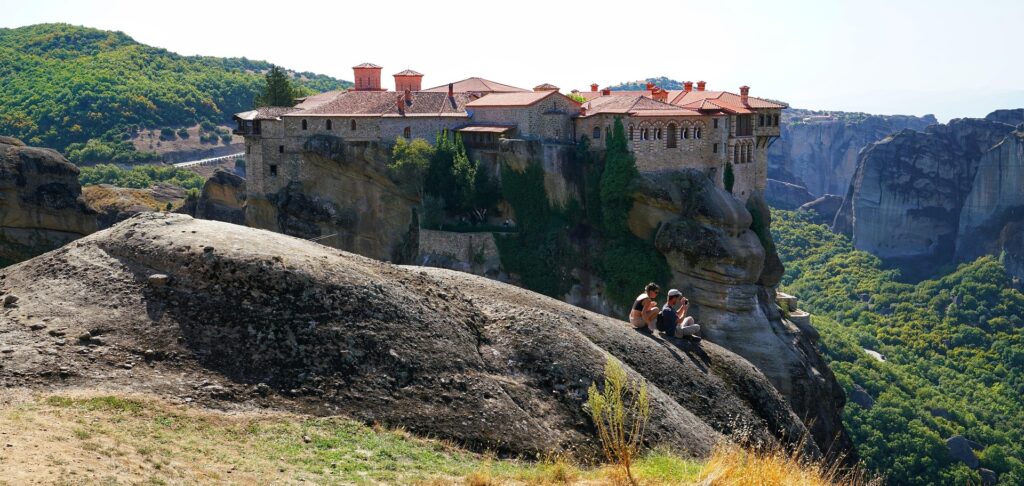
Meteora. Monks built these monasteries on top of stone pillars six hundred years ago. No roads. No stairs. Just ropes and faith.
The word meteora, in Greek, means suspended in the air.
This is literal, not metaphorical. Above the small town of Kalabaka in central Greece, a cluster of sandstone pillars rises almost vertically out of the plain — some of them more than 400 metres tall, smoothed by sixty million years of wind and water into shapes that do not look like anything nature should have thought of. In the fourteenth century, a group of Orthodox monks looked up at these rocks and decided that the tops of them were where they were going to live. They were not chasing a view. They were chasing altitude for reasons that were entirely theological — the higher the rock, the further from the world, the closer to God, the quieter the temptation. They climbed with ropes, they hauled up stone and timber with ropes, and then, once the monasteries were built, they pulled the ropes up after themselves.
At the peak of the Meteora community, there were twenty-four monasteries in operation. Six of them are still inhabited today. The Great Meteoron was founded around 1340 by Saint Athanasios the Meteorite, who had come from Mount Athos, and it remains the largest and most visited. Varlaam was founded in 1517 and still houses monks. Roussanou and Saint Stephen are now active nunneries, with nuns in residence who have lived there for decades. Holy Trinity — the monastery James Bond climbed in For Your Eyes Only, because even Hollywood occasionally admits when a real place is more dramatic than anything it can invent — is reached by 140 steps carved into the rock. Those steps did not exist until 1925. Until then, Holy Trinity was reached only by rope ladder or by being hauled up inside a net attached to a hand-cranked winch.
The nets are the detail that changes the story. For roughly 600 years, everything that went up or down a Meteora monastery — food, water, firewood, stone for construction, new monks arriving, old monks being sent home for burial, pilgrims, icons, letters, wine — went in a rope net. A nineteenth-century English traveller named Robert Curzon visited in 1834 and asked the monks how often they replaced the ropes. The answer he was given, and which he wrote down in his book, has been quoted ever since: “Only when they break.” This is not charming archaism. It is a complete theological statement about what trust in God looks like when translated into rope maintenance. The monks did not believe they would fall because the monks did not arrange their lives around the possibility of falling. A civilisation’s spiritual confidence, expressed as a logistics policy.
What was life like up there? Small. Cold in winter, burning in summer. The monasteries have kitchens that still have the original wooden beams black with four centuries of smoke. They have libraries with manuscripts from the fifteenth century, painted by monks who had never left these rocks and would never leave them. They have chapels painted floor to ceiling with frescoes by the Cretan school — Theophanes the Cretan frescoed the Great Meteoron in 1552, in pigments that have survived six hundred winters of cloud and six hundred summers of rising heat and are still, today, more saturated than anything modern pigment chemistry has managed. A monk’s day was prayer, work, silence, meals in silence, prayer, sleep. You did this for your whole life. The rocks were not the monastery. The discipline was. The rocks were simply what made the discipline possible.
Meteora became a UNESCO World Heritage Site in 1988, listed simultaneously for its natural and cultural value — one of very few places in the world to hold the double inscription. What the listing does not quite convey is how alive it still is. Services are held in these monasteries every day. Liturgy is sung by monks and nuns whose voices echo off stone walls that have absorbed identical liturgies for 700 years. Incense rises through air that has carried incense for half a millennium. On certain mornings, when the mist fills the valley below and the pillars rise out of it like islands, the old feeling the early monks came looking for — above the world, away from it, closer to something else — is still exactly available to anyone who takes the time to stand still and wait for the bells.
Some places are dramatic. Meteora is stubborn. There is a difference. The landscape is the evidence; the vow is the building. For seven centuries, men and women have looked up at these pillars and decided that the top of them was where they wanted to spend their lives, and then gone up, and stayed. Everything else — the ropes, the frescoes, the UNESCO plaque, the tourist coaches in the car park below — is what happens around a decision that has already been made.
Nine regions. One hundred and twenty destinations. Three hundred and fifty weeks remaining.
Some journeys take you across the world. Some take you straight up.

Beyondia
Trusted Travel CompanionReal digital nomad. I travel. I learn. I grow.
What about you? Where are you going?