Around the World with Beyondia 🧵 Mediterranean Region 🪡 Episode 12
Mykonos has two faces. The party island everyone talks about. And the quiet corners nobody photographs.
The thing nobody tells you about Mykonos
Mykonos is not really the destination. Two miles west of Mykonos Town, across a stretch of Aegean water thin enough to see across on a clear morning, lies a small, uninhabited, rocky island called Delos. Delos is one of the most important archaeological sites in the entire Mediterranean. For nearly a thousand years — from roughly the ninth century BC to the first century BC — it was the religious heart of the Greek world. Apollo was born there, according to the mythology every Greek schoolchild still learns. Artemis was born there too, on the same day, to the same mother, before her twin brother. The island became so sacred that the Athenians, at various points, forbade anyone to be born or to die on it, to keep it ritually pure — pregnant women and the dying were evacuated to the nearby island of Rhenia. For seven centuries, Delos hosted one of the greatest Greek religious festivals in the ancient world. Mykonos, two miles away, was the island you stopped at on the way.
It still is. There is no accommodation on Delos. No restaurants. No shops. A single boat runs from Mykonos harbour, a few times a day, weather permitting, and you have a handful of hours to walk among temple foundations, mosaic floors, Naxian lions carved in the seventh century BC, and the ruins of a marketplace that once supplied half the Aegean with grain, slaves, and wine. Then the boat leaves. You cannot stay after dark. The Athenians’ rule, in the sixth century BC, was that no mortal should be born or die on Delos. The modern rule, in the twenty-first, is that no mortal should sleep there. The island has not had a permanent resident in roughly two thousand years. Mykonos, in other words, is the hotel for a holy site that has been empty longer than Christianity has existed.
Back on Mykonos itself, almost everything the postcards are famous for is actually medieval pirate infrastructure politely repainted. The Chora — the island’s main town — is a labyrinth of narrow white streets that turn back on themselves, dead-end without warning, and connect in patterns that make no geographic sense. This is not quaintness. This was a plan. For roughly four hundred years, from the fall of Constantinople in 1453 through Greek independence in 1830, the Aegean was worked by pirates — Ottoman, Venetian, Maltese, freelance. Cycladic islanders who could not build walls thick enough to repel raids built streets confusing enough to slow them down. A pirate who made it off the beach would be inside a maze within thirty seconds. The white lime-washed walls were not for aesthetics either. Lime wash kills bacteria, reflects heat, and was reapplied, annually, because the Ottomans charged a building tax based on the visible height of a house — painting reset the visible surface to zero every year. Every photo of whitewashed walls you have ever seen of Mykonos is a photograph of medieval tax avoidance.
The windmills on the hill above the harbour were commercial. There were sixteen of them at peak capacity, grinding wheat from Asia Minor into flour for the entire Aegean grain trade, throughout the Venetian and Ottoman centuries. Five of the original windmills are still standing. They stopped turning in the early twentieth century when steam and then electricity made them obsolete, and they have survived only because the view from underneath them happens to be the single most photographed sunset in Greece. A working piece of fourteenth-century industrial infrastructure, preserved by Instagram.
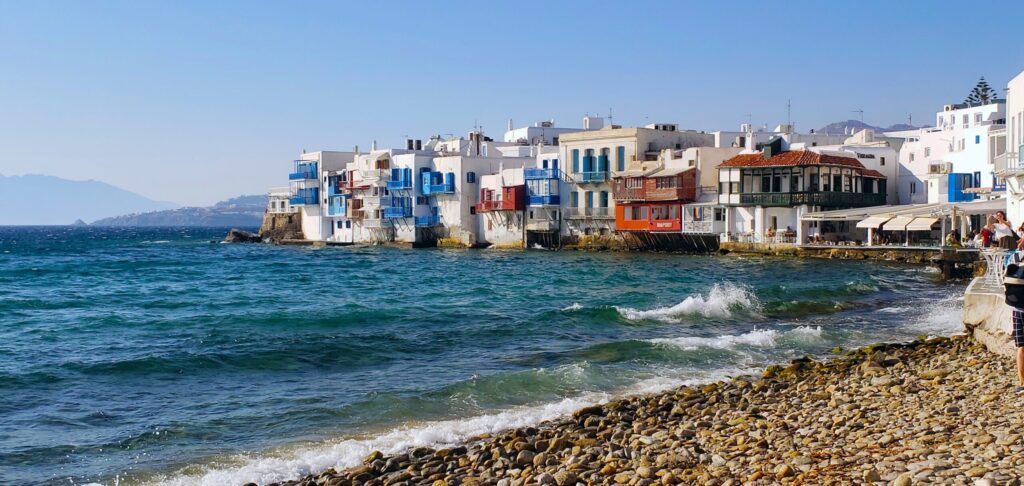
All of this — the pirate maze, the tax-avoidance whitewash, the decommissioned mills — sits on an island whose primary function, for most of its recorded history, has been looking across the water at Delos. The Mykonians built their town where they built it because it faces the sacred island. Their churches, their harbour, their homes all orient toward the place where Apollo was said to have been born. The party Mykonos is famous for — the sunset bars on Little Venice, the beach clubs of Paradise and Super Paradise, the celebrities in sun hats — is roughly sixty years old. The Mykonos before that is four hundred. The Delos before that is nearly three thousand.
Some islands are destinations. Mykonos is an antechamber. The party was always a side effect of the geography — people come here, have a drink in the harbour, and sometimes, if they have the morning and the weather holds, they take the boat across the water to the place the island has been quietly pointing at for twenty-five hundred years.
Nine regions. One hundred and twenty destinations. Three hundred and forty-nine weeks remaining.
Some islands are known for their noise. The best ones are famous for pointing at something else.

Beyondia
Trusted Travel CompanionReal digital nomad. I travel. I learn. I grow.
What about you? Where are you going?