🌐 Around the World with Beyondia 🧵 Mediterranean Region 🪡 Episode 19
Cairo is what every other old city in the Mediterranean dreams of being when it grows up.
Cairo — one of the largest cities on the planet
There is a phrase Cairenes have used about their own city for almost a thousand years: Umm ad-Dunya. The mother of the world. It is not a poetic flourish. It is a description of what the city has done, geographically and historically, for the entire civilisation around it. Cairo is one of the largest cities on the planet — around twenty-two million people in its metropolitan area, more than the population of the Netherlands, almost the population of Australia, packed onto both banks of a river that has been irrigating the same valley for seven thousand years. It is the largest city in Africa. It is the largest city in the Arab world. It is the largest city in the Islamic world. It has been all of these things, more or less continuously, for over a thousand years. Cairo does not have a golden age in its past. Cairo has been having its golden age, in some form, since before England had a parliament.
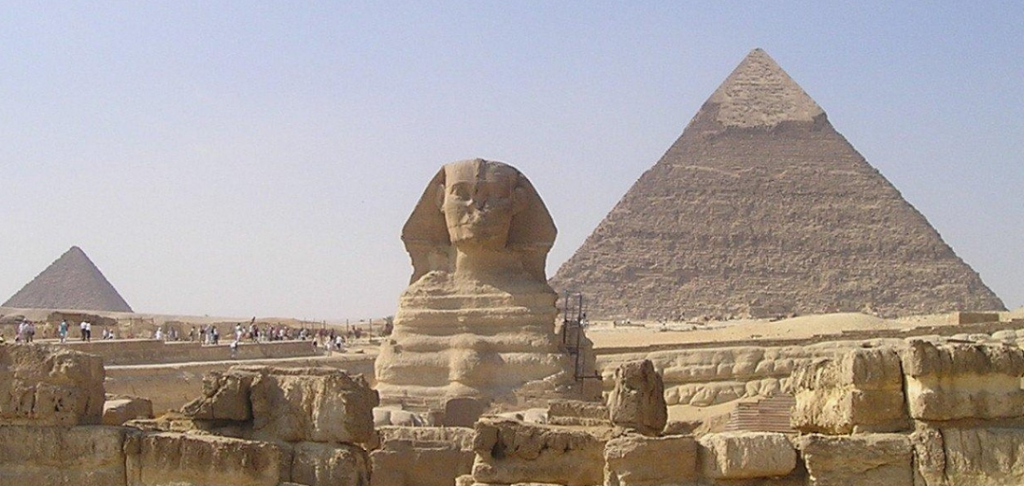
The city most travellers come to see is the Pyramid one. The three pyramids of Giza, twenty kilometres west of the city centre, were built between roughly 2580 and 2510 BC. They are forty-five hundred years old. They are the only one of the Seven Wonders of the Ancient World still standing. When Herodotus, the Greek historian who invented history as a written discipline, visited them in the fifth century BC, they were already two thousand years old to him — older to him than the Parthenon is to us. Cleopatra would not be born for another four hundred years. Julius Caesar would not see them for another five hundred. The Pyramids of Giza are so old that almost every other thing a modern visitor thinks of as ancient is, by comparison, recent. The Roman Empire is a recent event next to them. Islam is a very recent event. The crusades are last week.
Old Cairo
But the Pyramids are not the city. The city is on the other side of the river. Cairo proper began in 641 AD, when an Arab general named Amr ibn al-As set up a garrison camp called Al-Fustat — “the tent encampment” — on the east bank of the Nile, just north of an older Roman fortress called Babylon-in-Egypt. The Roman fortress was already five hundred years old at that point. The early Christians of Egypt — the Copts — had built their churches inside its walls. The Jewish community of Egypt had built its synagogue in the same compound. Amr ibn al-As did not destroy any of it. He built his mosque, the first mosque in Africa, next to the Roman fort, and let the Copts and the Jews keep their places. The four communities lived inside the same compound for the next 1,400 years, and still do. You can walk through Old Cairo today and stand in the Hanging Church, a Coptic church built around the year 690 AD on top of one of the gatehouses of the Roman fort, and look out a window at the Ben Ezra Synagogue, where a 10th-century manuscript discovery — the Cairo Geniza — produced 400,000 medieval Jewish documents that rewrote scholarship on Mediterranean Jewish life from Spain to India. The Mosque of Amr ibn al-As is across the road. None of these buildings has stopped functioning. People worship in all of them, this week, in the languages and rites they were built for.
In 969 AD, a new dynasty — the Fatimids, a Shi’a caliphate from North Africa — founded a new walled city slightly to the north of Al-Fustat and called it Al-Qahira, “the Victorious.” That word, Al-Qahira, is what most of the world’s languages now use to name the city: Cairo, Kairo, Le Caire, Il Cairo. From 969 forward, the city was one of the great capitals of the medieval Islamic world. The Al-Azhar mosque and university were founded in 970 AD; the university is still operating, the oldest continuously running university in the world by some measures, older than Oxford and Cambridge by three centuries. Saladin, the Kurdish general who eventually retook Jerusalem from the crusaders, ruled from Cairo in the twelfth century and built the great Citadel that still dominates the eastern skyline. The Mamluks — slave-soldiers turned sultans — ran the city from 1250 to 1517 and gave it some of the most extraordinary stone architecture in the medieval world, including the Sultan Hassan Mosque, whose facade is over a hundred metres tall and whose four iwans face inward across a single immense courtyard. The Ottomans took Cairo in 1517 and ran it for the next three hundred years. Napoleon arrived briefly in 1798 and was forced out in 1801. The British arrived more permanently in 1882. The Egyptians took the city back, fully, in 1952. Through every change of administration, Al-Qahira remained Al-Qahira, and Al-Azhar kept teaching.
The single most accurate way to experience modern Cairo is not the Pyramids and not the Egyptian Museum, although you should see both. It is the ahwa. The Cairene coffee shop. There are thousands of them, threaded through every neighbourhood of the old and the new city, populated mostly by men but increasingly by everyone, where the staple of business is small glasses of mint tea, Turkish coffee thick enough to stand a spoon in, shisha pipes, dominoes, backgammon boards, and conversation that does not stop. The ahwa is where Cairo thinks. Naguib Mahfouz, the Nobel laureate who wrote the city into world literature, sat in the same coffee shop in Khan al-Khalili for fifty years and wrote almost his entire body of work between glasses of tea. The shop is still there. You can sit at the same table. The traffic outside is the loudest of any city you will ever experience — Cairo’s car-horn use is its own dialect — and inside the ahwa, the noise becomes part of the texture, the way the Adriatic becomes part of the texture of Dalmatia, the way silence becomes the texture of Meteora. The city’s hum is the room tone of Cairo.
Cairo — The past open for business
This is what Cairo has, that almost no other ancient capital has: it is not preserved. It is occupied. Rome is occupied — but Rome is, in many ways, a city built around the management of its ancient parts. Athens has its old neighbourhoods, but they are small inside a modern capital. Istanbul is closer, but even Istanbul does not have the layered density of Pharaonic and Coptic and Islamic and modern that Cairo sits on top of itself. In Cairo, the past is not exhibited. The past is open for business. The Roman fort still has its walls. The Coptic churches are still holding services. The Islamic city is still the city. The pyramids are within sight, on a clear day, from the top floor of office buildings in downtown Cairo where someone is currently typing an email. The civilisations are not stacked in a museum. They are stacked in the same neighbourhood, occupying each other’s foundations, paying each other’s rent.
This is what Umm ad-Dunya means. Cairo did not become the mother of the world because of any single thing. Cairo became the mother of the world because it was the only city in this part of the planet that absorbed every civilisation that came through it without losing the previous one. The Pyramids stand on the desert plateau because someone four and a half thousand years ago thought they should. The Roman fort stands inside Old Cairo because someone two thousand years ago thought it should. The Hanging Church stands on top of the Roman fort because someone fourteen hundred years ago thought it should. The Mosque of Amr is next door because someone thirteen hundred years ago thought it should be. The Al-Azhar University is teaching this morning because someone, a thousand and fifty-six years ago, thought it should be teaching. And Cairo is what happens when none of those people are ever wrong, and none of their buildings are ever entirely abandoned.
The Mediterranean’s southern shore is not younger than its northern one. It is older. Every European civilisation in this series so far — Croatian, Greek, Roman before them — looked across this sea, in one century or another, toward Egypt, and either traded with it, learned from it, conquered it briefly, or feared it. Cairo is the city those civilisations have been looking at for three thousand years.
Nine regions. One hundred and twenty destinations. Three hundred and forty-two weeks remaining.
Some cities you pass through. This one is older than the idea of passing through.

Beyondia
Trusted Travel CompanionReal digital nomad. I travel. I learn. I grow.
What about you? Where are you going?