🌐 Around the World with Beyondia 🧵 Mediterranean Region 🪡 Episode 26
Florence Produced the Renaissance
In the early fifteenth century, the small Tuscan city of Florence had a permanent population of roughly forty thousand people. That is smaller than the modern American towns of Wenatchee, Washington, or Sandusky, Ohio. It is fewer than the crowd at a single Italian football match. From this population, in roughly one hundred and twenty years, came Filippo Brunelleschi, who built the largest dome the world had seen in thirteen centuries. Donatello, who reinvented sculpture. Masaccio, who reinvented painting. Fra Angelico, who reinvented religious painting. Sandro Botticelli, whose Birth of Venus and Primavera still hang two streets from the building Botticelli was born in. Leonardo da Vinci, who was trained in the workshop of the Florentine goldsmith Andrea del Verrocchio. Michelangelo Buonarroti, who was raised by a Florentine stonemason’s family and apprenticed to the Florentine painter Domenico Ghirlandaio at thirteen. Niccolò Machiavelli, whose Prince was written in a small farmhouse just outside the city. Galileo Galilei, who was professor of mathematics at the University of Pisa under Florentine patronage. Giorgio Vasari, who invented art history as a discipline by writing the biographies of the men he personally knew. Luca Pacioli, who codified double-entry bookkeeping in 1494 and was Leonardo’s mathematics teacher. The same town. The same fifty years. The same five square kilometres of city centre. Per capita, the highest concentration of historically consequential creative output ever produced by any human settlement.
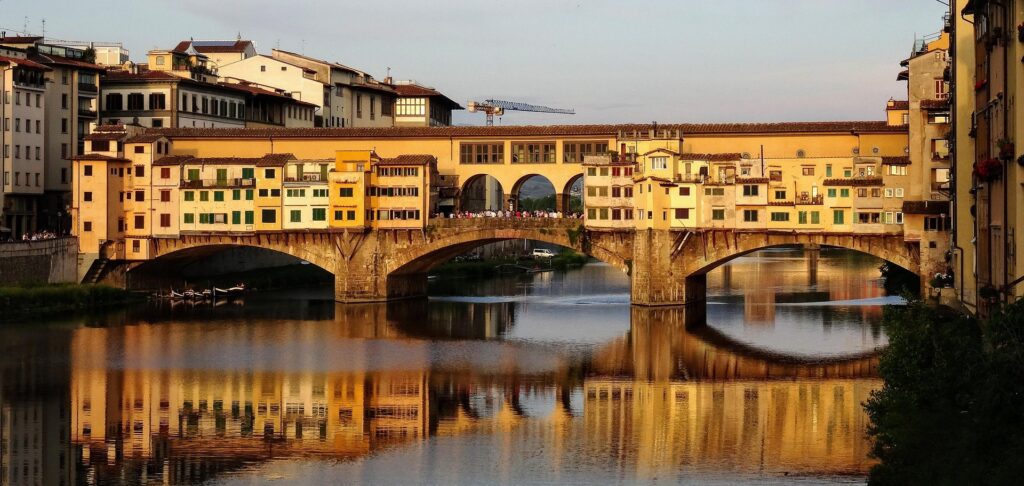
The arithmetic is so improbable that it is regularly forgotten. Most casually-informed visitors arrive in Florence assuming that what produced the Renaissance was Italy. What produced the Renaissance was Florence — and Florence specifically, not Rome or Milan or Venice, although all three caught the wave later. And the Florence that produced it was tiny. The historic centre is barely five square kilometres. You can walk from the Duomo to the Ponte Vecchio in seven minutes. From the Ponte Vecchio to the Pitti Palace in another five. The entire artistic, financial, philosophical, scientific, and political universe of the Italian Renaissance fit inside an area smaller than Central Park in New York. The cathedral, the baptistery, the great public square, the bankers’ palaces, the painters’ studios, the goldsmiths’ workshops, the booksellers, the printers, the universities, the brothels, the prisons, and the homes of all the people in this story were within walking distance of each other. Brunelleschi could have shouted out his window and Donatello might have heard him. Michelangelo, as a teenager, walked past the half-finished tomb of his patron’s grandfather on his way to school.
This is the foundational fact the rest of the city is built on. The second foundational fact — and the one that resolves most of the period’s apparent miracles — is that Florence’s art and Florence’s money were not separate operations. They were the same operation. The Medici family, who funded Donatello, Brunelleschi, Botticelli, the young Michelangelo, the construction of San Lorenzo, the rebuilding of the Convent of San Marco, the early career of Leonardo, and the design of the Uffizi, were not generous aristocrats with inherited wealth. They were bankers. The Medici Bank, founded in 1397 by Giovanni di Bicci de’ Medici, became Europe’s largest financial institution within a generation. It had branches in Rome, Venice, Geneva, Lyon, Bruges, London, and Avignon. It was the principal lender to the Papacy. It used the florin — the gold coin issued by Florence since 1252, weighing 3.54 grams of nearly pure gold — as its trading currency, and the florin was, for three centuries, what the dollar is now: the standard high-value coinage of European international trade. The Medici did not patronise art with surplus wealth. They patronised art with banking profits, deliberately, as both a public relations strategy and a way of laundering the moral cost of usury — the Catholic Church technically forbade lending at interest, and visible piety in the form of church-financing and art commissions was, in part, a way to settle the spiritual books. The Renaissance was funded by the medieval European credit market. Modern banking and Renaissance painting are not parallel inventions. They are the same project.
The same Luca Pacioli who taught Leonardo mathematics published, in Venice in 1494, a book called Summa de arithmetica. Buried inside its eight hundred pages was a thirty-page section called Particularis de Computis et Scripturis — a treatise on accounting that codified, for the first time anywhere in the world, the double-entry bookkeeping system. Every modern company’s balance sheet — every asset and liability, every credit and debit, every quarterly report filed to every stock market — descends directly from this thirty-page document. Pacioli did not invent double-entry bookkeeping; the Venetian and Florentine merchants had been using it informally for at least a century. He standardised it, named the columns, codified the rules. He was a Franciscan friar from a small Tuscan town who happened also to be one of the most consequential mathematical writers of the Renaissance. He shared a house with Leonardo da Vinci in Milan in the 1490s. They illustrated his next book together — De Divina Proportione, on geometric perspective and the golden ratio, with Leonardo’s drawings of polyhedra. A bookkeeper and a painter, sharing a kitchen, working on the same volume. This is what Florence was.
In the central piazza of the city, on the Duomo, sits the dome Brunelleschi built between 1420 and 1436. It is the largest brick dome in the world. Forty-five metres in diameter at its base, slightly wider than the Pantheon, which had been the world’s largest dome for the previous thirteen hundred years. Brunelleschi solved the engineering problem nobody else in Europe had solved — how to construct a self-supporting masonry dome of that scale without traditional centring scaffolding from below, which the size of the existing octagonal drum at Santa Maria del Fiore made physically impossible. He used a herringbone bricklaying technique he had reverse-engineered, possibly during a study trip to Rome to examine the surviving Pantheon. He invented the hoists, cranes, and brick-handling jigs required to lift four million bricks to a height of one hundred metres. He kept his methods secret. He had not trained as an architect; he had trained as a goldsmith. The cathedral had been waiting for someone to put a roof on it for nearly a century before Brunelleschi presented his plan. When Michelangelo travelled to Rome a century later to design the dome of Saint Peter’s Basilica, he is reported to have stood before Brunelleschi’s dome and remarked, of his own future work: “I will not build it any larger. I cannot build it more beautiful.” The dome remains the largest brick dome in the world six hundred years later. Nothing has surpassed it.
The accumulated weight of this — the dome, the paintings, the sculptures, the architecture, the buried codices and accounting books and bank ledgers, all of it inside a five-square-kilometre town — has measurable effects on visitors. In 1817 the French writer Stendhal — Marie-Henri Beyle, the future author of The Red and the Black — visited the Basilica of Santa Croce in Florence to see the tombs of Michelangelo, Galileo, and Machiavelli. He described in his journal an attack of dizziness, palpitations, sensations of unreality, and fear that he might collapse, brought on by the cumulative aesthetic experience. The episode was treated for almost two centuries as a literary curiosity. Then in 1979, the Florentine psychiatrist Graziella Magherini began documenting cases of acute psychiatric episodes in foreign tourists at the Santa Maria Nuova hospital in Florence — hyperventilation, hallucinations, panic, occasional dissociative episodes, all triggered by exposure to the city’s art and all temporary, all clearing within forty-eight hours of leaving Florence. By the time her clinical paper was published in 1989, she had documented over a hundred cases. She named the diagnosis after the writer who first described it: Sindrome di Stendhal. The Stendhal Syndrome. There is no other city in the world named in a psychiatric diagnosis on the basis of doing this to people. The diagnosis is real. The admissions are documented. Florence is the only town the human aesthetic nervous system reliably struggles to absorb on contact.
Some cities have a few great artists. Some cities have a few great inventions. Florence has all of them, simultaneously, in the same five square kilometres, produced by a population that would fit in a modern football stadium, financed by the medieval banking system the same people invented, recorded in the bookkeeping system the same people standardised, painted using the perspective the same people developed, and crowned by the dome the same people put on top of the cathedral they finished while still inventing everything underneath it. The Renaissance is not a movement that happened in Florence. The Renaissance is a business model that Florence ran for two hundred years, before Rome bought it, before Europe imitated it, and before the rest of the world inherited the result.
Some places are visited for what is in them. This one is visited because it is what we are.
Nine regions. One hundred and twenty destinations. Three hundred and thirty-five weeks remaining.
The journey continues north. The next stop is a city built on water — sinking quietly, sold many times, still refusing to leave.

Beyondia
Trusted Travel CompanionReal digital nomad. I travel. I learn. I grow.
What about you? Where are you going?