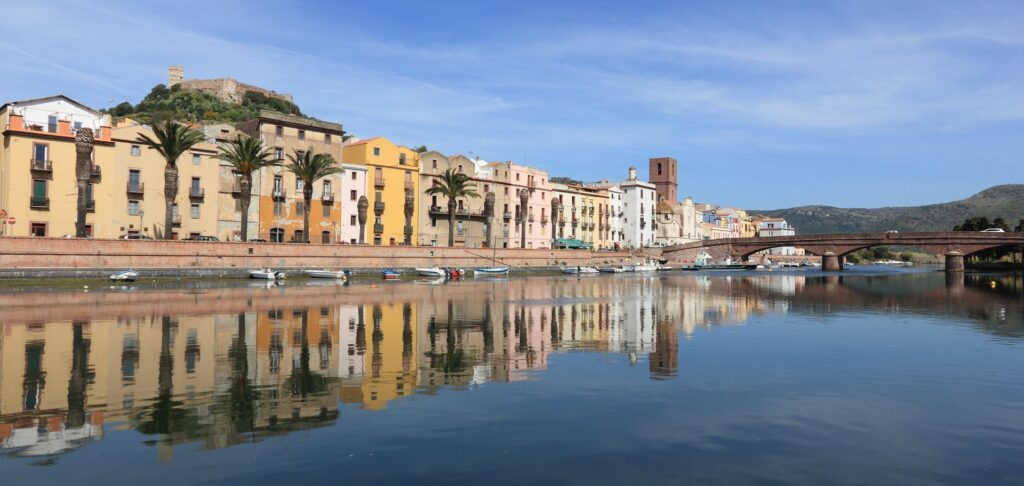
🌐 Around the World with Beyondia 🧵 Mediterranean Region 🪡 Episode 25
People in Sardinia live longer than almost anywhere on Earth
Sardinia — Island That Declined to Participate
For roughly seven centuries, between 238 BC and the collapse of the Western Empire in the fifth century AD, Sardinia was a Roman province. The Romans built ports at Cagliari and Olbia, mined the island’s iron, lead, and silver, established roads along the coastline, and shipped grain to Rome from the southern plains. They controlled the coast comprehensively and the lowlands competently. They never controlled the interior. The mountain regions of central Sardinia — the basalt highlands of the Barbagia, the gorges of the Supramonte, the limestone valleys of the Ogliastra — remained inhabited by shepherds and villagers who paid no taxes, took no Roman names, spoke no Latin, and met any Roman attempt to administer them with armed resistance from terrain the Romans could neither map nor easily march through. The Romans, who controlled half of Europe, North Africa, and most of the Middle East, came to call this inland region Barbaria — the place of the barbarians. The name stuck. To this day, the central highlands of Sardinia are called the Barbagia. The villagers there are descendants of the people the Romans could not subdue. The mountain dialect of Sardinian — which is its own Romance language, not a dialect of Italian — preserves grammatical structures and vocabulary that classical Latin has lost. The Barbagia did not learn from Rome. Rome learned, slowly and reluctantly, to leave the Barbagia alone.
This is the deepest fact about Sardinia, and the one that explains almost everything else. The island is the second-largest in the Mediterranean — 24,090 square kilometres, larger than Wales, larger than the state of Israel, slightly smaller than Sicily. It has 1,300 kilometres of coastline. The interior is mountainous, hard, ancient, and self-governing in a way that the outside world has consistently failed to penetrate. The island has been administered, in turn, by Phoenicians, Carthaginians, Romans, Vandals, Byzantines, Genoese, Pisans, the Crown of Aragon, the Spanish Habsburgs, the Austrian Empire, the Kingdom of Piedmont-Sardinia, and the modern Italian Republic. None of these powers ever fully controlled the inside of the island. The coast was always negotiable. The mountains were never available. This is why Sardinians have a particular relationship to the rest of Italy that is unlike Sicily’s, unlike Naples’s, unlike any other regional identity in the country. Sicily was conquered by everyone and absorbed all of them. Sardinia was conquered by almost everyone, but the central highlands quietly refused, and the rest of the island took its character from the part of itself the outside world could not reach.
The island’s most extraordinary archaeology is older than every conquest. Between roughly 1800 BC and 200 BC, a civilisation now called the Nuragic — because we do not know what its people called themselves, and they left no writing that has survived — built more than seven thousand stone tower-fortresses across Sardinia. The towers are called nuraghi, after the Sardinian word for them. They are truncated cones of dry-fitted basalt and granite, some single-towered, some multi-towered, some embedded in elaborate village complexes with cisterns, courtyards, and outer walls. The largest of them, Su Nuraxi at Barumini in the south-central part of the island, is a five-tower complex from the second millennium BC, a UNESCO World Heritage Site since 1997. It predates the Parthenon by a thousand years and the Colosseum by two thousand. The Nuragic civilisation also produced thousands of small bronze figurines — sailors, archers, mothers carrying children, animals, miniature ships — and a series of enormous stone statues, the Giants of Mont’e Prama, found shattered in a field in 1974 and only partially reconstructed since: nearly life-sized warriors and archers carved roughly three thousand years ago, in a sculptural tradition that has no obvious precedent or parallel in Mediterranean Bronze Age art. The Nuragic people were here for sixteen hundred years. They built more stone monuments per square kilometre than any other Bronze Age civilisation in Europe. We do not know what they spoke, how they organised, why they built the towers in the precise distribution they did, or what happened to bring their civilisation to its end. They are an entire vanished people whose architecture is intact and whose biography is missing. Sardinia is, in the deepest archaeological sense, one of the oldest unread books in the Mediterranean.
In the mountain villages of the Barbagia and the Ogliastra — Villagrande Strisaili, Talana, Arzana, Baunei, Seulo — something else has happened that has put central Sardinia on a different sort of world map. In 2004, the Belgian demographer Michel Poulain and the Italian doctor Gianni Pes published a study identifying central Sardinia as a region with an extraordinary concentration of centenarians, particularly male centenarians, at rates roughly ten times the European average. Pes and Poulain marked the area on a map with blue ink, and called it a Blue Zone. The American journalist Dan Buettner adopted and popularised the concept in National Geographic in 2005, and the term entered global vocabulary. There are five Blue Zones on Earth: Okinawa in Japan, Nicoya in Costa Rica, Ikaria in Greece, Loma Linda in California, and the Ogliastra and Barbagia regions of central Sardinia. The Sardinian Blue Zone has the world’s highest concentration of male centenarians, a demographic outlier found nowhere else on the planet. The reasons are partly genetic — these villages have been endogamous for centuries — partly dietary, partly the result of mountain physical labour continuing into very old age, and partly social. Multi-generational households are the norm. Old people are not retired into care facilities; they are integrated into the village. They walk uphill until they cannot. They drink the local cannonau wine, which has unusually high concentrations of certain polyphenols. They eat goat cheese, pecorino sardo, hand-rolled malloreddus pasta, mountain greens, pane carasau — the thin parchment-like flatbread invented for shepherds to carry into the mountains for weeks at a time. None of this is a longevity diet imposed by science. This is what these villages have been eating for two thousand years. The longevity is the side effect of a way of life that the rest of the modern world has more or less abandoned.
The famous Sardinia — the Costa Smeralda — is a 55-kilometre stretch of northeastern coastline developed by Prince Karim Aga Khan IV starting in 1962. He bought the coast from local landowners for a fraction of its future value, built a private consortium to control development, and turned an empty granite shore of fishing villages into a discreet European playground for royalty, oil money, and yacht-owning industrialists. Porto Cervo is its capital. The price of a coffee on the right marina table can equal a meal in any inland Sardinian village. The Costa Smeralda occupies less than one per cent of the island’s coastline and produces probably ninety per cent of its international press coverage. It is real. It is also entirely uncharacteristic of Sardinia. The Aga Khan’s coastline is to Sardinia what Monaco is to France — geographically inside it, culturally adjacent to it, financially detached from it. The island where men live to a hundred is the rest of the island. The island the Romans gave up on is the rest of the island. The island whose Bronze Age towers nobody outside Sardinia has heard of is the rest of the island. Ninety-nine per cent of Sardinia is the part nobody is photographing.
The interior is the deep place. The villages are stone-built, often perched on basalt outcrops, often reached by a single hairpin road. The shepherds still drive flocks of sheep along the highland passes in the autumn, the way their ancestors did under the Romans and before the Romans. The men in the village bars wear flat caps and play briscola with a particular Sardinian deck of cards. The women hand-roll pasta on wooden boards in the mornings. The bread is baked once a week in communal stone ovens, and a family will eat it for the seven days following, dipped briefly in water to soften, then dressed with olive oil or shaved cheese or wild greens. The cannonau wine is poured from unmarked bottles by the village’s own producer, and refilled directly from the tap of his cellar when the bottle is empty. None of this is staged. None of it is performed for tourists, because almost no tourists are there. The interior is the part of Sardinia that the conquerors never broke, that the resort developers never reached, that the Italian state has never quite figured out how to integrate, and that produces, with a quiet stubbornness, the longest-lived men in the world.
The Sardinian flag, official since 1999 but used informally for centuries, depicts the four heads of four Moorish kings — a heraldic image whose origin lies in the medieval Crown of Aragon, but whose meaning Sardinians have appropriated entirely. Sardinian intellectuals describe the flag, half-jokingly, as the four conquerors the island defeated. The heads are blindfolded. In the earlier versions of the flag, the eyes were uncovered and looking outward; the blindfolds were added later. The Sardinian historian Francesco Cesare Casùla once observed that Sardinians blindfolded the conquerors because they wanted them not to see the way out. The interior is what they were never allowed to see.
Some islands are conquered. Some islands negotiate. This one withdrew, kept its towers, fed its old men, and watched everyone else come and go.
Nine regions. One hundred and twenty destinations. Three hundred and thirty-six weeks remaining.
The journey continues north. The next stop is a lake older than any country it now belongs to.

Beyondia
Trusted Travel CompanionReal digital nomad. I travel. I learn. I grow.
What about you? Where are you going?