🌐 Around the World with Beyondia 🧵 Mediterranean Region 🪡 Episode 28: Bolzano
The waiter took my order in German. The receipt was in Italian. The sign on the bakery across the street was in both. None of this is unusual here. Bolzano did not become Italy when Italy arrived.
Bolzano: The Italian City That Refused to Become Italian
In a country whose national identity has been hammered into shape over two millennia, there is one city, in the far north, that decided not to participate. Bolzano — Bozen in German — is the capital of the autonomous province of South Tyrol, the slice of Alpine Italy that sits between the Brenner Pass and Lake Garda, against the Austrian border. Approximately seventy per cent of the people who live in this province speak German as their first language. Approximately twenty-five per cent speak Italian. A small remaining minority speaks Ladin, a Romance language descended from Latin that has been spoken in the high valleys of the Dolomites for the better part of two thousand years, and which is now spoken by roughly thirty thousand people in the entire world, almost all of them within a hundred kilometres of this city. South Tyrol is, in legal terms, an Italian province. In every other meaningful sense — the language on the radio, the cuisine in the restaurants, the architecture of the houses, the surnames in the phone book, the regional government’s working languages, the road signs, the church services — South Tyrol is something else, sitting underneath an Italian flag with a degree of resigned political competence. Bolzano is the only major city in the European Union where the dominant first language is not the language of the country the city is in.
This situation is not folkloric. It is the result of a specific, traceable historical accident. South Tyrol was Austrian for six centuries — part of the County of Tyrol, governed from Innsbruck within the Habsburg domains, with a population that spoke German and identified, to the extent regional populations identify with anything, as Austrian. When the First World War ended in 1918, Italy — which had entered the war on the Allied side partly in exchange for promises of Austrian territory — was awarded South Tyrol under the Treaty of Saint-Germain in 1919. Italy received a territory whose population was roughly ninety per cent German-speaking, and which had been Austrian since 1363. Almost no one in the province had asked to become Italian. Almost no one was consulted. The line of the border was drawn at the Brenner Pass, an Alpine watershed that the Italian negotiators considered geographically defensible. The line ignored every language, family, parish, school, and trade route that crossed it. South Tyrol woke up in 1920 to find that it had moved countries while remaining geographically, linguistically, culturally, and ethnically exactly where it had been the year before.
What happened next was the longest sustained Italianisation campaign in modern European history. Beginning in 1923, the Fascist government under Mussolini issued the Provvedimenti per l’Alto Adige — a series of decrees designed to eliminate German from the province within a generation. German-language teaching was banned in schools. German-language place names were officially renamed in Italian, often by direct translation, sometimes by inventing Italian names where none had existed. Bozen became Bolzano. Brixen became Bressanone. Meran became Merano. German-language street signs were removed. German-language court proceedings were banned. The use of German in public administration was forbidden. German family surnames were forcibly Italianised on official documents. Ethnic Italians from the south were resettled into the province on subsidised terms to dilute the German-speaking population. By 1939, Hitler and Mussolini, who needed each other politically, made a private deal — the Option — that gave South Tyroleans a choice: leave for the Third Reich and remain German, or stay in Italy and accept full Italianisation. Roughly 86% of the German-speaking population voted to leave. Then the war intervened, the option became impossible to execute, and most of those who had voted to leave ended up staying. The Italianisation policy continued, in slightly softened form, until well after the Second World War. It failed. Today, after a century of pressure, three quarters of South Tyrol’s population still speaks German first. The schools, since the autonomy statute of 1972, are again bilingual or German-medium. The public signs are again bilingual. The province has the strongest regional autonomy of any region in Italy and one of the strongest in Europe — its own tax collection, its own immigration controls, its own schools, its own labour market protections. South Tyrol is, in every practical sense, a German-speaking polity inside the Italian state, run by a regional government in three official languages, paying taxes to Rome under terms it negotiated for itself.
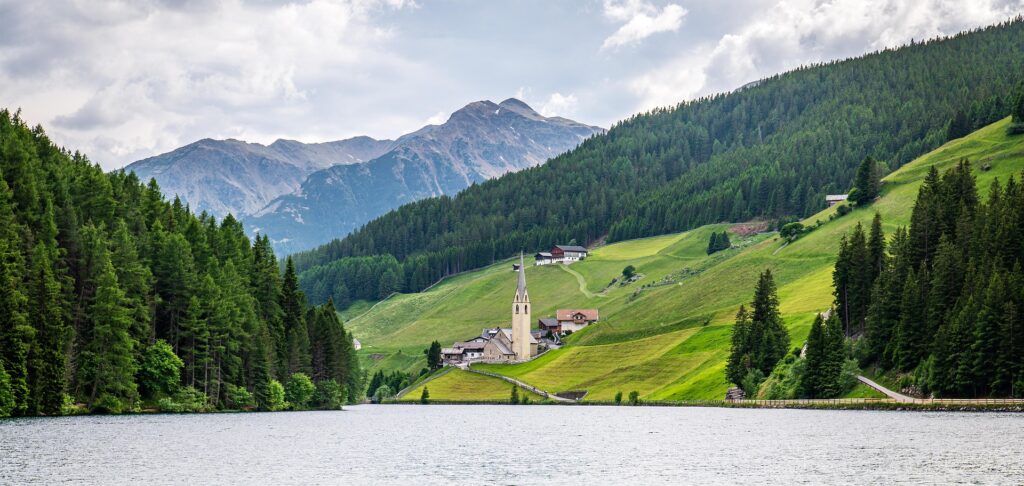
This is the city you walk into. The streets of central Bolzano have stone arcades — the Lauben in German, the Portici in Italian — built in the Middle Ages to protect merchants from snow, and they are full of bakeries selling Tyrolean Vinschger Paarl alongside Italian focaccia, butchers slicing the cured ham called speck under glass cases of mortadella, cafés serving Viennese Sachertorte next to tiramisù, and bookshops with separate German and Italian sections. The local cuisine is dumplings, canederli (the same word in Italian — borrowed and standardised), bread dumplings flavoured with speck or spinach or beetroot, served in clear broth or with melted butter. Sauerkraut is on every menu. Apple strudel is the default dessert. The wine is local — Lagrein, a deep ruby Tyrolean variety grown for centuries on the southern slopes around Bolzano; Gewürztraminer, a white wine named for the village of Tramin, fifteen kilometres south of the city, where it was historically cultivated and which gives the grape its name worldwide. The architecture is Tyrolean — frescoed façades, painted exterior corner medallions, balconies overflowing with geraniums, churches with bulbed spires more characteristically Austrian than Italian. The trains run on time. The buses leave to the second. The signs are in two languages, and where applicable, three.
In a refrigerated chamber on the second floor of the South Tyrol Museum of Archaeology — a converted nineteenth-century bank building in the centre of the old town — lies the oldest natural mummy in Europe. His name is Ötzi the Iceman, although this name was given to him after his discovery. In September 1991, two German hikers walking in the Ötztal Alps along the Italian–Austrian border, about ninety kilometres west of Bolzano, found a human body protruding from a melting glacier at 3,210 metres elevation. They thought it was a recent climbing fatality. Initial Austrian forensic investigation concluded it was something much older. Subsequent dating placed the body at approximately 5,300 years old, from the late Copper Age, roughly contemporary with the construction of Stonehenge. The ice had preserved him almost perfectly — his skin, his clothes, his shoes, his bow and arrows, his copper axe, his last meal, his diseases, his tattoos, and the arrowhead lodged in his left shoulder. He had been murdered, almost certainly, by an arrow fired from below and behind him at close range. The discovery transformed European archaeology. Scientists have now sequenced his entire genome, which links him most closely to modern Sardinians rather than modern Tyroleans. His last meal was ibex meat and ancient grain. His blood type was O positive. He had Lyme disease and intestinal parasites. He had sixty-one carbon tattoos in a pattern that may have been therapeutic. He was about forty-five years old when he died, short by modern standards at 160 centimetres, brown-eyed, with high-altitude lungs and worn knees. He is in Bolzano because the precise location where his body was found — the point in the Tisenjoch glacier where the ice had been holding him for fifty-three centuries — sits 92.56 metres south of the Italian–Austrian border line. Had the discovery been found 92 metres further north, Ötzi would be in Innsbruck. He is the most studied prehistoric individual in the world. His nationality was determined by a cartographic accident the size of a city block.
This is what Bolzano keeps doing. It is the seam. The geography is alpine, the food is Austrian, the language is German, the flag is Italian, the wine is local, the most famous resident is prehistoric, the most famous border is invisible. There is no contradiction here, only stratification. The Roman road through the Adige Valley ran through this place. The medieval Counts of Tyrol governed it from a castle still standing on the hill above. The Habsburgs added the arcades. The Fascists changed the names. The post-war republics gave it autonomy. The trains still run between Italy and Austria, two minutes’ walk from the central square, on tracks that the Austrians laid in 1867 and that have, in geographic terms, never moved. None of this is curated. All of it is in current operation. Bolzano did not absorb its history. Bolzano kept all of its history and now lives, sensibly, inside the resulting density.
The Dolomites rise on the eastern horizon, beginning roughly thirty kilometres from the city centre — the pale limestone peaks inscribed on the UNESCO World Heritage list in 2009 for their geological significance and their landscape value. The Italian–Austrian border runs along the Alpine watershed somewhere to the north, mostly across glaciers that are now retreating. The Brenner Pass, which once divided two empires and now divides only two members of the European Union, is forty kilometres away by motorway. There is a train station in Bolzano with departures to both Vienna and Rome leaving in the same hour. The route to Vienna takes seven hours. The route to Rome takes seven hours. Bolzano is, almost exactly, the midpoint. The capital of a province that has not entirely decided which capital it belongs to.
Some cities take their character from what conquered them. This one took its character from what it refused to give up.
Nine regions. One hundred and twenty destinations. Three hundred and thirty-three weeks remaining.
The journey continues. The next stop is a lake old enough to be older than Italy, large enough to be its own weather system.

Beyondia
Trusted Travel CompanionReal digital nomad. I travel. I learn. I grow.
What about you? Where are you going?