🌐 Around the World with Beyondia 🧵 Mediterranean Region 🪡 Episode 35: Brest
The city was destroyed in 1944. Not damaged. Destroyed. Ninety-five per cent of the historic centre, gone. The Brest a visitor walks through today is younger than my mother.
Brest is younger than many of the adults who live in it
In the late summer of 1944, in the westernmost city of mainland France, an American army under General Troy Middleton fought a forty-three-day siege against a German garrison of around forty thousand men commanded by General Hermann-Bernhard Ramcke. The objective was the deep-water port of Brest, which the German Kriegsmarine had spent the previous four years turning into one of the most heavily fortified Atlantic submarine bases in Europe. The German submarine pens at Brest — the U-Boot-Bunker — had been built between 1941 and 1944 with up to six metres of reinforced concrete overhead, capable of housing fifteen U-boats simultaneously and surviving direct hits from Allied bombs. The Allies had bombed the city 165 times during the occupation, mostly in attempts to destroy the bunker, mostly without success. The bunker survived almost every air raid. The city around it did not. By the time the Germans surrendered on the 19th of September 1944, approximately 95 per cent of Brest’s historic centre had been destroyed. Approximately 35,000 inhabitants — the great majority of the city’s surviving civilian population — had been evacuated to the countryside before the battle. They returned, in the autumn, to find that almost nothing was left.
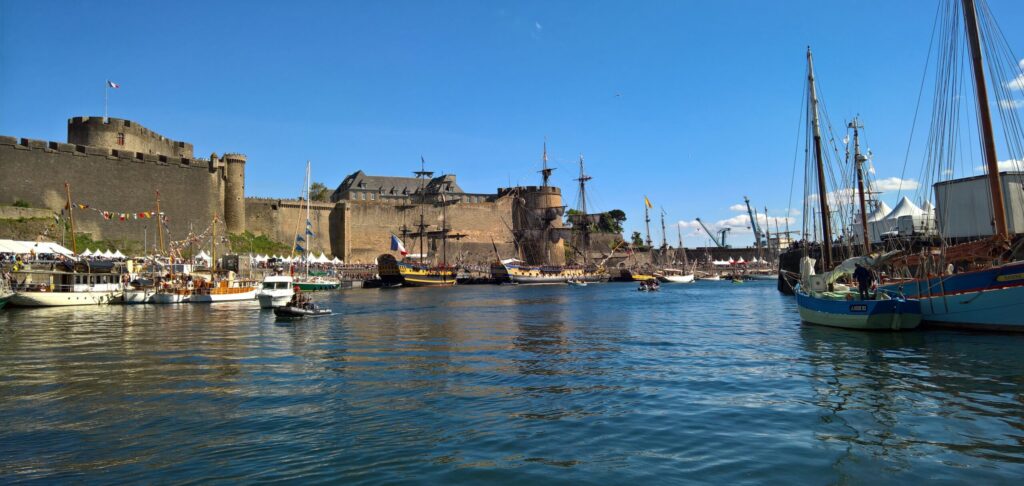
This is the foundational fact about modern Brest, and the one that explains almost everything else. The medieval city — Brest had Roman foundations, was a major medieval port from the twelfth century onwards, and was one of the most important Breton-French royal naval bases from the seventeenth century — was gone. The seventeenth-century arsenal town built by Colbert was gone. The eighteenth-century officers’ quarter was gone. The nineteenth-century apartment buildings of the bourgeois centre were gone. The early-twentieth-century town hall, the railway station, the cathedral, the schools, the cinemas, the cafés, the bookshops, the family homes that had stood for two and a half centuries — all of it was rubble. The only major medieval structure that survived was the Château de Brest, the fifteenth-century castle on the headland above the harbour entrance, which the French Navy had been using as its prefecture and which somehow remained largely intact through the bombing. The Tour Tanguy — a small medieval watchtower on the opposite bank of the Penfeld river — also survived. Apart from these two structures, there was essentially nothing of historic Brest remaining when the residents came home in 1945. The city was a field of rubble approximately five square kilometres in extent. Photographs from the autumn of 1944 show people walking through what looks like a quarried wasteland, with the harbour and the open Atlantic visible across the entire expanse where the city used to stand.
What France did then was unusual. The reconstruction was assigned, in 1947, to the architect Jean-Baptiste Mathon — a fifty-four-year-old veteran of the Reconstruction Ministry who had previously overseen the rebuilding of Le Havre, the other major French port destroyed in 1944. Mathon proposed a uniform Modernist reconstruction at scale: reinforced concrete apartment blocks of five to six storeys, organised on a regular grid, with wide avenues, uniform façade treatments in light stucco, repeating window patterns, ground-floor commercial frontages, and a deliberate refusal to imitate the medieval city that had been lost. The decision was politically explicit. France did not have the money or the time to reconstruct Brest in pastiche of its historic appearance. France had hundreds of thousands of homeless people across its destroyed cities and a desperate need for housing. The choice was speed and function over nostalgia. Construction began in 1948. The first apartment blocks were occupied by 1950. By 1961, when Mathon’s plan was substantially complete, Brest had been rebuilt as a city of approximately 120,000 people, in a uniform architectural style, in thirteen years. The historic centre that exists in 2026 — the streets between the Rue de Siam (the main commercial axis), the harbour, the Place de la Liberté, and the eastern districts — is, almost without exception, the Brest that Mathon designed and built between 1948 and 1961. There is, at street level, essentially nothing visible in central Brest that predates 1948. The city is younger than many of the adults who live in it.
The architectural verdict on this reconstruction has been, from the day it was finished, mixed. Tourist writing about Brest, particularly Anglophone tourist writing, has tended to describe the city as “ugly,” “concrete,” “soulless,” or “post-war.” Some Bretons describe it in similar terms. The criticism is honest but, in the article’s view, the wrong question. The Brest reconstruction was not designed to be photogenic. It was designed to give homes back to a population that had lost theirs, in the shortest possible time, at the lowest possible cost, using the materials and methods available to a devastated post-war France. By those measures, the project was a remarkable success. Brest in 1955 was a functioning city again. Brest in 1965 was housing 165,000 people in modern apartments with central heating, indoor plumbing, electric lighting, and access to the harbour where their fathers and grandfathers had worked. The aesthetic priorities of the reconstruction were inverted from those of Haussmann’s Paris: speed over beauty, function over symbol, equality over hierarchy. The result is what it is. It is also what France chose, under the circumstances. Calling it ugly is a judgement made from a position of having homes that the people who lived in Brest in 1944 did not have. The article will not call it ugly. The article will call it uncompromising — a city that chose to be rebuilt quickly and cheaply for the people who needed homes, rather than slowly and prettily for the people who would come to photograph it.
The naval function the city was rebuilt to serve is, today, the same naval function it has served continuously since 1631. In that year, Cardinal Richelieu — Louis XIII’s chief minister and the founder of modern French naval power — selected Brest as the principal French naval base on the Atlantic. The reasons were geographical. The Rade de Brest, the natural harbour formed by the estuaries of the Penfeld and the Élorn rivers, is one of the largest natural anchorages in Europe — approximately 180 square kilometres of protected water, with an entrance through the Goulet de Brest (the Brest Strait) only 1,800 metres wide at its narrowest point, easily defensible. The harbour can hold the entire French Atlantic fleet simultaneously. Colbert built the arsenal in the 1660s. Vauban — Louis XIV’s military engineer — designed the harbour fortifications in the 1680s and 1690s, with star-shaped bastions that still survive on either side of the Goulet. Three centuries of French naval activity flowed through this port. The expedition of Bougainville departed from Brest in 1766 on the voyage that produced the first French circumnavigation of the world. The expedition of Jean-François de La Pérouse departed from Brest in 1785 on the voyage that ended in shipwreck and disappearance in the south Pacific, and which Louis XVI is famously said to have asked after on the morning of his execution in January 1793: “avez-vous des nouvelles de M. de La Pérouse?” — “is there any news of M. de La Pérouse?” There was none. The expedition of Dumont d’Urville to the Antarctic departed from Brest in 1837. The expeditions, the voyages, the launchings of new ships of the line, the receptions of victorious admirals and the funerals of defeated ones — all of this is the city’s continuous history as the French Navy’s western anchor. The Battle of Trafalgar in 1805 was fought partly with ships built at Brest. The First World War saw Brest become the principal landing port for the American Expeditionary Force — over 800,000 American soldiers passed through Brest’s harbour in 1917–1918. The contemporary French nuclear submarine fleet — the four Triomphant-class ballistic missile submarines that constitute France’s seaborne nuclear deterrent, the Force Océanique Stratégique — is based at Île Longue, a small island in the southern part of the Rade, twenty-five kilometres from the city centre. France’s nuclear deterrent currently goes to sea, in part, from a base in the bay of a city that was destroyed by the previous use of strategic weapons against it.
Brest is the gateway to Finistère — Finis Terrae, the end of the earth — the westernmost department of France, a peninsula of granite cliffs and ancient stones and Atlantic fishing villages that does not entirely think of itself as French. The Breton language — Brezhoneg, a Celtic language descended from the same ancestral British Celtic that produced Welsh and Cornish — is still spoken by approximately 200,000 native speakers, the majority of them in western Brittany within an hour’s drive of Brest. Breton is taught in schools, used in road signs, broadcast on radio and television. Brittany was a sovereign duchy until 1532, when it was incorporated into the Kingdom of France through the dynastic marriage of Anne of Brittany to Charles VIII and then Louis XII, on terms that preserved many of its autonomous institutions — its parliament at Rennes, its tax exemptions, its customary law — until the French Revolution swept them away in 1790. Brittany retains a distinct national consciousness within France, with its own flag (the Gwenn-ha-Du — black-and-white striped, with eleven ermine spots in the upper corner, designed in 1923 by the Breton nationalist Morvan Marchal), its own anthem (the Bro Gozh ma Zadoù, set to the same melody as the Welsh national anthem), its own culinary identity (crêpes and galettes, cider, kouign-amann, fruits de mer), and its own ongoing political-cultural conversation about regional autonomy. The Bretons consider themselves Bretons first. The Bretons of Finistère — the western Bretons, the Bretons brittophones, the Bretons who still speak the Celtic language — consider themselves Bretons in a particularly intense form. Brest is the city this culture flows through, on the way to the lighthouses and the cliffs and the menhirs that mark the western edge of mainland Europe.
The lighthouses of Finistère are worth their own article. The Phare du Créac’h on the island of Ouessant, fifty kilometres west of Brest, is one of the most powerful lighthouses in the world — a beam visible from sixty kilometres out at sea on a clear night, guiding ships into the English Channel through one of the most dangerous shipping lanes in Europe. The Phare de la Vieille, the Phare de Tévennec, the Phare d’Eckmühl — each marking a separate rocky outpost in the Atlantic — are part of a system of navigation aids built between 1860 and 1916, mostly by lighthouse keepers who lived alone or in pairs for months at a time, on rocks barely larger than the lighthouses themselves. The system has been almost entirely automated since the 1990s, but the lighthouses are still there, still operating, still flashing the same patterns they were designed to flash a century and a half ago. The fishermen of Brittany, working the same Atlantic waters their families have worked for fifteen generations, still navigate partly by these lighthouses. The system was built to keep ships off the rocks. The system still does that. The Atlantic continues to demand it.
This is the deeper character of Brest. The city is younger than half the adults who live in it. It was destroyed comprehensively in 1944 and rebuilt comprehensively between 1948 and 1961 in an architectural language that prioritised speed and function over beauty and historical pastiche. It serves, in 2026, the same naval function it served in 1631, when Richelieu first established it as France’s western anchor. It guards a harbour that can hold the entire French Atlantic fleet and a submarine base that holds France’s seaborne nuclear deterrent. It is the gateway to Brittany — to the Celtic west of France, to the granite cliffs and the menhirs and the lighthouses, to a region that has been part of France for less than five centuries and which still considers itself something other than French in the way many of its citizens describe themselves first. Brest is not the postcard France of the Riviera or the Loire or Paris. Brest is the working France of the Atlantic — the naval France, the maritime France, the Celtic-fringe France that built the ships, fished the waters, kept the lights burning on the rocks, and rebuilt itself, in concrete, after the war that took it apart.
Some cities are old and look it. Some cities are new and look it. This one is new on the outside and very old underneath, and most of what is underneath is not buildings — it is the function the city has been performing, on the same harbour, for nearly four hundred years.
Nine regions. One hundred and twenty destinations. Three hundred and twenty-six weeks remaining.
The journey continues south. The next stop is a port on the Atlantic whose name is on every bottle of wine the world considers serious.

Beyondia
Trusted Travel CompanionReal digital nomad. I travel. I learn. I grow.
What about you? Where are you going?