🌐 Around the World with Beyondia 🧵 Mediterranean Region 🪡 Episode 41: Valencia
Valencia is the Spanish Mediterranean city that diverted its catastrophic river out of its centre after the 1957 flood, converted nine kilometres of dry riverbed into Europe’s largest urban park, and quietly became one of the most liveable major cities on the continent.
Río Turia — the river that had run through the centre of the city of Valencia
On the night of the 14th of October 1957, after several days of unusually heavy rains in the mountains of the Valencian hinterland, the Río Turia — the river that had run through the centre of the city of Valencia since the Roman founding of Valentia Edetanorum in 138 BC, two thousand and ninety-five years earlier — burst its banks. The flood arrived in the city in two waves, the second more catastrophic than the first. Water rose, in some neighbourhoods, to a depth of five metres. The official death toll was 81. The actual death toll was almost certainly higher. Thousands of buildings were damaged or destroyed. Tens of thousands of people were left homeless. The economic damage, in 1957 pesetas, was estimated at the equivalent of approximately 5% of the gross national product of Spain for that year. It was the worst urban natural disaster in modern Spanish history. The Franco dictatorship, which had been in power since 1939 and which managed the response with characteristic mixture of competence and indifference, debated for years what to do. Engineers proposed rebuilding the river through the city with higher embankments. Hydrologists proposed building dams upstream. Urban planners proposed something more radical: divert the river entirely. In 1958, the Plan Sur — the Southern Plan — was published, proposing the construction of a new channel for the Turia three kilometres south of the city centre, bypassing the urban core entirely and carrying the river directly to the Mediterranean by an artificial route. Construction of the new channel began in 1965. It was completed in 1973. From that year onwards, the Turia no longer flowed through the centre of Valencia. The original riverbed — nine kilometres of it, running from the western suburbs to the port — was emptied. For a decade, it lay dry and abandoned, an enormous urban scar through the heart of the city.
What happened next was unusual and politically consequential. Franco’s planners, who had completed the Plan Sur in 1973, proposed in 1972–73 that the dry riverbed be converted into a high-speed motorway through the centre of the city — the Plan Sur had always envisaged a motorway as the riverbed’s successor, providing fast vehicle access from the inland suburbs to the port. The proposal had municipal support and was technically feasible. Franco died in November 1975. The democratic transition began. In 1976, civic associations in Valencia organised a public campaign against the motorway proposal under the slogan “El llit del Túria és nostre i el volem verd” — “The bed of the Turia is ours, and we want it green.” The campaign was unusual in late-Franco-era Spain in that it mobilised tens of thousands of Valencians across political lines around a specifically urban-environmental issue. By 1977, the municipal government had reversed its position. The decision was made: the riverbed would become a park. Design competitions were held. Construction began in stages from 1979 onwards. The Jardí del Túria — the Garden of the Turia — was opened progressively from 1986. Today, it runs continuously for nine kilometres through the centre of the city, 110 hectares of green space — gardens, cycling paths, running tracks, children’s playgrounds, sports facilities, fountains, palm groves, citrus orchards, planted shaded walks, ornamental bridges that pass overhead at the level of the original embankments, and at the eastern end a futuristic complex of buildings called the Ciutat de les Arts i les Ciències. It is the largest urban park in Europe. Valencia’s worst day produced its best decision.
This is the foundational story of contemporary Valencia, and the one that explains the city’s character to almost any visitor. The decision not to put a motorway through the centre — taken in 1976 by a city government that had not yet fully transitioned from Franco-era municipal politics, under the pressure of a civic campaign that was one of the first significant democratic urban movements in post-Franco Spain — set a pattern that the city has followed for fifty years. The pattern is: when a choice exists between a project that benefits the long-term liveability of the city and a project that benefits short-term economic interests or developer pressures, Valencia tends to choose the former, slowly, with some compromises, but consistently. The contemporary city is, by most quality-of-life measures, the most liveable major Spanish city. Tourism numbers are a fraction of Barcelona’s, despite a comparable Mediterranean climate, comparable beaches, comparable architectural heritage, and a significantly better-preserved historic centre. Housing prices in the central neighbourhoods (Ciutat Vella, El Carmen, Russafa, El Cabanyal) are approximately half of comparable prices in central Barcelona. The Valencian language has been integrated into the public-administration and education system without producing the political crisis that has marked Catalonia. The working-class neighbourhoods near the port and the railway station have not been gentrified out of existence. The traditional festivals have been preserved without being commodified. The food culture remains substantially local. Valencia is, in 2026, one of the most successful European cities at the difficult negotiation between economic vitality and resident liveability. The article does not propose that Valencia is perfect. The article proposes that Valencia is, demonstrably, one of the European cities that has handled the post-industrial transition with the most quiet competence.
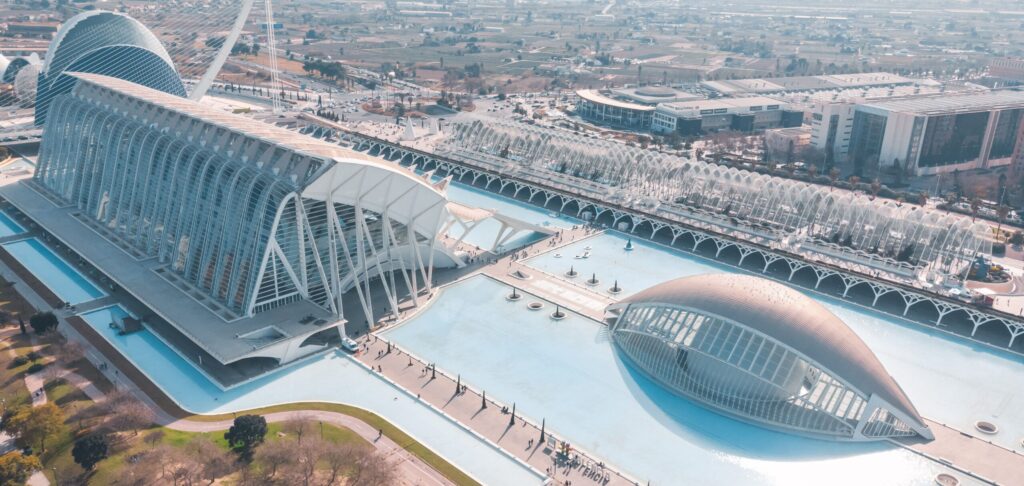
The eastern end of the Jardí del Túria, where the river once met the Mediterranean, is now occupied by the Ciutat de les Arts i les Ciències — the City of Arts and Sciences — one of the most architecturally ambitious public-works projects undertaken anywhere in late-twentieth-century Europe. Designed by Santiago Calatrava (born in Valencia in 1951, trained as both an architect and a civil engineer at the Polytechnic University of Valencia and the ETH Zurich, internationally famous for his bridges and stations), the complex was built in stages between 1991 and 2005. It contains five major buildings, all in white concrete and steel, with characteristic Calatrava forms that combine engineering ambition with sculptural curves: the Hemisfèric (an IMAX cinema and planetarium shaped like a giant human eye, 1998); the Museu de les Ciències Príncep Felip (a science museum shaped like the skeleton of an enormous animal, 2000); the Oceanogràfic (a large public aquarium designed by the Spanish architect Félix Candela, completed in 2003); the Palau de les Arts Reina Sofia (an opera house and performing arts centre, completed in 2005); and the Àgora (a multi-purpose covered plaza, completed in 2009). The complex has been controversial — Calatrava’s projects have a documented history of cost overruns, structural problems, and aesthetic divisiveness, and the Valencian government has been engaged in litigation with him over alleged defects since 2014 — but the visual impact is undeniable. Photographs of the Ciutat de les Arts i les Ciències now feature in approximately every Spanish tourism marketing campaign. The complex sits in the dry bed of the diverted river. The river that destroyed the city in 1957 was diverted in 1973. The riverbed was made into a park in 1986. The park’s eastern end was made into a futuristic architectural complex in 1998–2005. Each layer built on the previous. The story is a sequence of decisions, each one improving on the previous, sustained across fifty years of municipal politics under five different democratic mayors of three different political affiliations. Most cities do not sustain this kind of consistency. Valencia has.
Underneath all of this, the city is over two thousand years old. Valentia Edetanorum was founded by the Romans in 138 BC, on the right bank of the Turia, as a colony for veterans of the Lusitanian War. The site had been previously occupied by the Iberian Edetani people, after whom the colony was named. Roman Valencia grew steadily as a regional administrative centre. The city was destroyed by the Vandals in the fifth century, rebuilt, conquered by the Visigoths, and then conquered again by the Moors in the year 714, just three years after the initial Muslim invasion of the Iberian peninsula. For the next five centuries, Valencia was Balansiya — the capital of a series of small Islamic taifa states. The architecture, the agriculture (the irrigation systems for the surrounding rice paddies and citrus groves, which still function today, are essentially Moorish in design), the cuisine, the demographic mix, and the linguistic substrate (Valencian Catalan absorbed hundreds of Arabic loanwords during this period) were all profoundly shaped by Islamic Valencia. In 1238, the Catalan-Aragonese king James I of Aragon — Jaume el Conqueridor, the same king whose later death in 1276 produced the medieval Kingdom of Mallorca that featured in Episode 39 (Perpignan) — captured the city after a siege of nine months. Valencia became the capital of the new Kingdom of Valencia within the Crown of Aragon, with its own legal code (the Furs de València, written in Catalan) and its own parliamentary institutions. The new Christian kingdom inherited a substantial Muslim population that continued to live in the city and its agricultural hinterland — the Mudéjars, and later the converted Moriscos — for the following three and a half centuries, until their forced expulsion by Philip III in 1609–1614 (the same expulsion that Seville’s article will eventually address).
The medieval and early-modern Valencian economy was extraordinarily wealthy. By the late fourteenth and early fifteenth centuries, Valencia was one of the largest and wealthiest cities in Europe. Population estimates place it at perhaps 75,000 to 90,000 inhabitants in the 1480s — larger than London at the same date, larger than Paris had been a century earlier, comparable to Florence at its Renaissance height. The wealth came from agriculture (silk, citrus, sugar, rice, almonds, all of them established under Moorish irrigation), from textiles (Valencian silk was sold across Europe), from finance (the Taula de Canvis, the city’s public bank, was one of the earliest such institutions in Europe), and from Mediterranean trade. The architectural inheritance of this golden age survives in remarkable condition. The Llotja de la Seda — the Silk Exchange — built between 1482 and 1548 in the gòtic català style, is one of the most magnificent civil Gothic buildings in Europe. UNESCO inscribed it as a World Heritage Site in 1996, calling it “a wholly exceptional example of a secular building in late Gothic style, which dramatically illustrates the power and wealth of one of the great Mediterranean mercantile cities.” The building’s central hall — the Saló del Contractació — has eight twisted spiral columns rising 17 metres to a star-vaulted ceiling, in a structural and ornamental display that is the high point of late Gothic civil architecture in Spain. The merchants who funded the building did so on profits from the same Mediterranean trade that the same period saw flowing through Genoa, Florence, and Venice — Valencia was a peer of those cities, not a provincial outpost. The decline came in the sixteenth and seventeenth centuries, with the discovery of the Americas (which shifted Spanish wealth toward the Atlantic ports of Seville and Cádiz), the expulsion of the Moriscos in 1609–1614 (which destroyed much of Valencian agriculture), and the War of the Spanish Succession in 1707 (in which the Valencians backed the losing Habsburg side, like the Catalans, and were punished with the Decrees of Nueva Planta that abolished their autonomous institutions). The city remained an important regional centre but ceased to be a European-scale power. Most foreign visitors today do not know that Valencia was once a peer of Florence. The article should make them feel it.
The contemporary culinary culture is one of the great Mediterranean cuisines of Europe and is also, in its most famous element, almost universally misunderstood abroad. Paella — the rice dish that is the most internationally recognised Spanish dish — is from Valencia. It was invented in the Albufera wetlands south of the city, where rice has been cultivated since Moorish times, in the eighteenth and nineteenth centuries, by farmers who cooked rice mixed with whatever was at hand in the fields — rabbit, snails, chicken, beans, vegetables — over open fires of orange-wood and vine cuttings, in wide flat steel pans called paelles (from the Latin patella, “small dish”; “paella” originally meant the pan, not the dish, in Valencian). The original — the paella valenciana, codified by the Valencian regional government’s Denominación de Origen — contains ten specific ingredients: short-grain Bomba or Senia rice from the Albufera, chicken, rabbit, garrofó (a flat white bean specific to the Valencian huerta), green beans, ripe tomato, olive oil, sweet paprika, saffron, and water. It does not contain seafood. It does not contain chorizo. It does not contain peas. It does not contain bell peppers. The seafood version — paella de marisco — is a coastal variant of the rural original, and is recognised as legitimate but distinct. The mixed version — paella mixta, with both meat and seafood — is regarded by traditional Valencians as something close to a culinary heresy. The version served by every restaurant in Madrid, Barcelona, London, New York, Paris, Tokyo, and Dubai is almost without exception incorrect by Valencian standards. The Valencian regional government has, since the early 2010s, run educational campaigns explaining the original recipe to the international food press. The campaigns have been moderately successful in food-press circles and almost entirely unsuccessful in restaurant kitchens. The Valencians have stopped fighting the international misuse of the name. They continue, quietly, to cook the original at home every Sunday. The dish is more than a recipe; it is, in Valencian culture, the centrepiece of weekly family gatherings, cooked outdoors when possible, eaten directly from the paella with wooden spoons, accompanied by a salad of lettuce, raw onion, and ripe tomatoes, and a glass of local wine or vermouth. It is one of the most successful examples in Europe of a regional dish that has become globally famous in adulterated form while remaining authentic and central in its place of origin.
The Albufera itself, where paella was born, is one of Europe’s most important wetlands. It is a freshwater lagoon of approximately 24 square kilometres of open water, surrounded by 200 square kilometres of rice paddies, marshes, dune systems, and pine forests — a total protected area of 21,120 hectares, designated as a Natural Park in 1986. The lagoon is a critical migratory stopover for waterbirds — over 350 bird species have been recorded, including significant populations of herons, egrets, ducks, marsh harriers, and pochards — and supports a traditional fishing community of approximately 200 working fishermen who continue to fish for eels, mullet, and bass using methods substantially unchanged since medieval times. The rice cultivation around the lagoon — primarily of the Bomba and Senia varieties — has been continuous since the Moorish introduction of rice farming in the tenth and eleventh centuries. The rice fields are flooded and drained on a precise seasonal calendar that follows traditional Moorish water-management practice, regulated by the Tribunal de las Aguas — the Water Tribunal of Valencia — which meets every Thursday at noon outside the Cathedral’s Apostles’ Door and is the oldest continuously-operating judicial institution in Europe, with documented continuity since at least the year 1239. The tribunal adjudicates disputes over water allocation among the rice farmers and citrus growers of the Valencian huerta. Its decisions are binding under Spanish constitutional law. It conducts its proceedings in Valencian Catalan, orally, without written records, in front of a public audience, in a ritual that has been performed weekly for at least 786 years. UNESCO inscribed the Tribunal de las Aguas as Intangible Cultural Heritage of Humanity in 2009. Most foreign visitors who see the tribunal in session do not realise they are watching the longest-running judicial institution in continuous operation anywhere in Europe.
The annual festival that defines Valencian civic identity is Les Falles — the Fallas in Castilian — held every March, culminating on the night of the 19th of March (the feast of Saint Joseph, the city’s patron saint). The festival is, in its present form, the deliberate burning of hundreds of enormous sculpted papier-mâché monuments — falles — across the streets of the city, on a single night. The monuments are designed and constructed throughout the year by neighborhood committees called casals fallers — there are approximately 390 of them in the city — and reach heights of up to 30 metres, with construction budgets of up to several hundred thousand euros for the most ambitious ones. The sculptures satirise contemporary politics, popular culture, sports, celebrities, and social issues. They are erected in the streets during the week before Saint Joseph’s day, judged by a municipal jury, and then — almost all of them, on the night of the 19th of March, simultaneously across the city — set on fire and burned to ash. The single ninot indultat — the “pardoned figure” — chosen by public vote each year is the only sculpture spared. The night of the burning is one of the most extraordinary spectacles in any European city: hundreds of fires, simultaneously, in the streets, with crowds of half a million people watching, with firework displays continuing all night, with traditional music, with the mascletà (the deafening daily fireworks display at noon in the central square during the festival week — a Valencian invention that is essentially noise as music, rated by its rhythm and crescendo rather than its visual quality). UNESCO inscribed the Falles as Intangible Cultural Heritage of Humanity in 2016. The festival is the city’s most concentrated annual expression of itself, and it is genuinely unlike any other European urban festival in scale or character.
This is the deeper character of Valencia. The city is over two thousand years old, was once one of the wealthiest cities in Europe, has a continuous Catalan-language cultural identity that has been integrated into modern Spain without political crisis, has handled the post-industrial transition with quiet competence, hosts the longest-running judicial institution in Europe outside its cathedral every Thursday at noon, invented one of the world’s most internationally recognised dishes (which the world cooks wrong), turned its worst day in modern history into its best contemporary asset, and burns hundreds of millions of euros of papier-mâché sculptures in the streets every March. None of this is theatrical. All of it is current. Valencia has, for most of the past five hundred years, been the third or fourth most important city in Spain — eclipsed in international visibility by Madrid and Barcelona, often forgotten by foreign visitors who go directly from one of those two cities to the next. The city has continued, quietly, to do what it has always done. Mediterranean trade. Rice cultivation. Catholic ceremony. Civic festival. Architectural ambition. Civic competence. The kind of municipal achievement that does not make international headlines because it does not produce crisis. Most cities are interesting because of what they are still arguing about. This one is interesting because of what it has already, quietly, resolved.
Some cities are famous for what they fight over. This one is famous, in Spain, for what it has worked out — and is now, slowly, becoming famous abroad for the same.
Nine regions. One hundred and twenty destinations. Three hundred and twenty weeks remaining.
The journey continues south. The next stop is the city where flamenco was actually invented, oranges flower in February, and an entire civilisation departed in the seventeenth century leaving a single river name behind.

Beyondia
Trusted Travel CompanionReal digital nomad. I travel. I learn. I grow.
What about you? Where are you going?