🌐 Around the World with Beyondia 🧵 Mediterranean Region 🪡 Episode 40: Barcelona
Barcelona is the Catalan capital that became one of the most globally recognised city brands in Europe without ever becoming a national capital, designed substantially by a single generation of nineteenth-century architects, the most famous of whom is currently being canonised by the Catholic Church.
Barcelona was the capital of the medieval Principality of Catalonia
The cathedral has been under construction for one hundred and forty-four years. The first stone of the Basílica i Temple Expiatori de la Sagrada Família was laid on the 19th of March 1882, when the founding architect was a relatively conventional designer named Francisco de Paula del Villar y Lozano. Del Villar resigned in 1883 after disputes with the project’s patrons, and the commission passed to a thirty-one-year-old Catalan architect named Antoni Gaudí, who had recently completed his diploma at the Barcelona School of Architecture and was beginning his independent practice. Gaudí redesigned the cathedral from the foundations upward over the next four decades, working without computer software, without modular construction, without industrial precision, by methods of his own invention — including hanging models built from chains and small weights that he photographed and inverted to determine the compressed structural lines his vaults and towers would have to follow. He lived on the construction site in his final years. He worked on no other major commission after 1914. He was killed by a tram on the Gran Via de les Corts Catalanes in central Barcelona on the 7th of June 1926. He was 73 years old. The cathedral was approximately 25% complete at his death. The construction has continued, with interruptions for the Spanish Civil War and the dictatorship, for the following hundred years. The current expected completion date is 2026 — the hundredth anniversary of Gaudí’s death. When completed, the central Jesus Tower will rise to 172.5 metres, making the Sagrada Família the tallest church in the world. It will surpass Ulm Minster in Germany (161.5 metres), which has held the record since 1890. In April 2025, Pope Francis declared Antoni Gaudí venerable — the second formal stage in the Catholic Church’s canonisation process — for his life of personal piety, his charitable acts, and his architecture as a sustained spiritual expression. The next stage is beatification, requiring one verified miracle attributable to his intercession. The stage after that is canonisation. The architect of the Sagrada Família may, before the present century is over, be Saint Antoni Gaudí. Most cities have architects. This one has a candidate for sainthood and an unfinished building that may be his miracle.
This is the deepest fact about Barcelona’s identity as a contemporary global brand, and the one most foreign readers do not entirely carry: the city is unusually entirely the work of one cultural-political moment, and that moment was the late nineteenth and early twentieth centuries. The contemporary visitor walks through a city whose foundational urban grid was designed in 1859 by an engineer named Ildefons Cerdà, whose great public buildings were designed between 1888 and 1908 by a generation of architects called the Modernistes, whose stadium and airport and beachfront were built or rebuilt for the 1992 Olympic Games, and whose continuous architectural identity has been the deliberate work of one cultural-political project sustained across one hundred and seventy years. Almost nothing visible in central Barcelona predates the 1880s. The medieval Gothic Quarter (the Barri Gòtic) does, of course, and so does the Catedral de la Santa Creu (the city’s actual cathedral, the one consecrated in 1339, which most foreign visitors confuse with the Sagrada Família), and so do the medieval Born district and the Royal Shipyards (Drassanes Reials, where the medieval Catalan-Aragonese fleet was built — one of the largest surviving medieval shipyard complexes in Europe). But the city’s modern visual identity — the broad chamfered boulevards, the Modernist apartment blocks, the public markets, the great hospitals, the Sagrada Família, the Park Güell, the Casa Batlló, the Casa Milà — is the work of a single generation of architects who operated, deliberately, as the architectural arm of a political movement called the Renaixença (the Renaissance), the late-nineteenth-century Catalan cultural revival that asserted Catalan identity against three centuries of administrative suppression by Madrid.
The Catalan identity is the foundation. Barcelona was the capital of the medieval Principality of Catalonia, one of the most sophisticated small states of medieval Europe, with its own parliament (the Corts) from 1283, its own legal code (the Usatges, codified from the eleventh century), its own merchant marine that controlled significant Mediterranean trade routes, its own colonies on Sicily, Sardinia, and the Aegean islands, its own characteristic Gothic architecture (the gòtic català, with broad single naves, octagonal towers, and unusually wide spans), and its own literary tradition in the Catalan language, one of the earliest fully literary Romance languages of medieval Europe — Ramon Llull wrote philosophical treatises in Catalan in the 1280s, a century before similar literary work was being produced in Castilian. The Crown of Aragon, of which Catalonia was the largest component, dominated the western Mediterranean for two centuries. The 1469 marriage of Ferdinand of Aragon to Isabella of Castile unified the two crowns into what would eventually become Spain. From that moment on, Catalonia was a constituent part of a larger Spanish polity in which Castilian-speaking Madrid increasingly determined the cultural and political agenda. The Catalan Revolt of 1640–1652 (which briefly placed Catalonia under French protection), the War of the Spanish Succession of 1701–1714 (in which Catalonia backed the losing Habsburg side and was punished by the victorious Bourbons), and the Decrees of Nueva Planta (1716, which abolished Catalan autonomous institutions and made Castilian Spanish the sole administrative language) all reduced Catalan political autonomy step by step. By the late eighteenth century, Catalonia was administratively a region of Spain. By the early nineteenth century, the Catalan language had been excluded from public administration, courts, and higher education. The Renaixença — the Catalan cultural revival of the 1830s through the 1900s — was the reaction. It reasserted Catalan in literature (Jacint Verdaguer’s epic poem L’Atlàntida in 1877), in journalism, in theatre, in music (Pep Ventura’s reinvention of the sardana dance, Enric Granados and Isaac Albéniz in piano composition), in painting (Ramon Casas, Santiago Rusiñol), and — most ambitiously — in architecture.
The architectural expression of the Renaixença was Modernisme — the Catalan version of the European Art Nouveau movement, but with a distinctively political-cultural mission. Where French Art Nouveau and Viennese Jugendstil were primarily aesthetic projects, Catalan Modernisme was simultaneously aesthetic and political. The architects were asserting, through buildings, the cultural distinctiveness and modernity of Catalan identity. The leading figures — Antoni Gaudí, Lluís Domènech i Montaner, and Josep Puig i Cadafalch — designed buildings in deliberately Catalan idioms (using local brick, ironwork from Catalan foundries, ceramic tile from Catalan workshops, sculptural ornament drawing on Catalan mythology and folk tradition), while simultaneously absorbing and surpassing the international Art Nouveau styles emerging in Paris, Brussels, Vienna, and Glasgow. The output was extraordinary. Between approximately 1888 (when Domènech i Montaner designed the Café-Restaurant for the Universal Exposition of that year — one of the founding documents of the Modernist style) and 1910, Barcelona acquired the Palau de la Música Catalana (Domènech, 1905–1908, UNESCO World Heritage Site since 1997), the Hospital de Sant Pau (Domènech, 1902–1930, UNESCO since 1997), the Casa Batlló (Gaudí, 1904–1906, UNESCO since 2005), the Casa Milà / La Pedrera (Gaudí, 1906–1912, UNESCO since 1984), the Casa Amatller (Puig i Cadafalch, 1898–1900), the Casa de les Punxes (Puig i Cadafalch, 1903–1905), the Sagrada Família (Gaudí, 1882–ongoing, UNESCO since 1984), the Park Güell (Gaudí, 1900–1914, UNESCO since 1984), the Palau Güell (Gaudí, 1886–1888, UNESCO since 1984), the Casa Vicens (Gaudí, 1883–1885, UNESCO since 2005), and dozens of others. Most of central Barcelona’s most photographed buildings were built within a single twenty-year window between 1885 and 1910. The architecture was political. It said, in stone and tile, that Catalonia existed, was distinctive, was modern, was equal to any contemporary European cultural project.
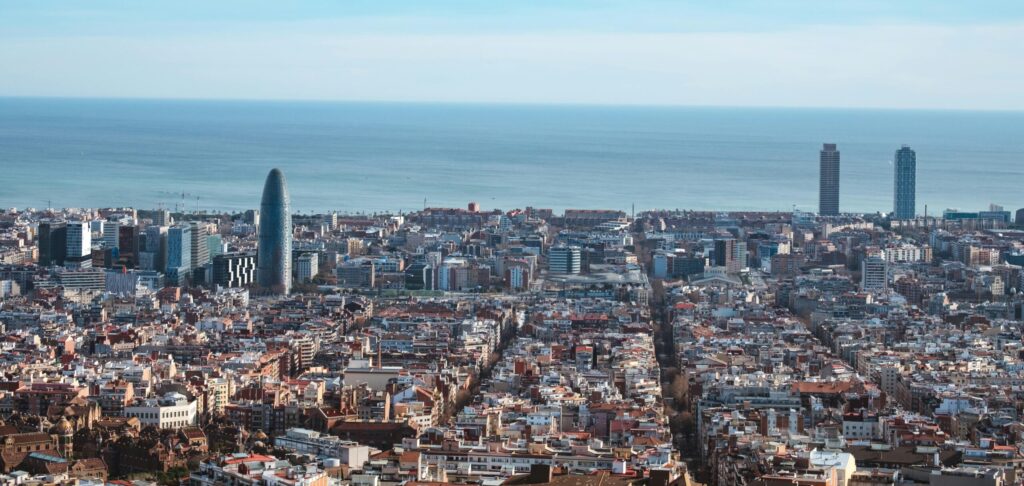
The grid the Modernist buildings sit in is older than they are. In 1859, the engineer Ildefons Cerdà i Sunyer published a city plan for Barcelona’s expansion called the Eixample (Catalan for “expansion”) that would become one of the most influential nineteenth-century urban planning documents. Barcelona at the time was a tightly-walled medieval city of perhaps 190,000 people, surrounded by farmland and small villages. The walls had been demolished in 1854 to allow expansion. Cerdà’s plan covered roughly nine square kilometres of the surrounding plain and proposed an orthogonal grid of identical city blocks, each 113.3 metres square, with their four corners cut off at 45-degree angles (the chaflanes, or chamfers) to improve sight lines, traffic flow, and the penetration of light and air. Each block would contain a central courtyard for shared green space. Building heights would be limited to preserve the courtyard’s light. Streets would be of uniform width (20 metres for most, 30 metres for principal arteries). Public services — markets, schools, hospitals, parks — would be distributed evenly across the grid. The plan was deliberately egalitarian: it refused the radial-monumental urbanism of contemporary Haussmann Paris (which Cerdà studied and explicitly criticised), in favour of a uniform grid where no neighbourhood was structurally superior to any other. Cerdà’s egalitarian provisions were largely overridden by developers over the following century — courtyards were partially built over, heights exceeded, prestige addresses concentrated along the Passeig de Gràcia — but the grid and the chamfered corners survived. The contemporary visitor walks across Cerdà’s chamfered intersections, watches Cerdà’s grid extend in every direction, sees Cerdà’s principle of equal-light penetration in every street, and is walking through one of the most influential pieces of urban design produced in the entire nineteenth century. The Sagrada Família sits inside Cerdà’s grid. The Casa Batlló sits inside Cerdà’s grid. La Pedrera sits inside Cerdà’s grid. Modern Barcelona’s design has the Cerdà plan as its foundation and Modernisme as its decorative skin.
Then, in 1992, Barcelona hosted the Summer Olympic Games — and the city transformed itself, again, in the same way the medieval city had transformed itself in the 1880s. The Olympic infrastructure built in the four years between 1988 and 1992 included: the new Olympic Stadium on Montjuïc (a renovation of the 1929 stadium, capacity 60,000), the Palau Sant Jordi indoor arena (architect Arata Isozaki), the Vila Olímpica residential district built on the former industrial waterfront (now one of the most desirable residential neighbourhoods of the city), the new beachfront (Barcelona had essentially no usable urban beaches before 1992, the coastline being entirely industrial; 4 kilometres of new sand beaches were constructed for the Olympics and remain among the most-used urban beaches in Europe), the reconstructed Port Vell (the old harbour, transformed from working port to mixed leisure-commercial waterfront), the second terminal at El Prat airport, the Ronda de Dalt and Ronda Litoral ring roads, the metro extensions, and the renovation of dozens of historic buildings across the city centre. The 1992 Olympics were one of the most successful Olympic Games in the modern era — they delivered measurable, lasting, positive transformation of the host city’s infrastructure and economy. They also created what is now called the Barcelona model — a phrase used in urban planning literature for fifteen years afterwards to describe the use of mega-events as catalysts for sustained urban regeneration. The Barcelona of 1992 was a depressed Mediterranean port city emerging from decades of dictatorship-era neglect. The Barcelona of 2002 was one of the most visited cities in Europe, with a global brand built almost entirely between 1988 and 1998. The Olympic transformation was, in this sense, the third great urban project of the city’s modern history — Cerdà laid out the grid in 1859, Modernisme decorated it between 1888 and 1910, and the Olympics opened it to the world in 1992.
The contemporary city, which is the product of all three of these projects layered on top of two thousand years of Mediterranean port-city continuity, is one of the most-visited cities in Europe and is currently engaged in a complex negotiation with its own success. Approximately 12 million overnight tourists arrived in 2019 (the pre-pandemic peak, recovering toward those levels in 2024–2025). When cruise ship passengers, day visitors, and regional Spanish tourism are added, the total annual visitor count exceeds 30 million. The population of the city itself is approximately 1.66 million in the commune, 5.8 million in the metropolitan area. The visitor-to-resident ratio in the city centre is the highest of any major European city. Housing prices in the central neighbourhoods — Gràcia, the Eixample, El Born, the Gothic Quarter — have risen substantially over the past fifteen years, with sustained displacement of long-term residents into outer districts. Anti-tourism protests have become a regular feature of Barcelona summers; the viral image of summer 2024 was of residents in Las Ramblas spraying tourists with water guns. The city government under Mayor Ada Colau (2015–2023, an anti-eviction activist before her election) and her successor Jaume Collboni (Socialist, 2023–) has implemented an increasingly strict regulatory regime on short-term rentals, cruise-ship arrivals at the cruise terminal, new hotel construction, and tourist infrastructure. The transformation that made the city desirable has produced the conditions that make it increasingly difficult for long-term residents to remain in the central neighbourhoods. This is not a problem unique to Barcelona — Amsterdam, Venice, Lisbon, Prague, and Berlin are all in various stages of the same negotiation — but Barcelona is the European city in which the tension between global success and local livability is most visibly contested. The article does not propose to resolve the tension. The article proposes only that the visitor should know it exists.
The Catalan independence question is the city’s other negotiation. Catalonia has held two unilateral independence declarations in modern times — in October 1934, by the regional government under Lluís Companys (which was suppressed within days), and on the 27th of October 2017, by the regional government under Carles Puigdemont, following an unofficial independence referendum on the 1st of October in which approximately 90% of voters voted for independence on a turnout of approximately 43%. The 2017 declaration was suspended by the Spanish constitutional court the same day, the Spanish government invoked Article 155 of the constitution to suspend Catalan autonomy, and most of the Catalan regional government were arrested or exiled (Puigdemont fled to Brussels, where he has remained, in effective exile, while continuing to serve in the European Parliament). The political crisis has subsided but not resolved. The Catalan independence movement remains a significant and persistent feature of Catalan politics. The Esquerra Republicana de Catalunya and Junts per Catalunya parties continue to hold significant numbers of seats in the regional parliament. The Catalan language remains the principal language of the regional government, education system, and public broadcasting. The Catalan flag — the Senyera, four red stripes on gold — flies on most public buildings in Catalonia alongside the Spanish flag. The estelada, the independence flag (the Senyera with a blue triangle and a white star), flies on private balconies across the city. Barcelona is, in 2026, a Spanish city whose status is genuinely contested by a significant portion of its own population. The article does not propose to resolve this either. The article notes that the contestation is real, ongoing, and a fundamental feature of contemporary Catalan civic life.
This is the deeper character of Barcelona. The city is the capital of a region with strong national identity that has not become a sovereign state, and which has projected itself globally on the strength of its cultural identity rather than its political sovereignty. The city was designed in three great waves — the Cerdà grid of 1859, the Modernist buildings of 1885 to 1910, the Olympic infrastructure of 1988 to 1992 — each of which served, in its own way, as the expression of Catalan cultural ambition. The most famous of its architects, who designed almost nothing outside Catalonia, who never travelled, who lived in poverty in his final years on his cathedral construction site, who was killed by a tram, is currently being canonised by the Catholic Church. The cathedral he designed has been under construction for one hundred and forty-four years and will be completed, on its current timeline, in 2026 — the hundredth anniversary of his death. The city was the first major European city in modern times to host an Olympic Games that genuinely transformed it, in the same way Berlin ’36 and Tokyo ’64 and Seoul ’88 had attempted but on a larger scale. The city is now negotiating the consequences of having become a global tourist destination, with the same difficulty Venice and Amsterdam are facing. The Catalan language is alive, the Catalan culture is producing, the Catalan independence question is unresolved. The architecture is being made a saint. Most cities have an identity. This one has a project.
Some cities are the capital of a country. This one is the capital of a region that has chosen to be a global brand instead, has succeeded at it more than any comparable city in Europe, and is now negotiating what that success costs.
Nine regions. One hundred and twenty destinations. Three hundred and twenty-one weeks remaining.
The journey continues. The next stop is a city where flamenco was actually invented, oranges flower in February, and an entire civilisation departed in the seventeenth century leaving a single river name behind.

Beyondia
Trusted Travel CompanionReal digital nomad. I travel. I learn. I grow.
What about you? Where are you going?