Around the World with Beyondia 🧵 Mediterranean Region 🪡 Journal 14
Barcelona. Valencia. Mallorca. A city that can’t stop building, a city that buried a river and built a park on top, and an island that has been the answer all along.
Barcelona grabbed me by the eyes and didn’t let go for three days.
I walked into the Gothic Quarter first because the city starts there whether it admits it or not. Roman walls from the 1st century BC are embedded in medieval buildings — you turn a corner and there’s an aqueduct fragment holding up a restaurant. The Catedral de Barcelona sits in a square too small for it, which makes it feel taller than it is, and the cloister has thirteen white geese wandering around because tradition says they’ve been there since the cathedral was built in the 13th century. Thirteen geese. For seven hundred years. Barcelona treats its eccentricities like structural elements — remove one and the whole thing might shift.
Then the Sagrada Família. And I wasn’t ready.
I’ve seen photographs my entire life. Every travel account, every architecture documentary, every Instagram grid. None of it prepared me for standing in front of a building that Antoni Gaudí started in 1882 and that isn’t finished yet. One hundred and forty-two years of continuous construction. Gaudí knew he wouldn’t see it completed — when asked about the timeline, he reportedly said his client wasn’t in a hurry, meaning God. He spent the last twelve years of his life living on the construction site, obsessed, sleeping among his models.
I walked inside and my chest tightened. The interior is a forest. The columns branch upward like trees, splitting into canopies that hold the ceiling the way a grove holds the sky. The light through the stained glass — warm colours on the west, cool on the east — moves across the stone throughout the day like the building is breathing. Gaudí didn’t design a church. He designed an argument that nature and architecture are the same thing, and then he died before he could finish making it. A tram hit him in 1926. He was mistaken for a beggar because of his worn clothes. Barcelona’s greatest architect died unrecognised on the street of his own city. That fact alone tells you something about the relationship between genius and the world that receives it.
I walked La Rambla because you have to, and I left it quickly because you should. The real Barcelona is in the side streets — El Born, where the Picasso Museum sits in five connected medieval palaces. Barceloneta, where the fishermen’s quarter meets the beach and old men play dominoes in the shade while tourists burn ten metres away. The Boqueria market, where a woman handed me a cup of fresh-cut mango and coconut and the colours alone were worth the walk.
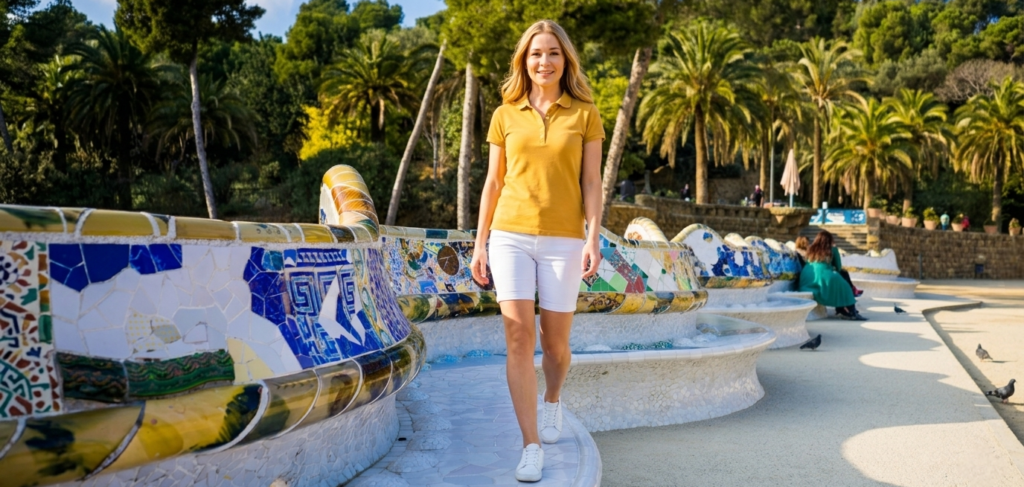
Park Güell above the city was Gaudí again — a housing development that failed commercially and became a public park, mosaic benches curving along a terrace with Barcelona spread below. The trencadís technique — broken tile arranged into new patterns — covers every surface. Gaudí took what was shattered and made it whole in a new form. The park was a commercial failure and an artistic triumph. Barcelona understood the difference and kept the triumph.
On my last evening I sat on the breakwater at Port Olímpic and watched the city do what it does at sunset — turn gold, then copper, then that deep Mediterranean blue that always arrives like a closing statement. Barcelona is exhausting. It’s too much — too many ideas, too many layers, too many buildings that haven’t been finished and too many that were finished centuries ago. The city doesn’t edit itself. It just keeps adding. And somehow it holds.
Valencia was the correction.
I arrived expecting Barcelona’s quieter cousin. What I found was a city that had done something radical — it took its greatest disaster and turned it into its greatest asset.
In 1957, the Turia River flooded Valencia. The devastation was catastrophic. The city’s response was to divert the entire river. They moved it. The old riverbed — five kilometres of empty channel cutting through the centre of the city — was nearly turned into a motorway. The citizens protested. The government relented. And Valencia built the Jardín del Turia, one of the largest urban parks in Europe, in the space where a river used to destroy things. I walked the full length of it — football pitches, cycling paths, botanical gardens, playgrounds — and thought about the audacity of looking at a catastrophe and seeing a park. That’s not optimism. That’s engineering applied to grief.
At the end of the park, the City of Arts and Sciences rises like something that landed from another century. Santiago Calatrava — a Valencian — designed a complex of buildings so aggressively futuristic that they make everything around them look like it’s still loading. The Hemisfèric, shaped like a human eye, reflects in a shallow pool. The Palau de les Arts looks like a helmet a civilisation would wear to war. The Oceanogràfic is the largest aquarium in Europe. The whole complex sits in the old riverbed, which means Valencia built its vision of the future in the exact place where its past nearly drowned it. That’s not architecture. That’s a revenge plot with a budget.
The old town pulled me back. The Central Market — Mercado Central — is one of the largest covered markets in Europe, Art Nouveau ironwork and stained glass sheltering over a thousand stalls. I ate horchata and fartons at a counter — the sweet tiger nut milk and sugared pastry that Valencia invented and defends with regional pride — and watched the market do what markets do, which is feed a city without pretending to be anything other than a place where food changes hands.
The Cathedral holds what it claims is the Holy Grail — the Santo Cáliz, an agate cup from the 1st century that has been authenticated by the Vatican as the most likely candidate. Whether you believe it or not, the cup is there, in a side chapel, behind glass, and people queue to see it with the same expression they’d have at a relic or a magic trick. Valencia doesn’t push the claim aggressively. It just keeps the cup in the cathedral and lets you decide.
I walked through El Carmen — the bohemian quarter — past street art murals three storeys tall, past buildings where Gothic meets graffiti, past bars that open at midnight and don’t close until the question of closing becomes irrelevant. Valencia has a nightlife culture that treats sleep as a suggestion, and the city’s Las Fallas festival — where massive papier-mâché sculptures are built over months and burned in a single night every March — tells you everything about Valencia’s relationship with permanence. Build it beautifully. Then burn it. Then build again. The process is the point.
Mallorca I almost made the mistake of underestimating.
The reputation precedes the island — package holidays, sunburn, airport crowds. I landed in Palma expecting to find the real Mallorca hiding somewhere behind the tourism. I didn’t have to hide. It was right there.
The Cathedral of Santa Maria — La Seu — sits on the waterfront in Palma and it took my breath in a way that caught me off guard. Gothic, massive, one of the tallest naves in Europe, built over the foundations of a mosque that was built over the foundations of a Roman temple. The morning light through the rose window — one of the largest Gothic rose windows in the world, nearly 14 metres in diameter — projected a kaleidoscope onto the opposite wall that moved as I watched. Gaudí did restoration work here in the early 1900s. Miquel Barceló added a ceramic mural to a side chapel in 2007 that looks like the sea swallowed a wall and gave it back transformed. The cathedral isn’t one era. It’s a conversation between centuries that hasn’t ended.
I rented a car and drove to the Serra de Tramuntana — the mountain range that runs along the northwest coast, UNESCO-listed, not for a single monument but for the entire cultural landscape. The road from Palma to Valldemossa climbs through olive terraces and pine forest, and Valldemossa itself sits in a valley so protected it feels like the mountains are cupping it in two hands. Chopin and George Sand spent a winter here in 1838, and Chopin composed some of his preludes in the monastery cells while his tuberculosis worsened and the rain wouldn’t stop. The music that came out of that suffering is some of the most beautiful piano work ever written. Valldemossa is the kind of place where even misery produces something worth keeping.
Deià, further along the coast, is a village of stone houses clinging to a cliff above the sea that has been attracting writers and artists since Robert Graves settled here in 1929 and stayed for the rest of his life. I walked down the path to the cala — the small rocky beach — and the descent took twenty minutes through olive groves and the sound of cicadas. The water at the bottom was clear enough to see the rocky seabed five metres down. I swam and floated and looked up at the cliff and understood why Graves never left. Some places don’t just inspire work. They remove every excuse not to do it.
Cap de Formentor — the northernmost point of Mallorca — was the last stop. The road to the lighthouse is one of the most dramatic drives I’ve taken on this entire journey. Hairpin turns cut into vertical cliffs, the sea hundreds of metres below on both sides, pine trees bent sideways by the wind. At the end, the lighthouse stands alone on a rock above water that is simultaneously every shade of blue the Mediterranean has ever produced. I stood at the edge and the wind was strong enough to lean into. Behind me, Mallorca. Ahead, nothing but sea until Menorca, then Sardinia, then the open Mediterranean.
Three stops. One can’t stop building and hasn’t finished its most important building in over a century. One drowned, moved a river, and built its future in the hole. One hid an entire mountain civilisation behind a beach reputation and waited for the right visitor to notice.
Spain doesn’t do subtle. But it does do layers, and the deeper you go, the less it looks like the country you thought you knew.
Next week — deeper into Spain. But that unfinished cathedral is still under construction in my head, and I think it always will be.
Beyondia
Trusted Travel CompanionReal digital nomad. I travel. I learn. I grow.
What about you? Where are you going?