🌐 Around the World with Beyondia 🧵 Mediterranean Region 🪡 Episode 43: Madrid
Madrid is the Spanish capital that was deliberately chosen by Philip II from an insignificant inland town, became the world capital of seventeenth-century painting by accident of imperial wealth, and remains the only major European capital with no indigenous regional identity to distinguish it from the country it leads.
Madrid was a small town of perhaps fifteen thousand people
In the spring of 1561, King Philip II of Spain — at the absolute height of Habsburg imperial power, ruler of Spain, Portugal (from 1580 onwards), the Netherlands, the southern Italian kingdoms, the Spanish Americas from California to Patagonia, and the Philippines (named after him) — moved his royal court permanently from the city of Toledo to a small inland town called Madrid. The decision was technically presented as temporary. It was, in practice, final. The court has been in Madrid, with one brief interruption from 1601 to 1606 when Philip III moved it to Valladolid (which proved a disaster and was reversed), continuously for the four hundred and sixty-five years since. The decision was not obvious. Toledo, the previous court city, was a great medieval centre on a defensible site above a sharp bend in the Tagus, with one of the most important cathedrals in Spain, with the primate see of the Spanish Catholic Church, with a continuous Roman-Visigothic-Moorish-Christian urban history dating to before the Reconquista. Madrid, by contrast, was a small town of perhaps fifteen thousand people on the high plateau of central Castile, at over 650 metres of altitude, with extreme continental climate, no defensive walls of any consequence, no significant cathedral (only the small Church of Santa María la Mayor), no university, no major industry, no port (Madrid sits roughly 350 kilometres from the nearest coast — the longest distance from the sea of any major European capital), and almost no historical importance. The town had been founded as a small Moorish fortress called Mayrit in the late ninth century, captured by Christian forces under Alfonso VI in 1083, and had spent the following five hundred years as a minor administrative outpost of the Crown of Castile. The reason Philip II chose it was precisely that nothing else was choosing it. Madrid had no archbishop to compete with the crown, no rival noble factions with claims on the king, no civic government with traditional rights that the crown would have to negotiate around, no entrenched ecclesiastical or municipal interests that would slow the construction of a new capital. The king could build whatever he wanted, on a blank canvas, with imperial wealth as the budget. The article that follows is the story of what he and his successors built.
Within forty years of the 1561 decision, Madrid had grown from fifteen thousand inhabitants to approximately seventy-five thousand. By 1700 it was approaching one hundred and fifty thousand. By 1900 it had crossed half a million. Today, the population of the commune is approximately 3.42 million, and the metropolitan area is around 7 million — making Madrid the third-largest metropolitan area in the European Union, after Paris and the Ruhr region of Germany. The growth was, throughout, the product of one fact: the centralisation of Spanish imperial and then national administrative power in this city. Every Spanish institution that needed to be in the capital had to be in Madrid. The royal court. The royal council (the Consejo de Castilla, the highest administrative body of the Spanish crown). The Inquisition’s central office (from 1561). The royal mint. The royal academies (the Real Academia Española, founded 1713, governing the Spanish language to this day; the Real Academia de la Historia, 1738; and a dozen others). The principal Spanish ministries, banks, newspapers, theatres, opera houses, and universities. The royal art collection that became the Prado Museum. The royal armoury that became the Real Armería. The royal libraries that became the Biblioteca Nacional de España. Each institution arrived because the court was here. The court was here because Philip II had decided it would be. The growth is, in this sense, the slowest and largest single demonstration of imperial intent in early modern European history. Most cities grow because of natural advantages — a port, a river crossing, a defensive position, a fertile hinterland. Madrid grew because a king ordered it to.
The most consequential cultural inheritance of this arrangement was the accumulation of paintings. The Spanish Habsburg court — beginning with Charles V, Philip II’s father, and continuing through Philip II, Philip III, Philip IV, and Charles II until the dynasty’s extinction in 1700 — was the wealthiest patron of art in early modern Europe. The wealth came from the silver mines of Potosí in Bolivia and Zacatecas in Mexico, which produced approximately 80% of the world’s silver supply between 1550 and 1700, almost all of which flowed through Spanish royal control. The royal patronage was on an unprecedented scale. Titian — the great Venetian painter — produced approximately forty paintings for Charles V and Philip II between 1530 and 1576, of which roughly twenty are now in the Prado. Rubens, working in Antwerp, produced major altarpieces and royal portraits for Philip IV between 1628 and 1640; approximately ninety Rubens paintings are in the Prado, more than in any single Belgian collection. El Greco — Domenikos Theotokopoulos, the Cretan-Greek painter — worked from his base in Toledo (south of Madrid) from 1577 until his death in 1614, producing the works that revolutionised late-Renaissance religious painting. Diego Velázquez was court painter to Philip IV for thirty-seven years, from 1623 until his death in 1660. Velázquez produced the entirety of his mature career — the royal portraits, The Surrender of Breda (1635), The Spinners (1657), Las Meninas (1656), the dwarves and the buffoons, Christ Crucified, the Apollo and the Forge of Vulcan — inside the royal household at Madrid, working directly from the king. Las Meninas alone has been called the single most analysed painting in the history of Western art: Michel Foucault opened The Order of Things (1966) with a thirty-page essay on it that became one of the foundational documents of late-twentieth-century intellectual history. The painting hangs in the Prado, on the second floor, in a room that holds approximately twenty works by Velázquez. Francisco Goya, born in 1746 in Aragón, became court painter to Charles III in 1786, to Charles IV in 1789, and continued in royal service to Joseph Bonaparte during the French occupation of 1808–1814 and to Ferdinand VII after the restoration. Goya produced the entire arc of his consequential work — the royal portraits, the Caprichos etchings, the Disasters of War, The Third of May 1808, the Black Paintings (painted directly onto the walls of his country house outside Madrid between 1819 and 1823) — in and around the Spanish capital. Approximately one thousand Goya works (paintings, drawings, prints) are in the Prado.
The Prado Museum itself opened to the public in 1819, under King Ferdinand VII, in a neoclassical building designed by Juan de Villanueva that had been completed in 1785 originally as a museum of natural history. The royal collection — accumulated by the Spanish Habsburgs over two centuries and then by the Bourbons over another century — was transferred to the museum and made publicly accessible. The transfer was, in its time, one of the most significant acts of cultural democratisation in Europe — comparable to the opening of the Louvre in Paris in 1793 and the establishment of the British Museum in London in 1759. The Prado today holds approximately 8,600 paintings, of which roughly 1,500 are typically on display in the public galleries. The collection is acknowledged by art historians to be the single most important collection of European painting from the late fifteenth to early nineteenth centuries — exceeding even the Louvre in the depth of its Spanish, Flemish, and Italian Renaissance holdings, though smaller in total breadth. The reason is genealogical: the Prado is what happens when an imperial court that ruled for two and a half centuries collects paintings as a continuous institutional activity, and then the empire ends and the paintings stay where they were last hung. Most foreign visitors to the Prado experience it as a generic great museum. Almost none of them understand that the museum’s specific character — heavily Spanish, heavily seventeenth-century, heavily court-portrait — is the direct product of the specific imperial-bureaucratic history that built Madrid itself. The paintings are the city’s deepest inheritance. They are also the most direct evidence of why Philip II’s 1561 decision produced what it produced.
The royal-court inheritance is not the only one. Madrid is a city whose deepest identity is something most foreign visitors do not initially recognise: the city has no indigenous regional culture to distinguish it from the rest of Spain. Catalonia has Catalan culture; the Basque Country has Basque culture; Andalusia has flamenco and the Moorish heritage; Galicia has Celtic-maritime culture; Aragón has its medieval kingdom; Valencia has its rice and its language. Madrid has Castilian culture — but Castilian culture is the generic culture of Spain, the national culture, the one that the Madrid centre has exported to the rest of the country for four centuries. There is no Madrileño costume distinct from Castilian-Spanish. There is no Madrileño language distinct from Castilian Spanish. The cuisine that is genuinely indigenous to Madrid — cocido madrileño (the slow-cooked chickpea, vegetable, and meat stew), callos a la madrileña (the tripe stew), the bocadillo de calamares (the squid sandwich), the churros con chocolate — is recognisably Castilian-Spanish rather than distinctly Madrileño. The closest thing to a Madrileño cultural form is the zarzuela (the Spanish operetta tradition that flourished in Madrid in the nineteenth and early twentieth centuries), but even zarzuela is genuinely a national rather than regional form. Madrid’s identity, if it has one, is the absence of regional identity. It is the city of arrival — the city where Spaniards from every other region of Spain have moved for the past four and a half centuries to participate in national life. The contemporary demographic data make this concrete: roughly 16% of the city’s population is foreign-born, and more than 60% of Madrileños over forty were born outside Madrid itself, in Andalusia or Galicia or Extremadura or Castile-La Mancha or the Latin American countries that the Spanish empire once ruled. Walking through the neighbourhoods of Madrid is walking through a federation of arrived populations: the Andalusian and post-1990s Latin American density of Lavapiés, the Galician cultural presence in Chamberí, the Filipino community around Tetuán, the Chinese commercial cluster around Usera, the Moroccan business presence in Cuatro Caminos, the post-2000 Eastern European concentration in the eastern suburbs. None of these populations is indigenous to Madrid. All of them are now Madrileño. This is what national capitals do that regional capitals cannot — they absorb populations from the country and from outside the country, and they call the result the capital’s culture. Paris does this. London does this. Madrid has been doing it for a longer continuous period than either.
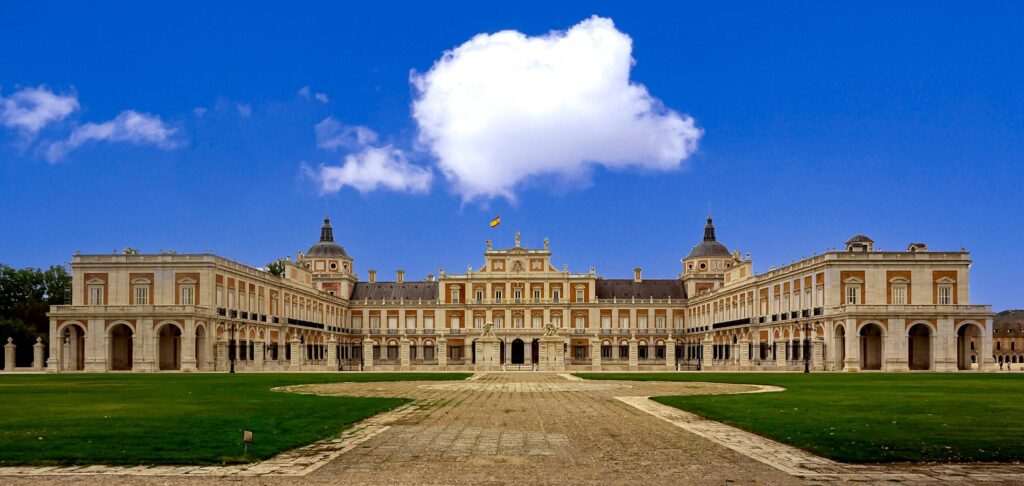
The city’s architectural skeleton is mostly later than the foundational decision of 1561. Philip II’s Madrid was a sprawling, chaotic, hastily-built town that struggled to keep up with the explosive growth of the new capital. The most significant survival from the Habsburg era is the Plaza Mayor — the great arcaded square at the heart of the old city, built between 1617 and 1620 under Philip III to a design by Juan Gómez de Mora. The plaza is 129 metres by 94 metres, surrounded by uniform three-storey buildings with arcaded ground floors and 237 balconies overlooking the square, with the central equestrian statue of Philip III (sculpted by Pietro Tacca and Giambologna, finished in 1616 in Florence and shipped to Madrid). For centuries, the Plaza Mayor was the site of royal proclamations, public bullfights, autos-da-fé of the Inquisition (the last in 1680), executions, and the principal civic gatherings of the city. It remains, in 2026, one of the most-visited public spaces in Spain. The Habsburg-era Real Alcázar — the principal royal palace of the Spanish Habsburg court — burned down in a catastrophic fire in 1734, taking with it many of the original Velázquez and Habsburg paintings that had been hung there (those that survived were the basis of the Prado’s eventual collection). The Bourbon monarchs who succeeded the Habsburgs after 1700 rebuilt the palace in a vastly larger and more ornate Baroque form: the current Palacio Real, designed by Filippo Juvarra and completed in 1755 under Charles III, has approximately 3,418 rooms and a total floor area of approximately 135,000 square metres — making it the largest royal palace by floor area in Western Europe, larger than Versailles and Buckingham Palace. The Spanish royal family has not lived in the Palacio Real since the early twentieth century (the current King Felipe VI lives at the smaller Palacio de la Zarzuela outside the city), but the palace is still used for state ceremonies and is open to the public as a museum. The Bourbon reorganisation of the eighteenth century also produced the Paseo del Prado (the grand boulevard connecting the royal palace area to the Prado Museum, lined with the principal cultural institutions of the city), the Atocha railway station (in its current Beaux-Arts form, completed in 1892), and the major nineteenth-century expansion of the city, the Ensanche of 1860 designed by Carlos María de Castro on principles similar to (though less rigorously applied than) those of Cerdà in Barcelona. The twentieth century added the Gran Vía (the broad commercial avenue cut through the medieval centre between 1910 and 1930), the major modernist additions of the 1930s, the Franco-era ministerial architecture, and the late-twentieth-century AZCA business district and the four supertall towers (Cuatro Torres Business Area) of the early 2000s on the northern edge of the city. The architectural inheritance is layered, varied, sometimes harmonious and sometimes not, and reflects the city’s continuous central role in Spanish institutional life across four and a half centuries.
The contemporary Madrid is, in many ways, one of the most quietly successful major European capitals of the 2020s. Population has grown approximately 8% over the past decade — from about 3.16 million in the commune in 2014 to approximately 3.42 million in 2024 — and the metropolitan area has crossed seven million for the first time, making Madrid the third-largest metropolitan region in the European Union. Madrid’s GDP per capita has grown faster over the past decade than that of any other major European capital except Stockholm. The city has navigated tourism more successfully than Barcelona (visitor numbers are comparable but the political negotiation with residents has been less contested), has handled the housing crisis less successfully than some Northern European cities but more successfully than London or Dublin, has developed a substantial post-Brexit financial-services sector (Madrid has overtaken Milan as the third-largest financial centre in continental Europe, behind only Paris and Frankfurt), has hosted growing numbers of multinational corporate European headquarters (Inditex’s central operations, Telefónica’s global HQ, Repsol, BBVA, Santander), and has maintained substantial cultural infrastructure investment (the Prado, the Reina Sofía Museum of contemporary art opened in 1992, the Thyssen-Bornemisza Museum of European painting opened in 1992, the National Library, the Cervantes Institute, the Royal Theatre opera house). The mayor since 2019, José Luis Martínez-Almeida of the centre-right Partido Popular, has been a competent and substantially uncontroversial executive — a quiet contrast to higher-drama predecessor administrations and to comparable European mayoralties. The contemporary city is functioning. It is also, by most measures, one of the most attractive major capitals in continental Europe for young professionals, immigrants, students, and investors.
And then there is the night. Madrid is the only major European capital where serious nightlife runs through the night until dawn as a standard cultural practice. The Spanish dinner hour is later than anywhere else in Europe — 9:30 to 10:30 PM is normal for the start of dinner. The expression de copas — for an evening of drinks at a series of bars — runs from 8 PM into the early morning. De discoteca — clubbing and dancing — does not begin until midnight or 1 AM and continues until 6 or 7 AM. The metro in Madrid runs until 1:30 AM, then reopens at 6 AM — but the actual practice is that taxis and night buses bridge the gap. The Plaza Mayor and the surrounding streets of La Latina and Malasaña and Chueca are full at 3 AM with people eating churros con chocolate between bar visits, having dinner at restaurants that opened at 10 PM and will not close until 2 or 3 AM, walking between flamenco performances and jazz clubs and dance clubs and rooftop bars. The Madrid night is one of the genuinely distinctive cultural features of the city, almost unique among major European capitals, and one of the few that distinguishes it from generic Northern-European urban patterns. The phrase no se duerme — Madrid does not sleep — is partly tourist marketing, but it is also partly true. The city that famously does not sleep was chosen as a capital, four hundred and sixty-five years ago, precisely because it had nothing competing for its attention. Whether the connection between the original blank canvas and the contemporary all-night culture is causal or coincidental is debatable. The continuity, in some form, is real.
This is the deeper character of Madrid. The city was created as a capital from almost nothing in 1561 by an imperial decision that prioritised the absence of institutional competition over every conventional advantage of geography. The city grew, over four and a half centuries, through the sustained centralisation of Spanish administrative and cultural power. The court inherited and accumulated one of the great painting collections in Western history, which became the Prado Museum, which remains the city’s deepest cultural inheritance. The city has no indigenous regional identity to distinguish it from the rest of Spain, because its identity is the absorption of populations from across Spain and beyond. The architectural skeleton is varied, the institutional inheritance is dense, the contemporary economic performance is strong, the population is growing, the financial sector is expanding, and the night runs until dawn. Madrid is the city of the centre — the city of arrival, the city of paintings, the city of the perpetual evening — and the city whose foundational fact, four hundred and sixty-five years after Philip II’s decision, is that it was built deliberately, on a blank canvas, by an empire that had decided it needed a capital and chose to make one from nothing.
Some cities became important because they were already important. This one became important because a king decided it would, and the city has been earning the decision, slowly and continuously, for four and a half centuries.
Nine regions. One hundred and twenty destinations. Three hundred and eighteen weeks remaining.
The journey continues south. The next stop is the city where flamenco was actually invented, oranges flower in February, and an entire civilisation departed in the seventeenth century leaving a single river name behind.

Beyondia
Trusted Travel CompanionReal digital nomad. I travel. I learn. I grow.
What about you? Where are you going?