Around the World with Beyondia 🧵 Mediterranean Region 🪡 Journal 15
Madrid. Sevilla. Málaga. The capital that refuses to explain itself, the city that turned heat into art, and the port town that raised a genius and then let him leave.
Madrid confused me. And Madrid didn’t care.
Every other capital on this journey announced itself — Paris with its monuments, Rome with its ruins, Athens with its hill. Madrid doesn’t do that. The city sits in the centre of Spain on a high plateau with no river worth mentioning, no coastline, no obvious geographical reason to be a capital at all. Philip II chose it in 1561 because it was in the middle — politically neutral, equidistant from the competing powers of Castile. Madrid became the capital not because it earned the title but because it occupied the space where no one else could argue. That might be the most Spanish political decision in history.
I started at the Prado. And the Prado broke something in me that I didn’t know was intact.
Three hours in front of paintings that don’t behave like paintings. Velázquez’s Las Meninas — a painting of a painter painting, with the viewer standing exactly where the king and queen would have stood, which means you’re not looking at art, you’re inside it. The longer I looked, the less I understood whose perspective I was seeing from, and I think that’s exactly what Velázquez intended. He painted a riddle in 1656 and nobody has solved it. Goya’s Black Paintings occupied an entire room — works he painted directly on the walls of his own house when he was deaf, old, and possibly losing his mind. Saturn Devouring His Son is not a painting you look at. It’s a painting that looks at you, and what it sees isn’t flattering. I stood in front of it longer than I’ve stood in front of anything on this journey, and when I left the room I needed air.
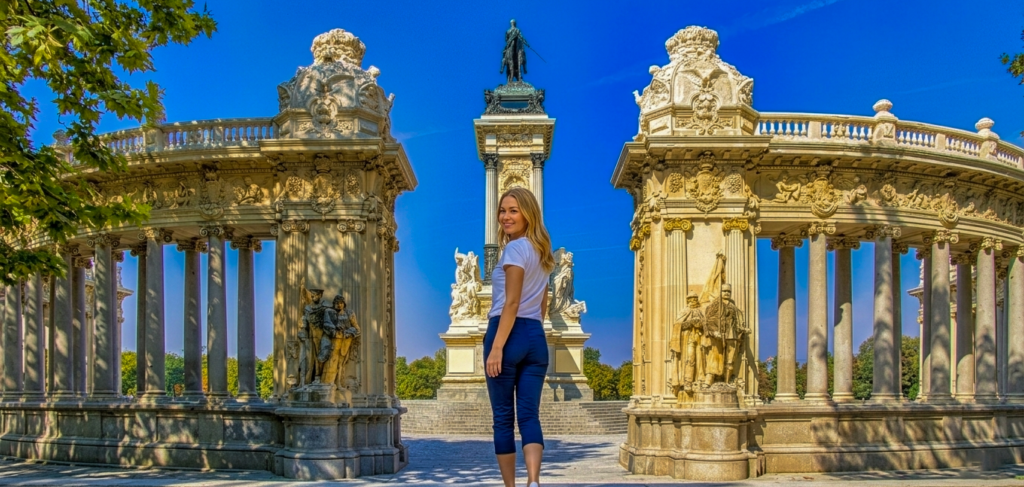
The Retiro — Madrid’s central park, originally the private garden of the royal family until the late 19th century — was the air I needed. The Crystal Palace sits inside it, an iron and glass pavilion built in 1887 to exhibit plants from the Philippines, now used for contemporary art installations. I walked through it empty, just glass and light and the sound of the lake outside, and it was the first quiet moment I’d had in Madrid. The city doesn’t offer quiet. You have to steal it.
I ate late because Madrid eats late. Dinner at ten is early. The tapas tradition here isn’t what I’d experienced on the coast — it’s more structured, more deliberate. Croquetas de jamón at a bar on Cava Baja where the bartender had been frying them for forty years and treated each one like a small personal commitment. Bocadillo de calamares — a squid sandwich on white bread that sounds absurd and tastes like the city distilled into a roll. Madrid’s food doesn’t photograph well. It doesn’t need to. It’s built for mouths, not screens.
The Royal Palace — the largest functioning royal palace in Europe by floor area — sits on a bluff above the Manzanares River and I walked through rooms that were designed to make foreign ambassadors feel small. The Throne Room ceiling, painted by Tiepolo, is one of the largest frescoes in the world. The armoury holds Charles V’s tournament armour, still polished, still terrifying. The palace isn’t used as a residence — the royal family lives elsewhere — but it operates as the official ceremonial site, which means it exists purely to represent power. Madrid is honest about that. Power is the city’s product. Everything else — the art, the food, the nightlife — is what happens when power gets bored.
Sevilla undid me in a different way.
I stepped off the train and the heat was a physical thing. Not warmth — pressure. Forty degrees in the shade and the city didn’t slow down. It can’t. Sevilla was built for this heat. The streets in the old town are deliberately narrow — medieval urban planning designed so buildings shade each other. Courtyards are open to the sky but walled on all sides, trapping cool air. The city engineered comfort into its architecture seven hundred years before air conditioning existed.
The Alcázar is the building I’ve been thinking about since I left. A royal palace started by the Moors in the 10th century, expanded by Christian kings who conquered the city in 1248 and then hired Muslim craftsmen to keep building in the same style because they recognised that no one else could do what they could do. The result is Mudéjar architecture — Islamic geometry, Christian function, both traditions in the same building without either one winning. I walked through the Patio de las Doncellas and the tilework stunned me into silence. Thousands of hand-cut ceramic pieces in patterns that repeat mathematically but never feel mechanical. Every surface was covered. Every surface was intentional. The Alcázar is the most beautiful argument for cultural coexistence I’ve ever stood inside.
The Cathedral of Sevilla is the largest Gothic cathedral in the world. The builders in 1401 reportedly said they wanted to construct a church so large that future generations would think they were mad. They succeeded. The interior is so vast that the first few seconds inside feel like stepping outdoors again. Christopher Columbus is buried here — or parts of him are, his remains having been moved so many times between Spain, the Dominican Republic, and Cuba that the final location required DNA testing to confirm. Even in death, Columbus couldn’t stop crossing the Atlantic.
I climbed the Giralda — the bell tower that was originally the minaret of the mosque the cathedral replaced. The ramp inside was built wide enough for horses to ride to the top. I walked the thirty-five ramps and at the summit, Sevilla opened in every direction — terracotta rooftops, the Guadalquivir River bending south, the Plaza de España in the distance gleaming in the sun like a stage set for a country that hasn’t finished performing. The Plaza was built for the 1929 Ibero-American Exposition, a semicircular building tiled with fifty-two ceramic alcoves representing every province of Spain. It’s enormous, it’s theatrical, and it’s completely sincere. Sevilla doesn’t do irony. It does commitment.
I ate in Triana — the neighbourhood across the river, the birthplace of flamenco, the barrio where ceramic artisans and bullfighters and singers have lived on top of each other for centuries. I had espinacas con garbanzos — spinach with chickpeas, a dish that sounds like poverty food and tastes like someone figured out how to make two cheap ingredients argue with each other until both become extraordinary. I watched a flamenco performance in a small tablao where the dancer’s heels hit the floor so hard the table shook. Flamenco doesn’t entertain. It confronts. The audience doesn’t clap at the end because they enjoyed it — they clap because they survived it.
Then Málaga. And the tempo dropped.
After Madrid’s intensity and Sevilla’s fire, Málaga felt like the city that had already figured out whatever the other two were still arguing about. The port town sits on the Costa del Sol, and it would be easy to mistake it for a beach resort — millions of tourists do exactly that, landing at the airport and heading straight for the coast without stopping. Their loss.
Picasso was born here. The house on Plaza de la Merced where he spent his first years is now a museum, and I stood in the room where he was born and thought about the fact that the most influential artist of the 20th century came from a mid-sized Andalusian port city and left at nineteen, never to live here again. Málaga didn’t hold him. It formed him and released him. The Museo Picasso Málaga, in a 16th-century palace in the old town, holds over 200 of his works, and walking through them chronologically is like watching a mind decide, decade by decade, that the rules didn’t apply. Málaga gave him the light. He gave the light back in forms nobody had seen before.
The Alcazaba — the Moorish fortress — climbs the hill above the city centre, and I walked through its gardens and archways in the late afternoon when the tour groups had gone and the shadows were long. Below, the Roman theatre — discovered in 1951 when a building was demolished and the ancient stone was just sitting there underneath, waiting. Málaga layers like that. Roman on the bottom. Moorish in the middle. Spanish on top. The whole city is an archaeological argument settled by geography.
I walked the Muelle Uno — the port promenade — and ate fried fish at a chiringuito where the menu was whatever came off the boats that morning. Espetos de sardinas — sardines skewered on a stick and grilled over a wood fire on the beach — are Málaga’s signature, and eating them with my hands, the grease on my fingers, the salt on the fish, the sand two metres from my chair, I thought about how food this simple only works when the ingredient had no distance to travel. The sardine was in the sea this morning. Now it’s on a stick. The distance between those two facts is the entire recipe.
The Centre Pompidou Málaga — a satellite of the Paris museum, housed in a multicoloured glass cube on the port — was the surprise. A French contemporary art institution in an Andalusian port city, and it works because Málaga has spent the last two decades quietly transforming itself into one of Europe’s most serious cultural cities without anyone outside Spain fully noticing. The city has over thirty museums now. It went from beach stopover to cultural destination in a generation, and it did it the Málaga way — without announcement, without rush, without asking for permission.
At sunset I sat on the beach at La Malagueta and watched the Mediterranean do what it does along this coast — turn gold, then amber, then dark. Behind me, the city climbed the hill toward the Gibralfaro castle. Ahead, the sea stretched south toward Africa, so close on clear days you can see the Rif Mountains of Morocco. Málaga sits at the hinge between Europe and Africa, between the Atlantic and the Mediterranean, between history and reinvention. It doesn’t announce its position. It just occupies it, the way it has for 2,800 years since the Phoenicians founded it and called it Malaka.
Three cities. One stares at you from a plateau and dares you to understand why it’s in charge. One catches fire every afternoon and turns the heat into music, tile, and food that hits like a closed fist. One raised a genius, let him go, and then spent a century quietly becoming something worth coming back for.
Spain’s south isn’t a holiday. It’s an education in what happens when cultures collide, layer, argue, and refuse to separate. The Moors built. The Christians expanded. The artists translated. And the kitchens made something out of all of it that no single tradition could have produced alone.
Next week — deeper south. But Sevilla’s tilework is behind my eyelids and I see it every time I blink.

Beyondia
Trusted Travel CompanionReal digital nomad. I travel. I learn. I grow.
What about you? Where are you going?