🌐 Around the World with Beyondia 🧵 Mediterranean Region 🪡 Episode 45: Málaga
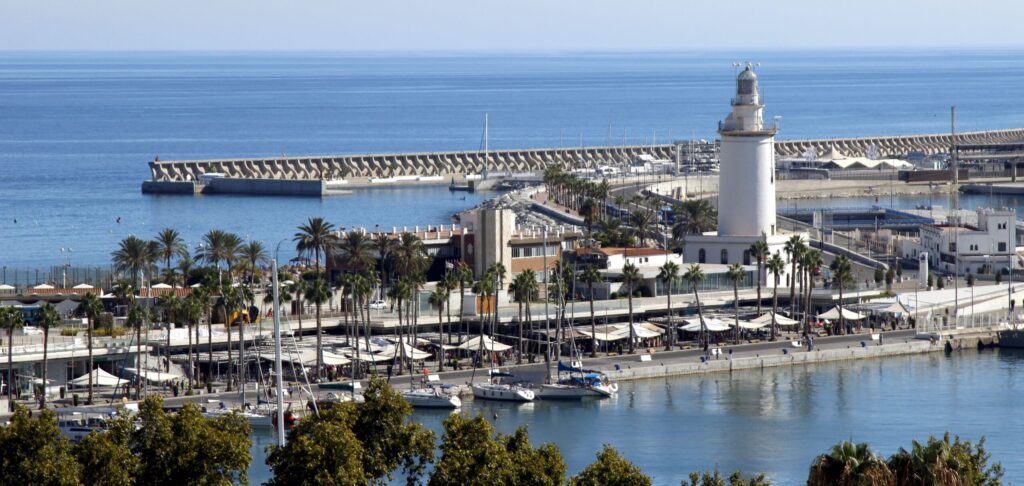
For approximately three thousand years, Málaga has been a working Mediterranean port on the southern coast of Spain, roughly a hundred and thirty kilometres east of the Strait of Gibraltar and directly opposite — across two hundred kilometres of narrowing sea — the northern coast of Morocco.
Málaga was founded around 770 BC by Phoenicians
The city was founded around 770 BC by Phoenicians from the eastern Mediterranean, who called it Malaka — probably from the Semitic root for salt, because the Phoenicians came here for the same reason they went almost everywhere along the Mediterranean coast in the eighth century BC: to salt and cure fish for export back to Tyre, Sidon, and Byblos. The Phoenicians left. The Carthaginians came. The Romans built a theatre at the foot of the hill in the first century BC, still standing, still in occasional summer use. The Visigoths held the city briefly. The Moors arrived in 711 as part of the initial Umayyad conquest of Iberia and held Málaga for seven hundred and seventy-six years — one of the longest continuous Muslim periods of any Iberian city. The Alcazaba above the harbour is eleventh-century Hammudid-Zirid, the Gibralfaro above the Alcazaba is fourteenth-century Nasrid, both are among the most intact Moorish fortifications in Andalusia after the Alhambra in Granada. In August 1487, after a four-month siege led personally by Ferdinand and Isabella, the city fell to the Catholic Monarchs. Almost the entire Muslim population was sold into slavery or expelled — a deliberate precedent five years before the fall of Granada and the completion of the Reconquista, five years before Columbus, five years before the Sephardic expulsion. Málaga has been Spanish, in continuous administrative terms, since that August. The port has been operational for approximately twenty-eight centuries. The name has changed on the map many times. The function has not.
For most of the four centuries following the Reconquista, Málaga was a small, poor, provincial port. Wine, raisins, lead ore, and iron ore left the harbour. Not much arrived. The city was overshadowed, at every step, by the other Andalusian cities — Seville with its imperial trade monopoly, Granada with the Alhambra, Córdoba with its Umayyad-Caliphate memory. Málaga was a peripheral working port on a peripheral working coast, and the coast around it had a name that reflected its working character. Locally, in Spanish travel writing and in casual usage among the malagueños themselves, the stretch of coastline west of the city — running through what is now Torremolinos, Fuengirola, Marbella, and Estepona toward Gibraltar — was called la Costa del Viento: the windy coast. The name was descriptive rather than official. The wind was, and remains, real: the levante blowing westward through the Strait of Gibraltar, the poniente blowing back the other way, both sustained, both drying, both familiar to any local fisherman as a scheduling constraint on when boats could and could not go out. The coast was windy. Everyone called it that. Almost nobody outside Andalusia had a reason to name it anything.
Málaga’s Costa del Viento was a difficult name to sell to Northern European visitors
Then, in the late 1920s and early 1930s, a small group of Málaga writers and journalists began, in newspaper columns and travel essays, to promote an alternative. The two most commonly credited figures are the journalist Rodolfo Lussnigg, who wrote for the local paper La Unión Mercantil, and the Málaga-born poet Salvador Rueda. The alternative name they promoted was Costa del Sol — the sun coast. The rationale was straightforward. Málaga records approximately three hundred days of sunshine per year, one of the highest sunshine counts in Europe. As Spanish tourism was beginning to develop in the late 1920s under Primo de Rivera’s dictatorship and continued (with interruption for the Civil War) into the 1930s and beyond, the Costa del Viento was a difficult name to sell to Northern European visitors who were themselves fleeing wind and weather. The Costa del Sol was, in every commercial sense, a better product. The name spread slowly through the 1930s and 1940s, gained regional adoption in the 1950s, and was fully industrialised as a promotional brand from the late 1950s onwards under the Franco regime’s Plan de Estabilización of 1959, which oriented the Spanish economy toward foreign tourism as a strategic development pillar. Charter flights from London, Frankfurt, Stockholm, and Copenhagen began landing at Málaga airport daily. Torremolinos exploded in unregulated hotel construction between 1959 and 1975. Fuengirola, Benalmádena, and Marbella followed. By 1970, the Costa del Sol was one of the most-visited coastlines in the Mediterranean. By 2000, it was one of the most globally recognisable coastal brands anywhere. And almost nobody outside Andalusia remembered that it had been called something else, seventy years earlier, by the people who lived there. The rebrand had erased its own history.
This is one of the cleanest case studies of a successful commercial rebrand in twentieth-century Europe, and it is worth pausing to name what actually happened. The wind did not disappear. The underlying geographical reality of the coastline did not change. What changed was one word, applied consistently, over decades, by increasing numbers of publications, tourism boards, hotels, journalists, and eventually by the visitors themselves. The mechanism is identical to what Milton Glaser did for New York City in 1977 with the I ❤️ NY campaign — a design and slogan that turned a bankrupt, dangerous, declining city into a lovable civic identity, at exactly the moment underlying conditions were beginning to improve for reasons that had nothing to do with the campaign, and got credit for a transformation it partly caused and partly rode. The Costa del Sol rebrand did the same thing on a coastline. The name was better than the place. The place then became better because the name attracted the money and the visitors that made it better. Rebrand and reality reinforced each other over three generations, until the original name had become historically invisible to almost everyone who mattered.
For the seventy years between the rebrand of the coastline and the second rebrand of the city, Málaga itself remained a somewhat peripheral participant in its own success. The tourism revenue flowed through Málaga airport but concentrated in the resort strips west of the city. The old town of Málaga proper — the Alcazaba, the cathedral, the historic centre around Calle Larios — was regarded through most of the twentieth century as a provincial Andalusian city, worth an afternoon before the visitor moved on to Torremolinos or Marbella or Granada. There was one large fact about the city that everyone knew and that the city itself barely mentioned: Pablo Picasso had been born there. He was born on 25 October 1881, in a fourth-floor apartment on the Plaza de la Merced. His father, José Ruiz Blasco, was a mediocre local painter and drawing instructor. His mother, María Picasso López, was the source of the surname the son eventually chose to sign his work with. The family left Málaga in 1891 when Pablo was nine and moved to A Coruña for the father’s teaching job, then to Barcelona, then Pablo to Paris in 1900. He returned to Málaga twice — briefly in his early twenties, briefly again in his sixties — and never to live. He died in France in 1973. For over ninety years after his departure, and for over twenty years after his death, the city that had produced the most consequential painter of the twentieth century treated him as a fact rather than an inheritance. There was a plaque on the birth house, converted to a small foundation in 1988. There was no museum. There was no cultural infrastructure that made Málaga a Picasso destination in the way that Barcelona, Paris, and even Vallauris (where Picasso worked with ceramics in the 1940s and 1950s) had become. Picasso’s centenary in 1981 was marked with modest local ceremonies. The silence continued.
Then, in October 2003, the Museo Picasso Málaga opened in the Buenavista Palace — a sixteenth-century Mudéjar-Renaissance palace in the old town, restored and adapted as a museum over the previous decade. The initial collection of 233 works was donated by Christine Ruiz-Picasso, the widow of Picasso’s son Paulo, and Bernard Ruiz-Picasso, Picasso’s grandson, both of whom had been in negotiation with the city of Málaga since the mid-1990s. The collection has grown since. The museum receives approximately 600,000 visitors per year. It was, from the moment it opened, one of the most-visited cultural sites in Andalusia. It was also, in retrospect, the first stone of a cascade. In 2011, the Carmen Thyssen Museum opened in another restored sixteenth-century palace, with over 200 works from the collection of Baroness Carmen Thyssen-Bornemisza — the largest private collection of nineteenth-century Andalusian painting in the world. In March 2015, the Centre Pompidou Málaga opened in the Cubo, a glass cube on the harbour — the first branch of the Centre Pompidou anywhere outside France, established through an agreement between the city of Málaga and the Pompidou in Paris that allowed a rotating selection of the Pompidou’s twentieth-century collection to be displayed on a fifteen-year renewable licence. In the same month, the Collection of the Russian Museum Málaga opened in the former Royal Tobacco Factory, showing selections from the Russian State Museum in Saint Petersburg. The Málaga Contemporary Art Centre had opened earlier, in 2003. The Automobile and Fashion Museum opened in 2010. By 2016, Málaga had approximately forty museums, sometimes cited as the second-highest museum density per capita of any Spanish city after Madrid — a fact that would have been unimaginable to any visitor to Málaga twenty years earlier.
This was the second rebrand, and it worked in almost the same way the first had. The mechanism was different — cultural institution densification rather than promotional relabelling — but the effect was the same: a rewriting of the story of the city that changed what visitors and residents believed about it. The reference case in urban planning literature is the Bilbao Effect — the phenomenon by which the opening of Frank Gehry’s Guggenheim Museum in Bilbao in 1997 transformed a declining Basque industrial port into a globally recognised cultural destination. Bilbao spent roughly $100 million on the museum and generated approximately $500 million in Basque regional economic activity in the first three years. The Bilbao Effect entered the urban policy vocabulary of the world. Málaga executed what is essentially a compound Bilbao Effect: not one museum, but five in twelve years, sustained across administrations of different political parties, funded by a combination of municipal, regional, national, and private investment. Málaga’s overnight visitors rose from approximately 800,000 in 2003 to approximately 1.4 million in 2015 to approximately 1.9 million in 2024. Cruise ship arrivals rose from roughly 200,000 passengers in 2003 to over 600,000 in 2024. The old town, which had been substantially neglected in the late twentieth century, was pedestrianised in stages from 2002 onwards under Mayor Francisco de la Torre — a centre-right politician of unusual longevity who held the mayoralty from 2000 until 2023 and whose sustained cultural-infrastructure policy is the political through-line that makes the whole transformation legible as a project rather than a series of accidents. Málaga was, from 2003 to 2015, in effect quietly running one of the most sustained cultural-infrastructure programmes in modern European urban policy.
The bones of the older city remain visible under both rebrands. The Alcazaba climbs the hill above the port with its horseshoe arches, its stepped gardens, its geometric tilework, and its layered defensive walls — one of the most intact eleventh-century Moorish fortresses still functioning as a public monument in Andalusia, entry approximately €3.50, best visited late afternoon when the honey-coloured stone absorbs the southern light. Directly below it, the Roman theatre — first century BC, capacity around 220 spectators, rediscovered in 1951 during construction work on the former Casa de la Cultura, restored progressively since — is still used for occasional summer performances, and is free to view from street level any hour of the day or night. Above the Alcazaba, the Gibralfaro castle — fourteenth-century Nasrid, expanded under Muhammad V of Granada, connected to the Alcazaba by a fortified corridor — offers what remains the best single view of the harbour and the coast to both the east and the west. The Cathedral of Málaga (Santa Iglesia Catedral Basílica de la Encarnación), begun in 1528 on the site of the former Great Mosque, is one of the most architecturally curious cathedrals in Spain: its south tower was never completed for lack of funds, giving the cathedral its local nickname La Manquita — “the little one-armed lady” — with only one of the two intended towers standing today. The cathedral is a strange, layered building that reflects three centuries of interrupted construction and shifting architectural fashion. The birth house of Picasso on the Plaza de la Merced is now the Fundación Picasso, a small museum of first works, family documents, and early sketches, free to visit. The Museo Picasso is a five-minute walk. The Centre Pompidou is fifteen minutes on foot along the pedestrianised port promenade.
On the beaches east and west of the historic centre — Playa de la Malagueta, Playa de Pedregalejo, Playa del Palo — the chiringuitos (beach bars) still cook espetos de sardinas: six fresh sardines threaded on a bamboo skewer, salted, roasted over olive-wood fires directly on the beach sand, served with lemon and a glass of cold local Málaga wine. The technique is essentially the same one the Phoenicians used, on the same beaches, in the same fires, for the same fish, for nearly three millennia. The Phoenician harbour is now a cruise terminal for ships that visit two hundred and fifty times a year. The Roman theatre is now a summer venue. The Moorish fortress is now a €3.50 ticket. The Picasso birthplace is now a museum. The Costa del Viento is now the Costa del Sol. Everything visible has been renamed at least once. The espetos on the beach have not. Some things stay the same across three thousand years because the fish and the fire and the salt did not require a rebrand. Everything else did.
This is the deeper character of Málaga, and the argument the article proposes to close on. The city is one of the oldest continuously inhabited ports in the world — twenty-eight centuries of continuous maritime function on the same natural harbour — and it is also, simultaneously, the cleanest case study in modern European tourism of the successful commercial rebrand. Twice. The first rebrand renamed a coastline in the twentieth century and turned it into one of the most valuable coastal brands in the world. The second rebrand renamed a city in the twenty-first century, through a compound Bilbao Effect of cultural infrastructure, and turned it from a poor cousin of Seville and Granada into one of the most-visited cultural cities in Spain. Both rebrands worked. Both are, on reflection, at least partly stories about how identity is manufactured rather than inherited. And underneath both, the espetos still cook on the beach the way they have cooked since Phoenician salt merchants first pulled into the natural harbour and worked out that this was a good place to stop. Málaga is not the postcard. Málaga is the mechanism by which the postcard was made — and then, seventy years later, made again.
Some cities inherited their names. This one changed the name of the coast, changed the story of the city, and kept the fire on the beach exactly where it had been for three thousand years.
Nine regions. One hundred and twenty destinations. Three hundred and fifteen weeks remaining.
The journey continues. The next stop is a town that carved itself into the top of a gorge, taught modern Spain how to look at a bull, and gave Ernest Hemingway his best line about a bridge.

Beyondia
Trusted Travel CompanionReal digital nomad. I travel. I learn. I grow.
What about you? Where are you going?