🌐 Around the World with Beyondia 🧵 Nordic & Western Europe Region 🪡 Episode 57: Porto
In the second century AD, the Romans called it Portus Cale — the twin port complex at the mouth of the Douro river, with Portus on the northern bank and Cale on the southern bank. Over the following seven centuries, Latin Portus Cale evolved through Suebic, Visigothic, and medieval Iberian pronunciation into Portucale, and eventually into Portugal. When Vímara Peres established the County of Portucale in 868 AD, the county took its name from the twin-port complex. When Afonso Henriques declared independence from León-Castile in 1139, the country he named the Kingdom of Portugal took its name — through the medieval county — from the port at the mouth of the Douro. Portugal was named after this port, not the other way around. Most residents take it for granted. Most foreigners do not know it. But when Porto residents refer to their city as ‘a Invicta’ — the Unconquered — they are referring to a place that was named before the country that would later be named after it.
Porto is the second-largest city in Portugal
Porto is the second-largest city in Portugal, the commercial and industrial capital of the northern country, and — genuinely — the etymological origin of the name of Portugal itself. The commune has a population of approximately 235,000; the greater metropolitan area of Porto is approximately 1.7 million, making it Portugal’s second-largest urban region after Lisbon. The city sits on the northern bank of the Douro river estuary approximately three kilometres upstream from the Atlantic coast. The Douro river — the third-longest Portuguese river (897 kilometres from source in the Spanish Sierra de Urbión to the Atlantic at Porto) and one of the largest Iberian river systems by drainage basin — has its final estuary here, providing the specific harbour infrastructure that gave rise to the Roman Portus Cale twin-port complex and, subsequently, to modern Porto and its southern-bank twin Vila Nova de Gaia.
The city’s name and etymology are worth pausing on. The Roman-era designation was Portus Cale — Portus meaning port (Latin), and Cale being the name of the settlement on the southern bank, of uncertain but possibly Celtic-Iberian origin. The twin ports functioned as a combined commercial complex under Roman administration from approximately the 2nd century AD, and the combined name entered common usage as the standard designation for the whole port area. When the Roman Empire’s western territories fragmented in the 5th century, the region entered the Suebi Germanic period (411-585 AD), then Visigothic (585-711 AD), then Moorish (711 onwards). During this thousand-year period of successive administrative regimes, Latin Portus Cale evolved through spoken Iberian Romance pronunciation into medieval Portucale, and eventually into Portugal. The Christian recapture of the northern territories began in the 9th century — Vímara Peres, a Christian nobleman under the Kingdom of Asturias, reconquered the region in 868 AD and established the Condado Portucalense (County of Portucale) as an autonomous Christian county under Asturian and later Leonese sovereignty. The county took its name from the Portus Cale twin-port complex on the Douro estuary. When Afonso Henriques — the son of Count Henry of Burgundy who had governed the County of Portucale from 1096 to 1112 — declared independence from León-Castile in 1139 after the Battle of Ourique, the new kingdom took its name from the medieval county, which took its name from the twin-port complex. So the etymology is genuine and specific: Porto → Portus (Latin) → Portus Cale (Roman) → Portucale (medieval) → Portugal (modern). The port at the mouth of the Douro literally gave the country its name.
Porto’s medieval and early-modern history
Beyond the etymology, Porto’s medieval and early-modern history follows the pattern common to Portuguese northern cities. Under the medieval County of Portucale and subsequently the Kingdom of Portugal, Porto developed as a substantial commercial port with active connections to England, Flanders, and the Baltic. The 1372 Anglo-Portuguese Treaty of Tagilde — negotiated in a small village near Braga between representatives of Portugal and Edward III of England — is the oldest active alliance in the world still in force (the Anglo-Portuguese Alliance was reaffirmed in the 1373 Treaty of London and the 1386 Treaty of Windsor, all signed during a period when Porto was a major Portuguese commercial centre with strong English trading connections). English merchants established a substantial trading presence in Porto in the medieval and early-modern periods, particularly in the wine trade, and the English-Portuguese commercial relationship became one of the defining economic patterns of both cities’ subsequent development. The city’s foral (royal charter) was granted in 1123 by Queen Teresa (Afonso Henriques’s mother), formalising Porto’s municipal autonomy. The medieval defensive walls — parts of which are still preserved and visible today — were built and expanded across the 13th and 14th centuries. The city’s specific character as a Invicta (“the Unconquered”) — the traditional nickname that Porto residents apply to their city — dates from the medieval Portuguese wars, when Porto successfully resisted multiple sieges (particularly the 1832-1833 Siege of Porto during the Liberal Wars, when the city held out for a year against Miguelite forces). The nickname is a genuine expression of Porto residents’ specific cultural pride in their city’s historical resilience.
The port wine trade is the article’s most substantive economic-historical claim, and it is worth substantive treatment because it is one of the more consequential Portuguese commercial exports of the modern era. Wine production in the Douro Valley — the mountainous region approximately 100 kilometres east of Porto, extending along the Douro river through the Alto Douro and Douro Superior sub-regions — has been continuous since Roman times. The specific fortified wine known internationally as port wine emerged in the late 17th century as a response to specific commercial circumstances. English merchants had been importing table wines from various European sources for centuries, and in the 1670s-1690s, the English wine market shifted dramatically toward Portuguese sources as a result of Anglo-French political tensions and the Methuen Treaty of 1703 (which established preferential tariffs on Portuguese wines entering England). The commercial demand was substantial. The problem was that ordinary Douro table wines did not travel well on the long sea voyage from Porto to English ports — the wine would often arrive spoiled or unstable. The English merchants in Porto experimented with adding grape spirit (aguardente) to the wine barrels before shipping, initially as a preservation technique. They discovered that if the grape spirit was added during fermentation, it would stop the fermentation process at a specific point, preserving substantial residual sugar and producing a wine that was fortified (approximately 19-22% alcohol), sweet, and remarkably stable during long voyages and long-term storage. This is fortified wine as we know it today. The technique was refined across the early 18th century and became the standard production method for Douro wines destined for the English market. By the 1740s, port wine (named for the Porto shipping port) had become one of the most-consumed premium wines in England, and remained so throughout the 18th and 19th centuries.
The Marquês de Pombal — who appears in three consecutive Portuguese articles at this point (Lisbon’s earthquake reconstruction, Coimbra’s university reforms, and now the Douro Valley demarcation) — established the world’s first formally demarcated wine region by royal decree on 10 September 1756. Pombal’s decree created the Companhia Geral da Agricultura das Vinhas do Alto Douro — the General Company of Agriculture of the Vines of the Upper Douro — with monopoly authority over port wine production, quality control, and export. The decree also formally delimited the specific geographical area within which port wine could legally be produced, marked with stone boundary markers (marcos pombalinos) placed throughout the Douro Valley — many of which are still visible today. This is genuinely the first formally demarcated wine region in world history. The 1855 Bordeaux classification, which is often cited as the origin of modern wine appellation systems, was established approximately a century after the Pombaline Douro demarcation. The Champagne appellation was formally protected in 1908. The French AOC (Appellation d’Origine Contrôlée) system, which became the model for modern wine appellations globally, was established in 1935. Portugal beat all of them by roughly 100-180 years with the Pombaline demarcation of 1756. This is under-recognised in international wine history writing, and the article names it explicitly.
Port wine production has continued substantially unchanged in its fundamental method since the 18th century. Grapes are grown on terraced vineyards on schist and granite slopes throughout the Douro Valley, at altitudes between approximately 100 and 800 metres. The specific grape varieties — Touriga Nacional, Touriga Franca, Tinta Roriz, Tinto Cão, Tinta Barroca (for red ports), and Malvasia Fina, Viosinho, Gouveio, Rabigato (for white ports) — are cultivated in a system that combines traditional terraced viticulture with more recent mechanised patch cultivation. Harvest takes place in September and October, primarily by hand-picking (the terrain is too steep for machine harvesting), and the grapes are transported to production facilities where they are crushed and fermented. In the highest-quality productions, the crushing is still done by traditional foot-treading in stone lagares — flat rectangular stone troughs where teams of workers spend hours treading the grapes with rhythmic collective movement, releasing the anthocyanins that give the wine its colour and structure. The foot-treading is not tourism theater. It genuinely produces slightly different chemistry than mechanical crushing, and vintage ports produced by foot-treading command premium prices. During fermentation, grape spirit (aguardente vínica) is added at a specific point — usually when the wine has reached approximately 6-8% alcohol — to stop the fermentation and preserve substantial residual sugar. The fortified wine is then transported down the Douro to Vila Nova de Gaia on the south bank of the Douro directly opposite Porto. In earlier centuries, transport was by the traditional rabelo boats — flat-bottomed wooden vessels with lateen sails, specifically designed to navigate the shallow rocky sections of the upper Douro. The rabelo boats are still preserved and displayed along the Cais da Ribeira in Porto, though most contemporary port wine transport uses road transport.
In Vila Nova de Gaia — the industrial district on the south bank of the Douro, physically continuous with Porto but administratively separate as a distinct municipality — the port wine ages in oak casks in the historic warehouses (armazéns) along the waterfront. This is where the specific character of different port wine styles develops. Ruby port — the youngest and most common style — ages in oak for 3-6 years and is bottled with substantial fresh-fruit character. Tawny port ages for longer periods (10-year, 20-year, 30-year, and 40-year tawnies are common commercial designations) and develops the specific tawny colour and nutty caramelised character through slow oxidation in oak. Vintage port — the highest-quality style, produced only in specific declared years — is aged in oak for 2-3 years and then bottled for further aging in bottle (vintage ports can continue improving for 40-60 years in bottle). Late Bottled Vintage (LBV) port is aged in oak for 4-6 years and then bottled. White port uses white grape varieties and is produced in dry, semi-dry, and sweet styles. The specific aging in the Gaia warehouses is regulated under the Port Wine Institute (Instituto dos Vinhos do Douro e Porto, IVDP), and only wines aged in Gaia can be legally sold as port under EU appellation law. This is genuinely one of the most complex fortified-wine production systems in the world, and its continuous maintenance across three centuries in the same physical infrastructure is one of the more remarkable European commercial-cultural continuities.
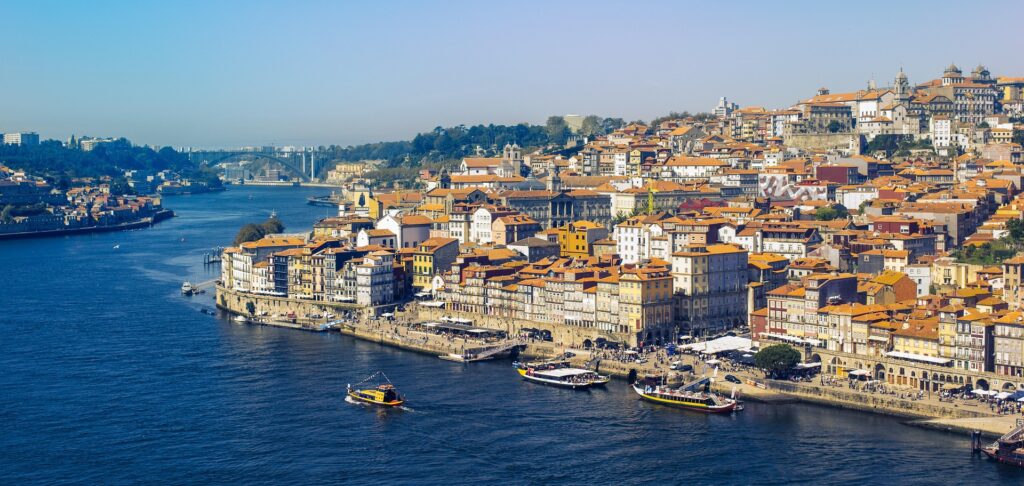
The Ribeira district of Porto — the medieval waterfront quarter on the north bank of the Douro, immediately opposite the Vila Nova de Gaia warehouses — is the visual heart of the city. The district was inscribed as a UNESCO World Heritage Site in 1996 for the specific integrated character of its historic buildings, narrow streets, and dramatic river-valley setting. The Cais da Ribeira — the ground-level waterfront promenade — is one of the most-photographed spots in Portugal, with the historic buildings rising in tightly-packed stacks up the river valley behind, the Douro flowing past, the Vila Nova de Gaia warehouses on the opposite bank, and the Dom Luís I Bridge spanning the gorge upstream. The buildings themselves are mostly 16th-19th century, with substantial 18th-century Baroque and 19th-century commercial-classical additions. The specific stacking of the buildings — climbing the narrow streets, sharing walls, with iron balconies, tile-decorated facades, and the specific granite construction of the northern Portuguese architectural tradition — creates the distinctive amphitheatre-like appearance that defines Porto’s visual identity. Walking the Ribeira in early evening is genuinely one of the more atmospheric urban experiences in Europe.
The Dom Luís I Bridge — the iconic double-deck iron arch bridge connecting Porto’s Ribeira to Vila Nova de Gaia’s port wine district — is worth substantive treatment. The bridge was designed by Théophile Seyrig, a French engineer who had been Gustave Eiffel’s business partner in the firm Eiffel et Seyrig from 1868 to 1879. After the partners’ split, Seyrig won the Porto bridge commission through his subsequent firm, and the bridge was built between 1881 and 1886 by Sociedade de Construções Metálicas. The specific design — a 172-metre single-span iron arch, 45 metres above the Douro at low tide, with two roadways (an upper deck for pedestrians and Metro trains, a lower deck for road traffic and pedestrians) — was structurally ambitious for its era. The bridge replaced an earlier suspension bridge (the Ponte Pênsil, opened 1843, replaced because of insufficient capacity) and became immediately iconic. The visual similarity to the Eiffel Tower construction techniques — riveted iron lattice construction, similar bridge-engineering language, similar late-19th-century industrial aesthetics — is real and reflects the shared engineering heritage. Both structures are considered among the more important works of late-19th-century iron construction. The bridge’s specific double-deck design is genuinely unusual and has become the visual symbol of Porto — comparable to the Ponte Vecchio in Florence, the Charles Bridge in Prague, or the Chain Bridge in Budapest as the specific bridge that defines a city’s identity.
The Portuguese azulejo tile tradition
The Portuguese azulejo tile tradition — the specific style of tin-glazed ceramic tiles used to decorate exterior building surfaces, developed from Moorish and Renaissance Italian traditions and refined into a distinctively Portuguese decorative language across the 16th-20th centuries — is particularly concentrated in Porto. Two specific azulejo installations are worth naming. The São Bento train station, opened 1916 to serve the Porto-Douro railway (which was designed to transport port wine and later expanded for passenger traffic), contains approximately 20,000 blue-and-white azulejo tiles in the main vestibule, painted by Jorge Colaço between 1905 and 1916, depicting scenes from Portuguese history — the Battle of Valdevez, the marriage of King João I to Philippa of Lancaster, the arrival of Prince Henry the Navigator, various regional folk scenes. It is one of the most-photographed train station interiors in the world. The Capela das Almas — a small church on Rua de Santa Catarina in the central shopping district — has its entire exterior covered in approximately 15,900 blue-and-white azulejo tiles, applied in 1929 by the ceramicist Eduardo Leite, depicting scenes from the lives of Saints Catherine and Francis. Both installations are examples of the specific Portuguese decorative tradition that treats exterior tile as substantial architectural surface. The tradition continues today, with contemporary Portuguese artists working in the azulejo medium.
The francesinha — Porto’s signature sandwich — is one of the specific culinary identifiers of the city. The sandwich was invented in the 1950s by a Portuguese-born chef named Daniel da Silva, who had spent time working in France as a young man and returned to Porto to open his own restaurant. He wanted to create a version of the French croque-monsieur sandwich adapted for Portuguese tastes, and the result was the francesinha (“little Frenchie” or “the French one”) — a bread sandwich filled with cured ham, linguiça sausage, fresh sausage, and grilled steak, covered with melted cheese and served in a hot sauce made from beer, tomato, and various spices. Sometimes it is topped with a fried egg. Sometimes it is served with fries. The result is genuinely enormous — a single francesinha is typically 800-1,200 calories and is intended as a full meal rather than a light snack. It is served in dozens of specialised restaurants throughout Porto (with substantial regional variations in the sauce recipe — the specific francesinha sauce is considered a family or restaurant secret), and it has become one of the specific Porto identity markers. It is not sophisticated cuisine. It is fundamentally a working-class sandwich developed for laborers who needed substantial caloric intake. It is delicious in the way that specific working-class comfort foods are.
The football rivalry between FC Porto and SL Benfica (Lisbon) is one of the more intense rivalries in European football, and Porto’s specific working-class club identity is a substantial part of the city’s contemporary culture. FC Porto has won the UEFA Champions League twice (1987 and 2004), the UEFA Cup twice (2003 and 2011), and multiple Portuguese league titles. The club’s Estádio do Dragão (opened 2003, capacity 50,000) is one of the most-attended football stadiums in Portugal. The specific supporter culture of FC Porto — the “Dragons” — reflects the city’s working-class northern character and provides one of the most intense football-supporter experiences in Portugal. The rivalry with SL Benfica is not merely sporting but reflects genuine cultural tensions between working-class northern Portugal and administrative-elite southern Portugal that predate the football clubs themselves.
The contemporary Porto is one of the fastest-growing tourism destinations in Portugal — approximately 3.5 million visitors per year, with substantial recent growth driven by low-cost European flight connections and the city’s specific gritty-attractive character. The city has become increasingly popular as a European tourism destination over the past decade, particularly for weekend trips and short breaks, and the specific tension between the city’s authentic working-class character and its increasing tourism development is one of the ongoing negotiations of Porto’s contemporary identity. Housing-price inflation has been substantial (though less extreme than Lisbon), the traditional working-class districts of the historic centre have experienced substantial gentrification, and the city faces the specific challenges of managing rapid tourism growth without losing its distinctive character. Portuguese Golden Visa investments (the same programme covered in the Ep 55 Lisbon article) have targeted Porto substantially, particularly in the Ribeira district and the neighbouring Foz do Douro (the Atlantic-coast district at the mouth of the Douro).
This is the deeper character of Porto, and the article proposes to close on it. The city is the working commercial and industrial capital of northern Portugal, the etymological origin of the name of Portugal itself, the operational centre of one of the most globally recognised Portuguese exports (port wine) for approximately three centuries, and a UNESCO-inscribed historic centre that climbs the Douro river valley in a distinctive stone amphitheatre. The Douro Valley — inscribed as UNESCO World Heritage since 2001 — is the world’s oldest formally demarcated wine region, established by decree of the Marquês de Pombal in 1756, predating the Bordeaux classification by nearly a century. The port wine production system — from the terraced schist vineyards through the traditional foot-treading of vintage productions through the fortification with grape spirit through the aging in the Gaia warehouses — represents one of the most complex and continuously-maintained traditional wine production systems in the world. The Dom Luís I Bridge, designed by Théophile Seyrig (former partner of Gustave Eiffel), is one of the most architecturally distinctive iron bridges in Europe. The azulejo tile installations at São Bento train station and the Capela das Almas are among the most spectacular exterior tile decorations anywhere. The Ribeira district is UNESCO-inscribed and genuinely one of the more atmospheric urban waterfronts in Europe. The francesinha sandwich is genuinely uniquely Porto. FC Porto’s football rivalry with SL Benfica is one of the most intense in European football, and Porto’s specific working-class northern Portuguese cultural pride is a substantial part of the city’s contemporary identity. And underneath all of it, the etymology continues to be true: this port, at the mouth of this river, in this small Iberian territory, is what named the country of Portugal.
Some cities carry their country’s name because they became the country’s capital. This one gave the country its name from the beginning — a Roman-era twin port whose Latin designation evolved through medieval Iberian pronunciation into the name of the kingdom, the modern country, and a language spoken by two hundred and fifty million people today. Porto has been a Invicta — the Unconquered — for a very long time, and it earned the nickname twice: once by resisting historical sieges, and once by being the port whose name became a whole civilisation’s identity.
Nine regions. One hundred and twenty destinations. Three hundred and four weeks remaining.
The journey continues east and up-river. The next stop is the Douro Valley — the world’s oldest formally demarcated wine region, where terraced schist vineyards climb the river banks in geometric patterns that have been maintained for over three centuries, and where port wine is still made in stone troughs by workers treading grapes with their feet.

Beyondia
Trusted Travel CompanionReal digital nomad. I travel. I learn. I grow.
What about you? Where are you going?