🌐 Around the World with Beyondia 🧵 Nordic & Western Europe Region 🪡 Episode 56: Coimbra
Every evening at closing time, the librarians of the Biblioteca Joanina spread leather sheets across the reading tables to protect them, and open the small ventilation apertures under the roof. Small bats fly in from the surrounding gardens and hunt insects through the night — bookworms, silverfish, paper-eating moths, all the small creatures that would otherwise destroy the 250,000 antique books in the library’s collection. In the morning, the librarians clean the leather covers of bat guano and reopen the library to readers. This has been the operating protocol since 1728. The bats are protected under the library’s rules. Some of the current colony’s ancestors have been living in this library for three hundred years. It is not a folk tale. It is a functioning integrated pest management system that predates modern chemical fumigation by two and a half centuries, and it is still working.
Coimbra is a small city on the Mondego river in central Portugal
Population approximately 105,000, situated approximately 200 kilometres north of Lisbon and 120 kilometres south of Porto. It is the seat of the Coimbra District and one of the most historically substantial small cities in the Iberian peninsula. The medieval walled centre climbs the hill above the Mondego from the riverside quarter to the summit, where the former royal palace — now the University of Coimbra — dominates the city skyline in a way that most other European small university cities cannot match. Coimbra is one of the two Portuguese cities inscribed on the UNESCO World Heritage list specifically for the university (Évora, treated in Ep 54, is inscribed for the entire town; Coimbra is inscribed for the University and its urban context, inscribed 2013). The city’s population is small, its economy is dominated by the university and by university-related services, and its overall character is defined by the specific rhythm of a working academic institution that has been continuously operating for over 700 years. This is what distinguishes Coimbra from Portugal’s other medieval cities. The past is not preserved as monument here. The past is continuously occupied.
The city’s role in Portuguese history began in the medieval period. Roman Aeminium was founded here in the 1st century AD as a small provincial administrative centre, and the settlement continued through the Visigothic and Islamic periods. The Moors held Coimbra from the 8th to the 11th centuries as Qulumriya, and Christian Portuguese forces recaptured the city definitively in 1064 under King Ferdinand I of León-Castile. In 1131, King Afonso Henriques — the founding king of the emerging Portuguese kingdom, who would formally declare Portuguese independence in 1139 — moved his royal court from Guimarães to Coimbra, establishing the city as the political capital of Portugal. Coimbra remained the royal capital for approximately 124 years, through the reigns of Afonso I (1139-1185), Sancho I (1185-1211), Afonso II (1211-1223), Sancho II (1223-1247), and the early reign of Afonso III, until Afonso III moved the court permanently to Lisbon in 1255 to consolidate Portuguese control over the southern territories recently reconquered from the Moors. This is a substantial fact that most foreign readers do not carry. Coimbra was Portugal’s first capital, not Lisbon, and the medieval royal buildings on the hill above the Mondego were the political centre of the emerging Portuguese state during its crucial formation century.
The University of Coimbra
The medieval royal palace at Coimbra — the Paço Real da Alcáçova — was built by successive Portuguese kings across the 12th and 13th centuries on the site of the former Moorish alcazaba (fortress), which itself had been built on the Roman Aeminium administrative buildings. When King Afonso III moved the political capital to Lisbon in 1255, the Coimbra royal palace continued to be used as a royal residence during Portuguese kings’ visits to the north, but was no longer the primary political centre. In 1290, King Dinis I formally founded the University of Coimbra by royal decree — the studium generale was initially established in Lisbon, but was moved between Lisbon and Coimbra several times over the following two centuries as successive kings and popes negotiated the university’s institutional character. The university was permanently established at Coimbra in 1537 under King João III, who transferred it from Lisbon and installed it in the former royal palace. The building has served as the institutional heart of the University of Coimbra continuously since 1537 — approximately 489 years of continuous academic occupation of the medieval royal palace of the first Portuguese kingdom. This is one of the longest continuous single-building institutional occupations anywhere in Europe.
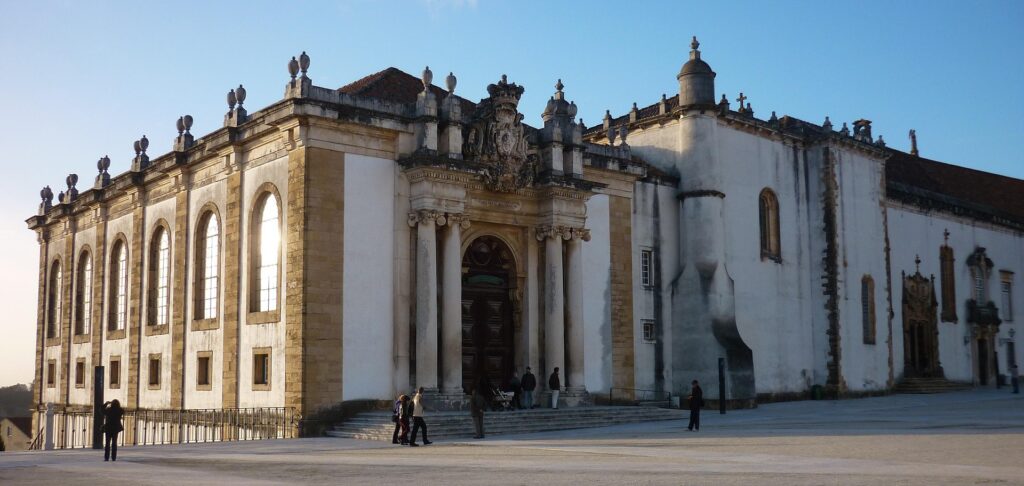
The Biblioteca Joanina — the Baroque library that is the article’s central subject — was built between 1717 and 1728, funded by King João V of Portugal (the “Portuguese Sun King,” r. 1706-1750, whose reign was funded by the substantial gold discoveries in the Portuguese colony of Brazil and who directed those revenues into ambitious architectural projects including the Mafra Palace, the Águas Livres Aqueduct in Lisbon, and the Biblioteca Joanina). The library is one of the more spectacular examples of Portuguese Baroque architecture. The main hall — three interconnected rooms extending approximately 40 metres in total length — is lined floor-to-ceiling with two-storey gilded wooden shelving (the estantes), painted in three colour registers (green in the first room, red in the second, and gold in the third — a specific colour progression that echoes the sequence of increasingly precious materials from the entrance to the interior). The ceilings are painted with elaborate Rococo scenes celebrating knowledge, learning, and Portuguese royal patronage of the arts. The two-storey wooden shelving is supported by intricately carved and gilded columns. The floor is inlaid oak parquetry. The collection contains approximately 250,000 books, with the oldest volumes dating to the 12th century and the most valuable single items including 16th-century first editions of Portuguese Renaissance humanist works, 17th-century philosophical treatises, and 18th-century scientific and mathematical works reflecting the Pombaline reforms of the university curriculum. The library is genuinely one of the more visually spectacular working library spaces anywhere in Europe, and is regularly cited alongside Trinity College Library in Dublin, the Herzog August Library in Wolfenbüttel, and the Duke Humphrey’s Library at the Bodleian in Oxford as one of the most important Baroque and early-modern library rooms in the world.
The library’s most operationally distinctive feature — and the specific fact that the locked article title celebrates — is the working colony of bats that has been protecting the collection from insect damage for approximately three hundred years. The colony is primarily composed of two bat species that are native to the surrounding Coimbra countryside: the greater noctule (Nyctalus lasiopterus), a substantial insectivorous bat with a wingspan of approximately 45 centimetres, and the common pipistrelle (Pipistrellus pipistrellus), a smaller bat with a wingspan of approximately 25 centimetres. The colony has been documented in the library’s records continuously since the early 18th century, and the operating protocol has been substantially unchanged since approximately 1728, when the library opened. Every evening at closing time, library staff perform three specific tasks: they spread large leather sheets across the reading tables (to protect the wooden surfaces from bat guano), they open small ventilation apertures under the library’s roof that connect to the surrounding garden spaces, and they close the library to the public. Overnight, the bats enter through the ventilation apertures and hunt insects throughout the library’s three interconnected rooms — particularly bookworms (Anobium punctatum and related species), silverfish (Lepisma saccharina), and paper-eating moths (multiple species) that would otherwise cause substantial damage to the antique book bindings, paper, and leather covers. In the morning, the librarians remove and clean the leather covers (which have caught the accumulated bat guano), sweep the reading tables, and reopen the library to readers.
This system is not folklore. It is a documented, functional integrated pest management system that predates modern chemical fumigation by approximately 250 years and continues in operation today because it works. The bats are protected under the library’s institutional operating protocols — they cannot be killed, disturbed, or removed. The library staff are trained to recognise individual bats. The colony population has been monitored by university biologists since the 1980s and is maintained in a stable range of approximately 20-30 individuals depending on the season. The bats do not damage the books (their guano is easily cleaned from the protected leather covers, and they show no interest in the paper or bindings themselves — only in the insects that live in and on them). The library has considered switching to modern chemical fumigation methods multiple times over the past century but has consistently decided to continue with the bat colony because it is more effective, more sustainable, less disruptive to the historical fabric of the space, and — perhaps most significantly — because the continuity of the practice is itself a valuable institutional tradition. The Coimbra library bats have become one of the most-discussed operational continuities in any European working institution, and are cited in library science and conservation literature as one of the earliest and most successful examples of biological pest control in a heritage collection setting.
The library sits within the larger university complex that occupies the former royal palace on the summit of the Coimbra hill. The complex includes the Sala dos Capelos — the university’s ceremonial hall, where doctoral degrees are conferred in the traditional Portuguese praxe académica ceremonies, with wooden ceiling panels painted with the coats of arms of the university’s historical benefactors and the specific ceremonial staffs and academic regalia still used for formal occasions. The complex includes the University Chapel (Capela de São Miguel) — a 16th-century Manueline chapel with 18th-century Baroque interior additions, including a rare Portuguese-built pipe organ from 1737. The complex includes the Sala do Exame Privado — where doctoral candidates historically defended their theses before the university’s committee of examiners. The complex includes the Torre da Universidade — the University Tower, one of the most recognisable buildings in Coimbra, built between 1728 and 1733 by the same royal patronage that funded the library, and containing a working carillon of six bells that mark the university’s ceremonial hours. The tower rises approximately 34 metres above the palace complex and is visible from most of the city below. The overall complex — the library, the ceremonial halls, the chapel, the tower, the surrounding cloisters and courtyards — represents one of the more architecturally coherent early-modern university complexes in Europe, and its continuous institutional use for approximately 489 years is genuinely unusual.
The University of Coimbra itself is worth substantive treatment. Founded in 1290 by King Dinis I, permanently established in Coimbra since 1537, it is one of the oldest continuously operating universities in the world — after Bologna (founded around 1088), Oxford (roughly 1096), Salamanca (1218), Cambridge (1209), Padua (1222), and a small number of others. The university trained the intellectual and administrative elite of the Portuguese empire for approximately six centuries — Portuguese royal officials, colonial administrators, ecclesiastical hierarchs, judges, physicians, and jurists — and shaped the specific character of Portuguese Renaissance humanism (16th century), Enlightenment scholarship (18th century), and modern academic tradition (19th-20th centuries). The Pombaline reforms of 1772 — instituted by the Marquês de Pombal, the same figure who directed the reconstruction of Lisbon after the 1755 earthquake (covered in the Ep 55 article) — reorganised the university’s curriculum along systematic Enlightenment scientific principles, establishing new faculties of mathematics, philosophy, and natural science, and moving Coimbra from a substantially theological-legal focus to a modern research-university structure that predated similar reforms at most other European universities by several decades. The university continues today as one of the leading universities in Portugal, with approximately 25,000 students, substantial research output particularly in the sciences and engineering, and a distinctive continuing academic culture that maintains the ceremonial traditions of the medieval institution alongside contemporary research practices.
The praxe académica — the specific academic ceremonial tradition of Coimbra — is one of the most visually distinctive university cultures in Europe. Students wear the traditional black cape-and-tunic (capa e batina) at official occasions, formal lectures, and specific ceremonial events. The cape is a long black wool garment that wraps the torso and shoulders; the tunic is a long black robe worn underneath. The complete outfit is worn with specific ribbons (fitas) in coloured combinations that indicate the student’s faculty and year — yellow for medicine, red for law, blue for arts and humanities, dark blue for sciences, purple for pharmacy, and other colours for other faculties. Students who complete the traditional academic year receive additional ribbons in specific ceremonies (the Queima das Fitas — “burning of the ribbons” — held annually in May, one of the largest student festivals in Portugal, involving symbolic burning of the students’ original ribbons and their replacement with new ones). The praxe also includes specific behavioural traditions: the way students greet professors, the seating arrangements in the ceremonial hall, the specific rituals of academic hierarchy that trace to medieval European university culture. Some elements of the praxe have been controversial in recent decades — the practice of praxe agressiva (aggressive hazing of first-year students by older students) has been the subject of substantial criticism and legal action, and the university has instituted reforms to eliminate the more coercive elements while preserving the ceremonial traditions. The distinction between the ceremonial praxe (which is a genuine cultural inheritance worth preserving) and the coercive-hazing praxe (which has been correctly identified as problematic and is being reformed) is a genuine institutional negotiation that the article names briefly.
The distinct Coimbra musical tradition
The fado de Coimbra — the distinct Coimbra musical tradition — is worth naming as a separate cultural inheritance from the Lisbon fado covered in the Ep 55 article. Where Lisbon fado emerged in the 19th century in working-class taverns of Alfama and Mouraria and was substantially performed by women (the fadistas), Coimbra fado emerged from the university’s student traditions and is sung exclusively by male university students, wearing the traditional black cape-and-tunic, accompanied by the Portuguese guitar and the classical guitar. The lyrics traditionally address romantic love and longing (particularly the specific student experience of unrequited love for local Coimbra women), academic and student life, and philosophical reflections on time and change. The tradition is genuinely alive — Coimbra fado is performed regularly at specific traditional locations in the medieval city, particularly in the small square in front of the Old Cathedral (Sé Velha) and at various student cultural venues. The two Portuguese fado traditions — Lisbon’s fado tradicional and Coimbra’s fado de Coimbra — represent two fundamentally different working-class and intellectual musical cultures within the same country, developed in the same century, using similar musical techniques but with distinct performative and social contexts. Both were inscribed together under UNESCO Intangible Cultural Heritage in 2011.
The medieval city surrounding the university complex is worth exploring on foot. The Old Cathedral (Sé Velha), immediately below the university on the hill, is a 12th-century Romanesque fortress-cathedral built between 1146 and 1218, one of the most distinctive medieval religious buildings in Portugal. The building has the substantial defensive character of a Reconquista-era fortress-church — thick granite walls, minimal exterior decoration, small windows, and a fortress-like square tower — and preserves in its interior one of the most complete Romanesque religious spaces in Portugal. The New Cathedral (Sé Nova), a 17th-century Baroque cathedral, was originally built as a Jesuit church and became the cathedral only after the 1772 Jesuit expulsion and the transfer of ecclesiastical functions. The Church of Santa Cruz — one of the oldest continuously-operating monasteries in Portugal, founded in 1131 by King Afonso I as part of the establishment of Coimbra as the royal capital — contains the tombs of the first two kings of Portugal, Afonso I and Sancho I. The Monastery of Santa Clara-a-Velha — a 13th-century monastery that was progressively flooded by the Mondego over the centuries and eventually abandoned in the 17th century, subsequently substantially excavated and restored in the 21st century — is a fascinating case study in medieval architectural preservation and flood damage. The Botanical Garden — founded 1772 by the Marquês de Pombal, one of the oldest botanical gardens in Portugal — contains substantial collections of Mediterranean, Atlantic, and tropical species, and functions as both a research institution and a public garden.
The Mondego river — the longest Portuguese river that flows entirely within Portugal (approximately 234 kilometres from source in the Serra da Estrela to the Atlantic at Figueira da Foz) — defines the geography of Coimbra. The river passes below the medieval city, is crossed by several historic bridges (the Ponte de Santa Clara, rebuilt in the 20th century after the medieval bridge collapsed, and the modern Ponte Rainha Santa Isabel), and provides the geographical foundation for the city’s specific stepped topography — the medieval city rises from the riverside quarter (Baixa) through progressive terraces to the university complex at the summit. The specific movement between river-level and hilltop is one of the defining Coimbra experiences.
The contemporary Coimbra is dominated by the university and university-related services. Approximately 25,000 students give the city a substantial youth population and academic culture, particularly during the university term. The economy is smaller and less dynamic than Porto or Lisbon, with a specific character of university-town Portugal — bookshops, cafés, small restaurants, live music venues, and the specific rhythm of academic life. The city receives approximately 500,000 visitors per year, most of whom come specifically for the university, the Biblioteca Joanina (visits are timed-entry and quite popular — the library imposes a maximum of 60 visitors per 20-minute time slot to protect the space), and the fado de Coimbra performances. The historical medieval city is walkable in an afternoon, but the specific quality of Coimbra life is best experienced across multiple days.
This is the deeper character of Coimbra, and the article proposes to close on it. The city was Portugal’s first medieval capital (1131-1255) and has been the country’s principal university city since 1537 — nearly 500 years of continuous institutional occupation of the former royal palace. The University of Coimbra is one of the oldest continuously operating universities in the world, founded 1290, and shaped the intellectual and administrative elite of the Portuguese empire for approximately six centuries. The Biblioteca Joanina — the Baroque library built between 1717 and 1728 by King João V — has been protected from insect damage by a working colony of bats for approximately three hundred years, one of the more remarkable operational continuities in any European institution. The praxe académica — the specific academic ceremonial tradition of Coimbra — is one of the most visually distinctive university cultures in Europe. The fado de Coimbra is a distinct musical tradition from Lisbon’s fado, sung by male university students in traditional black capes. The medieval city preserves substantial Roman, Moorish, and Portuguese layers, including the Old Cathedral (12th century), the Church of Santa Cruz (12th century, tombs of the first Portuguese kings), and the Monastery of Santa Clara-a-Velha (13th century, flood-damaged and recently restored). The Botanical Garden was founded in 1772 by the Marquês de Pombal (the same figure who directed the reconstruction of Lisbon after 1755). The Mondego river below the medieval city provides the geographical foundation for the city’s specific stepped topography. The contemporary Coimbra is a working university city, small, walkable, culturally rich, and defined by the continuity of institutional practices that have been maintained for centuries — the university, the library, the bats, the praxe, the fado. Some of the current bat colony’s ancestors have been in the library since 1728. That fact captures more of what Coimbra actually is than any tourism postcard ever will.
Some cities preserve their history in museums. This one preserves it in continuous institutional practice — a medieval royal palace still occupied by a university that has been running since 1290, a Baroque library still protected by a working colony of bats descended from the ones that arrived in 1728, and a specific academic ceremonial tradition still worn by students in the same black capes at the same annual festivals in the same medieval city where the first Portuguese kingdom made its capital eight hundred and ninety-five years ago.
Nine regions. One hundred and twenty destinations. Three hundred and five weeks remaining.
The journey continues north. The next stop is the northern capital — a working port city on the Douro estuary, home to some of the most-exported Portuguese wine in the world, one of the most famous single-arch iron bridges in Europe, and a UNESCO-inscribed historic centre where the buildings climb the river valley like a stone amphitheatre.

Beyondia
Trusted Travel CompanionReal digital nomad. I travel. I learn. I grow.
What about you? Where are you going?