🌐 Around the World with Beyondia 🧵 Nordic & Western Europe Region 🪡 Episode 60: Bath
Bath is a small city in southwest England, population approximately 90,000 in the commune, situated in the specific limestone valley of the River Avon approximately 25 kilometres southeast of Bristol and 160 kilometres west of London. The city is the administrative centre of the Bath and North East Somerset unitary authority, a substantial UK tourism destination (approximately 6.4 million visitors per year, mostly UK domestic tourism with substantial international traffic), and one of the most-photographed small cities in Britain. Bath is inscribed as a UNESCO World Heritage Site — originally listed 1987 as the “City of Bath,” and substantially extended in 2021 as part of the transnational “Great Spa Towns of Europe” inscription, which recognises Bath alongside ten other European spa cities (including Baden-Baden, Karlovy Vary, and Vichy) as an integrated cultural landscape representing the specific European tradition of therapeutic spa culture from approximately the 18th to 20th centuries. Bath’s unique position among British cities — the only city in the United Kingdom built around natural hot springs, the only genuinely thermal spa city in the country — is the geological anomaly that has shaped every subsequent development of the site across approximately 10,000 years of human occupation. This geological specificity is the article’s opening organising claim.
Bath Geological-Hydrological System
The specific geology that produces Bath’s hot springs is worth naming carefully. The springs emerge from a specific geological formation deep beneath the Mendip Hills southwest of Bath. Rainwater falling on the Mendips seeps through porous limestone formations to a depth of approximately 2,500-4,300 metres, where it is heated by the specific geothermal gradient of the Earth’s crust (temperatures at this depth are typically 60-90°C). The heated water then rises through fault systems in the limestone bedrock and emerges at the surface at three specific springs in central Bath — the Cross Bath spring, the Hetling Spring, and the King’s Bath (or Sacred) Spring — at a temperature of approximately 46°C and with a specific mineral composition (high in calcium, chloride, sulphate, and various trace elements) that gives the water its specific therapeutic and taste properties. Modern isotopic analysis of the Bath thermal waters suggests that the water currently emerging from the springs entered the geological system approximately 10,000 years ago (during the end of the last Ice Age), meaning that today’s bathers are literally bathing in water that fell as rain in the late Palaeolithic period. The specific flow rate — approximately 1.17 million litres per day, continuously since at least Roman times — has been substantially unchanged in recorded history. This is one of the more remarkable continuous geological-hydrological systems in Northern Europe, and it is the specific reason that a substantial city has existed on this site for approximately 2,000 years.
The specific pre-Roman period is worth acknowledging. The Iron Age Celtic peoples of the region — the Dobunni tribe — had recognised the specific hot springs as a sacred site and had developed some form of religious cult around the goddess Sulis, the Celtic deity of hot springs and healing waters. Archaeological evidence from the site suggests votive offerings had been made at the springs from at least the 6th-4th centuries BC. When the Romans arrived in Britain (43 AD) and progressively occupied the Bath region (approximately 43-60 AD), they recognised the specific religious and therapeutic significance of the site, and — in their characteristic pattern of religious syncretism — identified the Celtic goddess Sulis with the Roman goddess Minerva, producing the specific hybrid divinity “Sulis Minerva” that was worshipped at the Roman baths throughout the Roman period. This specific religious syncretism is documented in the substantial preserved inscriptions and votive objects recovered from the Roman baths, and provides one of the more substantial examples of Roman-Celtic religious integration in Britain.
The Roman baths at Bath
The Roman baths at Bath — the Aquae Sulis (Waters of Sulis) complex — were substantially constructed between approximately 60 and 100 AD, with continuous expansion and modification through approximately 380 AD. The specific Roman construction included: the sacred spring itself (enclosed within a lead-lined chamber preserving the specific religious sanctity of the water source); the Great Bath (a rectangular pool approximately 25 metres by 12 metres, lined with 45 sheets of lead approximately 8 centimetres thick, holding the specific heated water that emerged from the sacred spring); the specific hypocaust heating system (a Roman engineering technique using hot air circulation beneath raised floors to heat the various bath chambers); the sequence of specific bath rooms (the tepidarium or warm room, the caldarium or hot room, the frigidarium or cold room) following the specific Roman bathing ritual; the Temple of Sulis Minerva (a substantial classical temple that stood directly adjacent to the sacred spring, with a specific bronze cult statue of Sulis Minerva that has been substantially preserved, and a specific Gorgon’s Head pediment that combined Celtic and Roman iconographic traditions); the specific altar where sacrifices were made to Sulis Minerva; and the substantial surrounding infrastructure including changing rooms, walkways, and administrative buildings.
The Roman baths at Bath operated continuously from approximately 70 AD to approximately 410 AD — a period of approximately 340 years of continuous Roman religious and therapeutic use. When Roman Britain was substantially abandoned around 410 AD (as Rome withdrew its legions to defend the Italian core of the empire), the specific bath complex fell into gradual disrepair. The lead-lined channels were substantially preserved. The Great Bath remained partially functional. The specific sacred spring continued to produce hot water. But the specific Roman engineering — the hypocaust systems, the specific architectural infrastructure — was progressively damaged by lack of maintenance, changing water levels, and periodic flooding. By approximately 600 AD, the substantial Roman complex was buried under accumulating silt and debris, and the specific religious associations had been substantially transferred to the emerging medieval Christian religious culture.
The medieval period at Bath is worth substantive treatment. A Saxon minster (early monastery) was established at Bath approximately 675 AD, and the specific Christian religious activity at Bath centred around a specific medieval abbey that grew progressively across the following seven centuries. The specific Norman-era abbey (built substantially after the Norman Conquest of 1066) was one of the more substantial religious foundations in southwest England, and the specific abbey church became the coronation site for King Edgar in 973 AD — the first English king crowned “King of the English” rather than merely “King of Wessex” or the various regional titles. This coronation is considered by some historians as the specific ceremonial birth of the unified English monarchy, and its taking place at Bath is a substantial fact that most foreign readers do not carry. Throughout the medieval period, the Roman bath complex was substantially buried beneath the emerging medieval town, though the specific hot springs continued to be visited by medieval pilgrims and health-seekers for their therapeutic properties. The specific medieval understanding of the hot waters combined Christian religious associations (attribution of miraculous healing to divine intervention through the waters) with continuing folk beliefs about the springs’ special properties.
The Late Medieval Bath Abbey — the Perpendicular Gothic church that stands today — was rebuilt substantially between 1499 and 1616. The specific rebuilding was initiated by Bishop Oliver King of Bath and Wells (who reportedly experienced a specific religious vision inspiring the rebuilding — a dream of angels ascending and descending a ladder, an image that is depicted specifically on the west front of the current abbey). The specific abbey construction was interrupted by the Dissolution of the Monasteries under Henry VIII (1539) and was completed at reduced scale during the Elizabethan period. Bath Abbey is genuinely one of the last major medieval churches built in England before the Reformation, and its specific fan-vaulted ceiling represents one of the most substantial preserved late medieval English ecclesiastical decoration schemes. The Abbey stands directly adjacent to the Roman baths — the specific medieval and Roman religious sites in immediate physical continuity — and this physical juxtaposition is one of the specific aesthetic features of contemporary central Bath.
The specific 18th-century development that produced the modern city is the article’s second substantive historical claim. Throughout the 17th century, Bath had continued as a small market town of approximately 3,000 population, with the specific hot springs functioning as a modest local therapeutic destination. The specific 18th-century development began substantially around 1700, when the specific medical belief in thermal water treatments (both drinking and bathing) became fashionable among the wealthy English aristocratic and merchant classes. The specific figure of Beau Nash (Richard Nash, 1674-1761) — appointed as the specific “Master of Ceremonies” of Bath in 1704 by the Bath Corporation — organised the specific social patterns of the fashionable Georgian visitors, established specific rules of dress and behaviour for the Assembly Rooms and public spaces, and substantially coordinated the transformation of the specific small medieval market town into the fashionable Georgian spa destination. Nash’s specific role — combining social organiser, arbiter of taste, and effective municipal official — was one of the more unusual institutional positions in 18th-century England, and his specific influence shaped Bath’s fashionable character across half a century.
Bath Architectural Transformation
The specific architectural transformation was directed by the Wood family across approximately 50 years. John Wood the Elder (1704-1754) was born in Bath and trained substantially in London and the Yorkshire architectural traditions before returning to Bath around 1726. His specific architectural interests combined Renaissance Italian Palladian theory (particularly the works of Andrea Palladio and his English follower Inigo Jones), classical Roman architectural precedents (particularly the specific circular and geometric forms of Roman monuments), and specific interpretations of prehistoric English religious sites (Wood was substantially interested in the specific meaning of stone circles like Stonehenge and Avebury, which he interpreted through specific speculative religious frameworks). This specific combination of influences produced the specific Wood architectural approach — designing entire urban districts as coherent classical ensembles integrating Palladian architectural language with specific geometric symbolic references.
Wood’s specific major projects in Bath included Queen Square (1728-1736, one of the earliest examples of a completely designed classical residential square in Britain, with all four sides of the square treated as unified architectural compositions); the Parades (1740s, a specific sequence of residential terraces along the river with unified Palladian facades); and — most substantially — the specific plans for the Circus (a circular arrangement of terraced houses inspired directly by the Roman Colosseum), which Wood the Elder designed but died before construction began. The construction of the Circus (1754-1768) was completed by his son John Wood the Younger (1728-1782), who substantially followed his father’s original designs. The Circus consists of 33 houses arranged in three curved segments around a central circular space (diameter approximately 100 metres), with three storeys of classical facades (Doric on the ground floor, Ionic on the first floor, Corinthian on the second floor — the specific stacking of classical orders following the Roman Colosseum’s specific architectural pattern), and specific carved acorn finials at the top of each facade (a specific reference to Wood the Elder’s interpretation of the specific druidic religious symbolism). The specific formal completeness of the Circus — a coherent classical urban ensemble planned as a single architectural composition — represents one of the more substantial 18th-century British architectural achievements.
The Royal Crescent (1767-1774), directly to the northwest of the Circus and connected by Brock Street, is Wood the Younger’s most substantial individual achievement. The specific building is a 500-foot (152-metre) crescent of 30 terraced houses with a unified Palladian facade — the specific classical decorative language extending continuously across all 30 houses, with 114 giant Ionic columns forming a continuous architectural composition, and the specific curve of the crescent overlooking a substantial specific park (Royal Victoria Park) providing the specific dramatic setting. The Royal Crescent has been continuously occupied since 1774 (with individual houses converted to hotels, museums, and residential use over the centuries), and it represents one of the most substantial preserved classical urban ensembles anywhere in Britain. The Royal Crescent is one of the most-photographed classical facades in the United Kingdom, and the specific view from Royal Victoria Park across the lawn to the curving crescent is one of the defining images of Bath.
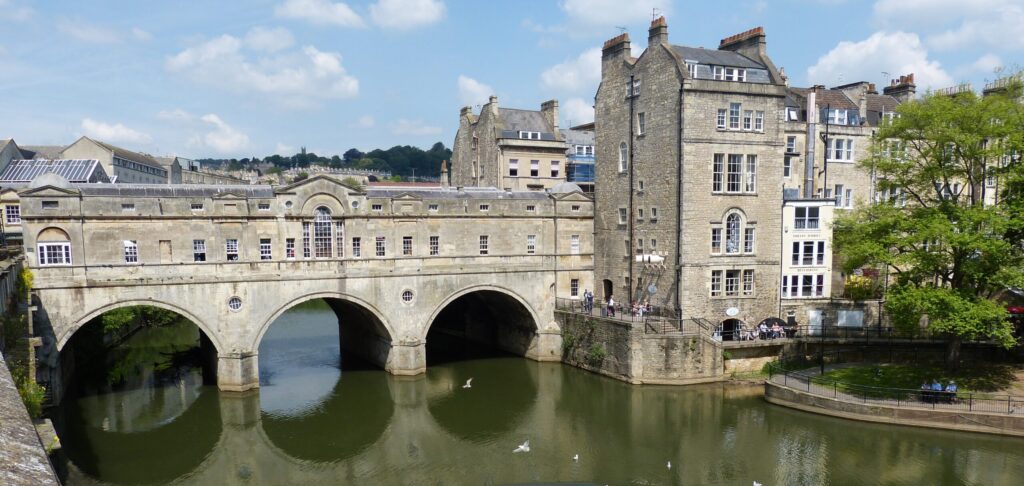
Other specific 18th-century architectural elements of Bath include the Assembly Rooms (1769-1771, designed by John Wood the Younger, containing the specific Great Ballroom, the Octagon Room, and the specific Tea Room where fashionable Georgian society gathered for balls, concerts, and social events — the specific Assembly Rooms are the setting for multiple scenes in Jane Austen’s Bath novels), the Pump Room (1789-1799, the specific building attached to the Roman baths where fashionable visitors would take the waters and socialise, containing a specific fountain of the spa waters that has been continuously operating since the building’s completion), Great Pulteney Street (1789, a specific 1,000-foot straight avenue of unified Georgian terraces leading from the Pulteney Bridge to the specific Sydney Gardens), and Pulteney Bridge (1774, designed by Robert Adam, a specific bridge with shops built into both sides — one of only four bridges anywhere in the world with buildings on both sides, the others being the Ponte Vecchio in Florence, the Rialto Bridge in Venice, and the Krämerbrücke in Erfurt, Germany).
The specific integrated architectural character of Bath — the specific Bath stone limestone (quarried locally at Combe Down and Odd Down), the specific Palladian classical language, the specific coherent urban planning across multiple districts, and the specific relationship to the Roman baths and the natural setting — is one of the most substantial 18th-century architectural achievements in Europe. Bath is one of the few European cities that was substantially transformed from a small medieval town into a coherent classical urban ensemble within a single 50-year period, and the specific quality of the transformation reflects the specific combination of individual architectural genius (the Wood family), specific commercial demand (the fashionable Georgian spa tourism industry), specific geological availability of appropriate building materials (Bath stone), and specific institutional coordination (the Bath Corporation, Beau Nash’s role as Master of Ceremonies).
The specific Jane Austen connections at Bath are worth substantive treatment. Jane Austen (1775-1817) lived in Bath from May 1801 to July 1806, following her family’s move from the Hampshire village of Steventon after her father Reverend George Austen’s retirement from clerical duties. The Austen family occupied several different residences during their Bath years — at 4 Sydney Place, then at 27 Green Park Buildings after Reverend Austen’s death in January 1805, then at 25 Gay Street. Austen’s letters to her sister Cassandra (which are one of the most substantial documented sources for Austen’s own perspective on her life) suggest that she substantially disliked Bath during her residence there. Her specific criticisms centred on what she perceived as the superficiality of fashionable Bath society, the constraining nature of specific social conventions, and possibly her specific dislike of the family’s relative financial insecurity during the period. Two of her six novels are set substantially in Bath: Northanger Abbey (drafted in the late 1790s and revised during her Bath residence, published posthumously in 1818) and Persuasion (drafted 1815-1816, published posthumously in 1818). The specific Bath locations that appear in Austen’s novels are still substantially preserved and can be walked today. Catherine Morland and Henry Tilney meet at the Assembly Rooms in Northanger Abbey. Anne Elliot in Persuasion walks specific streets that are still identifiable — Milsom Street, the Royal Crescent, the Pump Room, the specific Bath abbey and its immediate surroundings.
The Jane Austen Centre (opened 1999 at 40 Gay Street, near one of the specific Austen family residences) is a small museum specifically dedicated to Austen’s Bath connections. The specific annual Jane Austen Festival (established 2001, held every September) attracts substantial international visitor traffic. The specific Regency Ball at the Assembly Rooms (an annual event since 2011, where visitors wear specific Regency-era costume) provides substantial engagement for Austen readers. The specific literary heritage tourism represents a substantial portion of contemporary Bath’s international visitor economy, and the specific American, Japanese, and European Austen enthusiasts substantially drive the specific Austen tourism sector.
Beyond the Roman baths, the Georgian architecture, and the Austen connections, contemporary Bath preserves substantial additional specific character. The specific Thermae Bath Spa (opened 2006) provides modern access to the specific Bath thermal waters through contemporary spa facilities — the specific rooftop pool with views over the Georgian city has become one of the specific memorable modern Bath experiences. The specific Sally Lunn’s Historic Eating House (in a building dating to 1482, occupying what is claimed to be the oldest house in Bath, serving the specific “Sally Lunn bun” — a specific brioche-like sweet bread with medieval origins that has been served substantially unchanged for approximately 400 years). The specific Bath farmers’ market (established 1997, held monthly at Green Park Station, one of the earliest revived UK farmers’ markets and one of the more substantial regional food markets). The specific University of Bath (established 1966) and Bath Spa University (established as a college in 1946, university status 2005) provide substantial educational infrastructure. The specific creative sector — small design studios, publishing houses, digital media companies — has developed substantially in Bath particularly since 2000. The specific technology sector (with specific concentrations around software development and specific medical technology) has also developed. The specific Bath rugby club (established 1865, one of the most substantial UK rugby institutions) provides substantial specific sporting culture.
This is the deeper character of Bath, and the article proposes to close on it. The city is the only city in Britain built around natural hot springs, and one of only 11 European cities inscribed under the specific “Great Spa Towns of Europe” UNESCO designation. The Romans built one of the most complete Roman bath complexes anywhere in Northern Europe around the specific hot springs approximately 1,950 years ago, and the specific Roman engineering and religious infrastructure has been substantially preserved through 1,600 years and is now the centrepiece of one of the most-visited archaeological complexes in Britain. The specific medieval Christian religious infrastructure — the Saxon minster (established 675 AD), the site of Edgar’s coronation as King of the English (973 AD), and the Late Medieval Bath Abbey (rebuilt 1499-1616) — represents specific continuities of religious and civic function at the site. The specific 18th-century Georgian redevelopment, directed by John Wood the Elder and Younger between 1720s and 1770s, produced one of the most systematically planned classical urban districts anywhere in Europe — the Circus, the Royal Crescent, Queen Square, the Assembly Rooms, the Pump Room — funded by the specific 18th-century fashionable spa tourism industry that had developed around the same hot springs the Romans had built around 1,700 years earlier. Jane Austen lived in Bath from 1801 to 1806 and set two of her novels substantially in the city, providing one of the most substantial UK literary connections to a specific European city. The contemporary Bath continues the specific spa tradition through the Thermae Bath Spa (opened 2006), maintains the specific Georgian architectural inheritance through substantial preservation and continuing residential and commercial use, and functions as a substantial UK tourism destination, educational centre, and creative and technology sector employer. The specific hot springs — the geological anomaly that made all of this possible — continue to produce approximately 1.17 million litres of thermal water per day at 46°C, from water that fell as rain approximately 10,000 years ago. The specific continuity is one of the most remarkable in European urban history — a specific city that has existed on this specific site because of this specific geological anomaly for approximately 2,000 years, and that continues to exist for the specific same reason today.
Some cities exist because of specific historical circumstances that have long ceased to be relevant. This one exists because of specific geological circumstances — the specific hot springs of Sulis Minerva — that have not changed in ten thousand years, and that will presumably not change for another ten thousand. Everything visible in modern Bath — the specific Roman baths, the specific medieval abbey, the specific Georgian planned district — was built around the specific water that is still flowing today, and that will still be flowing when this specific city, whatever specific form it takes, celebrates its four-thousandth continuous year of urban settlement at the springs of Sulis Minerva.
Nine regions. One hundred and twenty destinations. Three hundred and one weeks remaining.
The journey continues north. The next stop is Scotland’s historic capital — a city built on volcanic bedrock, split between an ancient royal fortress on a rock and an 18th-century planned New Town that was the specific site of one of the most substantial Enlightenment intellectual centres in Europe.
Where are you going?

Beyondia
Trusted Travel CompanionReal digital nomad. I travel. I learn. I grow.
What about you? Where are you going?