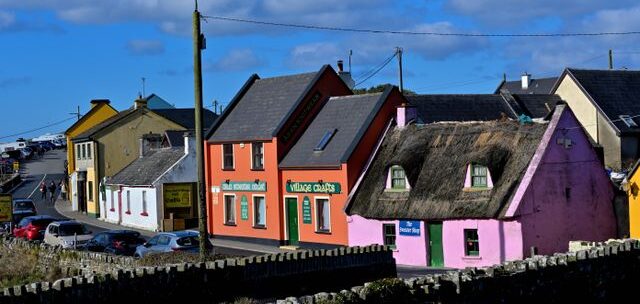
🌐 Around the World with Beyondia 🧵 Nordic & Western Europe Region 🪡 Episode 62: Doolin
Doolin is a small village on the Atlantic coast of County Clare in the west of Ireland, with approximately 800 permanent residents distributed across a specific 3-kilometre stretch of coastal road from Fisher Street through Roadford through Doolin proper. The village sits at the specific geological intersection of the Burren limestone landscape (extending inland to the east) and the North Atlantic (immediately to the west), with the Cliffs of Moher rising approximately 8 kilometres to the south and the Aran Islands visible on clear days approximately 10-30 kilometres offshore in Galway Bay. Doolin has been continuously inhabited as a small fishing and farming settlement for at least the past 400 years, with earlier archaeological evidence suggesting substantial prehistoric occupation of the surrounding Burren region. The specific character of the modern village — the specific music, the specific pubs, the specific position as a gateway to the substantial regional natural attractions — developed substantially during the second half of the 20th century, and it is the specific music that has substantially defined Doolin’s international reputation.
Doolin – The Specific Vocal Traditions
The specific character of Irish traditional music as a cultural practice is worth naming carefully, because most foreign readers carry it partially and with substantial misconceptions. Irish traditional music is a specific vernacular musical tradition with substantial pre-colonial roots — the specific harp tradition documented from at least the 11th century, the specific vocal traditions of sean-nós (old-style unaccompanied singing) documented substantially through medieval sources, and the specific instrumental traditions that developed substantially through the 17th-19th centuries. The specific instrumental repertoire that most people carry as “Irish traditional music” — the specific jigs (dance tunes in 6/8 time), reels (in 4/4 time), hornpipes (in 4/4 with distinctive dotted rhythm), slow airs, polkas, and other specific tune types — was substantially codified through the 18th and 19th centuries and preserved through specific rural western Irish communities during the period of substantial cultural pressure toward Anglicisation. The specific instruments most associated with the tradition — the uilleann pipes (the specific Irish bellows-blown bagpipes, substantially different from the Scottish Highland pipes, developed substantially through the 18th century), the fiddle (the standard European violin adapted for specific traditional playing techniques), the tin whistle (a specific simple flute), the flute (particularly the specific wooden simple-system flute), the bodhrán (a specific frame drum played with a wooden beater), the concertina (particularly the specific Anglo concertina), the button accordion, and the harp — provide the specific instrumental voice of the tradition.
The specific historical circumstances of Irish traditional music preservation are worth substantive treatment because the popular narrative is partially inaccurate. Contrary to common accounts, Irish traditional music was not formally banned by English legislation during the colonial period. What actually happened was more nuanced and, in some ways, more damaging: specific school-language policy after the 1830s (the specific “national school” system that operated substantially in English and discouraged Irish Gaelic language use), specific religious institutional discouragement (specific Catholic Church attitudes that in various periods discouraged specific forms of traditional dance and music as morally suspect), specific social pressure toward Anglicisation among the emerging Catholic middle classes, and — most damaging — the specific demographic collapse of the Irish-speaking western regions during and after the Great Famine (as treated in the Dublin Ep 61 article). The specific transmission of the traditional musical repertoire depended substantially on specific families passing tunes from generation to generation in specific rural communities, and the Famine catastrophe substantially disrupted this transmission in the specific western Irish-speaking regions where the tradition was strongest. The specific consequence was that Irish traditional music, while never formally banned, was substantially damaged by 1900, and specific tune traditions were lost or preserved only in the memories of specific elderly musicians in specific remote rural areas.
The 20th-century revival of Irish traditional music is one of the more substantial cases of deliberate cultural preservation and recovery in modern European history. The specific revival operated through several substantial mechanisms. The specific Irish nationalist movement of the late 19th and early 20th centuries (including the specific Gaelic League, founded 1893, and its specific work on Irish language and cultural revival) placed substantial emphasis on traditional music as a specific expression of Irish national identity. The specific establishment of the Radio Éireann broadcasting service (from 1926 onwards) provided a specific national platform for traditional musicians. The specific Comhaltas Ceoltóirí Éireann (Association of Musicians of Ireland, founded 1951) established a specific national organisational structure for preserving, teaching, and promoting the tradition, with specific competitive festivals (fleadhanna cheoil), specific classes, and specific documentation efforts. The specific commercial revival of the 1960s and 1970s — driven substantially by specific artists including The Chieftains (formed 1962), The Dubliners (formed 1962), The Clancy Brothers, Planxty (formed 1972), and others — brought the tradition to substantial international commercial audiences.
Doolin Emerging as Center of Traditional Music Revival
Doolin’s specific role in this revival was disproportionate to its scale. During the 1960s and 1970s, Doolin emerged as one of the specific national and international centres of the traditional music revival, driven substantially by specific local musicians who had been substantially preserving the tradition through the difficult mid-20th century period. The specific Russell brothers — Gussie Russell (1904-1988), Micho Russell (1915-1994), and Pakie Russell (1920-1977) — were substantially central figures. All three brothers were traditional musicians who had learned the specific Doolin tradition from their specific father Austin Russell and other specific local musicians during the specific difficult period when much traditional music was substantially suppressed by Anglicisation pressure. Micho Russell in particular became one of the more consequential single traditional musicians of the 20th century — his specific tin whistle and vocal traditions were substantially documented through recordings from the 1970s onwards, his specific tunes and songs became part of the standard traditional repertoire internationally, and his specific personal generosity in teaching and sharing the tradition with visiting musicians made Doolin a substantial international destination. Micho Russell’s death in 1994 marked the specific end of the immediate generational continuity, but the specific tradition he had substantially preserved has continued through subsequent generations of Doolin musicians.
The specific pubs at Doolin — Gus O’Connor’s Pub, McGann’s Pub, and McDermott’s Pub — have been continuously hosting traditional music sessions for approximately 50-60 years, with substantial specific continuity. Gus O’Connor’s Pub (established as a public house in 1832, with the specific Gus O’Connor’s ownership from approximately 1961) is the largest and most internationally famous of the three, hosting nightly music sessions substantially year-round with specific rotating groups of local and visiting musicians. McGann’s Pub (family-owned by the specific McGann family for approximately 80 years, with the specific pub identity substantially since the 1970s) hosts substantially similar nightly sessions with a slightly different specific musical character. McDermott’s Pub (the smallest of the three, family-owned by the specific McDermott family) provides the specific most-local of the three pubs’ sessions, with a slightly higher proportion of specific local musicians and lower proportion of specific visiting musicians. The specific character of a Doolin seisiún — the specific pattern of open musical sessions where musicians play together without formal performance structure, where any competent musician can join with their instrument, where the specific tune selection is negotiated informally through musical convention and personal knowledge of the tradition, and where the audience is substantially fellow musicians and specific listeners rather than commercial concert audiences — represents one of the more substantial preserved forms of pre-professional European vernacular musical culture.
The specific seisiún culture at Doolin is worth substantive description because it differs substantially from the specific commercial concert format that most foreign readers might expect. A traditional seisiún typically operates as follows: a specific musician or small group of musicians begins playing a specific tune, additional musicians join by ear (playing the same tune once they recognise it), the tune is played through multiple repetitions with specific variations and ornamentation, and then the group moves to a related tune (typically another jig follows the first jig, another reel follows the first reel, following specific structural conventions of tune-set selection). There is no specific applause between tunes within a set, though there is typically applause at the end of a full set. Musicians and listeners drink together — the specific pub context is substantial, and the specific hospitality of the seisiún extends from the music to the drinking and conversation. Specific tunes are named and requested through specific tune-naming conventions (many tunes have multiple names, and the specific tradition of tune-naming involves substantial local variation). Visiting musicians are welcomed if they can play the tradition substantially; visiting musicians who cannot play the tradition substantially but attempt to join are typically politely tolerated for a limited period and then gradually excluded through the specific social dynamics of the session. The specific cultural competency required to participate substantially in a Doolin seisiún is substantial, and represents one of the specific reasons that the tradition has been preserved as living practice rather than commercial performance.
The Three Doolin Pubs
The three Doolin pubs typically host multiple sessions per night during the substantial tourism season (approximately May through October), and continue substantial session activity through the winter with somewhat reduced frequency. The specific musicians at contemporary Doolin sessions include specific local Doolin musicians (multiple generations of specific local families), specific musicians from the broader County Clare region (including musicians from Ennis, Ennistymon, and other nearby towns), specific musicians from other parts of Ireland who have relocated to the region substantially for the music (a specific migration pattern that has substantially reshaped Doolin’s demographic character over the past 50 years), and specific visiting musicians from Ireland and internationally who come to Doolin substantially for the music. The specific American, German, French, and Japanese visiting musician communities are substantial — American musicians in particular have been substantially engaged with Doolin since the 1970s revival, with specific American musicians relocating to Doolin for extended periods to learn the tradition directly from specific local musicians.
Doolin’s specific geographical position produces the second dimension of the article’s substantive treatment. The village sits at the specific intersection of three of Ireland’s most substantial natural and cultural landmarks — the Cliffs of Moher, the Burren, and the Aran Islands.
The Cliffs of Moher extend southward from immediately south of Doolin’s harbour, running approximately 14 kilometres along the Atlantic coast to Hag’s Head. The cliffs rise to a maximum height of 214 metres at Knockardakin (approximately 6 kilometres south of Doolin), with the specific O’Brien’s Tower — a 19th-century observation tower built by the local landlord Cornelius O’Brien in 1835 — sitting at approximately the highest point. The specific geology of the cliffs — layers of Namurian shale, siltstone, and sandstone laid down between approximately 320 and 300 million years ago during the specific Carboniferous period, when the region was substantially covered by shallow tropical seas at what was then the specific southern edge of the ancient landmass — produces the specific horizontal banded appearance of the cliff face and the specific mineral content that gives the cliffs their specific colouration. The specific Atlantic exposure — the cliffs face directly into the specific North Atlantic prevailing westerly winds and swells, with waves during specific winter storms substantially reaching heights of 15-20 metres against the cliff base — produces the specific dramatic character. The Cliffs of Moher were designated a UNESCO Global Geopark in 2011 (as part of the broader Burren and Cliffs of Moher Global Geopark), receive approximately 1.6 million visitors per year, and are one of the most substantial single natural attractions in Ireland. The specific Doolin approach to the cliffs — via the specific Doolin Cliff Walk, a 7-kilometre coastal path from Doolin to the main Cliffs of Moher visitor centre — provides one of the specific substantive walking experiences on the Wild Atlantic Way, offering substantially less crowded access than the specific main visitor centre approach.
The Burren — the specific karst limestone landscape extending inland from Doolin across approximately 250 square kilometres of northern County Clare — is one of the more substantial European limestone pavement landscapes. The specific karst geology — produced by rainwater slowly dissolving the specific limestone bedrock across approximately 350 million years — produces the specific characteristic landscape of exposed grey limestone pavement, specific vertical fissures (grikes), specific horizontal slabs (clints), specific underground drainage systems, specific dry valleys, and specific turloughs (seasonal lakes that appear and disappear with the water table). The specific ecology of the Burren — one of the more remarkable in Europe — combines Arctic-alpine plant species that survive in the specific micro-climates of the limestone fissures with Mediterranean species that thrive in the specific warm-summer conditions of the limestone pavements. Specific plants growing together in the Burren include Arctic-alpine species (mountain avens, spring gentian, blue moor grass, hoary rock-rose) and Mediterranean species (dense-flowered orchid, maidenhair fern, thyme). The specific archaeological concentration of the Burren is genuinely remarkable — over 90 megalithic tombs including the famous Poulnabrone dolmen (a portal tomb dated to approximately 5,800 years ago, one of the most photographed prehistoric monuments in Ireland), over 500 ring forts (specific circular defensive enclosures dating substantially to the Iron Age and early medieval period), over 60 wedge tombs, extensive medieval church ruins (including the specific 12th-century Corcomroe Abbey), and substantial evidence of continuous occupation from approximately 6,000 years ago to the present.
The Aran Islands — three limestone islands (Inis Mór, Inis Meáin, Inis Oírr, together forming an extension of the Burren limestone formation) in Galway Bay approximately 10-30 kilometres offshore from Doolin — are accessed substantially through Doolin’s harbour (with the alternative embarkation point at Rossaveal in County Galway). The islands are one of the most substantially preserved Irish Gaelic-speaking communities in Ireland — the specific islands are among the few remaining Gaeltacht regions where Irish Gaelic remains the primary vernacular language for a majority of residents, particularly on Inis Meáin (population approximately 160) and Inis Oírr (population approximately 260). Inis Mór (population approximately 800) is the largest and most tourism-developed of the three. The islands contain substantial prehistoric monuments including Dún Aonghasa (an Iron Age semi-circular cliff-top stone fort on Inis Mór dating substantially to approximately 1100 BC, one of the most dramatic prehistoric monuments in Europe with the specific fort’s inner enclosure walls extending directly to the edge of the specific 100-metre Atlantic cliff), Dún Chonchúir (another substantial stone fort on Inis Meáin), and multiple early Christian monastic ruins. The specific Aran Islands cultural character — the specific Irish Gaelic language, the specific traditional dress (particularly the specific Aran sweater tradition, though the specific “Aran sweater” as commercial product substantially developed in the 1930s onwards rather than being the specific ancient tradition sometimes claimed), the specific traditional currach fishing boats, and the specific community continuity — has been substantially documented in specific literature including J.M. Synge’s The Aran Islands (1907), Robert Flaherty’s ethnographic film Man of Aran (1934), and Tim Robinson’s substantial multi-volume literary geography Stones of Aran (1986-1995). The specific Doolin-Aran Islands ferry provides substantial specific access, with services operating approximately April through October, with ferry crossings of approximately 30 minutes to Inis Oírr, approximately 60 minutes to Inis Meáin, and approximately 90 minutes to Inis Mór.
The contemporary Doolin combines the specific living traditional music culture with substantial international tourism traffic. Approximately 250,000 visitors per year pass through Doolin, most of them accessing the Cliffs of Moher and Aran Islands with Doolin as the specific base for one or two nights. The specific Doolin tourism economy — the specific accommodation providers (approximately 30 substantial B&Bs and small hotels, plus specific rental properties), the specific pubs and restaurants, the specific ferry operators (Doolin Ferries and O’Brien Line Ferries providing the substantial Aran Islands services), the specific cliff walk and tour operators, and the specific music-related businesses — supports the specific local economy substantially. The specific ongoing negotiation between preservation of the specific local character and accommodation of substantial external commercial demand is one of the specific tensions of contemporary Doolin. The specific housing pressure — substantial numbers of Doolin properties have been substantially converted to short-term tourism rental (particularly Airbnb-style operations), producing specific reductions in permanent-resident housing availability — is one of the specific contemporary tensions. The specific music sessions remain substantially oriented toward traditional practice rather than commercial performance, but the specific tourism intensity produces specific pressures on the specific seisiún culture that the older Doolin musicians have substantially navigated across recent decades. The specific consequence is that contemporary Doolin combines the substantial preserved traditional music culture, the substantial natural landscape access, and the substantial contemporary tourism industry in a specific complex balance that shifts substantially by season, day of week, and specific external circumstances.
This is the deeper character of Doolin, and the article proposes to close on it. The village is a small coastal settlement of approximately 800 permanent residents on the Atlantic coast of County Clare, at the specific geological intersection of the Burren limestone landscape, the Cliffs of Moher, and the Aran Islands. It is one of the most substantially preserved living traditional Irish music villages in Ireland, with three specific pubs (Gus O’Connor’s, McGann’s, and McDermott’s) continuously hosting seisiúns for approximately 50-60 years, and with a specific tradition substantially preserved by specific local families through the 20th century when much Irish traditional culture was substantially damaged elsewhere on the island. The specific Russell brothers — particularly Micho Russell — were substantially central to the Doolin music scene, and the specific music tradition they preserved has been continuously transmitted through subsequent generations. The village provides substantial access to some of Ireland’s most substantial natural attractions — the 214-metre Cliffs of Moher (approximately 1.6 million visitors per year, UNESCO Global Geopark since 2011), the specific karst limestone Burren landscape (approximately 250 square kilometres, one of the more substantial European limestone pavements, with approximately 90 megalithic tombs and substantial ecological distinction), and the Aran Islands (specific Irish Gaelic-speaking Gaeltacht communities, substantial prehistoric monuments including Dún Aonghasa). The contemporary Doolin combines the substantial traditional music culture with substantial international tourism (approximately 250,000 visitors per year), producing the specific ongoing negotiation of preservation versus commercial demand. But underneath the substantial tourism traffic, the specific music continues — in three specific pubs, night after night, session after session — as it has continued for approximately 50-60 years and as it will continue for as long as specific musicians are willing to play together on the Atlantic coast of County Clare for the specific pleasure of playing and the specific pleasure of listeners who understand what they are hearing.
Some villages preserve their historical identity in specific museums and specific monuments. This one preserves it in specific continuous musical practice, in three specific pubs, played by specific musicians whose specific grandparents played the same tunes in the same pubs when the tourism industry that now surrounds them did not yet exist. The music is not a heritage performance. The music is what specifically happens in Doolin, most nights, most weeks of the year, because specific musicians want to play it and specific listeners want to hear it. And that specific continuity — small, unglamorous, dependent on specific personal commitments across specific generations — is one of the specific ways that a culture actually survives.
Nine regions. One hundred and twenty destinations. Two hundred and ninety-nine weeks remaining.
The journey continues north across Galway Bay. The next stop is Ireland’s substantial western city — a specific university town on Galway Bay, the specific gateway to the Connemara Gaeltacht, home to the substantial specific Galway International Arts Festival, and one of the most substantially Irish Gaelic-speaking cities in Ireland.
Where are you going?

Beyondia
Trusted Travel CompanionReal digital nomad. I travel. I learn. I grow.
What about you? Where are you going?