GoBeyondia Atlas 🗺️ Middle-East Silk-Road 🗾
Bahrain: Where the Sumerians sent their hero Gilgamesh to find the secret of eternal life and he found a pearl instead, eleven thousand burial mounds prove that everyone who lived in the Land of the Living still died, a single tree has survived four hundred years in a desert with no visible water, and freshwater springs bubble up through the floor of a salt sea — because Bahrain has always been the place where what you came looking for is not what you find.
Bahrain in 30 Seconds
An archipelago of eighty-four islands in the Persian Gulf, ninety-two percent desert, smaller than most cities — and the site of one of the oldest trading civilizations on earth. Four thousand years ago, this was Dilmun, the hub between Sumer and the Indus Valley, where copper, timber, pearls, and dates flowed in every direction. In the Epic of Gilgamesh — the world’s oldest written story — the hero travels to Dilmun seeking immortality and is told to dive to the sea floor with stones tied to his feet to retrieve the flower of eternal life, which turns out to be a pearl. Bahraini divers did exactly this for millennia, plunging with rocks to harvest pearls that financed the island’s wealth — a UNESCO-inscribed pearling heritage that sustained the economy until Japanese cultured pearls killed the industry in the 1930s. Across the island, 11,774 burial mounds built between 2200 and 1750 BC form one of the largest ancient cemeteries on earth — graves for every level of Dilmun society, from commoners in simple chambers to kings in two-storey sepulchral towers, proof that the civilization called the Land of the Living buried its dead with more care than most cultures house their living. And in the southern desert, the Tree of Life — a solitary mesquite over four hundred years old — stands on a hill with no other vegetation for kilometers, green and thriving with no visible water, its roots reaching into aquifers that nobody can see, because Bahrain has always survived on what is hidden beneath.
Evoke — Why You Visit Bahrain
You come to Bahrain because you have been searching for something — the breakthrough, the answer, the thing that will make the work feel complete — and you need a country that shows you what happens when the oldest story ever written sends its hero on the same quest and he comes back with something entirely different. Gilgamesh went to Dilmun for immortality. He found a pearl. The pearl was stolen by a snake. He went home mortal. The Sumerians could have written a story where the hero wins. Instead they wrote one where the hero fails at the thing he wanted and discovers something beautiful on the way down. That is Bahrain’s origin story — not victory but redirection. The divers who tied stones to their feet and dropped into the Gulf were not looking for meaning. They were looking for income. But the pearls they brought up became the most valued gems in the ancient world, not because they were rare but because each one required a human being to stop breathing and sink into darkness. You come because you have been diving for one thing and surfacing with another, and you have been calling it failure. Bahrain will show you it is the oldest pattern in civilization.
Explore — How You Experience Bahrain
Visit Qal’at al-Bahrain, the fort built on layers of civilization stretching back four thousand years — Dilmun trading port at the bottom, Kassite Babylonian administration above it, Greek and Islamic periods layered higher, Portuguese fortress on top — an archaeological site where you can literally see time stacked in cross-section, each empire building on the bones of the last without knowing what was underneath. Walk the Pearling Path in Muharraq, the UNESCO trail through the houses where pearl merchants lived, the workshops where pearls were sorted by size and luster, and the shoreline from which divers launched — men who worked a season knowing that each descent might be their last, that the oyster might be empty, that the wealth of their family depended on holding their breath longer than their body wanted them to. Stand among the Dilmun burial mounds in A’ali, where royal tombs two storeys tall sit beside commoners’ graves in a necropolis so vast it rewrites the assumption that ancient cultures reserved elaborate burial for elites — Dilmun buried everyone, because in the Land of the Living, everyone’s death mattered equally. Drive south to the Tree of Life and stand beside a mesquite that was planted around 1583 and has not stopped growing, its canopy green in temperatures that reach forty-nine degrees, surrounded by nothing but sand and oil pumps, surviving on aquifers so deep and so hidden that scientists needed decades to confirm they existed — because the tree knew before anyone else that the water was there.
Evolve — Who You Become in Bahrain
You leave Bahrain understanding that the search and the finding are rarely the same thing — and that the finding is usually better. Gilgamesh wanted to live forever and instead discovered the pearl. The pearl divers wanted to earn a living and instead built a civilization. The Dilmun traders wanted profit and instead created the crossroads of the ancient world. The Tree of Life wanted water and found it where nobody was looking. You come home and look at the project that did not deliver what you planned, the career that veered from the path you set, the life that became something other than the blueprint — and you stop calling it a detour. Bahrain was called the Land of the Living by people who buried eleven thousand of their dead there with more devotion than they gave their homes. The hero dove for immortality and surfaced with a gem. The tree reached for water nobody could see and has been green for four centuries. What you are looking for may not be what you find. But what you find may be the reason you were searching.
Your practical guide to Bahrain starts bellow 👇
🕰️ Bahrain Historical Backdrop
Bahrain’s history is a 5,000-year “Strategic Market Entry.” Known in antiquity as Dilmun, it served as the primary logistics hub between the Indus Valley and Mesopotamia. This was the “Initial Public Offering” of Gulf trade. Its story is told in the thousands of burial mounds that ripple across the landscape, the Portuguese-built battlements of the Bahrain Fort, and the 1932 discovery of oil—the first in the region. Bahrain has always functioned as a “Cultural Clearing House”; it is an archipelago that has mastered the art of openness. Today, it stands as a leading financial hub that has audited its past to fund a visionary future, preserving its status as a “Cultural Fortress” where ancient pearl-diving traditions remain a non-negotiable part of the national identity.
🌟 Bahrain Local Experiences
Beyond the glitzy malls, discover Bahrain’s soul in the ritual of the “Souq Audit”—navigating the narrow alleys of Bab Al Bahrain where the scent of saffron, frankincense, and gold filigree creates a sensory “Due Diligence” of the senses. Experience the profound “Acoustic Stillness” of a sunrise at the Tree of Life, the exhilarating “G-Force Shift” of a lap at the Bahrain International Circuit, or the simple joy of a traditional Bahraini breakfast of Balaleet and Shakshuka in a Muharraq courtyard. Whether it’s diving for your own natural pearls in the turquoise shallows or exploring the avant-garde art galleries of Adliya, these moments reveal a nation that finds its greatest wealth in the balance of tradition and momentum.
🌄 Bahrain Natural Wonders & Landscapes
- The Tree of Life (Shajarat-al-Hayat): A 400-year-old mesquite tree standing alone in the heart of the desert with no visible water source—a proven example of “Low-Maintenance Resilience.”
- The “Two Seas”: The unique phenomenon of freshwater springs bubbling up from the seabed amidst the salt water, which gave Bahrain its name (Two Seas).
- Al Areen Wildlife Park: A sanctuary for the Arabian Oryx and diverse desert flora, representing the nation’s environmental “Hedging Strategy.”
- Hawar Islands: An offshore archipelago and bird sanctuary, perfect for observing the world’s largest colony of Socotra cormorants.
- Jarada Island: A tidal sandbar that appears and disappears with the tides, offering a “Limited-Time Access” beach experience in the middle of the Gulf.
🏙️ Bahrain Must-See Cities & Regions
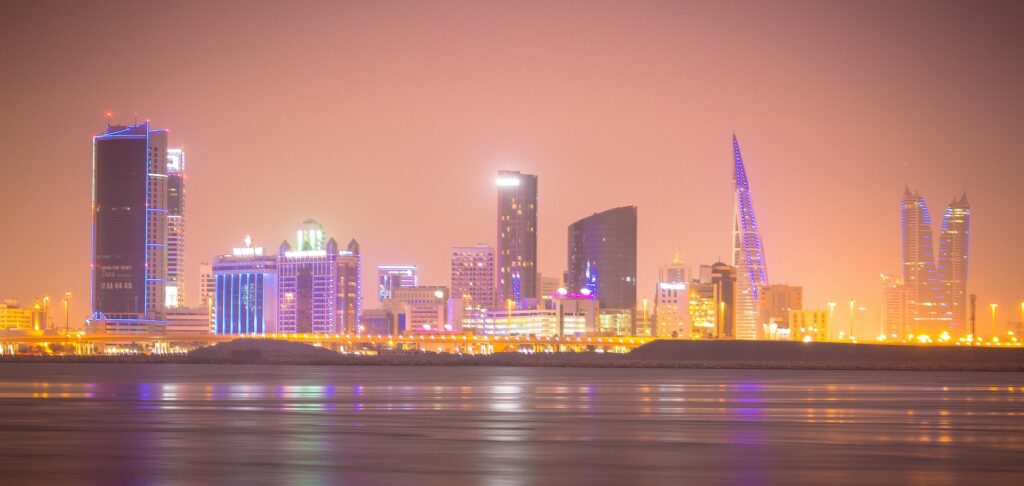
- Manama: (Capital) A sophisticated financial hub where the sleek towers of the Financial Harbour meet the historic Bab Al Bahrain. (Cosmopolitan, High-Energy, Diverse)
- Muharraq: The former capital and the country’s “Cultural Reserve,” home to the UNESCO Pearling Path and exquisitely restored traditional houses. (Authentic, Historic, Artistic)
- Adliya (Block 338): The “Art District,” a pedestrian-friendly neighborhood filled with high-margin culinary concepts and street art. (Trendy, Social, Gastronomic)
- Zallaq: Home to the pristine Al Jazayer beach and the high-tech Bahrain International Circuit. (Adventurous, Coastal, Modern)
- Riffa: A residential and historic stronghold, home to the impressive Riffa Fort overlooking the Haniniya Valley. (Noble, Traditional, Panoramic)
🏞️ Bahrain National Parks & Protected Areas
Managed with a focus on preserving island biodiversity by the Supreme Council for Environment.
- Tubli Bay: A critical mangrove ecosystem serving as a nursery for marine life and a stopover for migratory birds.
- Ras Sanad Mangrove Forest: A rare green lung offering kayaking through ancient saltwater forests.
🏛️ UNESCO World Heritage Sites
- Qal’at al-Bahrain – Ancient Harbour and Capital of Dilmun — A massive tell containing seven layers of civilization dating back to 2300 BC.
- Pearling, Testimony of an Island Economy — A 3.5km trail in Muharraq chronicling the era when Bahraini pearls dominated the global luxury market.
- Dilmun Burial Mounds — Thousands of tumuli that represent a unique record of early social complexity in the Bronze Age.
- For more information, visit the UNESCO Bahrain Portal.
🖼️ Bahrain Museums & Cultural Sites
- Bahrain National Museum: One of the best in the region, providing a comprehensive “Due Diligence” on 5,000 years of history.
- Beit Al Quran: A specialized museum housing rare Islamic manuscripts and the world’s smallest Quran.
- Al Khamis Mosque: Believed to be the first mosque built in Bahrain, dating back to the 7th century.
- Sheikh Isa bin Ali House: A masterpiece of Gulf Islamic architecture with intricate wind towers (Barjeels).
🎉 Bahrain Festivals & Celebrations
- Bahrain Grand Prix (F1): (March) The “Blue Chip” event of the sporting calendar, turning the island into a global high-frequency hub.
- Spring of Culture: (February/March) A nationwide “Cultural Reallocation” featuring international concerts, theatre, and workshops.
- National Day: (December 16-17) Celebrated with spectacular fireworks and parades across the island.
- Bahrain Food Festival: (Spring) Showcasing the nation’s high-margin culinary innovation and diverse food trucks.
🧽 How to Arrive
- ✈️ By Air
- Bahrain International Airport (BAH) is the primary hub, recently expanded with a state-of-the-art terminal.
- Note for Doha Residents: Direct flights (Gulf Air/Qatar Airways) make this a 45-minute tactical transit.
- 🚗 By Road
- The King Fahd Causeway connects Bahrain to Saudi Arabia (Khobar/Dammam). A 25km masterpiece of infrastructure.
- 🚢 By Water
- Occasional cruise calls at the Khalifa Bin Salman Port.
📶 Stay Connected
- SIM Cards: Major providers are Batelco (best coverage), Zain, and stc.
- Where to buy: Kiosks are 24/7 at the airport arrivals hall. Registration with a passport or GCC ID is mandatory.
- eSIM: Supported by all major providers and available via global platforms like Airalo.
- Digital Infrastructure: Bahrain has 100% 5G national coverage, reflecting its high-tech “Operational Bandwidth.”
🏨 Where to Stay
Bahrain offers a “Portfolio” of stays ranging from private island resorts to “Financial District” luxury.
- Four Seasons Hotel Bahrain Bay: An architectural Tier 1 asset situated on its own private island in the capital.
- The Merchant House: A boutique, art-filled “Core Asset” in the historic Bab Al Bahrain area.
- Jumeirah Gulf of Bahrain Resort & Spa: A luxury retreat on the pristine Zallaq coast.
- The Ritz-Carlton, Bahrain: A classic “Defensive Staple” offering world-class beach club facilities.
⛳ Unique Finds
- Natural Pearl Diving: Bahrain is one of the few places where you can legally dive for wild pearls and keep what you find—the ultimate “Resource Extraction” adventure.
- Gold City: Visit the specialized mall in Manama to see a massive “Vault” of 22k and 24k gold jewelry.
- Traditional Dhow Building: Visit the shipyards in Muharraq to see the construction of wooden vessels using techniques unchanged for centuries.
🤝 Bahrain Cultural Guidance
- Social Norms: Bahrain is the most liberal and socially diverse nation in the Gulf. However, respect for local customs (modest dress in religious sites) is a “Health Benchmark” for travelers.
- The “Two-Sided” Conversation: Bahrainis are highly educated and enjoy open, intellectual debate.
- Alcohol: Widely available in licensed hotels and restaurants in Adliya and Manama.
- Basic Phrases:
- Hello: “Salam” / “Hala”
- Thank you: “Shukran”
- How are you?: “Chifak?” (to male) / “Chifich?” (to female)
- Everything is good: “Zain” / “Tamam”
🛂 Bahrain Entry & Visa Requirements
- E-Visa: Most nationalities (and GCC residents) can apply via the efficient Bahrain e-Visa Portal.
- Visa on Arrival: Available for many citizens (including UK, US, EU, and GCC residents).
- Official Source: Consult the Bahrain Nationality, Passports & Residence Affairs (NPRA).
💰 Practical Essentials
- Currency: Bahraini Dinar (BHD). One of the world’s highest-valued currencies. It is pegged to the USD (1 BHD ≈ 2.65 USD).
- Electricity: Type G (Three rectangular pins—same as UK and Qatar). Voltage is 230V.
- Safety: Consistently ranked as one of the safest and most expat-friendly countries in the world.
- Climate: Best visited from November to March (Mild, pleasant “Defensive Period”) to avoid the high-volatility heat of summer.
✨ Bonus Tip: The Pearl Narrative
To truly embrace Bahrain, you must understand the “Pearl Audit.” Unlike cultured pearls, Bahraini pearls are 100% natural, formed by a “deviation from the norm” inside an oyster. This is the perfect analogy for the country: it is a small, natural gem that has maintained its “Fundamental Quality” despite being surrounded by massive regional shifts. Don’t just stay in the malls; walk the Pearling Path in Muharraq. It is in the transition from the high-margin skyscrapers to the humble, stone-built houses of the pearl merchants that the true, transformative spirit of Bahrain reveals itself.
🔗 Featured Links
- Official Tourism: Visit Bahrain.
- Cultural Authority: Bahrain Authority for Culture & Antiquities.

Beyondia
Trusted Travel CompanionReal digital nomad. I travel. I learn. I grow.
What about you? Where are you going?