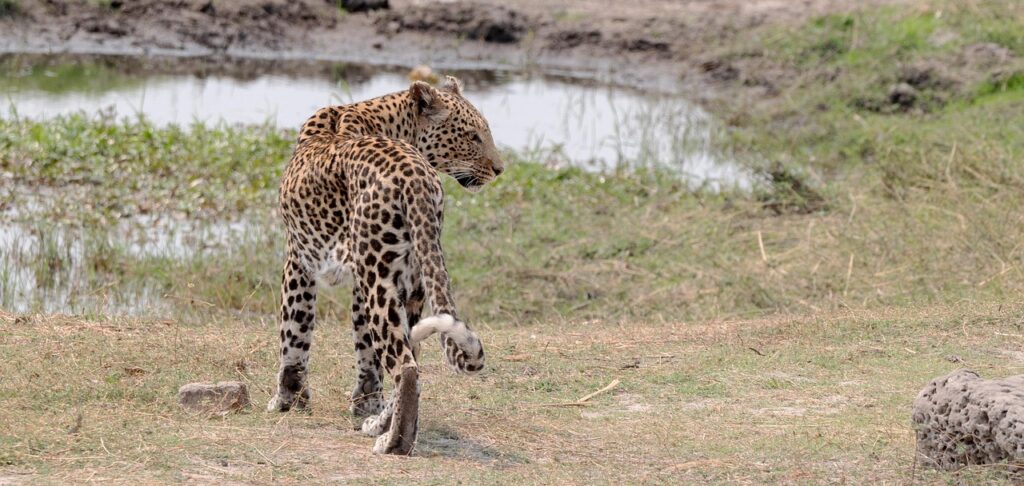
Botswana: Where the inland delta floods the desert and sixty thousand elephants move through wilderness that chose to stay wild.
Botswana in 30 seconds
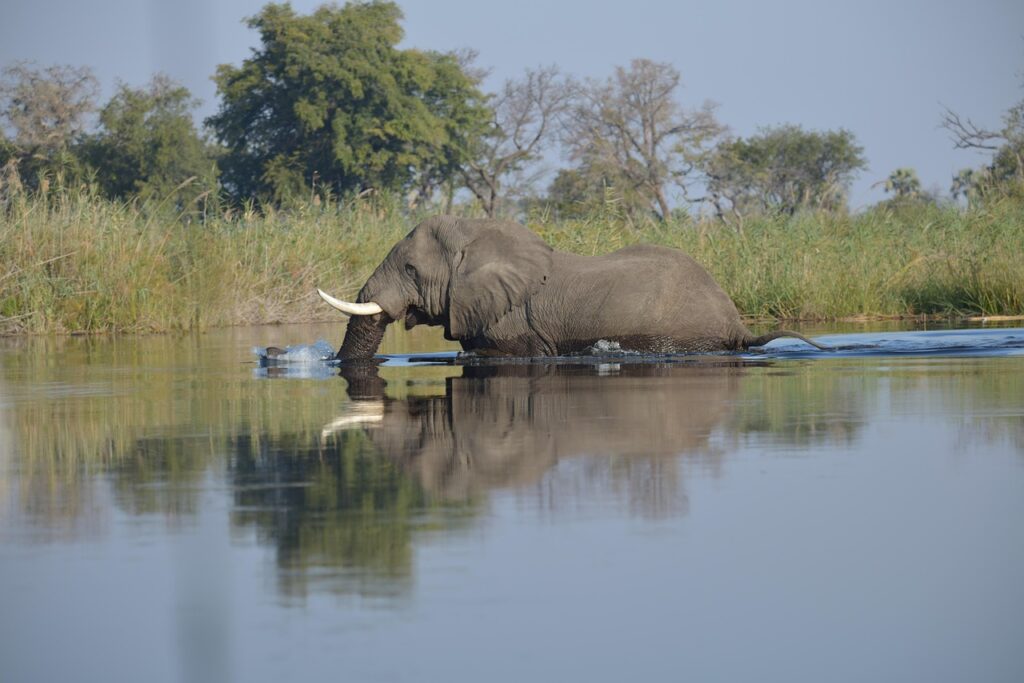
A country that discovered diamonds in 1967, three years after independence, and instead of descending into the resource curse that consumed its neighbors, built schools, hospitals, wildlife corridors, and one of Africa’s most stable democracies — then protected forty percent of its territory as national parks and reserves and decided that wilderness would be its defining export. The Okavango Delta is the world’s largest inland delta — a river that flows from Angola’s highlands into the Kalahari Desert and stops, spreading across 15,000 square kilometers of channels, islands, and floodplains that sustain one of Africa’s last intact large mammal ecosystems. Chobe National Park in the north has the highest concentration of elephants on earth — sixty thousand individuals moving through riverine forest with a confidence that comes from living in a country that decided they were more valuable alive than dead and built policy around that decision. The Central Kalahari Game Reserve is twice the size of Denmark and one of Africa’s last true wildernesses — ancient San Bushmen rock art, brown hyenas, black-maned Kalahari lions hunting in a desert that isn’t quite a desert. Botswana chose quality over quantity in tourism, high-cost low-volume, which means its wilderness encounters are among the least crowded and most genuine on the continent.
Evoke – Why You Visit Botswana
You come to Botswana because Africa is not a country and you’ve finally stopped treating it like one. You’ve been to the popular circuits and they were extraordinary and crowded and you want the version of this continent that requires more intention to reach. Botswana requires intention — the flights connect awkwardly, the lodges are expensive, the wilderness doesn’t accommodate shortcuts — and all of that friction is the filter that means when you arrive you are surrounded by people who came specifically for the place rather than the photograph. You need to be somewhere that made good decisions and shows it. Botswana is a functioning argument that governance matters, that conservation works when it’s funded properly, that the wild world can persist if a country decides it will. You need that argument right now. You need to stand in the Okavango at dawn in a mokoro canoe pushed silently through papyrus by a poler who knows this waterway the way you know your own street and understand that some things were worth protecting. Botswana protected them. You came to witness what that looks like.
Explore – How You Experience Botswana
Drift through the Okavango’s channels at dawn in a mokoro — a traditional dugout canoe — in a silence broken only by the cry of a fish eagle and the sound of your guide’s pole finding the bottom, the papyrus so tall on both sides that the waterway becomes a private corridor through a world operating entirely without you until a hippo surfaces three meters ahead and your guide reverses with a calm that communicates this has happened before. Drive into Chobe National Park at the dry season when the elephants concentrate at the river in herds so large they create their own dust, the young ones stumbling at the water’s edge while matriarchs organize the crossing with a management efficiency that makes corporate org charts seem aspirational. Fly into the Central Kalahari — the only way in — and track Kalahari lions across ancient sand river beds with a guide who reads pawprints the way you read text, finding in the compressed sand a direction, a pace, a mood, an intention. Sleep in a camp where the only barrier between your bed and the bush is canvas and the sounds at 3am — hyena calls, the distant crash of an elephant through brush — are not alarming but orienting, placing you correctly inside a food chain you’ve spent your whole life outside of. Sit with a San elder in the Kalahari and watch him start a fire using two sticks and dry grass in under four minutes — a technology sixty thousand years old, more reliable than anything requiring batteries — and understand that knowledge systems the modern world is only beginning to study have been operating continuously in this landscape since before recorded history began anywhere else on earth.
Evolve – Who You Become in Botswana
You leave Botswana with your urban nervous system genuinely reset — not temporarily relaxed but structurally recalibrated, the way a compass needle settles after being removed from interference. The wilderness did something biological that no spa or meditation retreat quite replicates: it returned you to your correct position in a larger system, reminded your nervous system that you are an animal in a world of animals, and that the hypervigilance city life requires is not the only available mode of attention. You also leave with a quiet political optimism you didn’t expect — Botswana demonstrated that a poor country with good leadership and a long view can build something worth having, which you needed to see in a decade that has made long views seem naive. The elephants stay with you longest. Not the dramatic moments — the crossings, the charges, the close encounters — but the ordinary moments: a herd moving through late afternoon light in the same direction they have been moving for ten thousand years, the matriarch at the front making decisions with a certainty that comes from remembering droughts her grandchildren haven’t lived through yet. You come home and start thinking in longer time frames. Botswana gave you permission to do that.
Your practical guide to Botswana starts bellow 👇
🕰️ Botswana Historical Backdrop
Botswana’s history is a proven example of strategic “Core Asset Preservation.” Upon gaining independence in 1966, it was one of the world’s poorest nations. However, the discovery of diamonds shortly after became its “Tier 1 infrastructure.” Unlike many neighbors, Botswana managed this capital with high-health benchmarks, avoiding the “resource curse” and investing heavily in social stability and high-value, low-impact tourism. Its story is told in the ancient rock art of the Tsodilo Hills—the “Louvre of the Desert”—the peaceful transition of its democratic Tswana chiefdoms, and its bold decision to ban commercial hunting in favor of photographic safaris. Through decades of steady growth, what endures is a nation that treats its wildlife not as a commodity to be liquidated, but as a long-term strategic asset. This is a land where the roar of a lion and the quiet dip of a mokoro paddle whisper tales of a civilization that successfully balanced rapid modernization with the preservation of its primal soul.
🌟 Botswana Local Experiences
Beyond the luxury lodges, discover Botswana’s soul in the rhythmic storytelling of a San (Bushman) elder in the Kalahari, the communal warmth of a “Kgotla” (traditional village meeting), or the exhilarating silence of the Makgadikgadi Salt Pans under a billion stars. Experience the grit and grace of the “Cowboy” culture in the Ghanzi district, witness the intricate basket-weaving techniques of the Bayei people, or enjoy a “sundowner” on the Chobe River as hundreds of elephants come down to drink. These are the textures and shared moments that reveal Botswana’s unique spirit—an analogy for “Operational Bandwidth”: the city-dweller learning to navigate by the stars and the tracks in the sand.
🌄 Botswana Natural Wonders
- Okavango Delta: A UNESCO World Heritage site and the world’s largest inland delta, where the Okavango River thaws into the desert, creating a seasonal paradise.
- Makgadikgadi Pans: One of the largest salt flats in the world, a remnant of a prehistoric lake that offers a surreal, shimmering landscape of nothingness.
- The Kalahari Desert: A vast, red-sand basin that covers 70% of the country, home to the black-maned Kalahari lion.
- Chobe Riverfront: Boasting one of the highest concentrations of elephants on Earth, offering spectacular boat-based game viewing.
- Central Kalahari Game Reserve (CKGR): One of the most remote and largest protected areas in Africa, providing a raw, high-volatility evaluation of true wilderness.
🏙️ Botswana Must-See Towns
- Gaborone: (Capital) A fast-growing modern hub. While it lacks the “imperial grandeur” of European capitals, it offers a “Fundamental Quality Audit” of modern African success. (Modern, Safe, Business-centric)
- Maun: The “Gateway to the Delta,” a bustling frontier town where high-end safari-goers rub shoulders with local donkey carts. (Bustling, Frontier, Gateway)
- Kasane: Situated at the four-corners where Botswana, Namibia, Zambia, and Zimbabwe meet; the gateway to Chobe. (Wildlife-rich, Strategic, Coastal-feel)
- Francistown: One of the oldest towns in Botswana, reflecting the country’s gold-rush history. (Historic, Industrial, Regional)
🏞️ Botswana National Parks & Nature Reserves
Botswana’s “Portfolio Governance” of its land is managed by the Department of Wildlife and National Parks.
- Chobe National Park: Famed for its four distinct ecosystems and massive elephant herds.
- Moremi Game Reserve: The first reserve in Africa established by local residents; it covers a significant portion of the Okavango Delta.
- Nxai Pan National Park: Known for the “Baines’ Baobabs”—seven ancient trees immortalized by Thomas Baines in 1862.
- Kgalagadi Transfrontier Park: A massive trans-boundary park shared with South Africa, perfect for “High-Volatility” desert exploration.
🏛️ UNESCO World Heritage Sites
- Tsodilo Hills — With over 4,500 rock paintings, it is a spiritual “Core Asset” for the San people.
- Okavango Delta — Inscribed as the 1,000th site on the World Heritage List.
- For more details, visit the UNESCO Botswana Portal.
🖼️ Botswana Museums & Galleries
- National Museum and Art Gallery (Gaborone): Exhibits on Botswana’s history, culture, and a collection of local and African art.
- Thapong Visual Arts Centre: A hub for contemporary Batswana artists in a historic building.
🎉 Botswana Festivals & Celebrations
- Maitisong Festival: (April) Gaborone’s largest performing arts festival.
- Botswana Independence Day (Boipuso): (September 30) A nationwide celebration with parades, traditional music, and dance.
- Toyota 1000 Desert Race: (June) An off-road racing event that tests “Operational Bandwidth” in the extreme Kalahari terrain.
🧽 How to Arrive
- ✈️ By Air
- Sir Seretse Khama International (GBE): The main gateway in Gaborone.
- Maun Airport (MUB): The primary hub for Delta-bound travelers.
- Airlines: Air Botswana, Airlink (Connects from Joburg/Cape Town). Travelers from Doha can fly Qatar Airways to Johannesburg and connect easily.
- 🚗 By Road
- Borders with South Africa, Namibia, Zambia, and Zimbabwe are generally efficient. The Kazungula Bridge (Zambia border) is an engineering “Proven Example” of modern trade. Driving is on the left.
📶 Stay Connected
- SIM Cards & Telecom
- Top Providers: Mascom, Orange, BeMobile.
- Where to buy: Easily available at airports and malls in Gaborone/Maun. Registration with a passport is mandatory.
- eSIM: Limited availability locally; third-party international eSIMs (Airalo/Holafly) are recommended for convenience.
🏨 Where to Stay
Botswana is the pinnacle of “High-Margin” luxury. It pioneered the model of low-volume, high-price tourism to protect its “Core Assets.”
- Notable Hotel Chains: Belmond (LVMH-owned; properties like Eagle Island and Savute Elephant), &Beyond, Wilderness Safaris.
- Unique Stays:
- Luxury Tented Camps: Permanent structures in the Delta that offer “Diamond Tier” service in the middle of a swamp.
- San Camp (Makgadikgadi): A 1940s-style safari camp with no electricity, emphasizing “Data-Driven Validation” of old-school exploration.
- Jack’s Camp: An iconic, museum-like camp in the desert.
⛳ Unique Finds
- Mokoro Excursion: Navigate the Delta channels in a traditional dugout canoe; the ultimate “Asset Preservation” of traditional transport.
- Walking with the San: Learn the “Fundamental Quality” of desert survival, tracking, and medicinal plants.
- Meerkats of the Makgadikgadi: Habituation projects allow you to sit among wild meerkats as they use your head as a lookout post.
🤝 Botswana Cultural Guidance
- Pula: The word for currency means “Rain” or “Blessing”—showing how highly they audit their most scarce resource.
- Greetings: “Dumela” (Hello). A three-way handshake (standard, thumb-grip, standard) is the “Operational Standard” here.
- Politeness: Batswana are generally soft-spoken and value formal greetings before diving into business.
- Basic Phrases (Setswana):
- Hello: “Dumela rra” (to a man) / “Dumela mma” (to a woman)
- Thank you: “Ke a leboga”
- How are you?: “O tsogile jang?”
🛂 Botswana Entry & Visa Requirements
- e-Visa: Most Western nationals (US, UK, EU) do not require a visa. Others can apply via the Botswana e-Visa Portal.
- Official Source: Republic of Botswana Immigration.
💰 Practical Essentials
- Currency: Pula (BWP). 1 USD ≈ 13-14 BWP. Credit cards are accepted in major lodges/malls, but cash is needed for smaller towns.
- Electricity: Type G (same as Qatar/Pullman Doha) and Type M (South African 3-pin).
- Safety: One of the safest countries in Africa.
- Health: Malaria is present in the north (Delta/Chobe). Take “Portfolio Governance” over your health and use prophylaxis.
✨ Bonus Tip
To truly embrace Botswana, lean into the “Thinness of the Wild.” This isn’t a zoo; the fences are often non-existent. When a lion roars near your tent at night, it’s a “Data-Driven Validation” that you are a guest in their kingdom. Respect that boundary, and the wilderness will offer you a high-margin return on your soul’s investment.
🔗 Featured Links
- Official Resources: Botswana Tourism Organisation.
- Safety: US State Dept – Botswana.

Beyondia
Travel CompanionReal digital nomad. I travel. I learn. I grow.
What about you? Where are you going?